The Berlin Mills Railway (BMS) became closely identified with its fleet of 50ft exterior-post boxcars, built in 1979 by Pacific Car & Foundry (PC&F). Of the 799 constructed, 399 were leased to BMS, and it was these that came to define the type in the public eye. With capacities of either 5,241 or 5,317 cubic feet depending on their interior fit, they were children of the Incentive Per Diem (IPD) era – instantly distinguished by their flat roofs and the heavy ribs that gave their ends a purposeful, almost industrial severity.
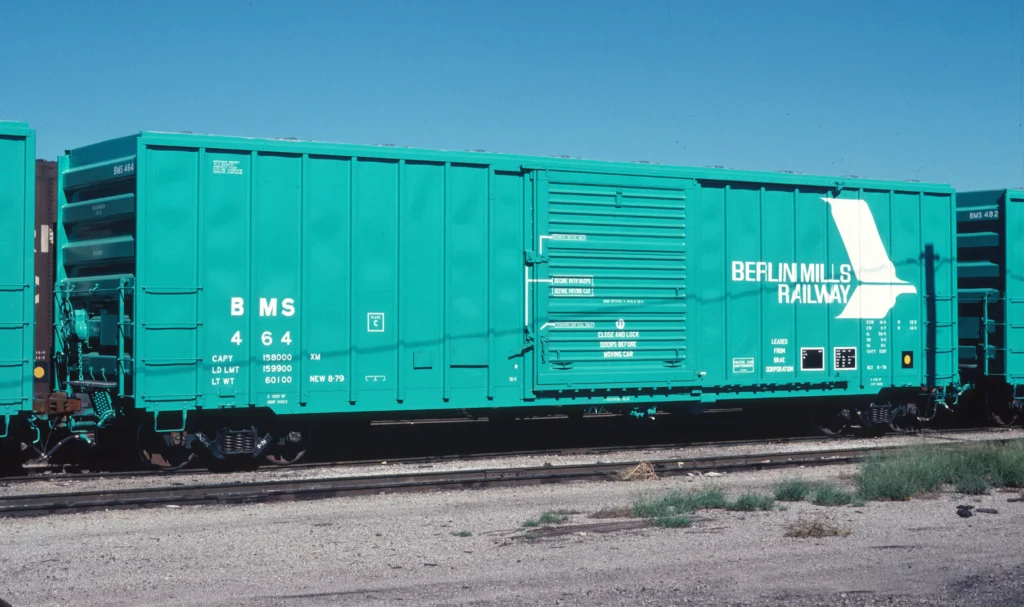
What truly set them apart, though, was their livery. Painted in a bold light green, they blazed their way across the North American rail network, proclaiming the railway’s roots in the paper mills of Berlin and Cascade, New Hampshire. Originally tasked with hauling the products of those mills, the cars soon found themselves carrying all manner of loads far beyond their home territory. Through the 1980s and 1990s they became familiar travellers from coast to coast, an unlikely ambassador for a modest New England short line.
| Nos. | Type | Notes |
|---|---|---|
| BMS 200-499 | PC&F Boxcars | |
Epilogue
Today, the Berlin Mills boxcars are remembered less for the freight they carried than for the impression they left – bright green flashes in a sea of browns and reds, a reminder of a time when even a small railway could leave its signature on the continent. For modellers and historians alike, they remain touchstones of the IPD era: ordinary cars elevated by colour, context and memory into something just a little iconic.