Stonington is a town in Hancock County, Maine, United States. It is located on the southern portion of the island of Deer Isle. With its picturesque harbours, rugged mountains, and secluded islands, the coast of Maine offers some of the most spectacular scenery in America.
Structural Components
- Baseboards (American English: Benchwork) – Foundations of the layout, ensuring stability and modularity.
- Legs & Supports – Adjustable or fixed-height supports for the layout.
- Presentation?
Track and Rail
- Trackwork, Turnouts & Crossovers – Designing, laying, and securing tracks (straight, curved, points/switches).
- Track Ballasting – Adding realistic gravel or ballast around tracks.
- Track Cleaning & Maintenance – Ensuring smooth operation.
Electronics & Wiring
- Power Supply – Transformers, controllers, and digital systems.
- Wiring – Electrical connections for track, points, and accessories.
- DCC (Digital Command Control) – Digital systems for independent train control.
- Lighting – LED or bulb systems for buildings, signals, and streetlights.
Rolling Stock
- Locomotives – Engines, including steam, diesel, and electric types.
- Carriages & Wagons – Passenger and freight cars.
- Couplings – Connecting mechanisms for rolling stock.
Scenery
- Groundwork – Base layers for landscape, such as grass, dirt, and roads.
- Buildings – Stations, houses, factories, and other structures.
https://itlascalemodels.com/products/n-3150-allstate-machine-parts-kit - Bridges – Features for varied terrain.
- Trees & Vegetation – Adding realistic flora.
- Water Features – Lakes, rivers, canals, and streams.
Operations
- Layout Design – Planning track and scenery to fit space and theme.
- Control Panels – Centralised or distributed systems for managing the layout.
- Timetables & Schedules – Operating the layout like a real railway.
Detailing and Customisation
- Weathering – Adding wear and tear to tracks, buildings, and rolling stock.
- Figures & Vehicles – Human and vehicular elements for realism.
- Custom Painting & Decals – Personalising stock and structures.
Maintenance & Upkeep
- Track Inspection – Checking for faults or debris.
- Rolling Stock Maintenance – Cleaning and lubrication.
- Electronics Troubleshooting – Ensuring smooth functionality.
Documentation & Community
- Layout Documentation – Keeping plans, wiring diagrams, and inventory.
- Clubs & Exhibitions – Engaging with fellow modellers and showcasing layouts.
- Photography & Video – Documenting progress and creating content.
- Baseboards (American English: Benchwork)
- Trackwork
- Electronics & Wiring
Bucksport Branch. This 19 mi (31 km) branch was chartered in 1873 as the Bucksport and Bangor Railroad after its grade had been surveyed in the autumn of 1872. Construction of the line began in the spring of 1873 with trains beginning to run regularly over its whole length on December 21, 1874. The company was reorganized as the Eastern Maine Shoreline Railway in 1882 and leased as the Maine Central Bucksport branch in 1883.
St. Regis Papers, Bucksport
A 43-mile extension of the Bucksport Branch
Placeholder for Stonington, a Maine Central Harbour railroad terminal in N Scale.
- Lighthouse
- Cedar Shakes & Shingles / Lapboard Cladding
- Lobster Shack with floats
- Isle au Haut Lighthouse
- Opera House, School Street
- St. Mary, Star of the Sea Roman Catholic Church
- Square Deal Garage, North Main Street (corner of Granite Street), Stonington
Oil Dealer
North Lubec Canning Company built a factory in Stonington, c.1910. It had several owners over the years, before it closed in 1992. With its wharf, the site is now the headquarters for the Isle au Haut Stonington Dock Company. It was opposite the “Lobster Trap.”
L.G. Cortesi “Oceanville Brand Maine Mussels” later Colwell Bros
Petroleum products Gasoline and heating oil
- Office, Truck Loading Rack, Portable Tanks, Tank Car Unloading, Storage Tanks, Pump House
Union’s X-3
The Stonington Extension: Maine Central’s Coastal Connection
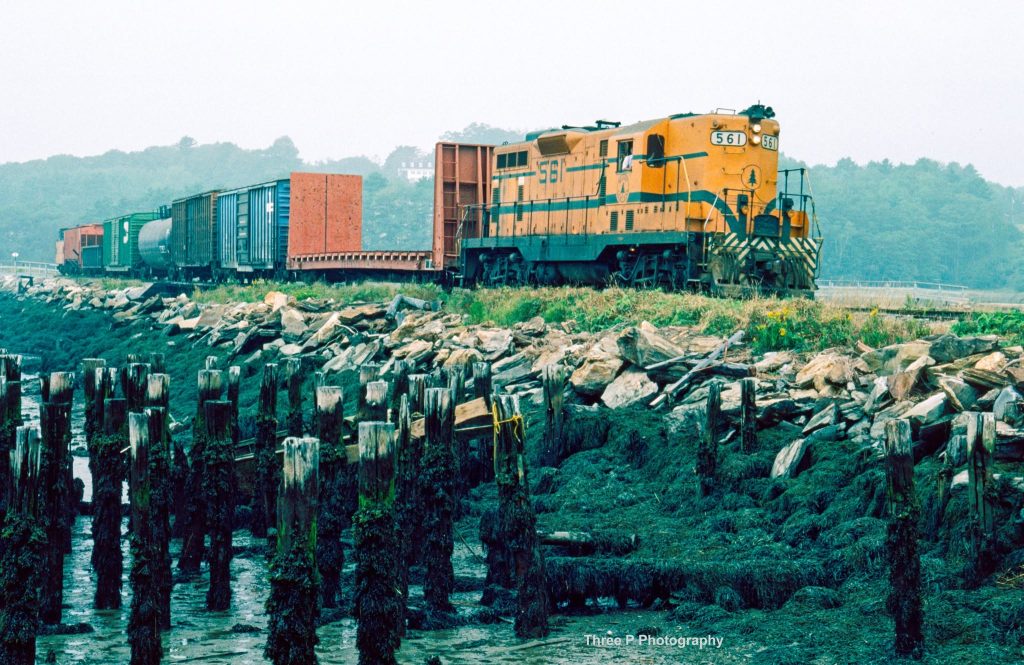
Nestled at the southern tip of Deer Isle, Stonington, Maine, is a rugged coastal town steeped in maritime heritage. In this reimagined history, the Maine Central Railroad extended its Bucksport Branch to Stonington in the 1880s, drawn by the booming granite quarries and thriving fisheries. By the late 1970s and early 1980s, the railroad remains a vital link, keeping industries humming and connecting this vibrant community to regional and national markets.
Industries of Stonington and Rail Traffic
Stonington’s industries reflect a balance of tradition and adaptation, with the railroad playing a central role in both bulk freight and high-value shipments.
Fish Meal and Rendering Plant
The rendering plant was the backbone of Stonington’s rail traffic well into the 1980s. While most such works along the Maine coast had fallen silent with the collapse of the sardine fishery, Stonington’s plant kept going thanks to steady investment and a reliable flow of by-products from nearby canneries and fishing grounds.
The season typically stretched from May through November, tied directly to the herring catch. In those months the works ran almost without pause. Trucks delivered barrels of scraps and offal from canneries up and down the coast, where they were tipped into great steam cookers. The process was simple but relentless: the waste was boiled under pressure, pressed to squeeze out oil, and then dried and ground into meal. The oil was drawn off into drums for use in paints, coatings, and lubricants, while the dried residue became a fine, protein-rich powder valued by poultry farmers and feed mills.
At the height of the season the plant would ship several carloads a week — covered hoppers filled with bulk meal for large feed mills, alongside boxcars loaded with bagged product for smaller buyers. Drums of fish oil were stacked and loaded into boxcars, their smell seeping into the timber of the cars long after they were emptied. Salt, vital for preservation, arrived steadily by rail, as did tank cars of fuel oil to keep the boilers fired.
The work came at a price. On warm days the smell of cooked fish hung over the town, drifting inland with the breeze. It was inescapable, a source of complaint to some and a badge of livelihood to others. The rendering plant provided steady jobs and dependable carloads, making it the single most important reason for the railroad’s continued presence in Stonington.
Inbound Freight:
- Salt in boxcars and covered hoppers (stockpiled before peak season)
- Fuel oil in tank cars for the boilers
Outbound Freight:
- Fish meal in covered hoppers (bulk shipments to feed mills)
- Bagged fish meal in boxcars (for smaller customers)
- Fish oil in drums, shipped in boxcars
Sardine Cannery
The sardine cannery once defined Stonington’s waterfront. In its heyday, dozens of canneries lined the Maine coast, their whistles marking the start and end of long shifts as herring were packed into tins for markets across the country. By 1983 Stonington’s plant was one of the last still at work. The pace was slower, the workforce smaller, and much of the distribution had shifted to trucks, yet the railroad still handled the heavier loads and the long-distance traffic.
The season followed the herring runs. Boats landed their catches at the pier, where fish were quickly gutted, cleaned, and packed into tins by hand. Olive oil or mustard was added, lids sealed, and cases stacked high. The smell of hot oil and brine hung in the air, mingling with the noise of canning machinery and the shrill call of gulls waiting for scraps.
Inbound traffic remained steady even as output declined. Boxcars brought tinplate for cans, pallets of cardboard for packing, and imported ingredients such as olive oil. Salt, vital for curing, arrived either bagged in boxcars or in bulk by covered hopper. Tank cars of fuel oil kept the boilers running.
Outbound loads were still respectable: boxcars of canned sardines left for wholesale distributors across the Northeast and beyond. Very occasionally a refrigerator car was loaded with live lobsters for direct shipment to Boston or New York — a rare echo of the days when rail moved much of Maine’s seafood.
Inbound Freight:
- Tinplate for cans in boxcars
- Cardboard and packaging in boxcars
- Bulk salt in covered hoppers or bagged salt in boxcars
- Bulk ingredients (such as olive oil) in boxcars
- Fuel oil in tank cars
Outbound Freight:
- Canned sardines in boxcars
- Live lobsters in reefers (occasional)
Oil Depot
The oil depot was one of Stonington’s most dependable rail customers. Unlike the fishing trade, which rose and fell with the herring runs, demand for fuel was constant. Heating oil was essential through the long Maine winters, while gasoline and diesel kept cars, lorries, and fishing vessels in service.
Tank cars rolled in regularly with a mix of products. Gasoline, diesel, and kerosene were pumped into storage tanks for distribution to local garages and fuel dealers. Heavier bunker-grade oil supplied the fishing fleet and powered industrial boilers along the waterfront.
Though unglamorous compared to fish or paper, the depot provided steady business for the Maine Central, ensuring the branch had work even when the canneries and rendering plant were out of season.
Inbound Freight:
- Gasoline, diesel fuel, and kerosene in tank cars
- Bunker-grade fuel oil in tank cars for fishing vessels and industrial use
Boatyard and Team Track
By the 1980s Stonington’s boatyard had shifted away from big schooners and coasters to focus on lobster boats and the growing trade in fibreglass pleasure craft. Rail no longer carried finished boats — lorries and low-boy trailers had taken over that business — but the yard still depended on the railroad for heavy and bulky materials.
The adjacent team track gave the railroad flexibility, allowing cars of almost anything to be set out for local consignees. Boxcars delivered general merchandise and machinery, everything from diesel engines to winches. Other cars brought fibreglass and resins for new hulls, steel plates in gondolas for repairs, and flatcars of lumber for wooden boat restorations.
Although traffic was irregular compared to the rendering plant or oil depot, the team track added variety and kept the crews guessing what might turn up next.
Inbound Freight:
- General merchandise in boxcars for local businesses
- Fibreglass, resins, and other boatbuilding materials in boxcars
- Steel plates in gondolas for hull repairs
- Lumber in flatcars for wooden boats or restorations
- Engines and machinery in boxcars
Outbound Freight:
Pier
The pier was Stonington’s traditional link between sea and rail, handling smaller shipments and high-value cargo. Fishing boats landed their catch only yards from the siding, and at one time much of it left town in refrigerator cars bound for the markets of Boston and New York. By 1983 that traffic had dwindled, with lorries carrying most seafood direct, yet the occasional rail shipment still reminded townsfolk of the old ways.
Inbound loads kept the waterfront supplied: boxcars delivered chandlery stock, rope, hardware, and other provisions for the fishing fleet. Outbound traffic was far less frequent than it once had been, but on a busy summer week a reefer might still be iced and loaded with lobsters or fresh fish for southern buyers. For the crew working the branch, spotting a reefer at the pier remained one of the highlights of the season.
Inbound Freight:
- Chandlery supplies for maritime trade in boxcars
Outbound Freight:
- Fresh lobsters and seafood in reefers (occasional)
Paper Mill Traffic from Bucksport
Although Stonington had no paper mill of its own, the branch occasionally hosted cars from the great St. Regis mill at Bucksport. At times of congestion in Bangor, overflow cars were “offspotted” here to ease yard pressure. Woodchip hoppers and gondolas, pulpwood flats, and boxcars of finished paper could all appear unexpectedly on the branch.
This traffic was never for local consignees, but it gave the crews variety and reminded everyone that Maine Central was more than just fish and fuel. For the modeler, it adds operational colour — an excuse to work in cars of raw timber and bright-paper boxcars amongst the salt, oil, and sardines.
Overflow / Through Freight:
- Boxcars of finished paper
- Woodchip hoppers and gondolas
- Pulpwood bulkhead flats
The Daily Rhythm
Stonington was a one-train-a-day railroad. Each morning a local left Bangor with a mixed consist of salt, packaging, fuel oil, and machinery, winding down the rocky coast behind a GP7, GP38, or occasionally one of the MEC U-boats in Pine Green or Harvest Gold.
By midday the crew were at work in town, switching the rendering plant, sardine cannery, oil depot, team track, and pier, collecting empties and spotting fresh cars. In summer the job might include a reefer of lobsters; in winter the sidings filled with tank cars of heating oil. By afternoon the cars were tied back together, outbound with fish meal, sardines, or whatever else the town had to give, for the return run north to Bangor.
One train, every day — enough to keep the branch alive, varied, and never quite predictable.
A Romantic Slice of Coastal Railroading
The Stonington Extension captures more than just industry. It speaks of a working waterfront in transition — where the tang of fish meal drifts across the harbour, gulls wheel overhead, and a GP7 burbles by with a short cut of boxcars.
Here, rails and waves converge. It is a story of resilience, ingenuity, and the timeless romance of railroading along New England’s rugged coast.
Track
| Code | Description | Qty |
|---|---|---|
| SL-300F | Peco Streamline SL-300F N Gauge Wooden Sleeper Type Flexi Track – Single | 10 |
| SL-310 | Peco Streamline SL-310 N Gauge Conducting Rail Joiners | 2 |
| SL-311 | Peco Streamline SL-311 N Gauge Insulating Rail Joiners | 1 |
| SL-E386F | Peco Streamline SL-E388F N Gauge Code 55 Large Radius Turnout Right-Hand | 1 |
| SL-E388F | Peco Streamline SL-E388F N Gauge Code 55 Large Radius Turnout Right Hand | 1 |
| SL-E397F | Peco Streamline SL-E397F N Gauge Code 55 Y Medium Radius Turnout | 3 |
| SL-U395F | Peco Streamline SL-U395F N Gauge Code 55 Unifrog Medium Radius Right Hand Turnout | 1 |
| SL-U396F | Peco Streamline SL-U396F N Gauge Code 55 Unifrog Medium Radius Left-Hand Turnout | 1 |
Buildings
- Walthers Cornerstone Part # 933-3815 City Water Tower – Kit – 2-3/8 x 2-3/8 x 7″ 6 x 6 x 17.7cm
- Walthers Cornerstone Part # 933-3200 Interstate Fuel & Oil – Kit
- Heilman II, Carl. The Coast of Maine. Rizzoli, 2009.
Operations
Stonington can use either the MERG DCC System with a MERG Handheld Throttle, or Digitrax with a Digitrax or Iowa Scaled Engineering ProtoThrottle.
MERG Handheld Throttle
Selecting a Locomotive
When the handset displays:
SEL. LOCO
=
Enter the locomotive number exactly as it appears on the locomotive, then press Enter. If the locomotive number is one, two or three digits, enter those digits. There is no need to enter leading zeros.
Once you press Enter, the CANCAB will only take control if the throttle is fully closed. If the throttle is not at zero, the handset will emit a continuous beep until you return the throttle to the fully closed position. This safety feature prevents a locomotive from unexpectedly moving when it is selected.
Preparing the Locomotive
Once the locomotive has been selected, prepare it for service before moving off.
On the real railroad, the front of a locomotive is identified by an “F” painted on the frame. If you’re not sure which end is the front on the model, the easiest way to identify it is to switch on the front headlight using Function 0 (F0). Press the yellow LOCO button to access the locomotive functions, then press 0 to toggle the front headlight on or off.
If the headlight does not illuminate, press 0 again to switch it off, then press 5 to switch on the rear headlight using Function 5 (F5). The illuminated headlight will identify the corresponding end of the locomotive.
If the locomotive is fitted with a sound decoder, switch on the sound using Function 8 (F8). Allow the locomotive to idle for a few moments before moving off.
Ensure the locomotive is facing in the required direction. Press the Direction button if necessary. The green Fwd LED indicates forward and the red Rev LED indicates reverse.
Once the route has been set and you have authority to proceed, gently open the throttle by rotating the knob clockwise and move off.
On the Road
Once underway, drive the train in a smooth and realistic manner. The locomotives on this layout have been configured with realistic acceleration and deceleration, so they will not respond instantly to changes in the throttle.
Plan ahead when approaching speed restrictions, stations, or signals at danger. Closing the throttle alone may not be sufficient to stop the train where intended. Most locomotives are fitted with a brake function (F9), which should be used to control the train’s speed and bring it to a smooth stop.
Avoid abrupt changes in throttle position. Instead, increase power gradually to accelerate and reduce power progressively when slowing. With experience, you’ll develop a feel for each locomotive and train, just as real engineers become familiar with the characteristics of their locomotives.
Use the horn and bell where appropriate. Sound the horn before moving off, when approaching public crossings, and whenever warning is required. Ring the bell when departing stations or yards, while passing through areas where staff or members of the public may be present, and stop it once clear.
The objective is not simply to reach your destination, but to operate the train in a safe, smooth and prototypical manner.
On the Road
Once underway, drive the train in a smooth and realistic manner. The locomotives on this layout have been configured with realistic acceleration and deceleration, so they will not respond instantly to changes in the throttle.
Plan ahead when approaching speed restrictions, stations, signals or stopping points. Closing the throttle alone may not be sufficient to stop the train where intended. Most locomotives are fitted with a brake function (F9), which should be used to control the train’s speed and bring it to a smooth stop.
Avoid abrupt changes in throttle position. Apply power smoothly and anticipate braking well in advance. With experience, you’ll develop a feel for each locomotive and train, just as a real engineer becomes familiar with the characteristics of their locomotive.
Starting a Journey
Once your locomotive has been prepared for service and you have authority to proceed:
- Ensure the correct headlight is illuminated.
- Switch on the bell.
- If moving after standing, sound the appropriate horn signal:
- Forward: Two long blasts.
- Reverse: Three short blasts.
- Release the brake.
- Open the throttle gradually and allow the locomotive to begin moving.
- Once clear of the station, yard or immediate area, switch off the bell.
These horn signals are intended to warn anyone nearby that the locomotive is about to move. They should be sounded before the movement begins, not after.
Note: Throughout this handbook, forward and reverse refer to the direction of travel of the locomotive, not the train. A reverse movement simply means the locomotive is travelling with its rear end leading.
Headlights
Headlights should normally remain illuminated whenever a locomotive is in service.
The leading headlight should be displayed brightly while travelling on the main line. When standing, working in yards, or passing another train, dim the headlight if your locomotive is fitted with this feature. This reflects common North American operating practice and helps avoid dazzling other crews.
When making a reverse movement, extinguish the leading headlight and illuminate the headlight on the end that is now leading the movement.
Public Crossings
This layout represents a railroad operating through communities where quiet zones are in force. Routine sounding of the crossing signal at public road crossings is therefore not required.
Approach public crossings with the bell ringing, and use the horn only if necessary to warn pedestrians or road users of danger.
Switching
During continuous switching movements, it is not necessary to repeat the forward or reverse horn signals every time the locomotive changes direction. Likewise, there is normally no need to stop and restart the bell after each movement.
Use the bell while working around stations, yards or people, and use the horn whenever additional warning is required.
Braking
Unlike many model railways, simply closing the throttle will not bring the train to an immediate stop.
Most locomotives are fitted with a brake function (F9). Begin reducing the throttle well before your stopping point, then apply the brake progressively to control the train’s speed. As on the prototype, smooth, well-planned stops are preferable to last-minute heavy braking.
Good Driving
Drive the train, not the throttle.
Watch the locomotive and train rather than the handset. Listen to the engine, anticipate the road ahead and think about what the crew would be doing. Smooth acceleration, realistic braking, restrained use of the horn and bell, and thoughtful handling of the train all contribute to an enjoyable and authentic operating session.
–
F1 – Bell
F2 Horn
F9 – Brake