Guilford Passenger Coaches
Guilford Transportation Industries was never a passenger operator in the traditional sense, but during the mid-1980s its Office Car Special (OCS) became a signature train. Usually three or four cars long, the consist was short, distinctive, and perfect for a modeller looking for something unusual. With simple orange-striped paint, high-nose Geeps on the point, and occasional use on railfan charters, the train offered a rare passenger highlight in Guilford’s otherwise freight-focused era.
Motive Power
Typical power on the OCS included:
Guilford (MEC) GP38 #251
The locomotives were often freshly painted compared to Guilford’s usual road power, which made them stand out.
MEC GP7 #573
No. 573 had a particularly colourful history:
- Early 1980s: painted MEC green with gold stripes.
- July 1982: repainted maroon with yellow stripes.
- 1983: appeared in Guilford grey, lettered Maine Central.
- Early 1984: lettered D&H.
- 1985: returned to Maine Central lettering.
It retained its steam generator, making it suitable for passenger service. In 1996, Mary Jayne’s Railroad Specialties issued a postcard of the unit at Rigby Terminal. That same year, it was sold to the Conway Scenic Railroad and repainted into maroon and gold for tourist service.
Passenger Cars
The OCS roster around 1984–1985 included four principal cars:
Springfield Terminal #100 (Observation)
- Ex-N&W #102, purchased by D&H in 1976.
- Originally stainless steel fluted below the windows; still fluted in 1984, later stripped.
- Early history (whether built for N&W or acquired second-hand) remains unclear.
- 100 Steel Business Car PV Pullman N&W #102 9/1976 transferred to Guilford N&W diagram dated 8/15/1957. Sleeps 8 plus 2 porters.
https://www.rrpicturearchives.net/rsPicture.aspx?id=394433
In N scale: No exact model exists. A Con-Cor smoothside observation or brass import (Overland has done N&W cars) could serve as a base. Modify sides depending on whether you want the fluted or smooth look.
Springfield Terminal #101 (Diner/Lounge North Point)
- Built by Pullman-Standard in 1946 for Pere Marquette.
- Before delivery in 1950, sold to D&RGW as #1290.
- Sold to D&H in 1967 as #43.
- Retained stainless steel fluting into 1984, later removed.
- 43 Stainless Buffet-Lounge 1950 P-S D&RGW #1290 10/1967 transferred to Guilford “Champlain” – D&H Color Guide, p. 23
In N scale: Use a Kato smoothside diner or Con-Cor Pullman-style car as a starting point, with repaint and decals.
Maine Central #322 (Power/Steam Heat Car)
Maine Central #322 was considerably older than the other passenger cars associated with the Guilford-era business train and performed a rather different role. Built in 1921 by Osgood Bradley specifically for the Maine Central Railroad, it began life as a combined baggage and passenger coach.
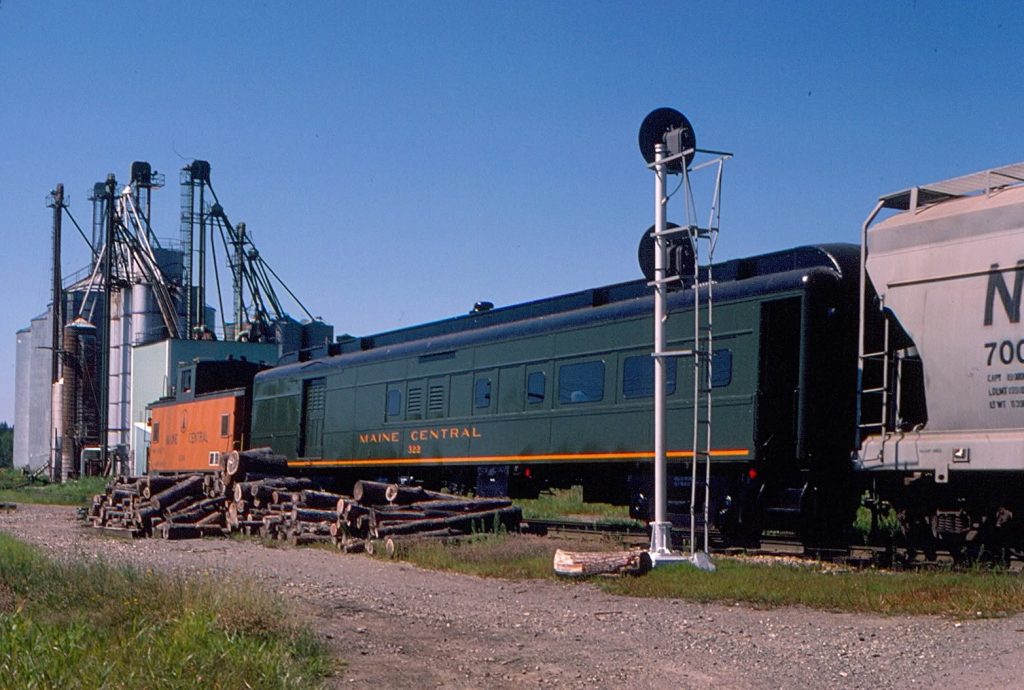
The car is 65 feet long, 10 feet wide and 14 feet high, with a listed weight of approximately 50 tons.
At some point during its Maine Central career, #322 was extensively converted into a power and steam-heat car for the Maine Central business train. The former baggage room was extended to accommodate the additional machinery required to support the train. This included a steam-heating boiler, diesel-powered DC generator, air compressor, water tanks and fuel tanks.
The conversion effectively turned #322 into the business train’s utility car, providing the equipment necessary to supply steam heat and electrical power to the accompanying passenger and business cars. This became particularly useful as passenger-equipped locomotives disappeared and the railroad increasingly relied upon normal freight locomotives for business-train duties.
Mechanically, #322 rides on cast pedestal trucks with rotating end-cap bearings. Other surviving equipment includes E-type couplers, body-mounted brake cylinders, UC brake valves and cast brake shoes. The car has also subsequently received new wheels.
Its age makes #322 an especially interesting component of the train. Whereas several of the other cars used by Maine Central and Guilford originated with the streamlined passenger equipment of the 1940s and 1950s, #322 was already more than sixty years old by the beginning of the Guilford era. It was a genuine Maine Central car from the heavyweight passenger era that had been adapted to continue serving a useful role long after the type of passenger service for which it had originally been constructed had disappeared.
Remarkably, #322 survives in New Hampshire. In 2026, it was offered for sale by Ozark Mountain Railcar, initially at $80,000 and subsequently reduced to $69,999. The car is not currently self-contained and would need to be moved from its present location by road.
The surviving car has been covered by a tarpaulin for several years to protect it from rain and snow, meaning that current complete exterior photographs are not available. However, photographs accompanying the sale listing show portions of the lower side sheets and side sills, which the seller reports as showing no corrosion.
Its survival provides a fascinating physical link between two very different periods of Maine Central history: a car constructed for the railroad’s passenger service in 1921 that was later rebuilt to support its business train and survived through the transformation of Maine Central into part of the Guilford system.
In N scale:
Maine Central #390 (Coach)
- Built by Pullman-Standard for PRR (PRR #4044).
- Became PC #4044, later Amtrak #5444.
- Eventually acquired by MEC or Guilford (exact timing unclear).
- A 1978 side shot exists online.
In N scale: Kato smoothside coach in PRR style is a decent stand-in. Strip/repaint into Guilford grey.
Maine Central #391 (Food Service Car)
- Conflicting reports:
- Built by Budd in 1939, or
- Built by Pullman-Standard in 1948 for NYC as #3011.
- Renumbered NYC #3211, became PC #3211, then Amtrak #3951.
- Later acquired by MEC or Guilford.
- Photographed post-Guilford at CPC Railroad Museum.
In N scale: Micro-Trains smoothside diner or Kato NYC-style car could stand in, with heavy repainting/decals.
Railfan Specials
The OCS wasn’t just for inspections. Photographs on rrpicturearchives show:
- Operation Lifesaver September 1983 over Mountain Sub
A fan special to North Conway, NH, in 1983. - Another in Maine in 1984.
These are some of the clearest photographic records of the train’s consist and condition.
It even appeared on the cover of Railpace magazine in June 1984 under the title Rumford Rocket, running in charter service. GP38 251 and GP7 573 on 3 cars.
Modelling in N Scale
For N scale modellers, the OCS has real advantages:
- Compact length – just 3–4 cars, ideal for small layouts.
- Recognisable power – Atlas has produced all three common locomotive types.
- Simple paint scheme – plain grey with orange stripes, doable with Microscale decals.
The challenge lies in the passenger cars. There are no ready-to-run matches, so you’ll need to rely on:
- Stand-ins – Kato or Con-Cor smoothside diners/coaches repainted.
- Kitbashing – modify brass imports or smoothside cars for window arrangements.
- Interim compromises – run substitutes now, upgrade later when correct cars are built or found.
Legacy
Though Guilford never operated regular passenger service, its OCS gave the system a unique visual highlight. With its compact consist, distinctive paint, and unusual roster, it remains an attractive subject for modellers. In N scale, the locomotives are straightforward, the paintwork is manageable, and while the passenger cars demand creativity, the result will be a train that stands out in any consist.