The Bangor & Aroostook’s freight car fleet was closely tied to the traffic that sustained the railroad: potatoes, pulpwood, paper, and other forest products. Unlike larger systems with broad industrial traffic, the BAR’s roster developed around the needs of northern Maine, and that gave it a character all its own. Boxcars and refrigerator cars became the best-known elements of the fleet, but flats, pulpwood cars, and later woodchip conversions were just as important to the everyday work of the railroad.
By the 1940s, boxcars made up the largest single group of cars on the roster, while refrigerator cars rose steadily in importance as potato traffic expanded. Much of the early fleet was still wooden, but over time the BAR rebuilt, renumbered, retired, and replaced older stock with steel cars better suited to interchange and modern service. The result was a fleet that was practical rather than uniform, shaped by local traffic and adapted repeatedly as the needs of Maine industry changed.
Boxcars
Boxcars formed the backbone of the Bangor & Aroostook freight fleet. In the 1940s, they accounted for roughly three-quarters of all BAR freight cars, carrying paper, potatoes, merchandise, and a wide range of general traffic. Early cars included a mixture of wooden and steel-underframe designs, but over time the BAR moved steadily towards more modern all-steel construction.
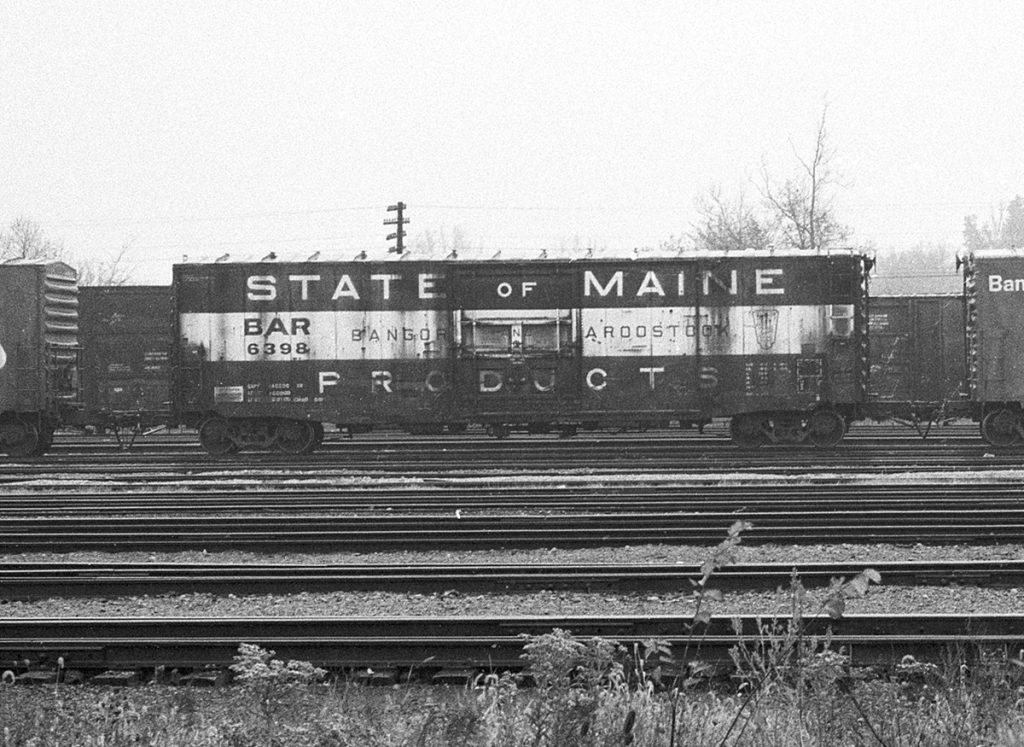
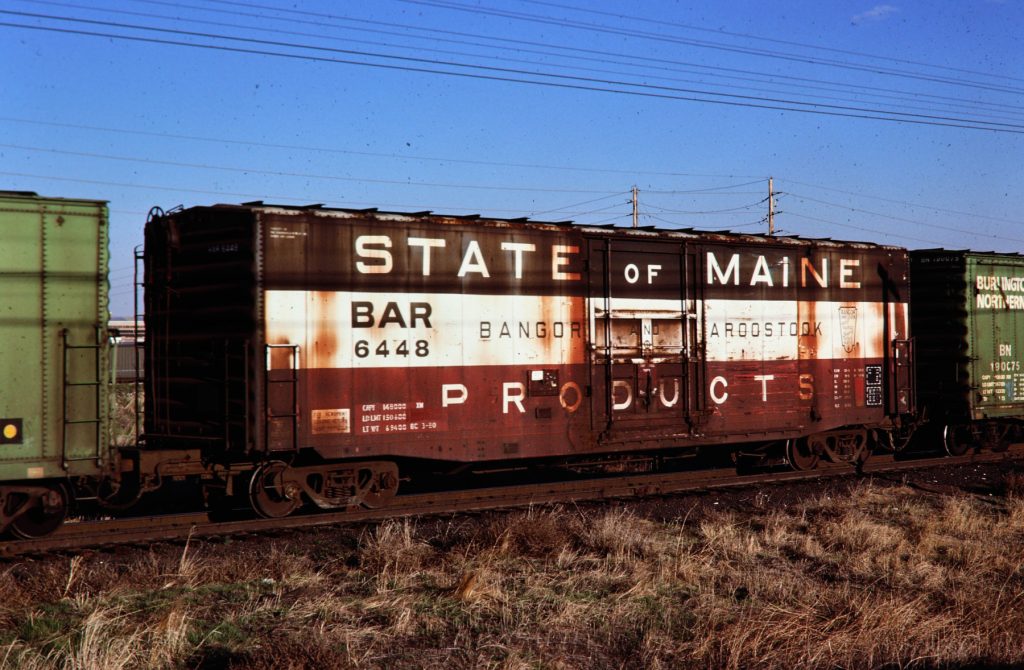
The BAR’s boxcar fleet was closely tied to paper, potatoes, and forest products. Some insulated cars were equipped with plug doors and underslung charcoal heaters for winter potato traffic, while others were rebuilt for loose bulk potato loading with sloped floors and conveyor systems. Even within the better-known “State of Maine” fleet, the cars were far from uniform.
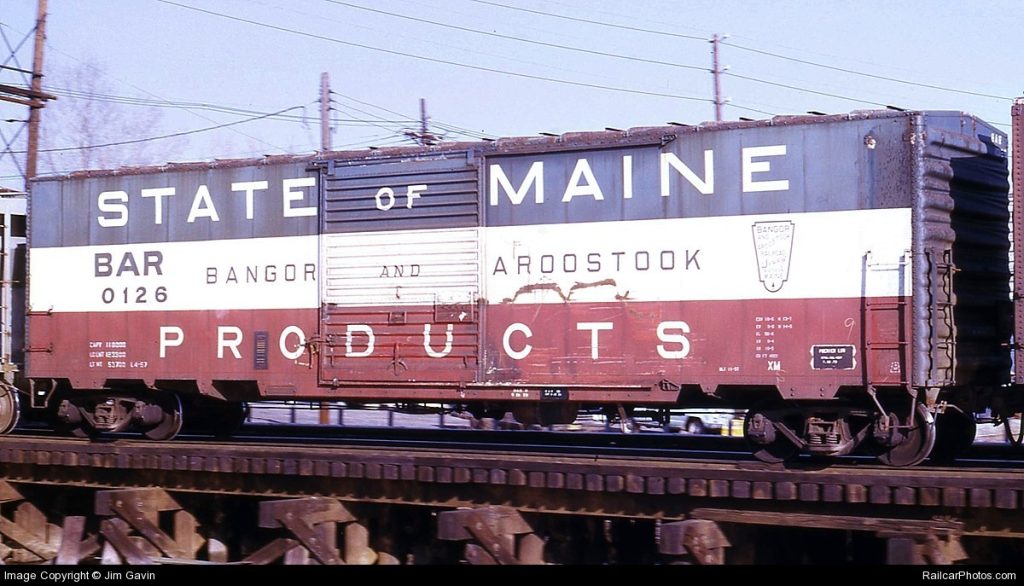
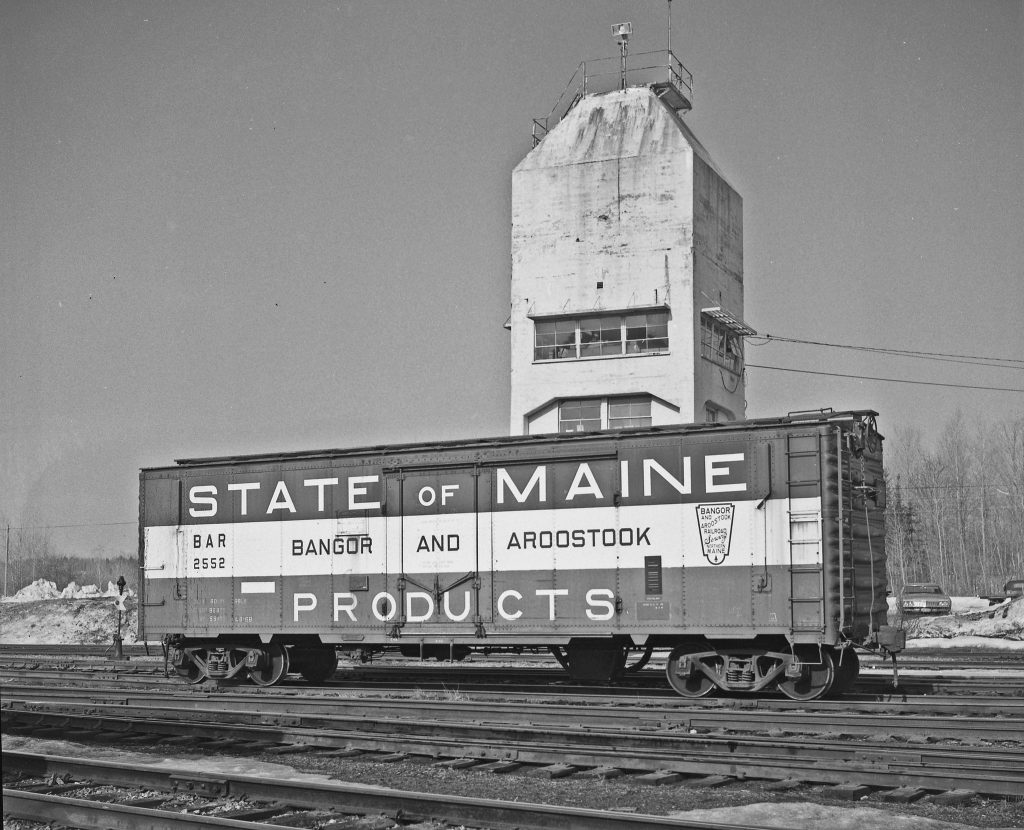
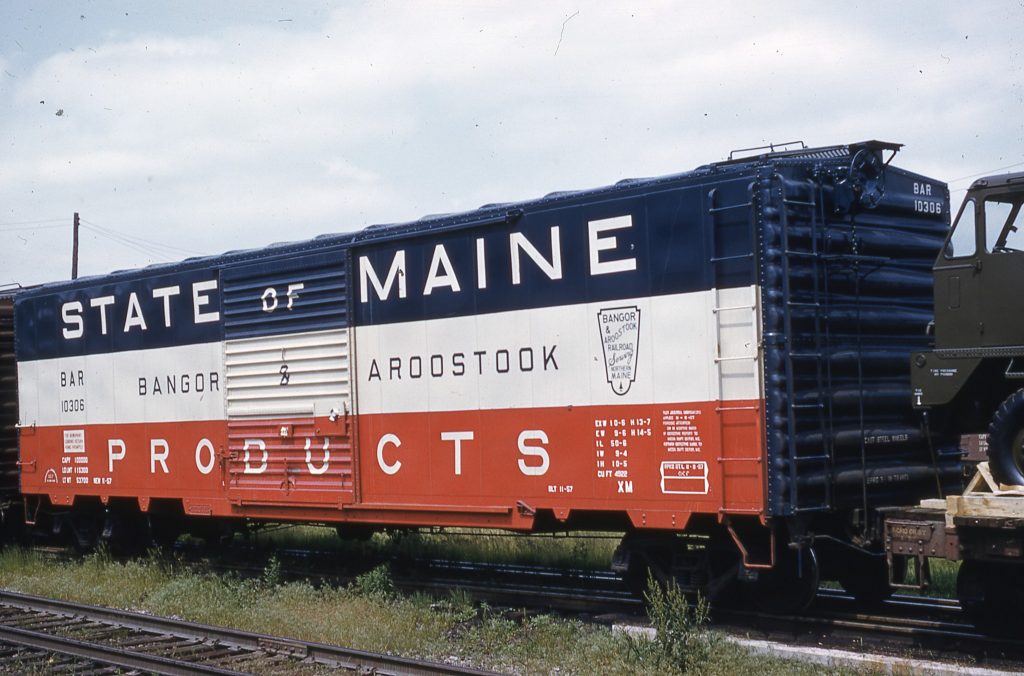
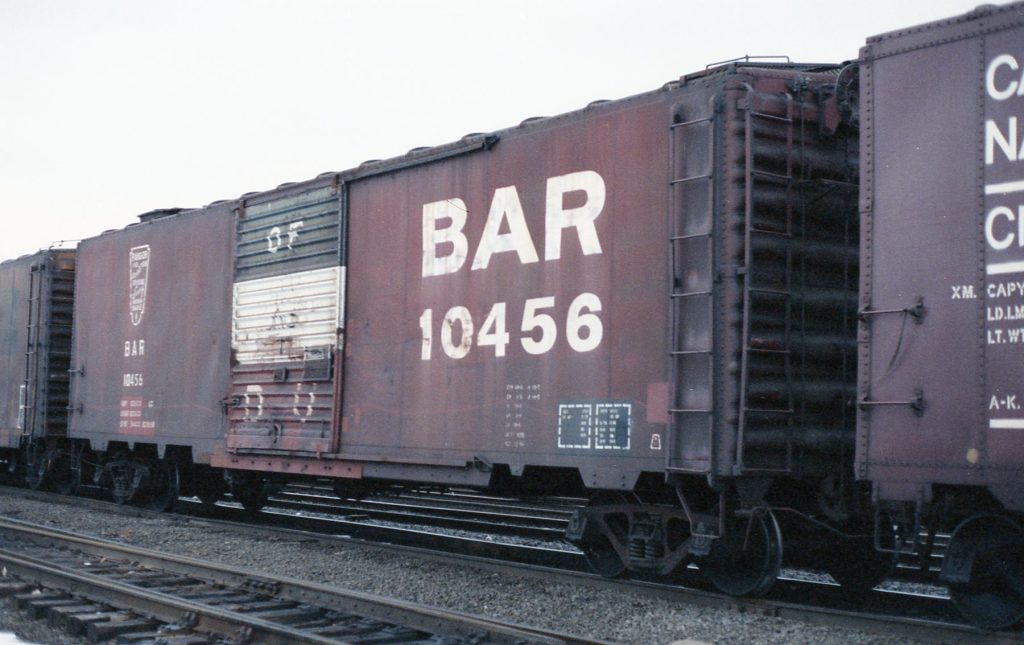
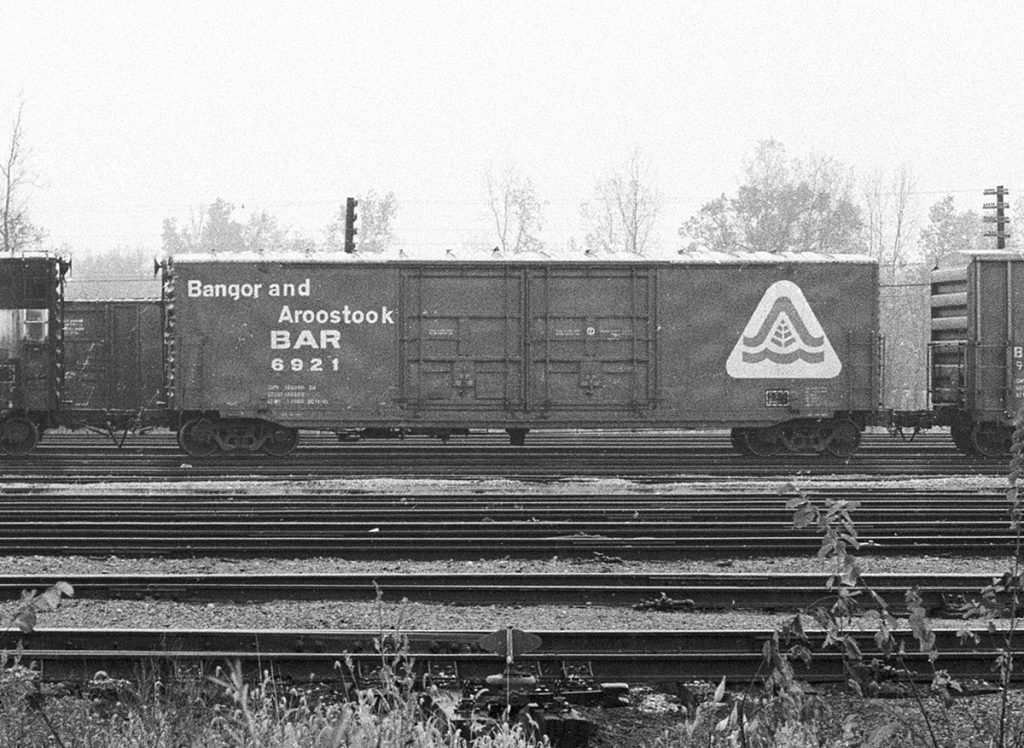
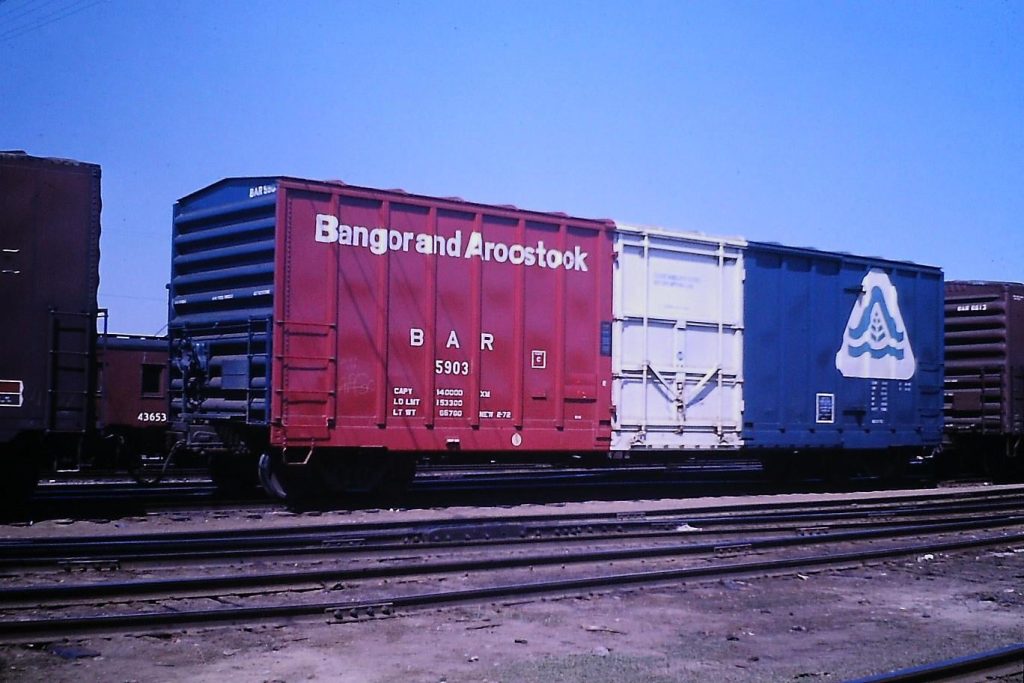
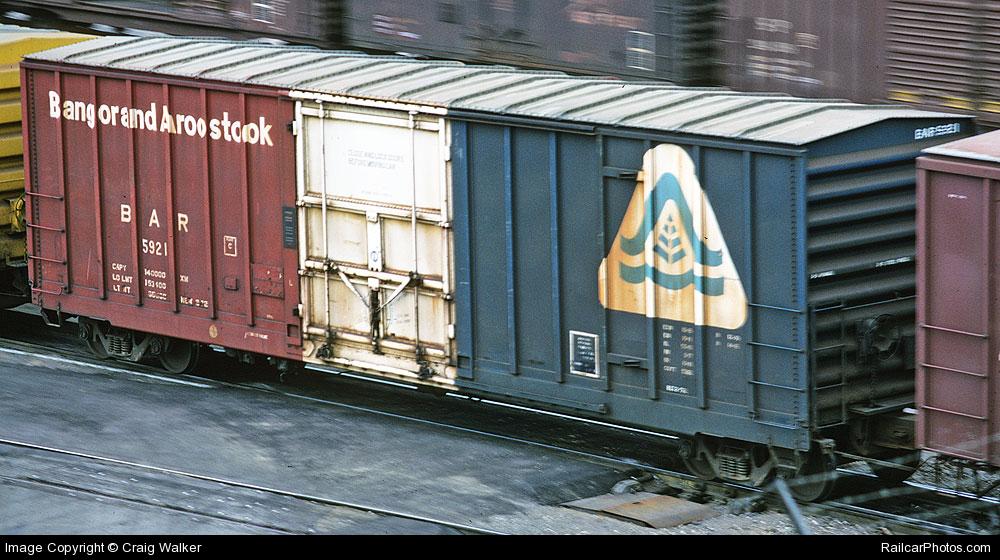
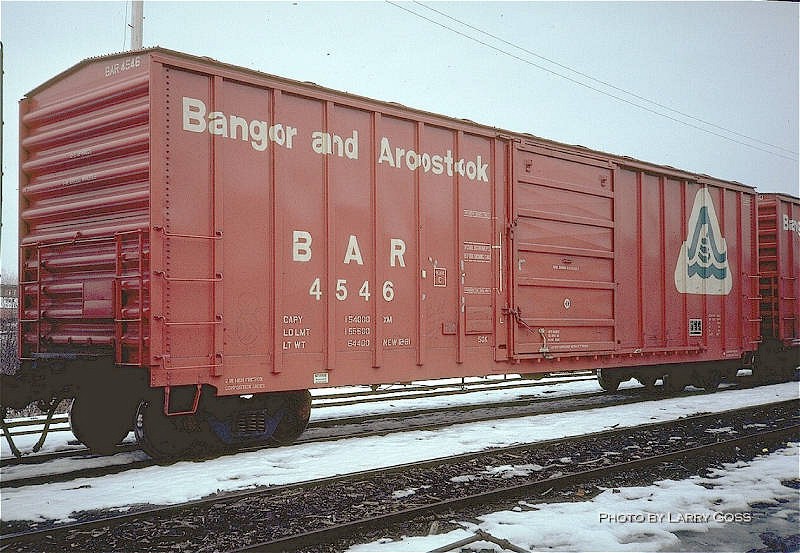
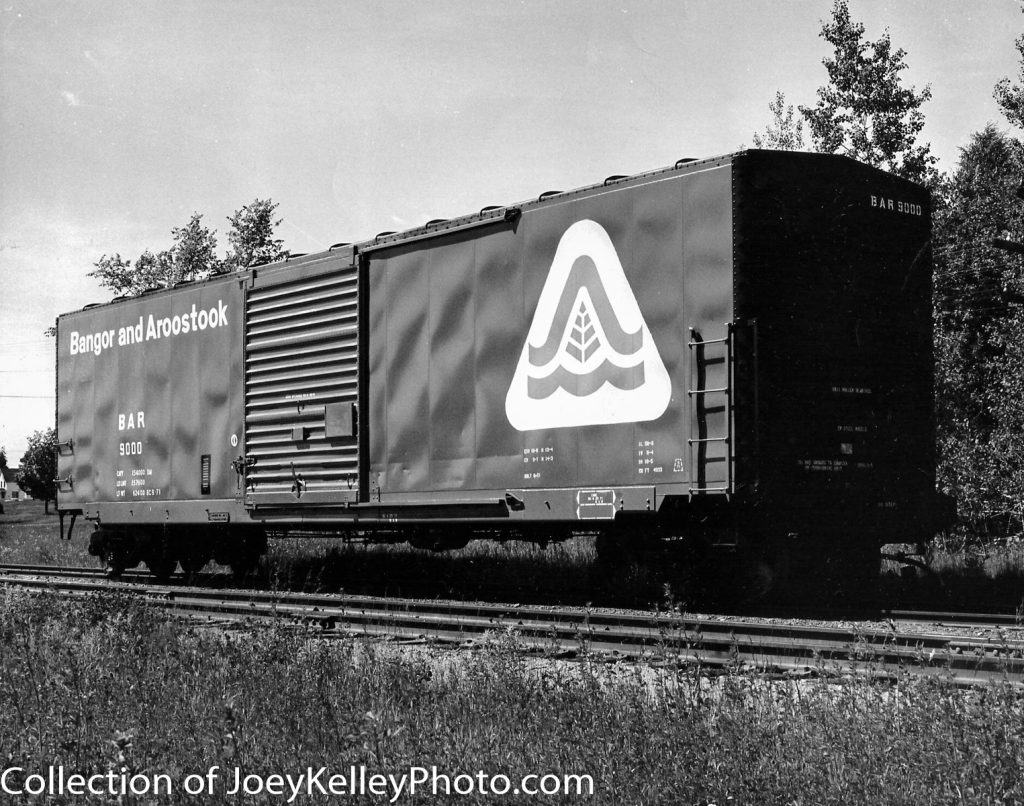
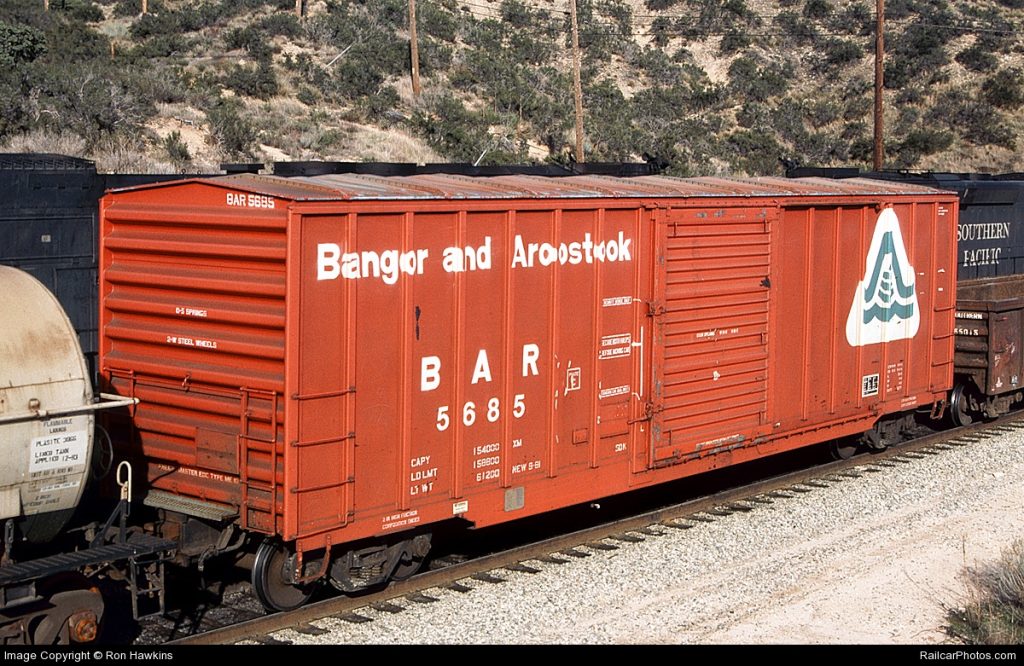
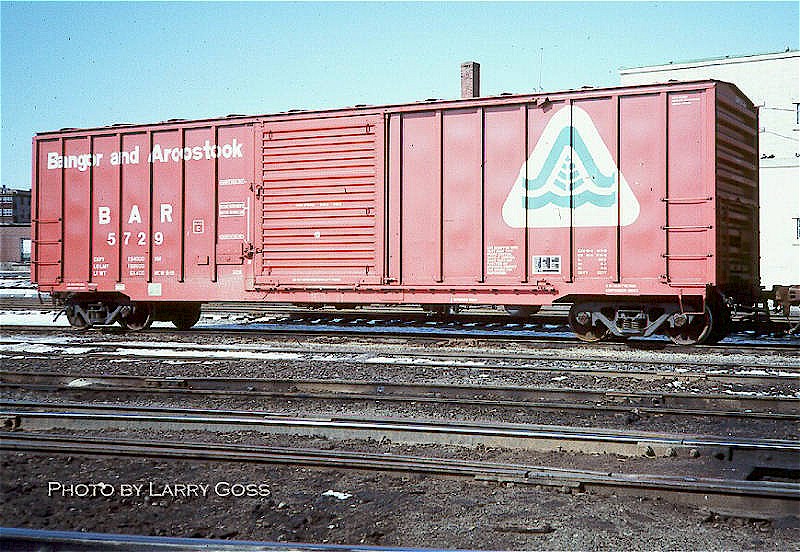
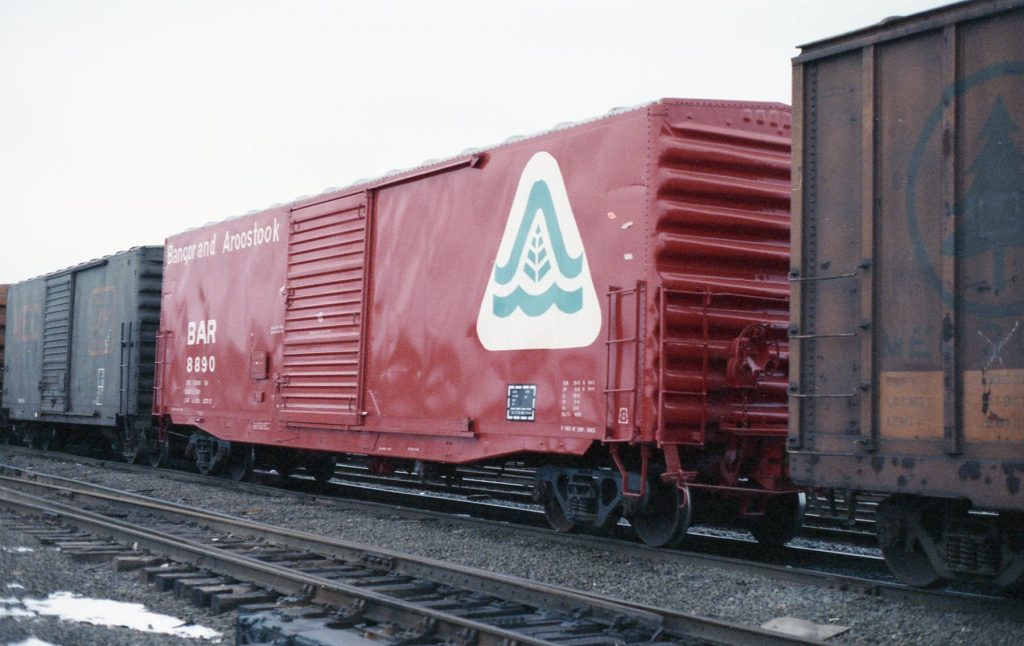
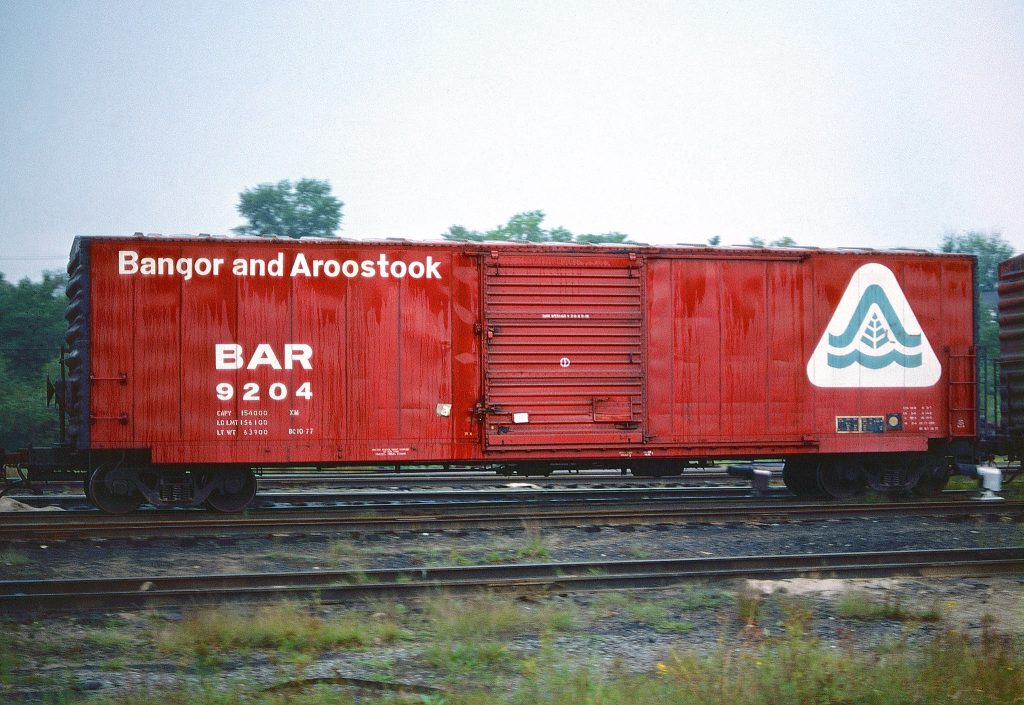
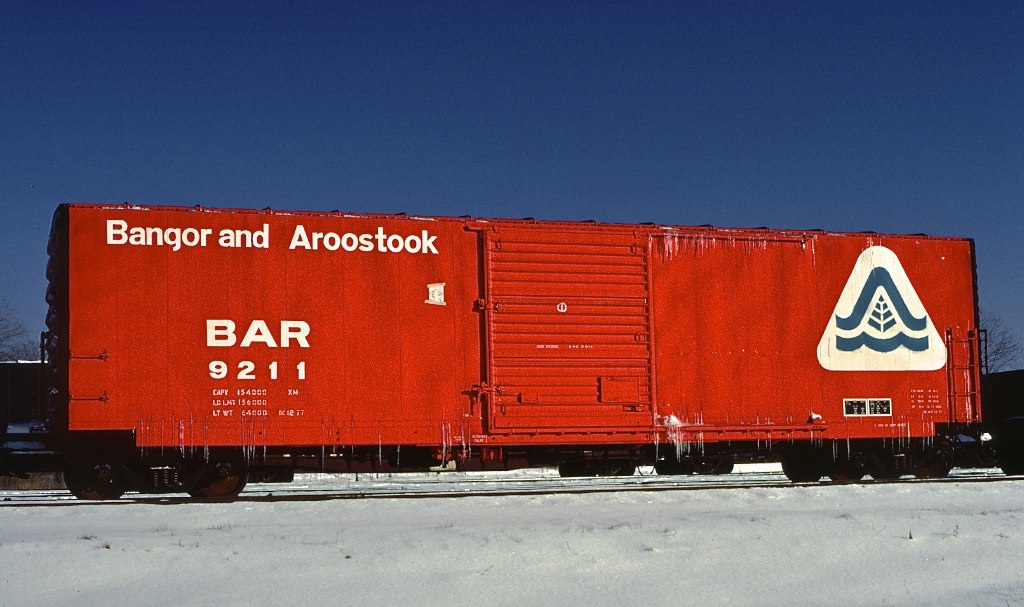
These cars also became the best-known on the roster. Before the introduction of the red, white, and blue “State of Maine Products” scheme, BAR boxcars were generally painted boxcar red with white lettering. From the early 1950s onwards, however, they became some of the most recognisable freight cars in North America, advertising both the railroad and the state it served.
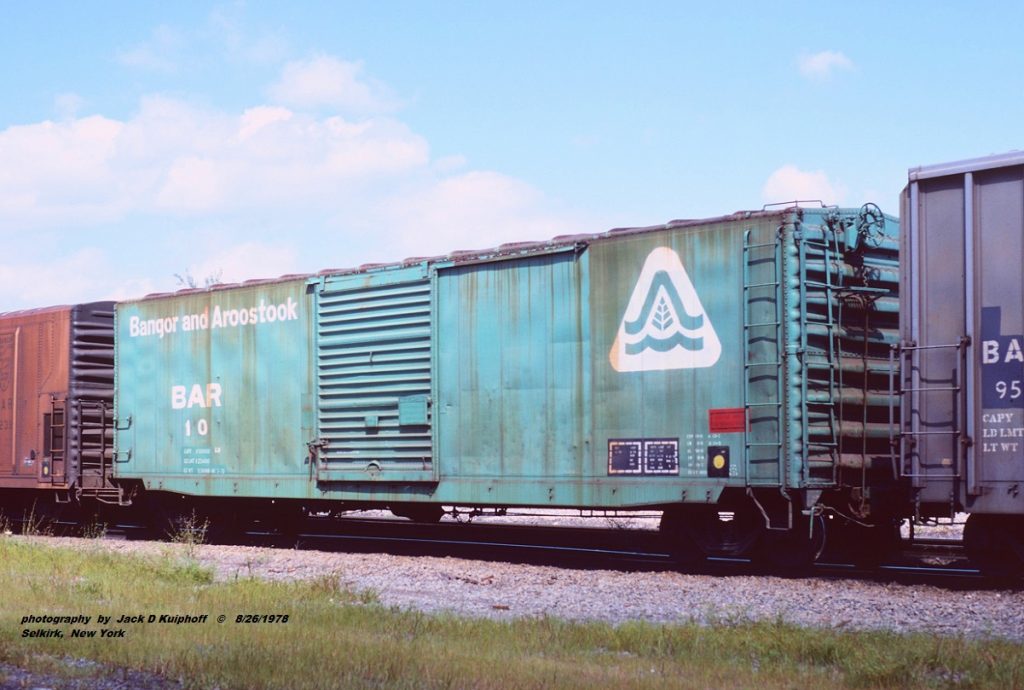
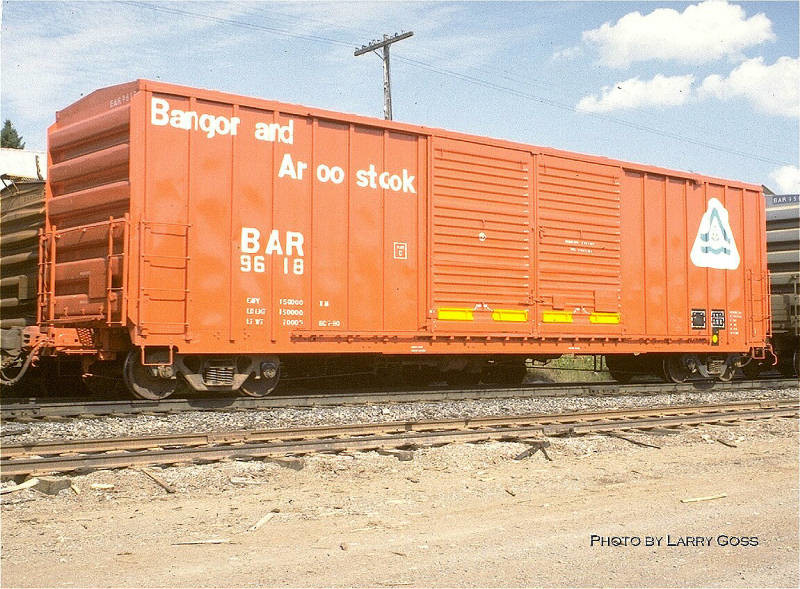
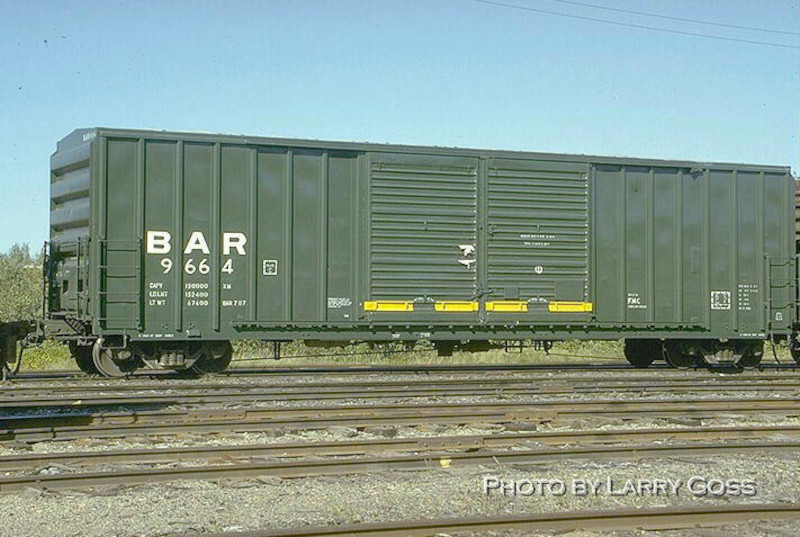
In 1977, the Bangor & Aroostook began what became a long series of purchases of second-hand exterior-post boxcars. The first 75 cars, numbered BAR 9500–9574, came from the Milwaukee Road, while BAR 9575–9674 came from the Minnesota, Dakota & Western in 1977 and 1981, respectively. Built by FMC in 1975 and 1979, these cars marked a later phase in the development of the BAR boxcar fleet, showing the railroad’s willingness to acquire relatively modern second-hand equipment rather than rely solely on older home-road cars. A few were repainted International Orange in the late 1970s, but most retained their faded light blue scheme until being repainted dark green in the mid-1980s.



| Nos. | Type | Notes |
|---|---|---|
| BAR 20 | 40′ Box Car | |
| BAR 71–72 | 40′ Box Car | |
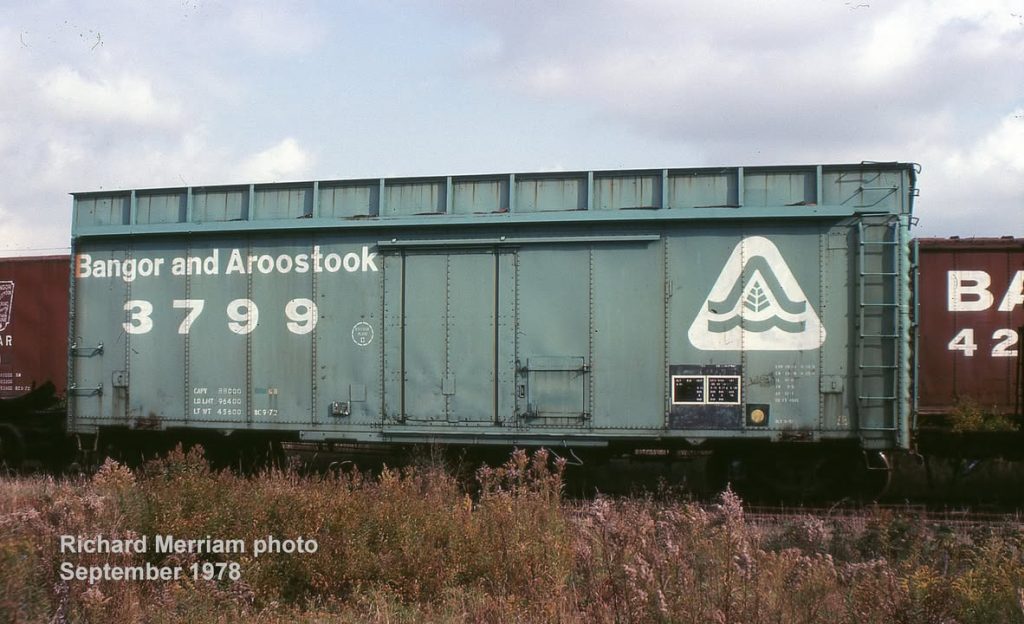
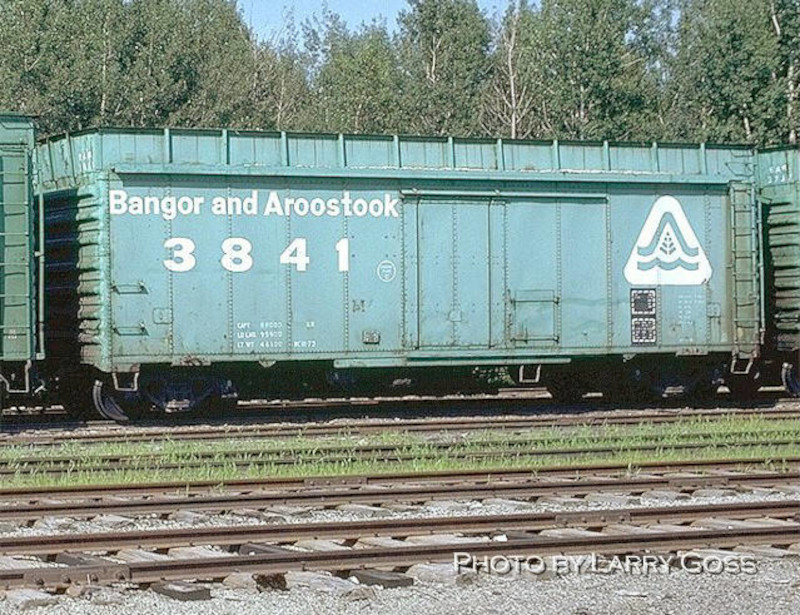
| BAR 2000–2299 | 40′ Box Car | Built by Magor Car Corp., these 40ft insulated boxcars were fitted with plug doors and underslung charcoal heaters for winter potato traffic, with off-season use carrying paper products. They were delivered in the distinctive “State of Maine” scheme. From the late 1950s, a number were repainted solid red with the winged red, white, and blue shield, followed in the early 1960s by the standard boxcar red livery with large “BAR” lettering. Some cars were rebuilt for bulk potato handling with V-shaped floors and conveyor systems, becoming the 2500 series. By the early 1970s, most of the 2000 series had been converted into woodchip gondolas, renumbered into the 3700 and 3800 series and repainted forest green with the white triangle logo. A small number survived into the late 1970s in plain red, assigned to a dedicated Great Northern Paper service at Millinocket, likely for wood pulp transfer between mills. |
| BAR 2300–2449 | 40′ Box Car | Built by Pacific Car & Foundry. |
| BAR 2500–2579 | 40′ Insulated Box Car / Bulk Potato Car | Eighty cars rebuilt from the 2300–2449 series with 30-degree sloped floors and conveyors for loose potato and other bulk commodity traffic. Reclassified RBLH. Sixty-eight remained on the roster in July 1976, but only 15 by October 1978. Gone by January 1981. |
| BAR 3000–3099 | 40′ Box Car | xxxx; xx/19xx |
| BAR 4000–4499 | 40′ Box Car | AC&F (Lot 4195); 3/1954 |
| BAR 4500–4504 | 40′ Box Car; PS-1 | Pullman-Standard (Lot 8160A); 2/1954 |
| BAR 4510–4516 | 40′ Box Car | xxxx; xx/19xx |
| BAR 4517–4521 | 40′ Box Car | xxxx; xx/19xx |
| BAR 4600–4603 | 40′ Box Car; roof hatches | xxxx; xx/19xx |
| BAR 5000–5499 | 40′ Box Car | Ex BAR 65000–65499. Magor-built 1932 AAR design all-steel boxcars, delivered 6/1938. Renumbered in the early 1950s. Many later repainted into the large BAR scheme; some survived in Maintenance of Way service. |
| BAR 5500–5549 | 40′ Box Car | Ex BAR 65500–65549. Magor Car Corp. (Lot W710); 2/1945. |
| BAR 5550–5649 | 40′ Box Car | Ex BAR 65550–65649. Magor Car Corp. (Lot W895); 12/1945. |
| BAR 5109–5199 | 50′ Box Car | Ex NS; nee ITC 5390–5489 |
| BAR 5500–5599 | 50′ Box Car | Ex LVRC 5050–5399 |
| BAR 5600–5749 | 50′ Box Car | Berwick Forge & Fabricating (Lot 46900); 9/1981. International Orange exterior-post cars with white triangle logo, among the last new boxcars built for the BAR. Many later repainted solid orange without logo. |
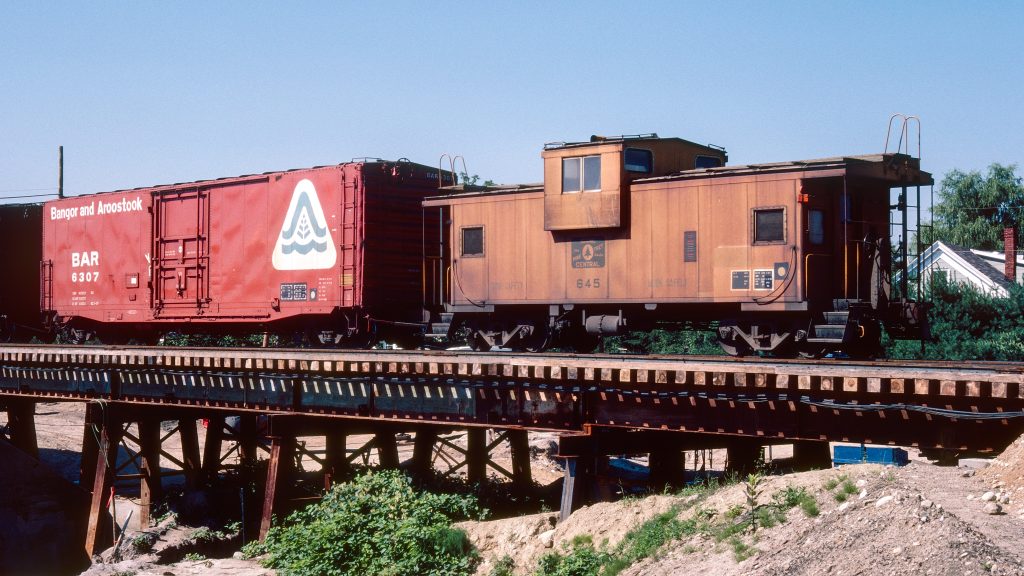
| BAR 5800–5999 | 50′ Box Car | Berwick Forge & Fabricating (Lot 16400-1); 1–3/1972. Upper part of the series carried the short-lived red, white and blue triangle-logo scheme. |
| BAR 6000–6029 | 50′ Box Car | Pullman-Standard (Lot 8689); 6/1962 |
| BAR 6030–6059 | 50′ Box Car | Pullman-Standard (Lot 8690); 6/1962 |
| BAR 6100–6224 | 50′ Box Car | Pullman-Standard (Lot 8821); 8–9/1963. Cars 6200–6224 were delivered with solid-bearing rather than roller-bearing trucks. |
| BAR 6300–6499 | 50′ Box Car | Pullman-Standard (Lot 8982); 1–2/1965. Widely seen in the “State of Maine Products” red, white and blue scheme. |
| BAR 6500–6699 | 50′ Box Car | Pullman-Standard (Lot 9099); 8/1966 |
| BAR 6700–6794 | 50′ Box Car | Pullman-Standard (Lot 9465); 3/1970 |
| BAR 6795–6799 | 50′ Box Car | Pullman-Standard (Lot 9465A); 3/1970? |
| BAR 6800–6999 | 50′ Box Car | General American; 1966 |
| BAR 8734–8742 | 50′ Box Car | Ex BAR 6300–6499 |
| BAR 8800–8822 | 50′ Box Car | Ex BAR 6100–6224. Many rebuilt in 1983 with new cushion draft gear and renumbered into the 8800 series. By about 1978, repaints began receiving orange rather than black ends. |
| BAR 8874–8877 | 50′ Box Car | Ex BAR 6100–6224 |
| BAR 9000–9034 | 50′ Box Car | Rebuilt 1971 from ACF-built 10000-series cars. Among the first BAR boxcars in International Orange with black ends. |
| BAR 9050–9099 | 50′ Box Car | Rebuilt 1981–82 from the 6800–6999 series, with roof hatches for grain loading and in some cases a single plug door replacing double doors. Some were later repainted into a revived red, white and blue scheme. |
| BAR 9100–9149 | 50′ Box Car | Rebuilt 1975–76 from ACF-built 10000-series cars. |
| BAR 9200–9249 | 50′ Box Car | Rebuilt 1977–78 from ACF-built 10000-series cars. 50ft 6in cars with 9ft doors, part of the modernised fleet for paper and forest products traffic. |
| BAR 9500–9574 | 50′ Box Car | Second-hand exterior-post boxcars acquired in 1977 from the Milwaukee Road. Built by FMC in 1975. A few were repainted International Orange in the late 1970s; most retained faded light blue until repainted dark green in the mid-1980s. |
| BAR 9575–9674 | 50′ Box Car | Second-hand exterior-post boxcars acquired in 1981 from the Minnesota, Dakota & Western. Built by FMC in 1979. |
| BAR 9700–9888 | 50′ Box Car | Ex CPLT 7750–7849 and A&MR 1000–1099 |
| BAR 10000–10349 | 50′ Box Car | ACFI (Lot 01-5084); 11–12/1957. 50ft 6in, 50-ton cars with 9ft doors and 4,922 cu ft capacity. |
| BAR 10350–10399 | 50′ Box Car | AC&F; xx/1957 |
| BAR 10400–10407 | 50′ Box Car | AC&F; xx/1962–63 |
| BAR 10410–10418 | 50′ Box Car | AC&F; xx/1965 |
| BAR 10450–10490 | 50′ Box Car; roof hatches | xxxx; xx/19xx |
| BAR 12000–12004 | 40′ Box Car; insulated | xxxx; x/19xx |
| BAR 24011–24147 | 50′ Box Car | Ex D&H 24001–24150 |
| BAR 65000–65499 | 40′ Box Car | Magor Car Corp. (Lot P9150); 6/1938. 1932 AAR design, 4/5 Dreadnaught ends and 6ft Youngstown doors; renumbered to 5000–5499 in the early 1950s. |
| BAR 65500–65549 | 40′ Box Car | Magor Car Corp. (Lot W710); 2/1945 |
| BAR 65550–65649 | 40′ Box Car | Magor Car Corp. (Lot W895); 12/1945 |
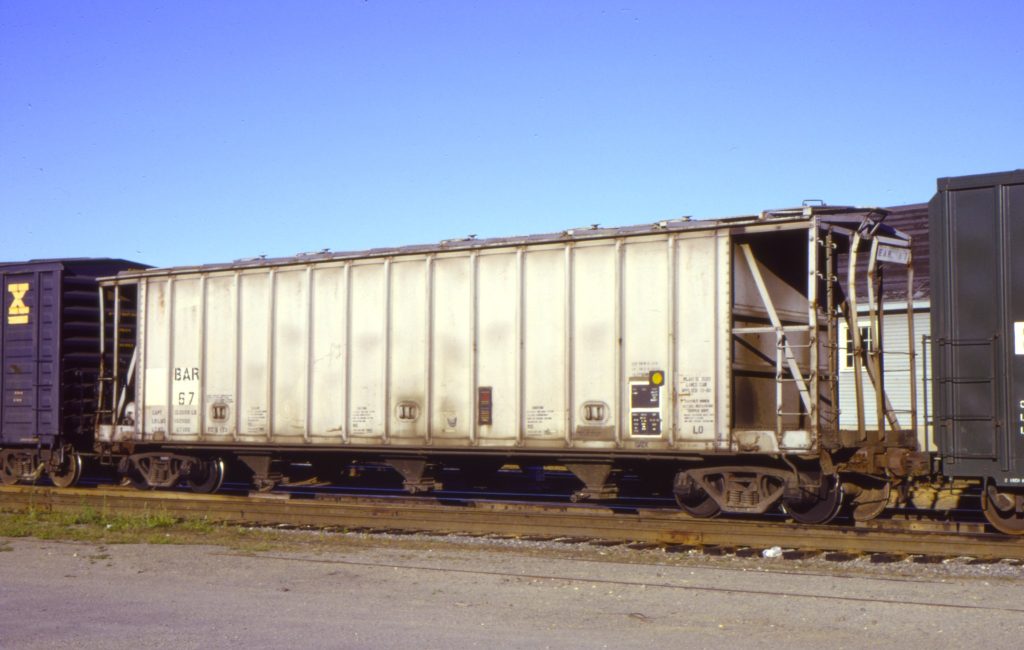
Covered Hoppers
| Numbers | Type | Description |
|---|---|---|
| BAR 1–99 | Originally 5000–5099 (Magor 1947); converted 1960 to standard pulp racks 1502–1599. | |
| BAR 60-68 | Dry-Flo Hopper | ex GACX 501xx-501xx; 1977 |
| BAR 69-73 | Dry-Flo Hopper | ex GACX; 1980 |
| BAR 94-99 | 50′ Reefers | xxxx; 19xx |
| BAR 100-149 | 50′ Reefers | xxxx; 19xx |
| BAR 250-299 | 50′ Reefers | xxxx; 19xx |
| BAR 500-599 | Pulpwood Flat; side frame | ex BAR 4500-4599 |
| BAR 1600-1714 | Pulpwood Flat | Magor (Lot W-3605); 8/1956 |
| BAR 1715-1864 | Pulpwood Flat | Magor (Lot W-4275); 9/1958 |
| BAR 2300-2449 | 40′ Box Car | xxxx; xx/19xx – Eastern Seaboard Models? Built by Pacific Car & Foundry |
| BAR 2500-2579 | ||
| BAR 4000-4499 | 40′ Box Car | |
| BAR 4500-4599 | Pulpwood Flat; side frame | Greenville Steel Car Co.; 6/1938 |
| BAR 4500-4504 | 40′ Box Car; PS-1 | PS (Lot 8160A); 2/1954 |
| BAR 4510-4516 | 40′ Box Car | xxxx; xx/19xx |
| BAR 4517-4521 | 40′ Box Car | xxxx; xx/19xx |
| BAR 4500-4582 | ||
| BAR 4600-4603 | 40′ Box Car; roof hatches | xxxx; xx/19xx |
| BAR 5000-5499 | 40′ Box Car | ex BAR 65000-65499 https://www.protocraft.com/category.cfm?ItemID=1144&Categoryid=20 The Bangor & Aroostook’s first all-steel boxcars were purchased from Magor Car Corp. in 1938 and 1945. These 1932 AAR design cars were in use through the 1960s and most were repainted in the then current “large BAR” scheme as shown. Originally numbered in the 65000 series the “6” was eliminated in the early 1950s and a few were also renumbered into the 3000 series. The cars were stored during the 1970s although several survived in Maintenance of Way service. |
| BAR 5109-5199 | 50′ Box Car | ex NS; nee ITC 5390-5489 |
| BAR 5500-5549 | 40′ Box Car | ex BAR 65500-65549 |
| BAR 5550-5649 | 40′ Box Car | ex BAR 65550-65649 |
| BAR 5500-5599 | 50′ Box Car | ex LVRC 5050-5399 |
| BAR 5600-5749 | 50′ Box Car | BF&F (Lot 46900); 09/1981 – Athearn? Models: BAR 5697 Athearn 10931 ★, BAR 5699 Athearn 6753 ★, BAR 5705 Athearn 6754 ★, BAR 5717 Athearn 6755 ★, BAR 5722 Athearn 10932 ★ |
| BAR 5800-5999 | 50′ Box Car | BF&F (Lot 16400-1); 1-3/1972 |
| BAR 6000-6029 | 50′ Box Car | PS (Lot 8689); 6/1962 – Athearn? |
| BAR 6030-6059 | 50′ Box Car | PS (Lot 8690); 6/1962 |
| BAR 6100-6224 | 50′ Box Car | PS (Lot 8821); 8-9/1963. 6200-6224 were delivered with solid bearing instead of roller bearing trucks. |
| BAR 6300-6499 | 50′ Box Car | PS (Lot 8982); 1-2/1965 Photos: Models: BAR 6316 Athearn 14171 ★, BAR 6358 Athearn 14172 ★, BAR 6460 Athearn 2804 ★, BAR 6462 Athearn 2805 ★, BAR 6465 Athearn 2806 ★ |
| BAR 6500-6699 | 50′ Box Car | PS (Lot 9099); 8/1966 |
| BAR 6700-6794 | 50′ Box Car | PS (Lot 9465); 3/1970 |
| BAR 6795-6799 | 50′ Box Car | PS (Lot 9465A); 3/1970? |
| BAR 6800-6999 | 50′ Box Car | General American; 1966 |
| BAR 8734-8742 | 50′ Box Car | ex BAR 6300-6499 |
| BAR 8800-8822 | 50′ Box Car | ex BAR 6100-6224. In 1983 many of the 6000-6224 series cars were completely rebuilt with new cushion draft gear and renumbered to the 8800 series. Some time in 1978 box car repaints began receiving orange instead of black ends. |
| BAR 8874-8877 | 50′ Box Car | ex BAR 6100-6224 |
| BAR 9000-9034 | 50′ Box Car | ex BAR 10000-10***; rblt 1971 |
| BAR 9050-9099 | 50′ Box Car | ex BAR 6800-6999; rblt 1981-1982 with roof hatches for grain loading and a single plug door. In 1981 the Bangor & Aroostook rebuilt a few of the 6800-series General American boxcars with roof hatches for grain service. Some cars had their double doors replaced with a single one. These cars were numbered in the 9060 series and later were repainted into a new version of the original red, white, and blue boxcar scheme. Number 9060 is a good example of the salmon color that International Orange often faded to. |
| BAR 9100-9149 | 50′ Box Car | ex BAR 10000-10***; rblt 1975-1976 |
| BAR 9200-9249 | 50′ Box Car | ex BAR 10000-10***; rblt 1977-1978 |
| BAR 9500-9574 | 50′ Box Car | Ex Milwaukee Road in 1975. FMC corp xxxx; xx/19xx |
| BAR 9575-9674 | 50′ Box Car | Ex Minnesota, Dakota and Western in 1981 built by FMC Corp. in 1979. |
| BAR 9700-9888 | 50′ Box Car | ex CPLT 7750-7849 + A&MR 1000-1099 |
| BAR 10000-10349 | 50′ Box Car | AC&F (Lot 01-5084); 11-12/1957. These 50′-6″, 50 ton, box cars were built by ACFI (Lot 01-5084) in 11-12/1957. They featured 9′ doors and 4922 ft3 capacity. – InterMountain? |
| BAR 10350-10399 | 50′ Box Car | AC&F; xx/1957 |
| BAR 10400-10407 | 50′ Box Car | AC&F; xx/1962-1963 |
| BAR 10410-10418 | 50′ Box Car | AC&F; xx/1965 |
| BAR 10450-10490 | 50′ Box Car; roof hatches | xxxx; xx/19xx |
| BAR 11000-11049 | 50′ Reefers | xxxx; 19xx |
| BAR 11100-11149 | 50′ Reefers | PC&F; 6/1970 – Athearn? |
| BAR 12000-12004 | 40′ Box Car; insulated | xxxx; x/19xx |
| BAR 24011-24147 | 50′ Box Car | ex D&H 24001-24150 |
| BAR 65000-65499 | 40′ Box Car | MCC (Lot P9150); 6/1938 |
| BAR 65500-65549 | 40′ Box Car | MCC (Lot W710); 2/1945 |
| BAR 65550-65649 | 40′ Box Car | MCC (Lot W895); 12/1945 |
Refrigerator Cars
Refrigerator cars were central to the BAR’s identity and to its potato traffic. As one of Maine’s major agricultural products, potatoes generated a huge seasonal movement, and the BAR developed a large fleet of reefers to handle it. By 1970, refrigerator cars made up around one-third of the freight car roster, showing just how important that traffic had become.
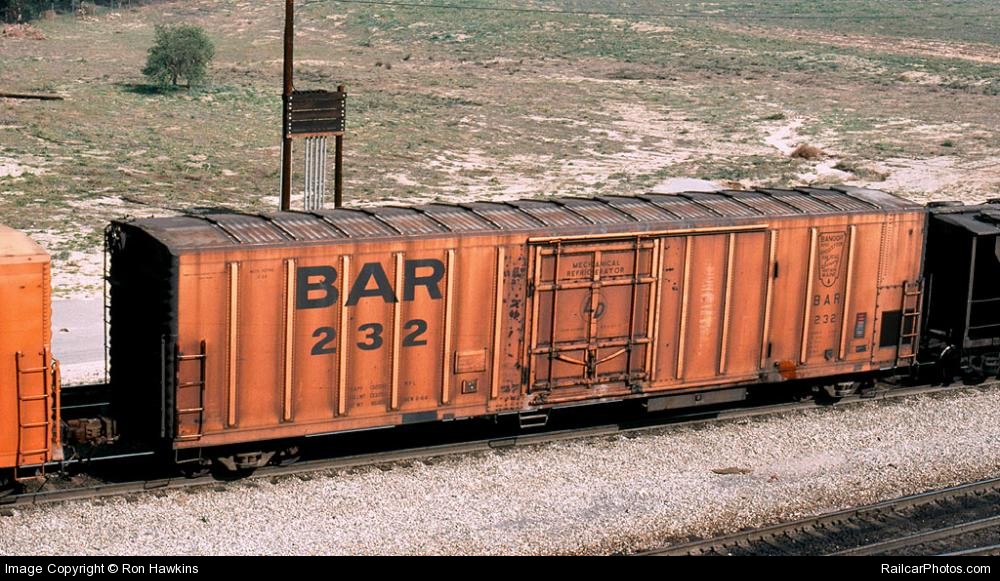
BAR used its refrigerator cars as ventilated cars during the potato shipping season in the autumn and winter, allowing airflow while protecting the crop from freezing. Outside that period, many of these cars were leased to Pacific Fruit Express, where they were used in conventional iced refrigerator service.
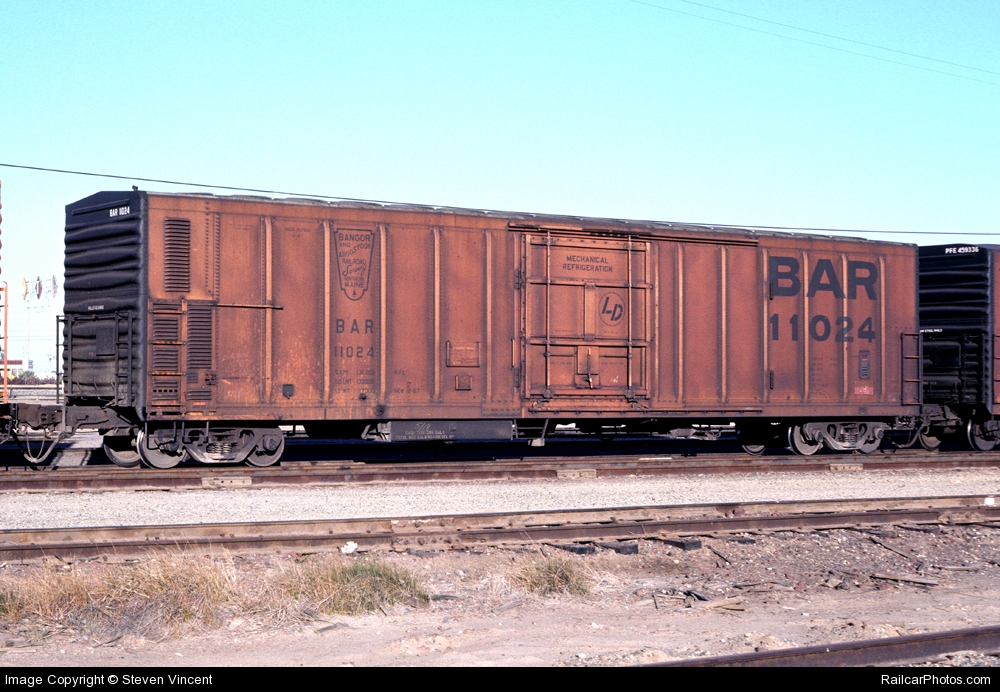
Visually, these were among the most distinctive BAR cars. The railroad’s mechanical refrigerator cars, with their bright orange sides and bold black reporting marks, were instantly recognisable. They were built not simply to look smart, but because the potato business demanded large numbers of dependable, insulated and refrigerated cars capable of moving a perishable crop to distant markets.
| Nos. | Type | Notes |
|---|---|---|
| BAR 94–99 | 50′ Refrigerator | |
| BAR 100–149 | 50′ Refrigerator | |
| BAR 150–249 | 50′ Refrigerator | Built by Pacific Car & Foundry, 1964. |
| BAR 250–299 | 50′ Refrigerator | |
| BAR 8600–8697 | 40′ Refrigerator; ice-bunker | Built 1939. Early cars for perishable traffic prior to widespread mechanical refrigeration. |
| BAR 8700–8749 | 40′ Refrigerator; ice-bunker | |
| BAR 11000–11049 | 50′ Refrigerator | Built by Pacific Car & Foundry; 1967. |
| BAR 11100–11149 | 50′ Refrigerator | Built by Pacific Car & Foundry; June 1970. |
Flat Cars
Flat cars were an important part of the BAR fleet in the earlier years, making up more than fifteen percent of freight cars in 1940. Their share fell sharply over time, but they remained useful for loads that did not fit easily into enclosed cars, including machinery, timber, and other bulky traffic.
The BAR roster included several series of 40ft steel-underframe flats, many of them dating back to the 1920s. Renumberings, rebuildings, and retirements altered the fleet repeatedly, so flat cars can look slightly confusing on paper, but they were a steady if less glamorous part of the railroad’s freight operation.
Pulpwood Cars
Pulpwood was one of the Bangor & Aroostook’s major on-line traffics, and the fleet reflected that. The railroad served a region where the forest products industry dominated, so cars for hauling short pulpwood logs were a constant necessity. These were workaday vehicles rather than showpieces, but they were fundamental to the BAR’s business.
As with other northeastern roads, pulpwood equipment often evolved through rebuilding and adaptation rather than through entirely new standard designs. Strength mattered more than appearance, and these cars were expected to stand up to rough loading, hard use, and the demands of mill traffic.
Woodchip Cars
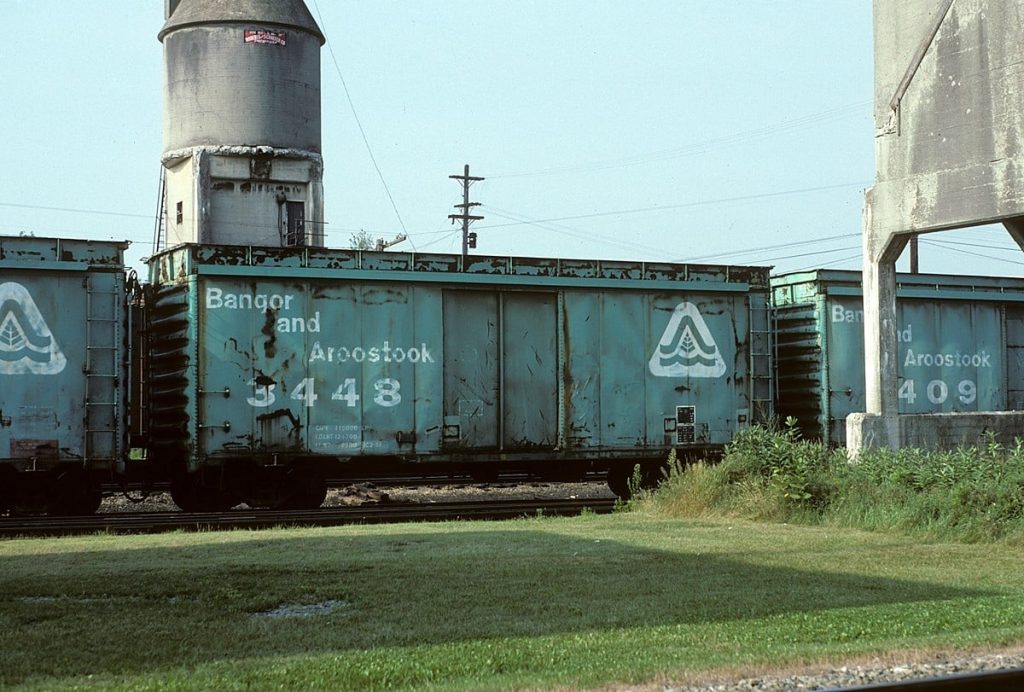
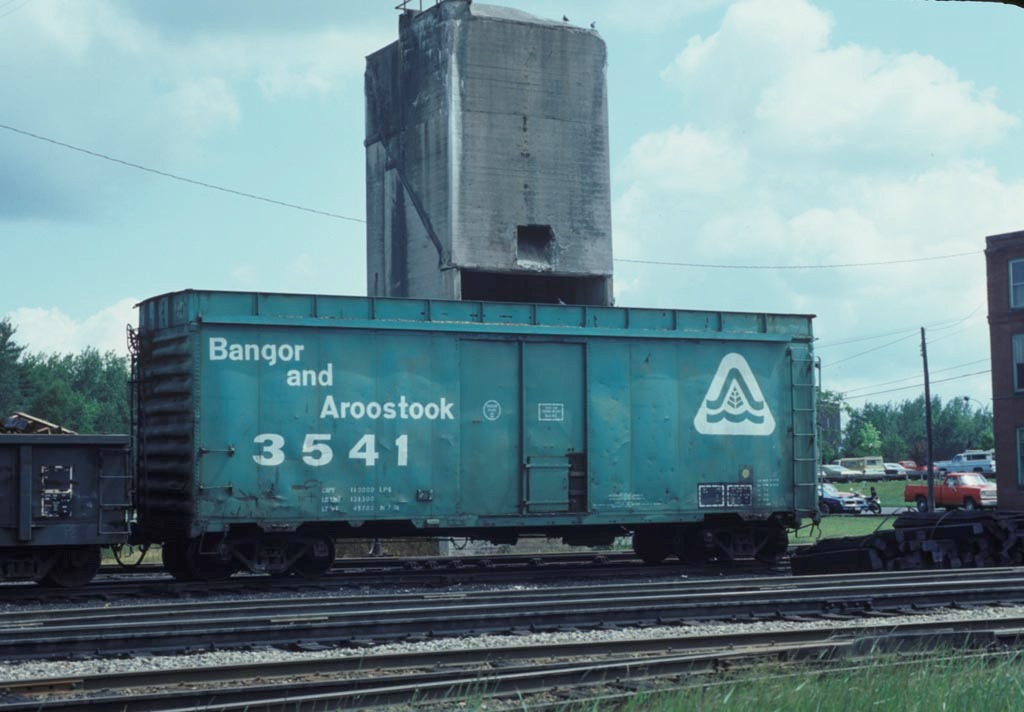
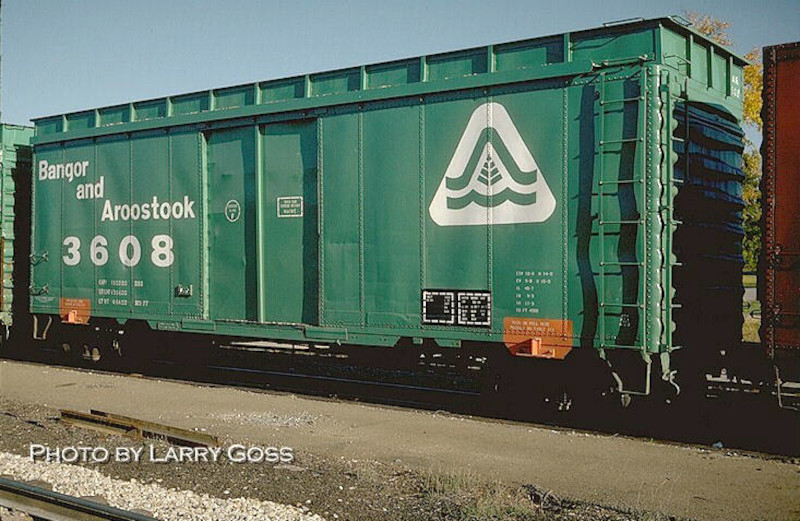
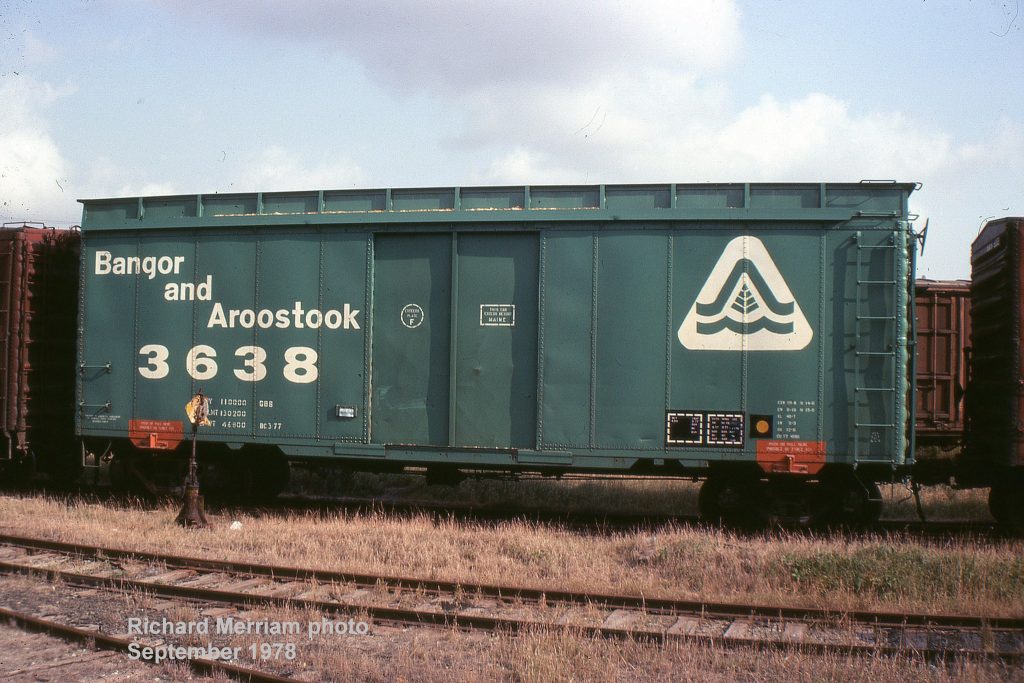
Woodchip traffic on the Bangor & Aroostook developed as a natural extension of the state’s pulp and paper industry, creating demand for cars capable of handling large volumes of lightweight material. As mills increasingly processed waste timber into chips, the railroad needed equipment that prioritised capacity rather than strength, in contrast to the heavy four-foot logs carried in pulpwood service.
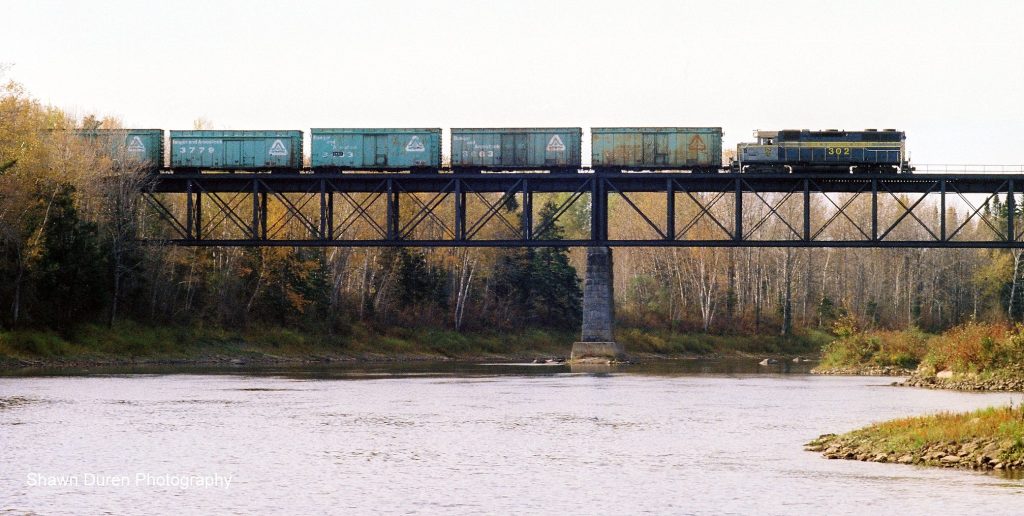
To meet this need, the BAR converted large numbers of redundant 40ft boxcars into woodchip carriers. These conversions typically involved removing the roof and increasing the effective capacity of the body, while retaining the original underframe. Many cars continued to show clear signs of their origins, including plug doors or conventional sliding doors, now incorporated into open-topped, high-sided bodies.
As with other parts of the BAR fleet, this was a practical, cost-driven solution rather than a standardised new-build design. The resulting cars could appear ungainly, but they were well-suited to the low-density, high-volume nature of woodchip traffic.
By the late 1970s, woodchip traffic had become a major part of the railroad’s business, with hundreds of these converted cars on the roster. They often ran in long blocks, their tall, open sides making them instantly recognisable among more conventional freight stock.
| Nos. | Type | Notes |
|---|---|---|
| BAR 3500- | ||
| BAR 3700- | Woodchip Car | Ex BAR 2000–2499 |
| BAR 3800- | Woodchip Car | Ex BAR 2000–2499 |
From 1922 through 1924, the BAR built 600 36″ boxcars of the Howe Truss design with an inside height of 8′-1″, in their Derby, Maine shops, as Series 9800-10399. Between November 1927 and October 1930, BAR’s Derby, Maine shops built 600 of the new ARA XM-1 Pratt Truss single-sheathed boxcars. These cars had an inside height of 8′-7″ and were assigned Series 61000-61599. In 1951, 234 cars were renumbered into the 1000-1399 Series, and in 1955, additional cars were renumbered into Series 3000-3199 for newsprint service. An additional 100 cars were fitted with pulpwood racks and renumbered to 3500-3599. Decal sheet designed and created at Protocraft Decals.
https://protocraft.com/category.cfm?Itemid=227&Categoryid=20
The Bangor & Maine Railroad ordered 650 1932 ARA design boxcars with an inside height of 9′-2″ and dimensions to specifically accommodate their newsprint customers and the roll size. Lettering on the side noticed other railroads that these cars were to be loaded with newsprint only. The cars were built by the Magor Car Corporation in 3 lots and delivered as follows: Series 65000-65499, 500 cars, delivered June 1938 Series 65500-65549, 50 cars, delivered February 1945 Series 65500-65649, 100 cars, delivered in 1945 (Note: In 1954, the first digit was dropped, effectively renumbering the series as 5000-5649) Initially delivered with BANGOR & AROOSTOOK spelt out, in August 1949, the cars went through a repaint schedule that employed the new ‘shield’ monogram. In 1948, the round medallion was used but was soon dropped, and the cars were repainted again with the ‘shield’ monogram. In mid-1950s, many of these cars were repainted with the red, white and blue banner “STATE OF MAINE PRODUCTS scheme.
https://protocraft.com/category.cfm?Itemid=249&Categoryid=20
8700-8799 36′ Steel centre sill underframe
60000-60099 36′ Steel centre sill underframe
60500-60699 36′ Steel centre sill underframe, renumbered in 1952 to 8500-8649 retired by 1955.
65000-65499 Magor Car Company with 4×5 Dreadnaught ends and 6′ wide Youngstown doors to AAR’s 1932 design (Atlas?) in 1938. They were renumbered to 5000-5499 in 1952.
9800-10399 36′ Steel under-frame, became 9000-9999 series after 1952.
6500 from 1966
- Highball Graphics F-106 – Bangor & Aroostook Red 50′ Single Door Boxcars
- Highball Graphics F-108 – Bangor & Aroostook Red 50′ Double Door Boxcars
More Information
- Sweetland, David R., and Stephen Horsley. Northern New England Color Guide to Freight & Passenger Equipment. Morning Sun Books, 1995.
Epilogue
The Bangor & Aroostook’s freight cars were never just a collection of stock numbers. They were a direct expression of the railroad’s territory and traffic. Potatoes needed refrigerator cars, forest products needed boxcars, pulpwood flats, and later woodchip conversions, and the BAR’s roster evolved accordingly.
That practical, traffic-led development is what gives the fleet its appeal. The famous “State of Maine” boxcars and orange reefers may be the stars, but they only make full sense when seen alongside the plainer working cars that supported the same economy. Taken together, BAR freight equipment tells the story of a railroad built to serve northern Maine, and of a fleet that changed as that traffic changed with it.