Boxcars
 Columbus & Greenville 40-foot PS-1 boxcar No. 3703 is photographed at Columbus, Mississippi, on 3 April 1976. Built by Pullman-Standard in December 1957 as part of Lot 8364, the car was one of fifty similar boxcars numbered 3401-3450. Still carrying its attractive green livery with the slogan “Through the Heart of Dixie,” the car presents a classic appearance typical of Southern short line freight equipment during the 1970s. © Matt Herson
 Columbus & Greenville 50-foot boxcar No. 14047 is photographed at Akron, Ohio, in May 1978. Built by Pacific Car & Foundry in April 1959, the car carries the railroad’s distinctive blue Southwide livery, a marketing brand introduced to promote the Columbus & Greenville’s freight services throughout the southern United States. Although owned by a relatively small Mississippi railroad, the car is seen far from its Mississippi home, illustrating the nationwide interchange of North American freight cars. © Roger Durfee
 Columbus & Greenville 40-foot boxcar No. 14066 is photographed at City of Industry, California, on 13 March 1978. Built by Pacific Car & Foundry in 1959, the car was one of thirty-eight similar boxcars numbered 14061-14098, acquired second-hand from FCWX, having previously served as DSDX. It carries the railroad’s striking blue Southwide livery, reflecting the Columbus & Greenville’s efforts to market itself beyond its Mississippi home territory. © Ron Hawkin
 Columbus & Greenville 40-foot boxcar No. 14089 is seen passing through Tehachapi, California, on 25 November 1978. Built by Pacific Car & Foundry in April 1959, the car was one of thirty-eight similar boxcars numbered 14061-14098, acquired second-hand from FCWX after earlier service as DSDX. Still wearing the railroad’s distinctive blue Southwide livery, the boxcar is a long way from its Mississippi home rails as it traverses one of North America’s best-known freight routes. © Craig Walker
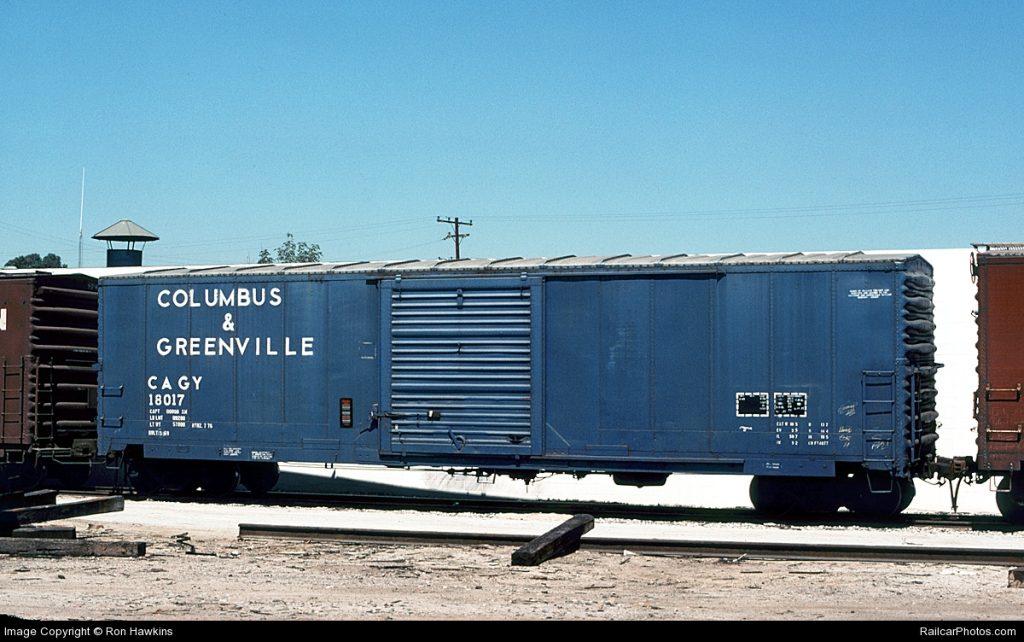 Columbus & Greenville 50-foot boxcar No. 18017 is photographed at Anaheim, California, on 8 September 1977. One of twenty-five cars numbered 18000-18024, it carries the railroad’s simple blue livery with large Columbus & Greenville lettering. Despite belonging to a regional Mississippi railroad, the car is a long way from home, illustrating how boxcars from even relatively small railroads could be found in freight service across North America. © Ron Hawkins
 Columbus & Greenville FMC 50-foot boxcar No. 19107 is photographed at Long Island City, New York, on 12 October 1976. Built new by FMC in May 1976 as part of Lot 17771, it was one of twenty-five cars numbered 19100-19124. Finished in a striking white and blue scheme, the car carries Cushion Service lettering and the railroad’s The Delta Route emblem, reflecting its role in protecting shock-sensitive freight while advertising the Mississippi short line far beyond its home territory. © Matt Herson
 Columbus & Greenville FMC 50-foot boxcar No. 19116 is seen at Oceanside, California, on 26 May 1977. Built by FMC in May 1976 as part of Lot 17771, it was one of twenty-five boxcars numbered 19100-19124. The car is finished in the railroad’s distinctive white Cushion Service scheme with a blue sliding door and The Delta Route emblem, advertising its specialised cushioned underframe for shock-sensitive freight while roaming the national rail network. © Steve Vincent
 Columbus & Greenville 50-foot Evans boxcar No. 20006 is photographed at Columbus, Mississippi, on 17 February 1978. Built new by Evans-USRE in October 1976 as part of Lot 1417, it was one of fifty cars numbered 20000-20049. The insulated boxcar features the railroad’s clean white and blue livery, with a blue sliding door and matching cushioned end panels, reflecting the modern image Columbus & Greenville adopted for its growing fleet of high-capacity freight cars. © Steve Vincent
 Columbus & Greenville FMC 50-foot boxcar No. 21097 is photographed at Stockton, California, on 4 April 1979. Built new by FMC in March 1979 as part of Lot 17985, it was one of 150 cars numbered 21000-21149. Finished in the railroad’s striking dark blue Cushion Service livery with The Delta Route emblem, the car was designed for the transportation of shock-sensitive freight and is seen only weeks after entering service. © Steve Vincent
 Columbus & Greenville 50-foot CNCF boxcar No. 21628 is photographed at Oceanside, California, on 29 July 1979. Built new in Mexico by Constructora Nacional de Carros de Ferrocarril (CNCF) in February 1979, it was one of 200 cars numbered 21500-21699. Finished in the railroad’s attractive dark blue Cushion Service livery with The Delta Route emblem, the high-capacity boxcar is seen just months after entering service while roaming far beyond the Columbus & Greenville’s Mississippi home territory. © Steve Vincent
 Columbus & Greenville 50-foot boxcar No. 22004 is photographed at Stockton, California, on 5 April 1979. Built by Emons Railcar between November 1978 and January 1979 from Berwick Forge & Fabricating kits, it was one of 200 cars numbered 22000-22199. Finished in the railroad’s distinctive dark blue Cushion Service livery, the high-capacity boxcar is seen only a few months after entering service, demonstrating how Columbus & Greenville’s modern freight car fleet ranged widely across the North American rail network. © Steve Vincent
 Columbus & Greenville 50-foot boxcar No. 22232 is photographed at Highgrove, California, on 27 December 1979. Built new by Berwick Forge & Fabricating in January-February 1979 as part of Lot 38700, it was one of 200 cars numbered 22200-22399. The dark blue Cushion Service livery features the railroad’s distinctive The Delta Route emblem together with the slogan “The Railroad That Cares,” promoting its premium service for shock-sensitive freight as the car travelled well beyond its Mississippi home rails. © Steve Vincent
 Columbus & Greenville 40-foot boxcar No. 24013 is photographed at Columbus, Mississippi, on 17 February 1978. Built in October 1954, the car had been repainted into the railroad’s white and blue scheme in October 1975, carrying The Delta Route emblem but little other external branding. The view highlights the contrast between this older 40-foot car and the Columbus & Greenville’s newer high-capacity boxcars that were beginning to dominate the fleet during the late 1970s. © Steve Vincent
 Columbus & Greenville 40-foot boxcar No. 24018 is photographed at Greenwood, Mississippi, on 24 May 1984. Built by Pullman-Standard, the veteran boxcar carries the railroad’s plain white and blue paint scheme introduced during the mid-1970s. By the time of this photograph, the car shows extensive weathering and rust streaking from years of service, while its partly open sliding door offers a glimpse of the interior. © Diesel Dave
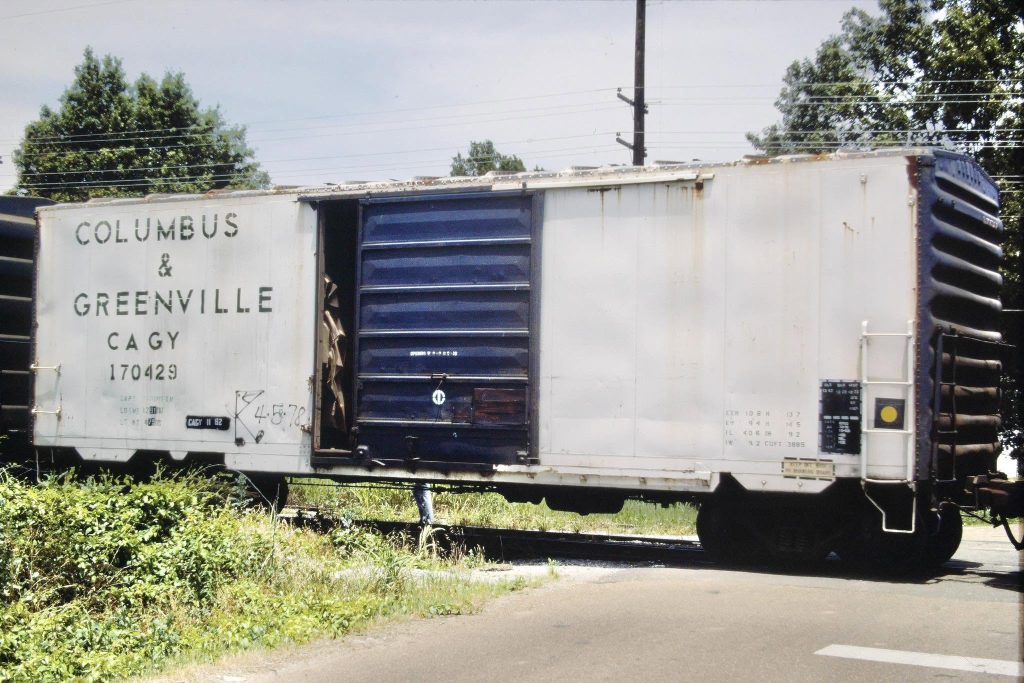 Rebuilt Columbus & Greenville PS-1 boxcar No. 170429 is photographed at Greenwood, Mississippi, on 24 May 1984. Originally built by Pullman-Standard in December 1957 as one of fifty PS-1 boxcars, the car was rebuilt at Greenville, Mississippi, during 1977 and renumbered into the 170401-170450 series. The well-worn white and blue livery reflects several years of service following the rebuilding programme. © Diesel Dave
 Rebuilt Columbus & Greenville PS-1 boxcar No. 170440 is photographed at Atlanta, Georgia, on 15 February 1978 with its sliding door open, revealing the clean timber-lined interior. Originally built by Pullman-Standard in December 1957 as part of Lot 8364 and numbered 3440, the car was one of fifty PS-1 boxcars rebuilt at Greenville, Mississippi, during 1977 and renumbered into the 170401-170450 series. It wears the railroad’s smart white and blue livery introduced as part of the rebuilding programme. © Steve Vincent
 Rebuilt Columbus & Greenville PS-1 boxcar No. 170443 is photographed at Ono, California, on 11 July 1981. Originally built by Pullman-Standard in December 1957 as part of Lot 8364 and numbered 3443, the car was one of fifty PS-1 boxcars rebuilt at Greenville, Mississippi, during 1977 and renumbered into the 170401-170450 series. Still wearing its white and blue rebuilding scheme four years later, the veteran boxcar continues to roam far beyond the railroad’s Mississippi home territory. © Ron Hawkins
| Nos. | Type | Notes |
|---|
| CAGY 3401-3450 | 40′ Box Car; PS-1 | PS (Lot 8364); 12/1957 |
| CAGY … 9036 … | 50′ Box Car | Evans-SIECO (work order 1440); 2-4/1979. ex ADN 5600-5899 by 1984. |
| CAGY … 14047 … | | 1959 |
| CAGY 14061-14098 | 40′ Box Car | from FCWX series 4000-4098; from DSDX series 2000-2199 built by Pacific Car & Foundry, Lot _, -59. |
| CAGY 18000-18032 | 50′ Box Car | xxxx; 19xx |
| CAGY 19100-19124 | 50′ Box Car | FMC (Lot 17771); 5/1976 |
| CAGY 20000-20049 | 50′ Box Car | Evans-USRE (Lot 1417); 10-12/1976 |
| CAGY 21000-21149 | 50′ Box Car | FMC (Lot 17985); 3/1979 |
| CAGY 21500-21699 | 50′ Box Car | CNCF; 1979 |
| CAGY 22000-22199 | 50′ Box Car | Emons Railcar from BFF kits (Lot 38300); 11/1978-1/1979 |
| CAGY 22200-22399 | 50′ Box Car | Berwick Forge & Fabricating, Lot 38700, Jan-Feb 1979. |
| CAGY … 24013 … | 40′ Box Car | |
| CAGY 170401-170450 | 40′ Box Car; PS-1 | ex CAGY 3401-3450 |
https://hawkinsrails.net/shortlines/cagy/cagy_freight.htm