The BR Diagram 1/112 16-ton mineral wagons were one of the most unusual members of the British Railways 16T steel mineral family. Although they ran in BR service during the 1950s and 1960s, they were not originally designed for British traffic. Instead, they were built in 1946 for the French national railway, SNCF, before being repatriated and absorbed into the BR wagon fleet.
Among the many variants of BR 16-ton mineral wagons, the Diagram 1/112 stands apart because of its continental design features, most notably its full-height cupboard side doors and fixed ends. In freight formations, they were immediately recognisable, their relatively smooth slab-sided bodies and tall outward-opening doors giving them a distinctly non-standard appearance within British mineral rakes.
Post-War Origins
In the immediate aftermath of the Second World War, the French railway system faced severe shortages of rolling stock. To assist with reconstruction, the British government arranged for 7,000 steel mineral wagons to be built for use in France. The contract was placed with Metropolitan-Cammell, with Dorman Long supplying body components; the latter acted as subcontractors for the bodywork, whilst Metropolitan-Cammell produced the underframes.
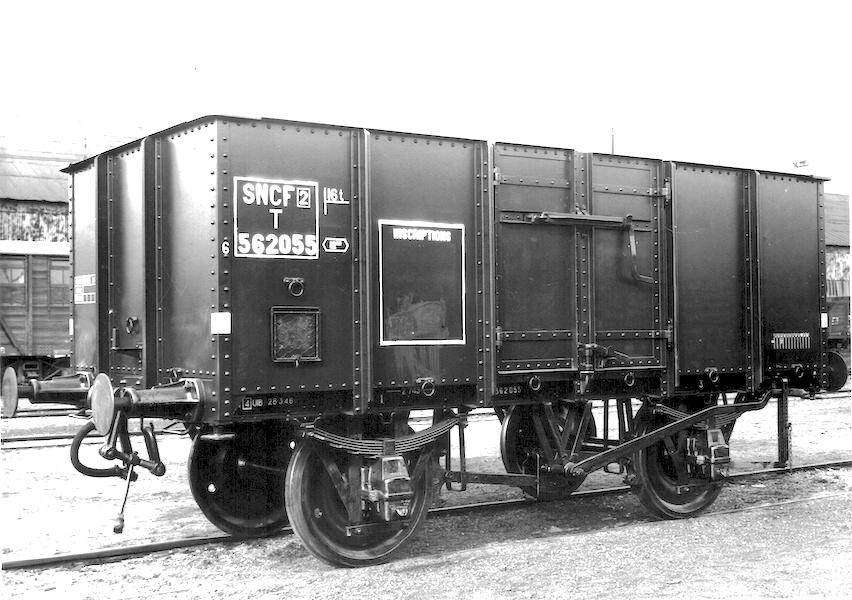
The wagons were delivered in kit form and assembled in Bordeaux during 1946. Final assembly was undertaken by the Compagnie Industrielle de Matériel de Transport (CIMT) at Bordeaux. In SNCF service, they were numbered 562001–569000. The SNCF subsequently renumbered the series into the 733000–739999 range, and later into 7733000–7739999 as part of an early move toward UIC-style numbering.
Although built on a fundamentally British 9ft wheelbase underframe, the wagons incorporated distinctly continental features. The most obvious difference from standard British 16T mineral wagons was the use of tall, outward-opening cupboard side doors rather than drop doors and end doors. The wagons had fixed ends and were fitted with screw couplings and longer buffers suitable for continental practice. A through-air pipe was fitted, although the wagons were not air-braked, and a hand brake was provided on one side only. In SNCF service, they carried a reddish-brown livery with black underframes.
The type was officially classed by the SNCF as a 16-ton “tombereau” series allocated to the Nord region (Index 2), and contemporary white corner markings indicated unfitted vehicles equipped with a through pipe.
Return to British Railways
By 1950, the French no longer wished to retain these non-standard vehicles. British Railways purchased the entire batch and began refurbishing them for domestic use. They were allocated BR numbers B190000–B196999 and designated Diagram 1/112. The wagons had only seen relatively brief service in France before sale, being transferred to British Railways and shipped by sea from Dunkirk to Dover in 1950.
Refurbishment was carried out during 1950 under Lot 2286 at Earlestown and New Cross Gate. Although classified by BR as Open wagons, they were numbered within the mineral series B190000-B196999.
Of the original 7,000 vehicles, 6,982 entered BR stock. Numbering was allocated in blocks between the two works, as shown below:
| Lot | Number | Numbers | Date | Works |
|---|---|---|---|---|
| 2286 | 1000 | B190000-190999 | 1950 | Earlestown |
| 2286 | 300 | B191000-191299 | 1950 | New Cross Gate |
| 2286 | 1000 | B191300-192299 | 1950 | Earlestown |
| 2286 | 300 | B192300-192599 | 1950 | New Cross Gate |
| 2286 | 2200 | B192600-194799 | 1950 | Earlestown |
| 2286 | 2182 | B194800-196999 | 1950 | New Cross Gate |
| Total | 6982 |
Refurbishment took place between late 1950 and early 1952. The work included removal of the through air pipe, reinstatement or modification of handbrake arrangements, and replacement of continental wheelsets and axleboxes where necessary, together with repainting into BR unfitted grey livery, initially lead grey with a black underframe.
Although some plates later recorded a 1944 build date, the wagons were in fact constructed in 1946. The incorrect dating appears to have arisen during the transfer and rebuilding process, with BR attributing construction to Metropolitan-Cammell and plating them accordingly.
Design and Dimensions
In terms of dimensions, the Diagram 1/112 wagons followed standard British 16T practice in underframe layout, with a 9ft wheelbase and overall length over buffers of approximately 19ft 11in. The body height was roughly 8ft 7½in, with a cubic capacity of about 595 cubic feet, lower than many contemporary BR-built 16T minerals.
The defining feature remained the full-height cupboard doors. Unlike typical BR 16-ton mineral wagons, which relied on drop side doors and end doors for unloading, the 1/112 wagons had hinged doors extending almost the full height of the body side. The ends were fixed, giving the wagons a slab-sided appearance that set them apart visually from the heavily riveted British-built minerals of the period. Many wagons were fitted with buffers projecting about 1ft 8½in, slightly longer than the normal British unfitted standard of around 1ft 6in, reflecting their intended compatibility with continental screw couplings.
In traffic, this design proved less than ideal. The cupboard doors could work loose, particularly when used in ballast and spoil service, where heavy impact loading could cause the door fastenings to deteriorate in service. There were instances in which doors fouled adjacent lines, leading to restrictions and prominent branding in the early 1960s, warning against their use for ballast traffic and contributing to their allocation to more controlled traffic.
Operational Use
Because of their non-standard body design, Diagram 1/112 mineral wagons were often allocated to specific traffics rather than being treated as fully interchangeable minerals. They were seen in general freight formations but also in chemical and other specialised flows where their door arrangement was less problematic.
They never achieved the ubiquity of standard BR-built 16T mineral wagons and were gradually withdrawn during the mid-1960s. By this stage, more modern designs and the move toward air-braked freight stock were reshaping British freight operations, and the 1/112 wagons were increasingly surplus to requirements.
Industrial and Private Use
A significant number of Diagram 1/112 wagons passed into industrial service after withdrawal from BR. One of the most notable users was British Titan Products (BTP) at Grimsby, which acquired around 300 wagons in 1964–65 for ilmenite traffic.
In BTP service, the wagons were modified, with the side doors removed and the openings plated over to form tippler bodies. Some survived in main line traffic until the mid-1970s, with others continuing in internal industrial use for several years thereafter. Their robust underframes ensured that many had long second careers, even if heavily altered, with some examples passing through multiple private owners before final withdrawal.
Preservation
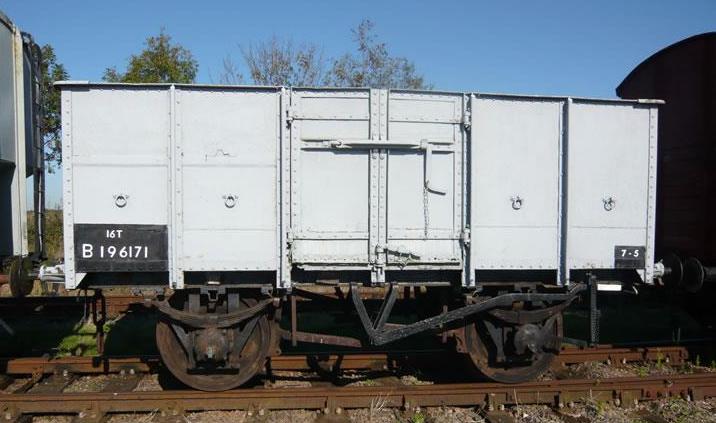
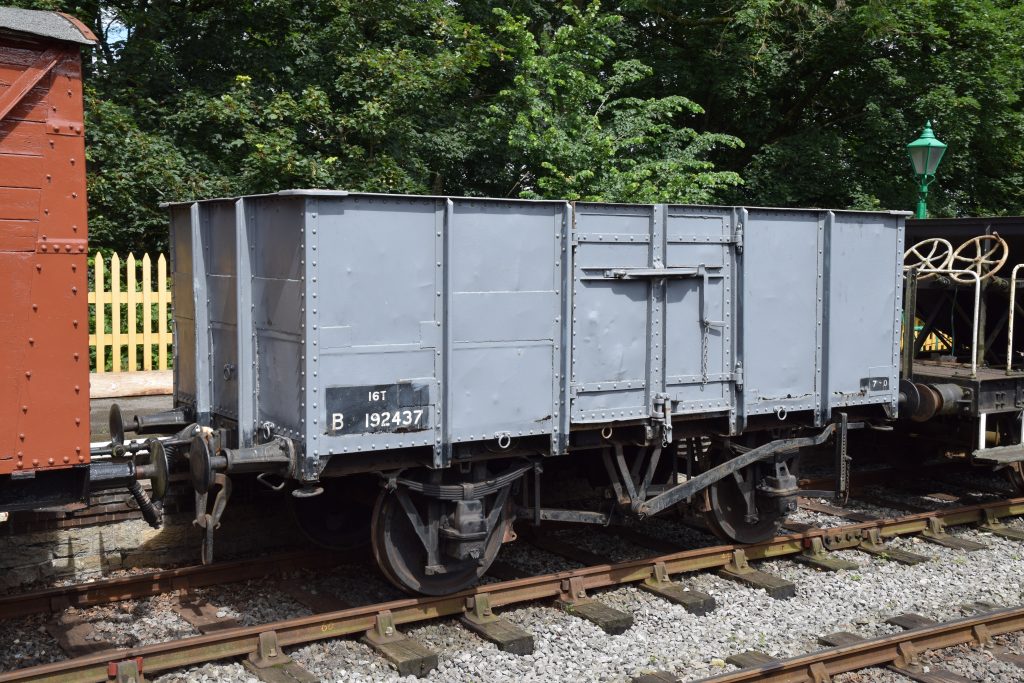
Two confirmed examples of the BR Diagram 1/112 mineral wagon are known to survive. B192437, formerly part of the National Railway Museum collection, was transferred in 2021 to the Somerset & Dorset Railway Heritage Trust at Midsomer Norton. A second survivor, B196171, is preserved at the Mangapps Railway Museum near Burnham-on-Crouch. Together, these vehicles provide important physical evidence of this distinctive Anglo-French post-war wagon design.
Modelling Diagram 1/112 Minerals
For modellers of 1950s and early 1960s freight trains, Diagram 1/112 wagons provide a visually distinctive addition to a rake of standard BR 16T minerals. Their cupboard doors and fixed ends immediately set them apart. Care should be taken to represent the correct period livery, early branding relating to ballast restrictions where appropriate, and the absence of end doors.
For 2mm Finescale modellers, the 2mm Scale Association produces an excellent injected moulded plastic body kit 2-500, “SNCF Mineral Dia 1/112”. This captures the distinctive full-height cupboard doors and fixed ends that define the type and immediately distinguish it from standard BR-built 16-ton minerals. The body is intended to be mounted on the Association’s 9ft RCH etched chassis, kit 2-324, which is specifically for the SNCF mineral variant.
For a late-1950s or early-1960s BR example, wheel choice should reflect normal maintenance variation. By this period, many wagons had received 3-hole disc wheels, making Association wheels 2-0021 (6mm diameter, 12.25mm axle) an entirely appropriate choice. Eight-spoke wheels (2-0041) are equally defensible, particularly if modelling a wagon that may not yet have been through a wheelset replacement cycle. A mixture within a rake is realistic.
Axleboxes and springs should reflect BR-period maintenance rather than strict original Metro-Cammell detail. The BR-pattern two-part six-leaf spring and axlebox castings (2-430) are appropriate for a mid-period example. As with wheels, some variation is entirely believable; these wagons were reconditioned at Earlestown and New Cross Gate, and components were not always uniform thereafter.
Buffers require more care. Although originally built with longer buffers for screw coupling and subject to continental substitutions during their time in France, most wagons in general BR mineral service during the late 1950s and early 1960s appear with conventional round-base mineral buffers. The Association’s 2-072 turned brass round-base buffers are therefore a safe choice. Heavy ribbed RCH types such as 2-070 are less commonly seen on this diagram in BR use and should only be fitted if supported by photographic evidence for a specific wagon.
In terms of finish, a late-1950s to early-1960s model should be painted in BR unfitted grey. Early repaints were in lead grey, but by this period, the lighter BR wagon grey predominated. Numbering should fall within the B190000–B196999 range. For models set after around 1960, the addition of ballast restriction branding would firmly place the wagon in the final phase of its BR career.
Used sparingly within a rake of standard 16-ton minerals, a correctly detailed 2mm Finescale Diagram 1/112 adds subtle but unmistakable variety. The tall cupboard doors and slab-sided appearance do most of the visual work; the key is to get the underframe detail and wheel choice quietly right.
To model one wagon
- 2-500 – Wagon Body: SNCF Mineral Dia 1/112: Injected Moulded Plastic
- 2-324 – Wagon Chassis: RCH 9ft (SNCF): Etched Nickel Silver
- 2-0021 – 3-Hole Disc Wheels, 6mm diameter, 12.25mm axle – 2 axles required
(or 2-0041 – 8-Spoke Wheels, 6mm diameter, 12.25mm axle – 2 axles required, depending on chosen prototype) - 2-0501 – Top Hat Bearings for Pinpoint Axles – 4 required (pack contains approx. 50)
- 2-430 – BR 2-Part Wagon Spring & Axlebox (6-Leaf) – 1 set (4 axleboxes and springs)
- 2-070 – Wagon Buffers: RCH 4 Rib 1’6: Low Top Rib: Cast Brass 4 required (pack is set of 8)
More Information
- Patrimoine Ferroviaire Français. “SNCF tombereau B-196771 – Burnham-on-Crouch (Angleterre).”:
https://www.patrimoine-ferroviaire.fr/sncf-tombereau-b-196771/ - Photographs: Paul Bartlett, BR ex-SNCF 16T Mineral Wagons:
https://paulbartlett.zenfolio.com/brsncfmineral - Fidczuk, Peter. “The 16-ton Steel Mineral Wagon, Part 1: Pre-War and Wartime Designs.” Modellers’ BackTrack, vol. 1, no. 3, Aug.–Sept. 1991, pp. 125–133.
- Larkin, David. Wagons of the Early British Railways Era: A Pictorial Study of the 1948–1954 Period. Kestrel Railway Books, 2005.
- Middleton, G. P. BR Diagram 1/112 mineral wagon B193827, March 1962. Model Railway Constructor, June 1962, p. 159. “Your Letters.”
- Trotter, E. B. “Plans Page: Two All-Steel Mineral Wagons – Ex. W.D. 16-ton Mineral Wagon and M.W.T Mineral Wagon.” Model Railway Constructor, Apr. 1962, pp. 94–95.