Maine Central’s car fleet was built around the state’s forest products economy. Boxcars for newsprint and paper, rebuilt cars for pulpwood and woodchips, and insulated woodpulp cars dominated the roster, with steady infusions of leased and new builds to keep up with demand. A clear evolution can be seen: 1930s–40s Magor and ACF steel cars; late-1940s/early 1950s Pullman-Standard PS-1s; and by the late 1970s and early 1980s, modern FMC and Berwick cars.
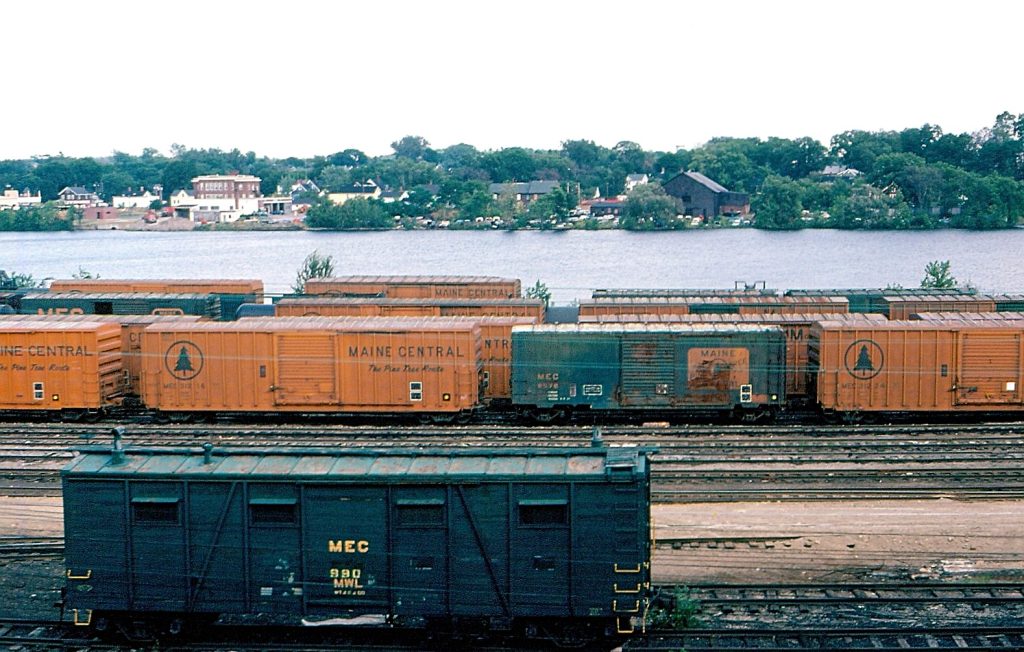
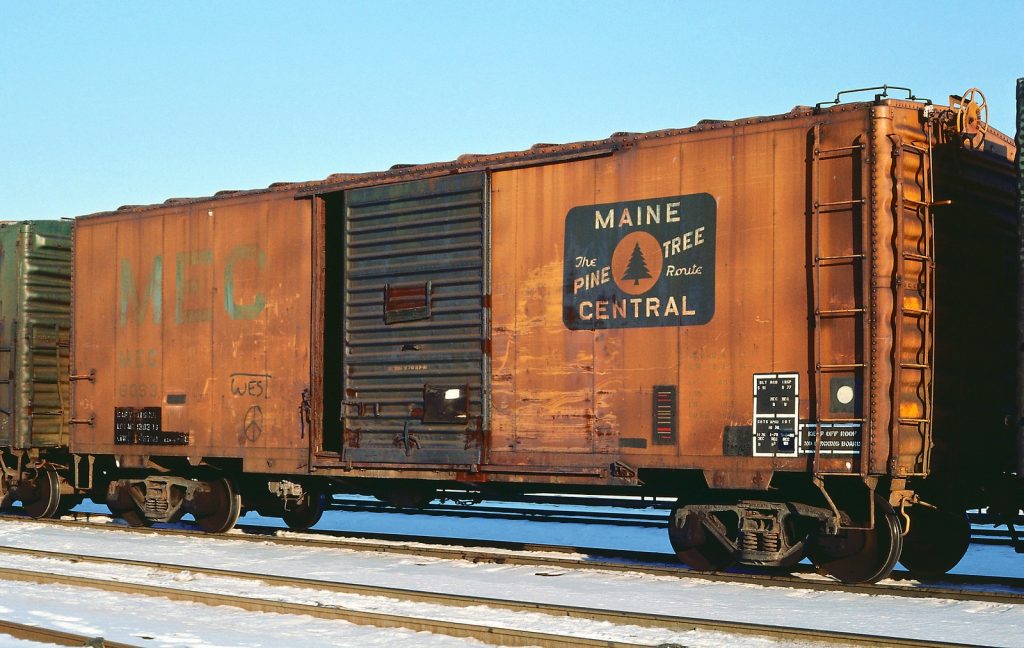
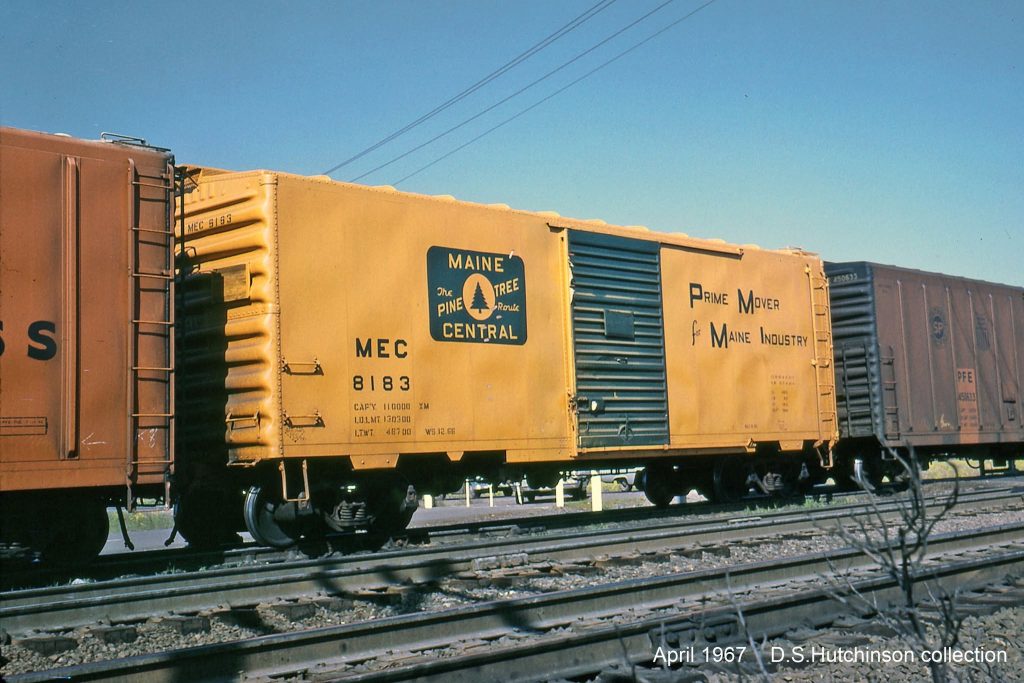
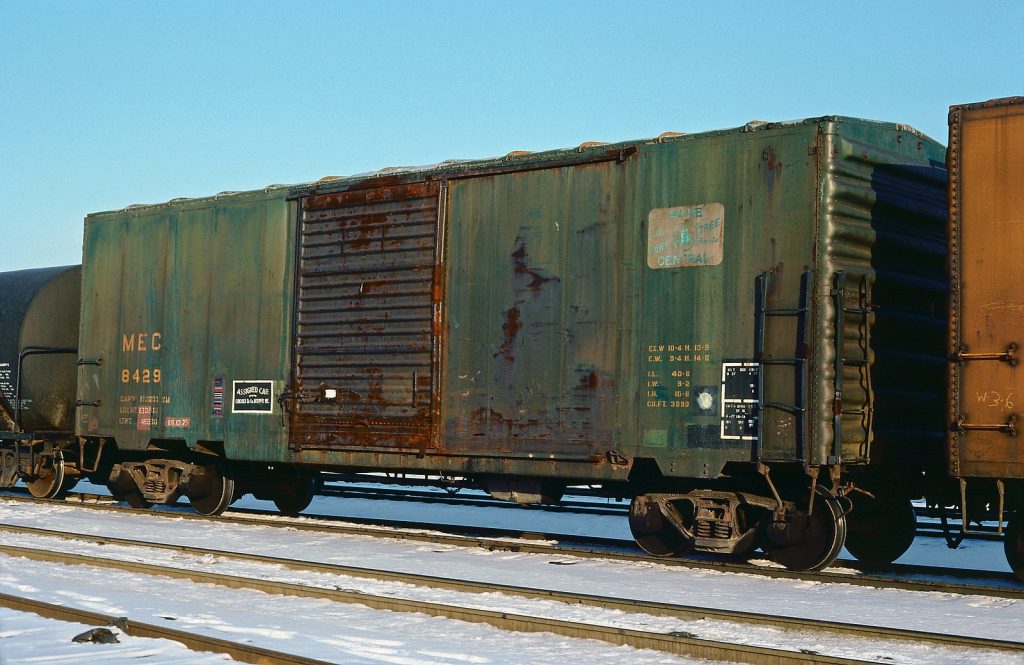
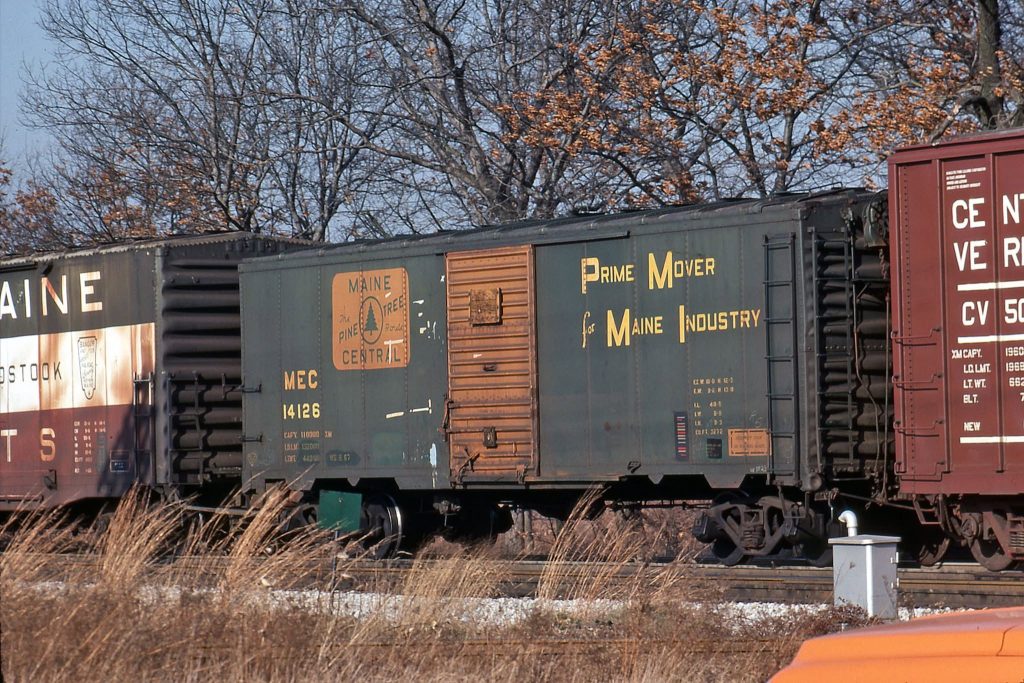
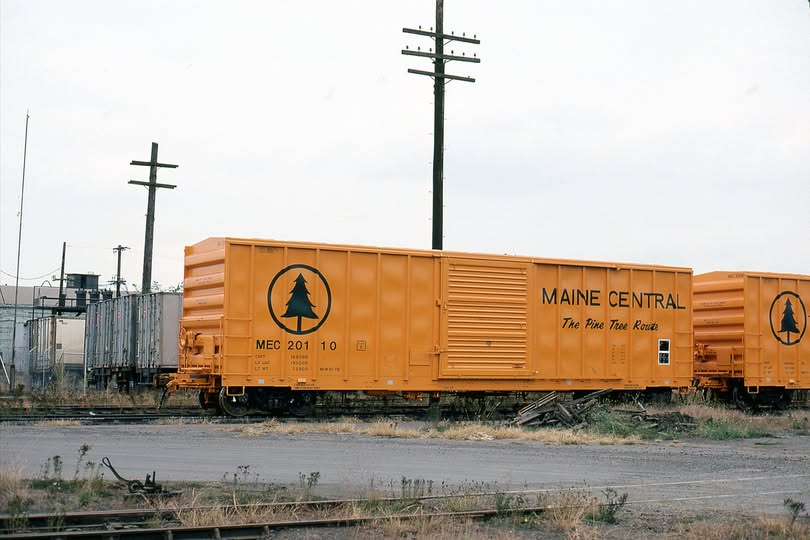
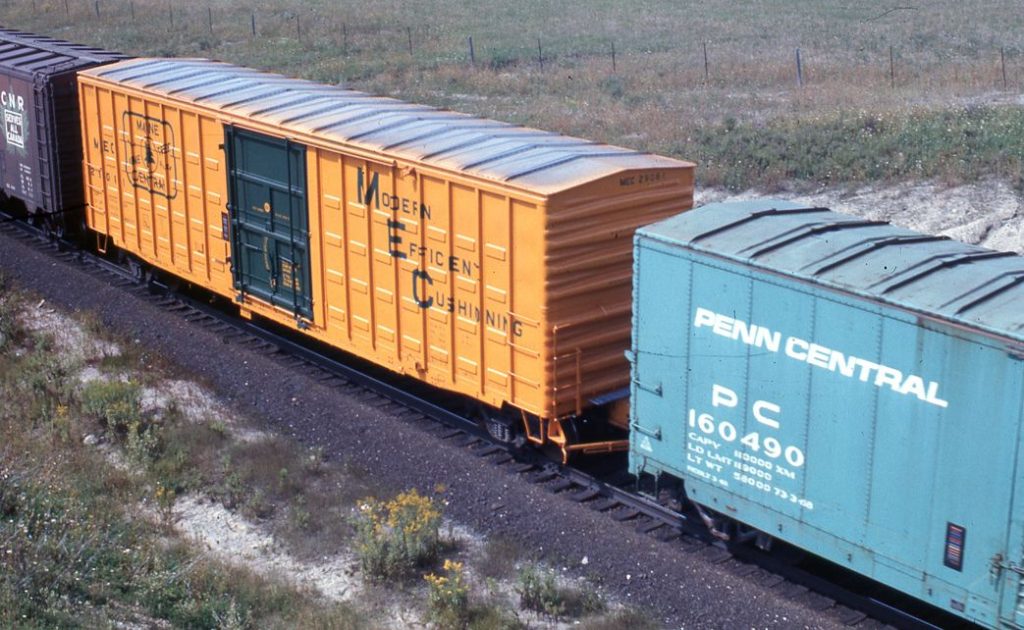
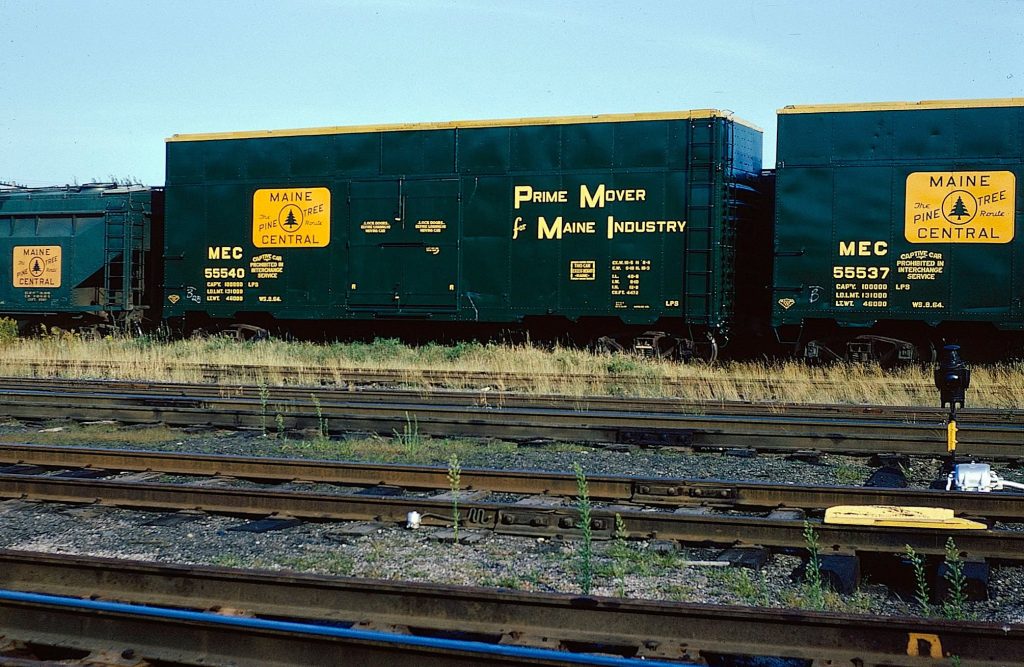
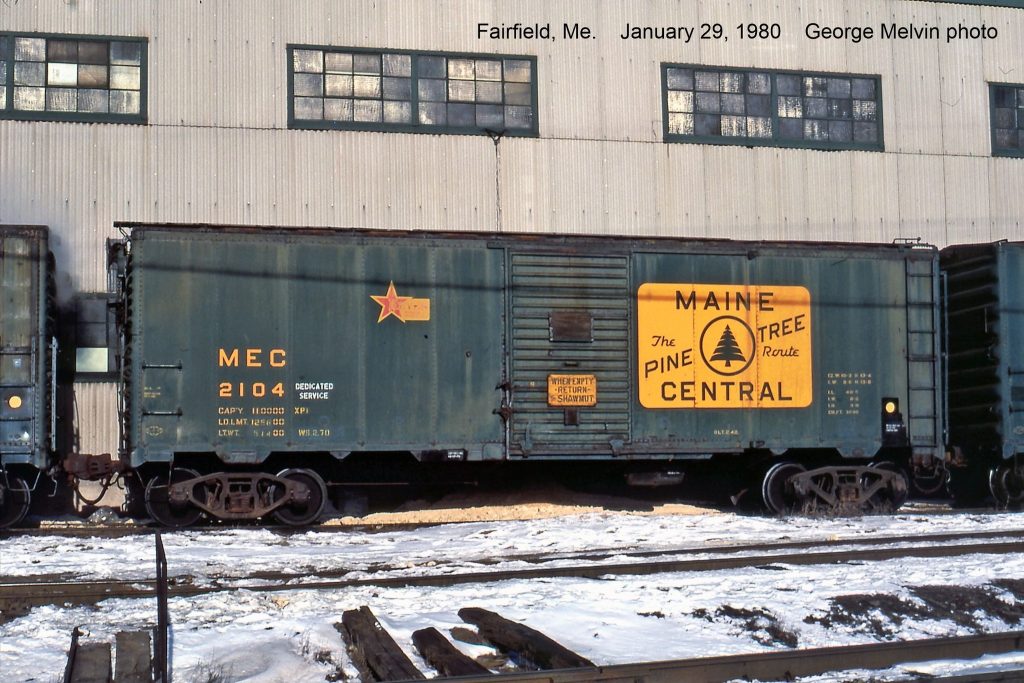
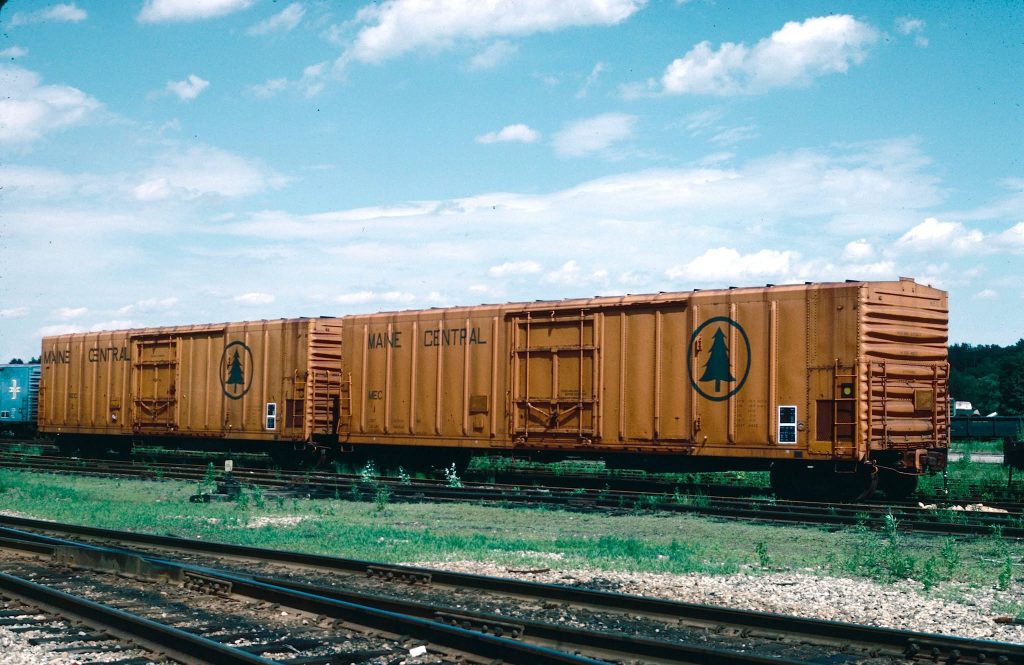
By the mid-1960s, MEC launched a repaint and upgrade program on its 40-foot fleet. The “Prime Mover of Maine Industry” slogan began appearing, though not on all cars, and paint practice wasn’t entirely uniform. Some cars wore the block MEC at one end with the rectangular herald at the other; the plan was for every fourth car to be painted in yellow, but in practice, there was considerable variation. Earlier greens (often called “pine green”) coexist with the later harvest yellow introduced on new cushioned 50-foot cars in 1964, then carried forward on the mid-to-late 1970s FMC and Berwick fleets.
A hallmark of the roster is conversion and reuse. Low-side gons became bulkhead pulpwood flats; older boxcars lost their roofs and gained higher sides for woodchips; PS-1s were insulated and sealed for woodpulp. MEC also leaned on Chicago Freight Car Leasing and other lessors to fill gaps, notably in the 8600–8999 series, and adopted cushioning (Keystone, Hydra-Cushion, Freight Saver) as paper traffic demanded gentler handling.

Boxcars
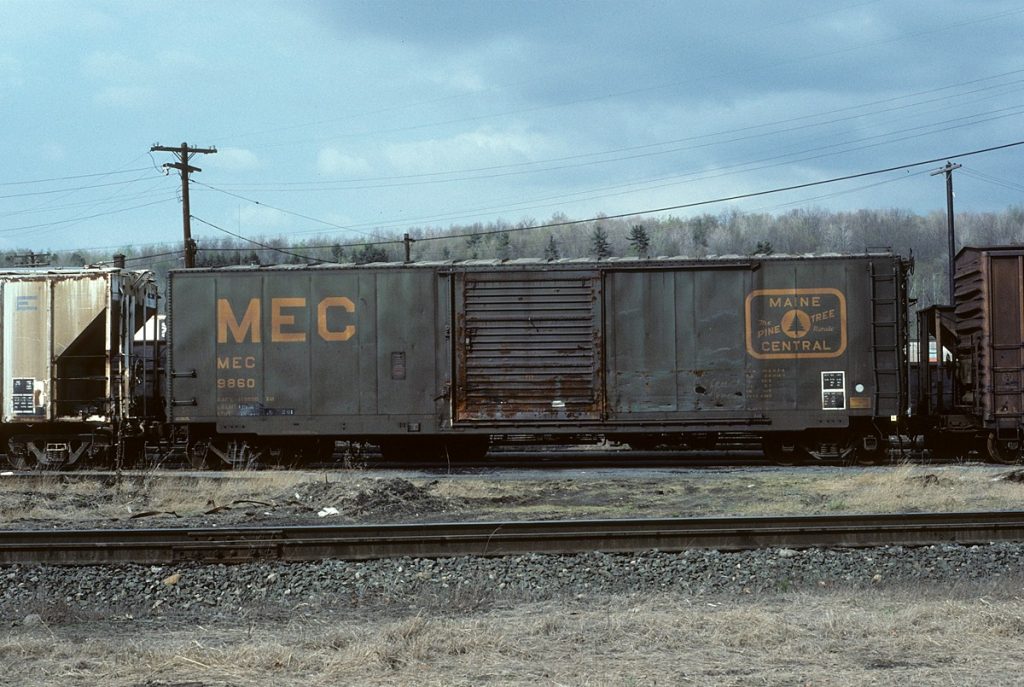
Boxcars formed the backbone of the MEC freight car fleet, handling everything from paper and newsprint to general merchandise. Over time, the roster reflected a mixture of Magor-built ARA cars from the 1930s and 40s, Pullman-Standard PS-1s, leased cars from Chicago Freight Car Leasing, and modern FMC and Berwick designs. Many were rebuilt or converted for specialised service, including pulpwood and insulated woodpulp cars.
While railroads elsewhere were rapidly retiring their 40 ft boxcars during the 1970s, Maine Central retained and rebuilt substantial numbers alongside its newer 50 ft fleet. One important reason was the paper industry: many of New England’s older paper mills had been built around 40 ft cars, with loading doors and other facilities spaced accordingly. The older cars therefore remained particularly useful for serving these customers even as longer boxcars became increasingly common elsewhere on the system.
https://canadianfreightcargallery.ca/cgi-bin/displayrailway.pl?o=mec#boxcar








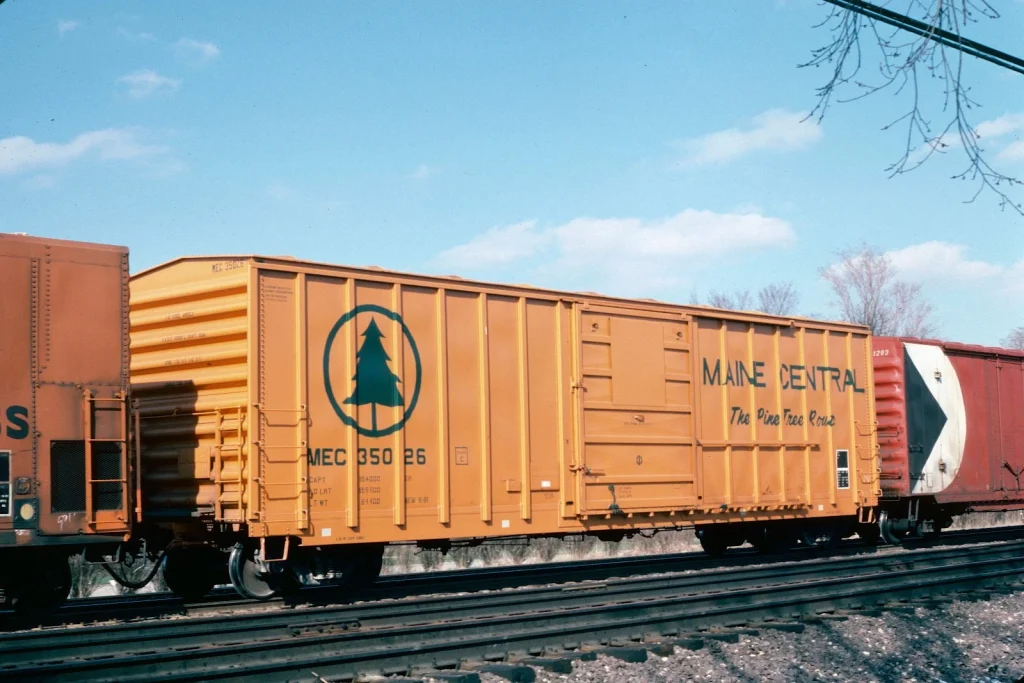
| Nos. | Type | Notes |
|---|---|---|
| MEC 27 | 40′ Boxcar | Built 1/1932. 40 ft 6 in inside length, 9 ft inside height. Wooden boxcar. Painted boxcar red with white lettering. Known from photographs in 1967. |
| MEC 100–149 | 50′ Boxcar | (50 cars) – Built February 1964 by Magor (Lot W-6001). AAR: XM (ECC). Inside length 50 ft 6 in, inside width 9 ft 4 in, inside height 10 ft 5 in. Outside length 57 ft 9 in, outside width 10 ft 8 in, outside height 15 ft 1 in. Door opening 9 ft wide by 9 ft 10 in high, plug type. Capacity 4,932 ft³, load limit 150,000 lb (70 tons). Fitted with Keystone 20 in end-of-car cushioning, the first cushioned cars on the MEC. Delivered in yellow with green doors, but without the “Modern Efficient Cushioning” slogan that later appeared. In service in 1976: 46 cars. Photos: RCP MEC 109, CFCG MEC 140. |
| MEC 4248–4249 | 40′ Boxcar | Built 7/1939 by Magor (Lot P9349). 40 ft 5 in inside length, 9 ft 4 in inside height. Equipped with 6 ft doors. Painted green with a yellow large herald. |
| MEC 4250-4499 | 40′ Boxcar | Built 8/1939 by Magor (Lot P9300). ARA 1932-design cars with 9 ft 4 in inside height and 6 ft Youngstown doors. |
| MEC 4500–4999 | 40′ Boxcar | Built 12/1936 by Magor (Lot P8750). 40 ft 3 in inside length, 9 ft 3 in inside height. Equipped with 6 ft doors. |
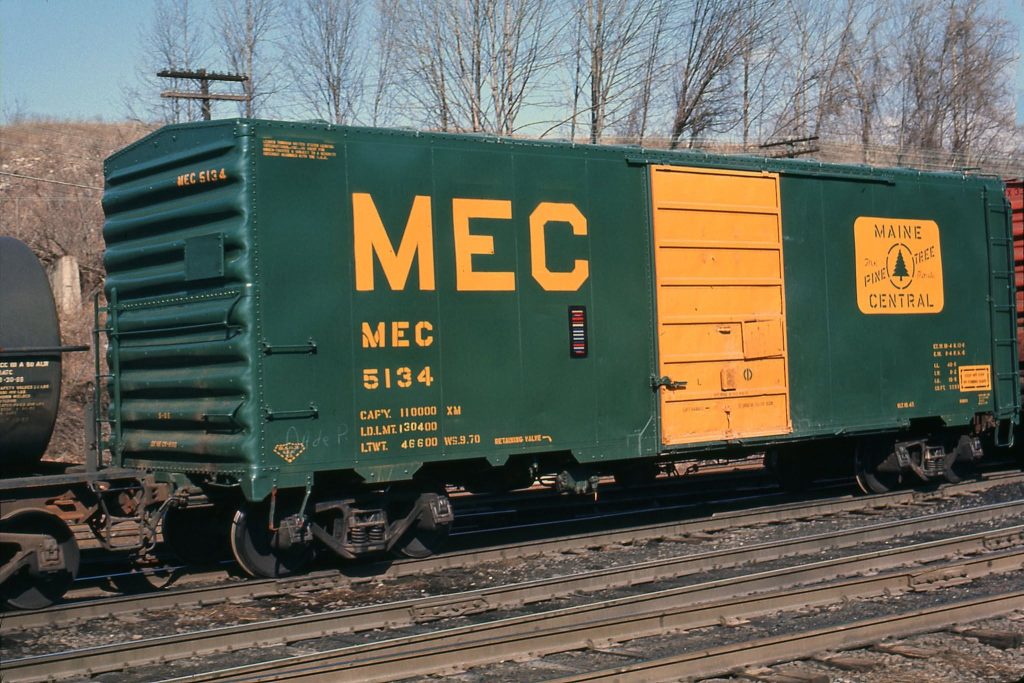
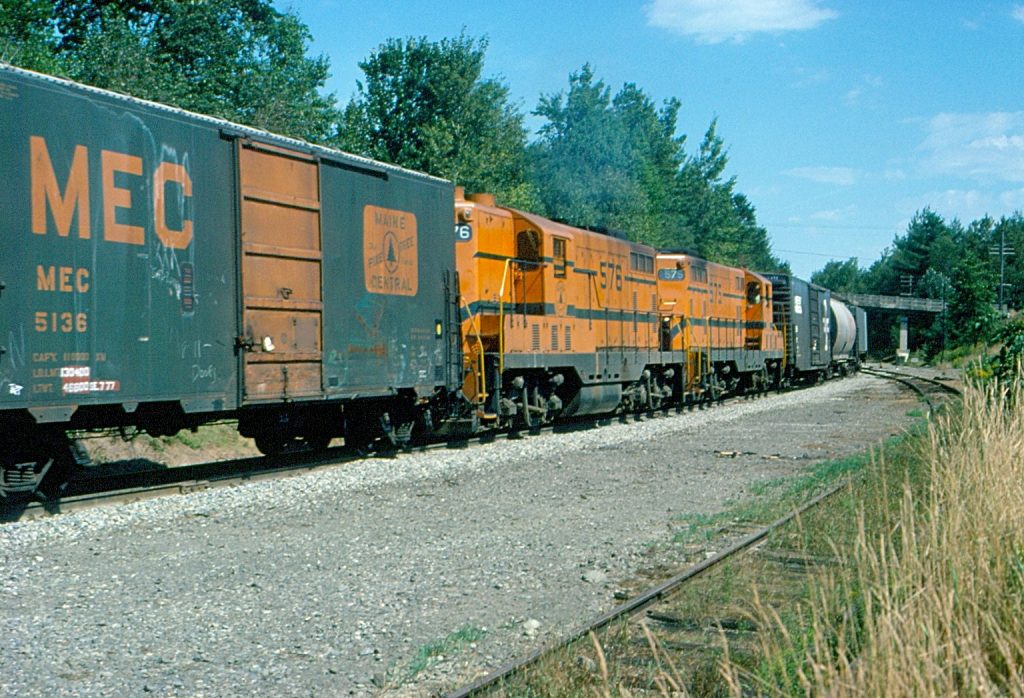
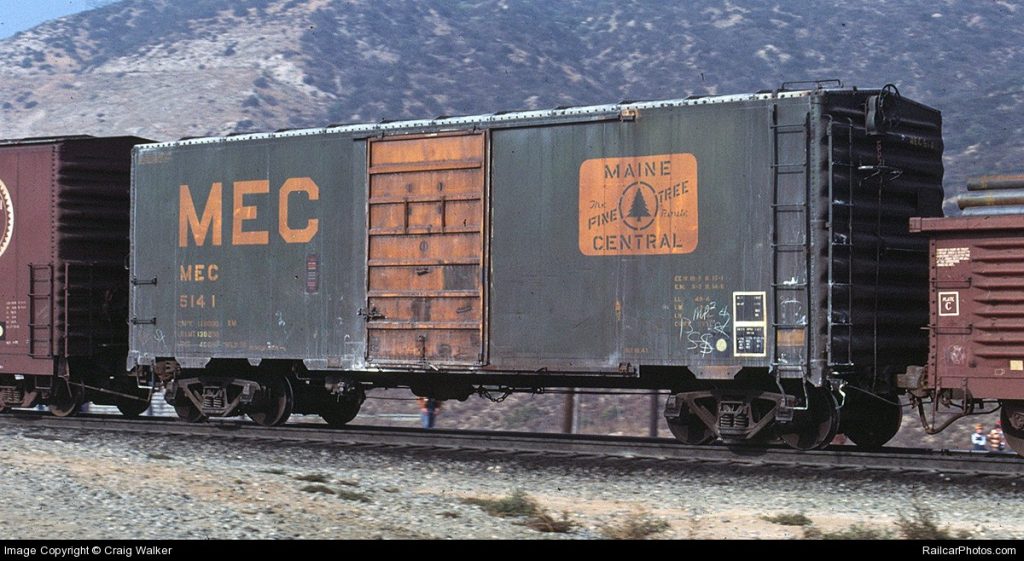
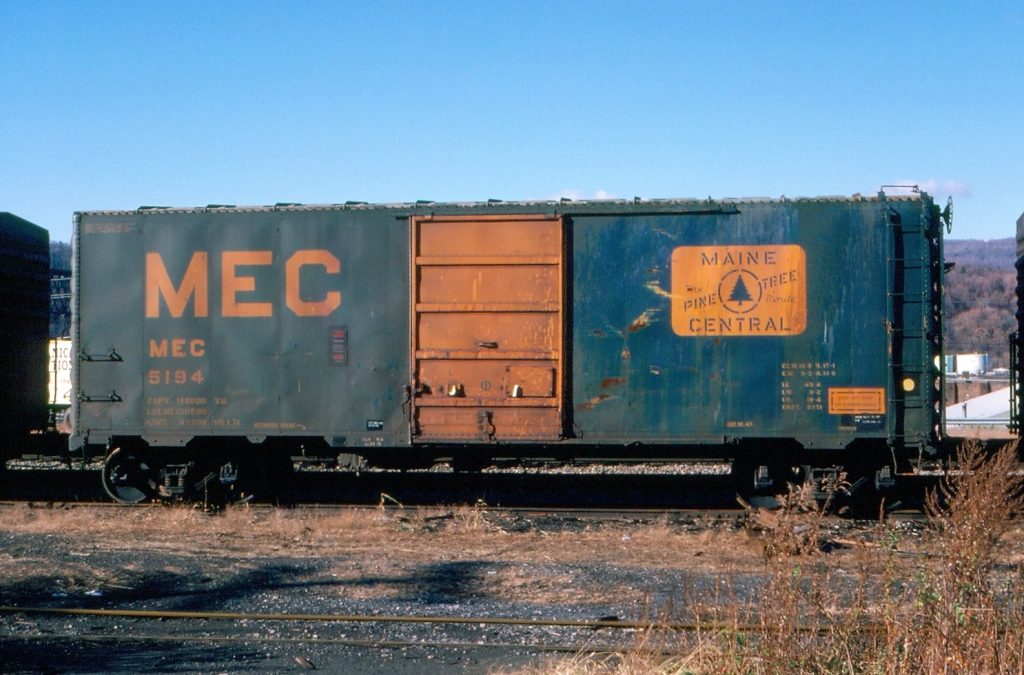
| MEC 5000–5199 | 40′ Boxcar | Built 1/1947. 40 ft 4 in inside length, 10 ft 5 in inside height. Equipped with 7 ft Superior doors. Green with yellow doors and lettering. Converted in 1969 from MEC 6500–6749 series; 200 cars sold and leased back. Models: Micro-Trains – 073 00 120 Photos: CFCG MEC 5005, RRPA MEC 5045, RRPA MEC 5087, RRPA MEC 5101, RCP MEC 5141, CFCG MEC 5170, RRPA MEC 5194. |
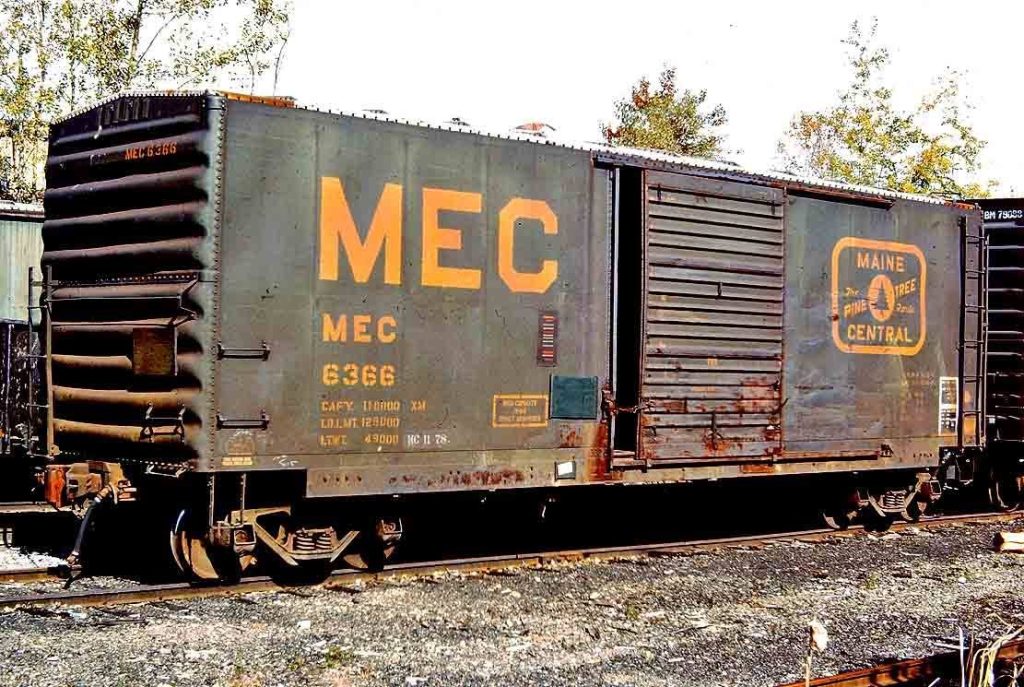
| MEC 6000–6249 | 40′ Boxcar | Converted in 1970 from MEC 8000–8249 PS-1 series. 40 ft 3 in inside length, 10 ft 6 in inside height. Equipped with 8 ft doors. Yellow with green doors and lettering. Cars acquired from Chicago Freight Car Leasing. Photos: CFCG MEC 6079, RCP MEC 6117 |
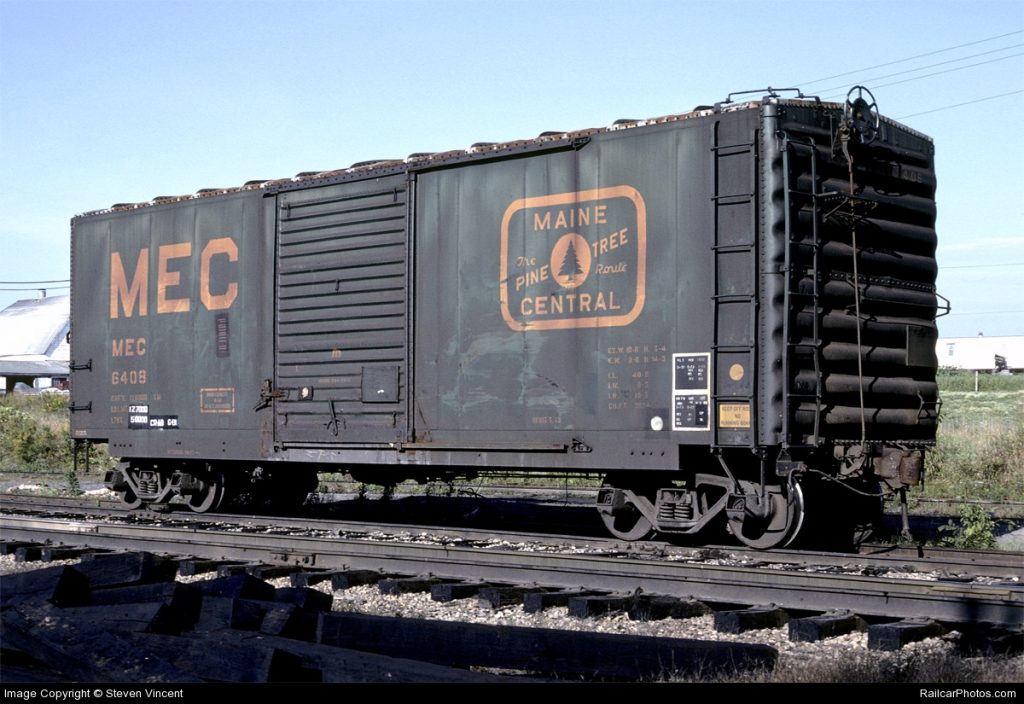
| MEC 6100–6499 | 40′ Boxcar | Built 2/1942 by Magor (Lot P9925). 40 ft 5 in inside length, 9 ft 11 in inside height. Equipped with 6 ft doors. AAR 1937-design cars. Many were converted later to pulpwood and insulated cars; none remained after 1970. Upgraded in 1956 with 50-ton trucks, creating the 16000–16284 series. In 1959–60, some were converted to insulated woodpulp cars (2100–2109, 2150–2175). In 1970, 300 cars were refurbished and leased back as MEC 25000–25299, with door openings increased from 6 ft to 8 ft. Photos: CFCG MEC 6116, CFCG MEC 6307, RCP MEC 6332, CFCG MEC 6356, CFCG MEC 6381, RCP MEC 6408 |
| MEC 6300–6349 | 40′ Boxcar | Built 1/1951. 40 ft 3 in inside length, 10 ft 6 in inside height. Equipped with 8 ft doors. Converted in 1971 from MEC 8000–8249 series. |
| MEC 6385-6434 | 40′ Boxcar | Built 5/1951 by Pullman-Standard, Lot 5999A. AAR type B102, mechanical designation XM. 40 ft 6 in inside length, 44 ft 4 in extreme length, 3934 cu ft capacity, 127000 lb load limit, 50000 lb light weight, and 177000 lb gross weight. Plate B. Equipped with 8 ft doors. Rebuilt in 5/1973 from MEC 8000–8249 series, becoming MEC 6385–6434 series. |
| MEC 6500–6749 | 40′ Boxcar (PS-1) | (250) Built 10/1947 by Pullman-Standard (Lot 5877). 40 ft 6 in inside length, 10 ft 6 in inside height. Equipped with 7 ft Superior doors. In 1961, nine cars were insulated for woodpulp service. In 1969, 200 cars were sold and leased back as MEC 5000–5199. Photo: RRPA MEC 6651. |
| MEC 8000–8249 | 40′ Boxcar (PS-1) | Built 5/1951 by Pullman-Standard (Lot 5999A). 40 ft 6 in inside length, 10 ft 5 in inside height. Equipped with 7 ft Youngstown doors. Models: Atlas 50 000 956 / 50 002 653* / 50 002 654* Photos: RRPA MEC 8093, CFCG MEC 8191, CFCG MEC 8193, RRPA MEC 8193. |
| MEC 8250–8254 | 40′ Boxcar | Ex-New Haven 31050 series. Built 1/1969 by Berwick. 40 ft 5 in inside length, 9 ft 11 in inside height. Equipped with 8 ft doors. |
| MEC 8400–8599 | 40′ Boxcar | Built 9/1957 by ACF (Lot 5032). 40 ft 6 in inside length, 10 ft 5 in inside height. Equipped with 8 ft doors. Painted green. Photo: CFCG MEC 8430. |
| MEC 8600–8677 | 40′ Boxcar | Built 1/1947. 40 ft 6 in inside length, 10 ft 5 in inside height. Equipped with 8 ft doors. Ex-Reading cars, leased from Chicago Freight Car Leasing in 1963. |
| MEC 8678–8729 | 40′ Boxcar | Built 1/1948. 40 ft 6 in inside length, 10 ft 5 in inside height. Equipped with 8 ft doors. Ex-ACF cars, leased from Chicago Freight Car Leasing in 1963. |
| MEC 8730–8774 | 40′ Boxcar | Built 1/1948. 40 ft 6 in inside length, 10 ft 5 in inside height. Equipped with 8 ft doors. Ex-ACF cars, leased from Chicago Freight Car Leasing in 1963. Ex Reading car leased by Maine Central and painted by the RDG before delivery to MEC. |
| MEC 8775–8779 | 40′ Boxcar | Built 1/1946. 40 ft 6 in inside length, 10 ft 5 in inside height. Equipped with 8 ft doors. Ex-Reading cars, leased in 1963. |
| MEC 8800–8924 | 40′ Boxcar | Built 1/1966, rebuilt. 40 ft 5 in inside length, 10 ft 6 in inside height. Equipped with 8 ft doors. Acquired through Chicago Freight Car Leasing in 1967. Originally EJ&E 60400–60899. Photo: CFCG MEC 8922. |
| MEC 8925–8999 | 40′ Boxcar | Built 1/1967, rebuilt. 40 ft 6 in inside length, 10 ft 5 in inside height. Equipped with 8 ft doors. Acquired through Chicago Freight Car Leasing in 1967. |
| MEC 9000–9049 | 50′ Boxcar | Built 1939 by Magor to the AAR 1932 design. 50 ft 5 in inside length, 10 ft inside height. Equipped with two 6 ft doors. Painted green with yellow lettering. In 1968, eighteen were converted to open-top rack cars for woodchip service by removing roofs and extending sides by 2 ft 10 in. Another conversion was made in 1967 as car 9000. |
| MEC 9050–9099 | 50′ Boxcar | Built 1941. 50 ft 6 in inside length, 10 ft 1 in inside height. Equipped with two 7 ft doors. Leased from Chicago Freight Car Leasing in 1962. |
| MEC 9100–9349 | 50′ Boxcar | Built 3/1956 by American Car & Foundry. 50 ft 6 in inside length, 10 ft 5 in inside height. Equipped with 9 ft Youngstown sliding doors. Plain XM classification, no loaders or cushioning. Delivered in March 1956 with 8+8 riveted side panels. Models: Atlas |
| MEC 9350–9549 | 50′ Boxcar (PS-1) | Built 6/1961 by Pullman-Standard (Lot 8615). 50 ft 6 in inside length, 10 ft 5 in inside height. Equipped with 9 ft doors. Delivered in green with aluminium doors, though these were later replaced with steel due to fragility. Favoured for tissue loading because of their relatively low 50-ton capacity. Photo: CFCG MEC 9358. |
| MEC 9600–9749 | 50′ Boxcar | Built 1/1964 by Magor (Lot W-6000). 50 ft 6 in inside length, 10 ft 5 in inside height. Equipped with 9 ft doors and cushioned underframes. Delivered in yellow with green doors, the first MEC boxcars to wear the yellow scheme. |
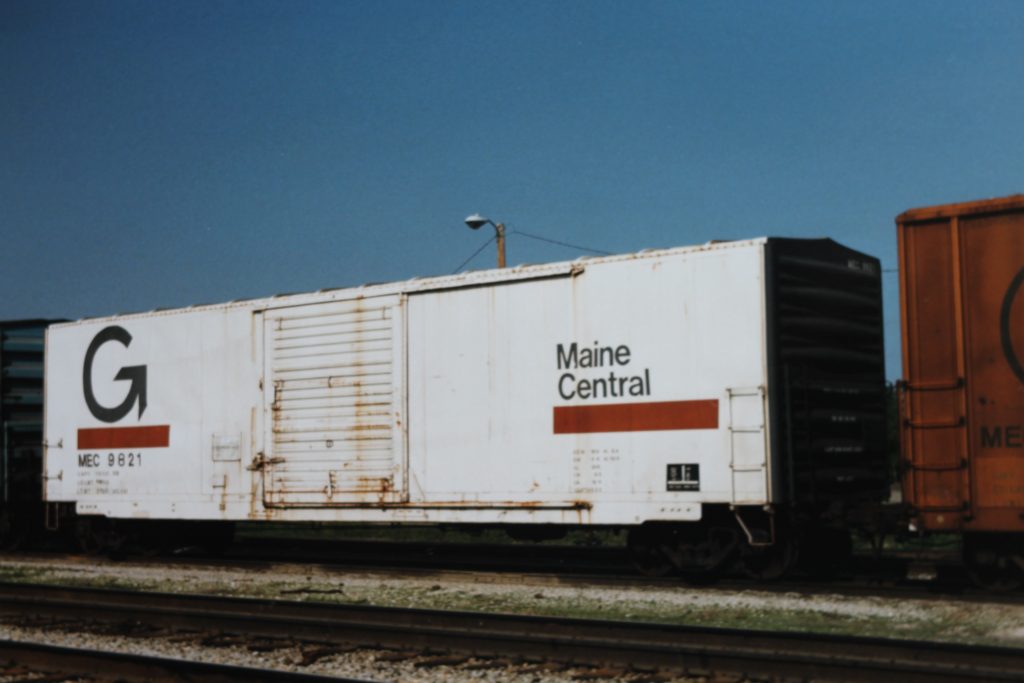
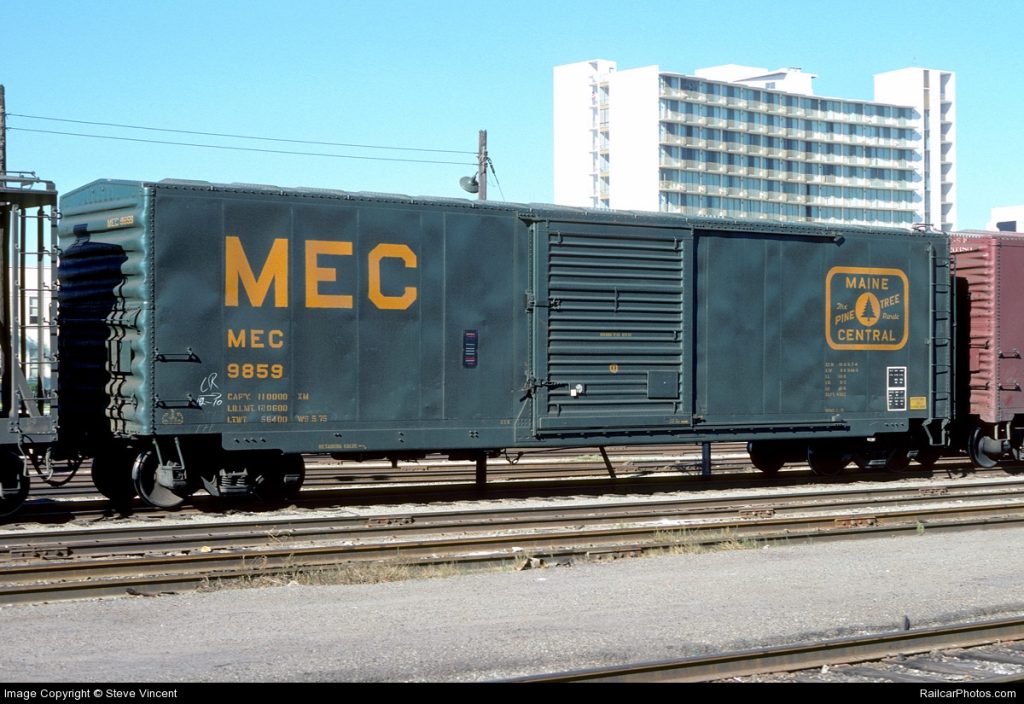
| MEC 9800–9899 | 50′ Boxcar (Rebuilt) | Rebuilt 1974–75 from MEC 8000–8249 series PS-1s. Stretched from 40 ft cars to 50 ft 6 in inside length, 10 ft 5 in inside height. Rebuilding carried out between August 1974 and November 1975. Photos: CFCG MEC 9853, RCP MEC 9859, CFCG MEC 9867, RCP MEC 9878, CFCG MEC 9896. |
| MEC 9965–9999 | 50′ Boxcar | Built 1941. 50 ft 6 in inside length, 10 ft 5 in inside height. Equipped with two 7 ft doors. Leased from Chicago Freight Car Leasing in 1962. Photo: CFCG MEC 9969. |
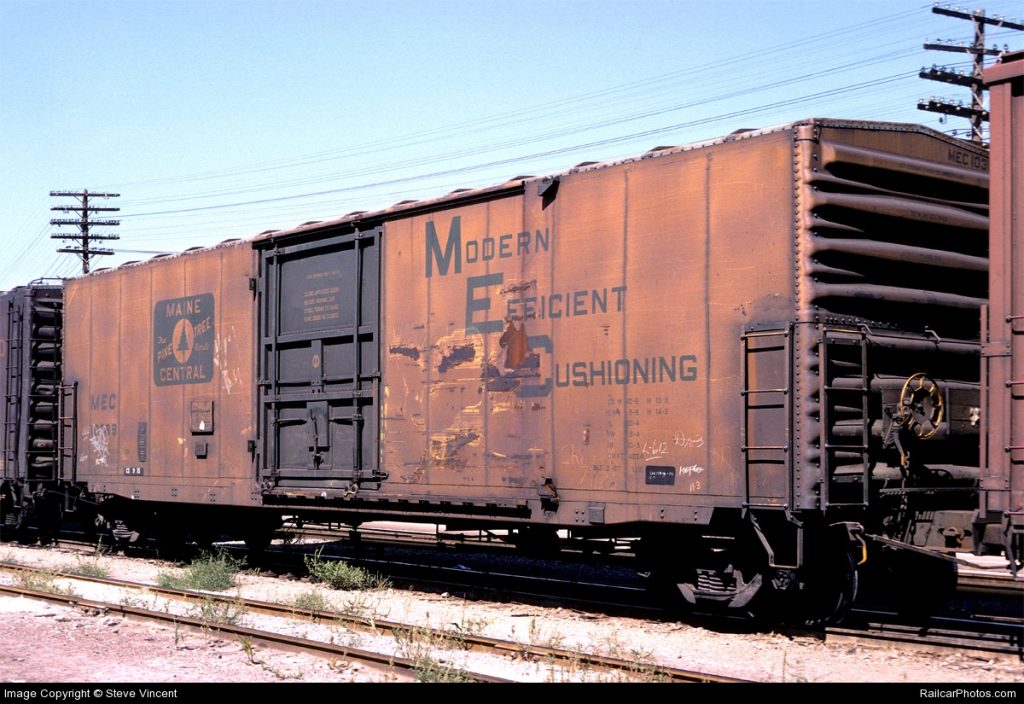
| MEC 10000–10199 | 50′ Boxcar | Built 3/1965 by General American Transportation Corp. (GATC). 50 ft 4 in inside length, 10 ft 5 in inside height. Equipped with 9 ft doors and Hydra-cushioned underframes. Delivered in yellow with green doors and “Modern Efficient Cushioning” slogan. Early cars had roofwalks; later builds had low brake wheels and no roofwalks. Photos: CFCG MEC 10050, CFCG MEC 10114, RCP MEC 10115. |
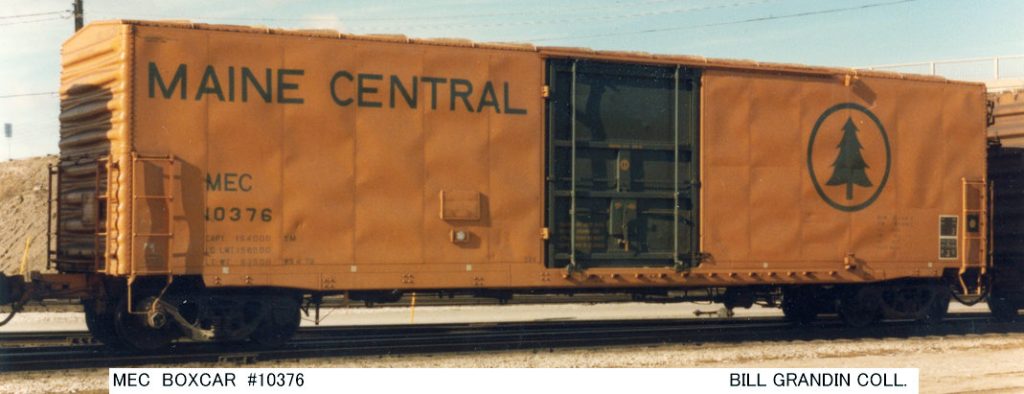
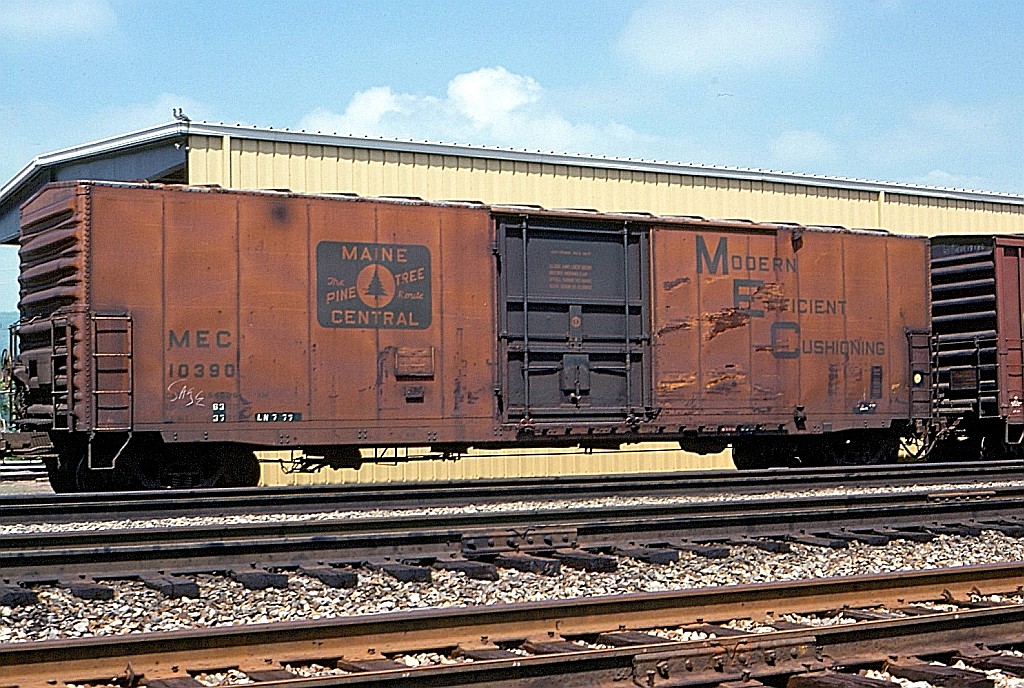
| MEC 10200–10399 | 50′ Boxcar | (200) Built 1–2/1967 by American Car & Foundry (Lot 11-06136). 50 ft 4 in inside length, 10 ft 5 in inside height. Equipped with 9 ft plug doors and Freight Saver cushioned underframes. Delivered in yellow with green plug doors. Used heavily in newsprint service. Photos: CFCG MEC 10227, CFCG MEC 10246, CFCG MEC 10295, CFCG MEC 10315, CFCG MEC 10376, RCP MEC 10389. |
| MEC 14000–14247 | 40′ Boxcar | Built 1/1937 by Magor. 40 ft 5 in inside length, 9 ft 4 in inside height. Equipped with 6 ft doors, riding on 50-ton trucks. Many were later rebuilt into other car types. |
| MEC 14248-14249 | 40′ Boxcar | Reclassified ex-MEC 4248–4249 circa 1958. |
| MEC 14250-14499 | 40′ Boxcar | Reclassified ex-MEC 4250–4499 circa 1958 |
| MEC 14500–14999 | 40′ Boxcar | Built 1/1939 by Magor. 40 ft 5 in inside length, 9 ft 4 in inside height. Equipped with 6 ft doors, riding on 50-ton trucks. Painted green with yellow large herald. Reclassified from MEC 4500–4999 circa 1958. |
| MEC 16000–16284 | 40′ Boxcar | Built 2/1942 by Magor (Lot P9925). 40 ft 3 in inside length, 9 ft 11 in inside height. Equipped with 6 ft doors. Converted from MEC 6100–6499 series beginning in 1956 after truck upgrades. Some later rebuilt to insulated woodpulp cars. |
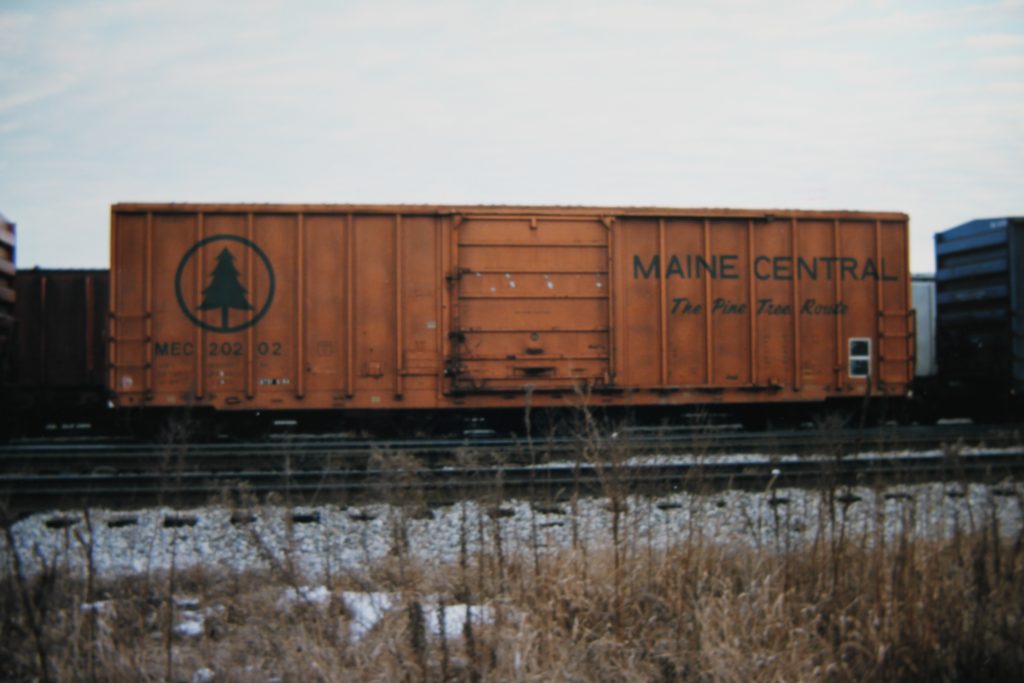
| MEC 20000–20149 | 50′ Boxcar | (150) Built 9–10/1979 by FMC (Lot 17968). 50 ft 6 in inside length, 10 ft 6 in inside height. Modern cars painted in yellow. Photos: CFCG MEC 20001, RCP MEC 20002, RCP MEC 20002, RCP MEC 20003, RCP MEC 20005, RCP MEC 20007, RCP MEC 20011, RCP MEC 20018, CFCG MEC 20021, RCP MEC 20028, RCP MEC 20030, CFCG MEC 20032, RCP MEC 20033, RCP MEC 20035, RCP MEC 20035, RCP MEC 20038, CFCG MEC 20042, RCP MEC 20042, CFCG MEC 20044, CFCG MEC 20049, RCP MEC 20049, CFCG MEC 20052, RCP MEC 20053, RCP MEC 20054, RCP MEC 20056, RCP MEC 20058, RCP MEC 20067, RCP MEC 20073, RCP MEC 20079, RCP MEC 20081, RCP MEC 20088, RCP MEC 20089, RCP MEC 20099, RCP MEC 20102, RCP MEC 20108, RCP MEC 20112, RCP MEC 20112, RCP MEC 20123, RCP MEC 20130, RCP MEC 20131, RCP MEC 20135, RCP MEC 20137, RCP MEC 20138, RCP MEC 20141, RCP MEC 20144, RCP MEC 20144, RCP MEC 20144. |
| MEC 20150–20349 | 50′ Boxcar | Built 10/1980 by FMC (Lot 18170). 50 ft 6 in inside length, 10 ft 6 in inside height. Modern cars painted in yellow. Photos: RCP MEC 20182, RCP MEC 20197, CFCG MEC 20242. |
| MEC 24000–24104 | 40′ Boxcar | Rebuilt beginning in 1964 from MEC 14000 and 14500 series. 40 ft 5 in inside length, 9 ft 3 in inside height. Door openings enlarged to 8 ft. Painted green with yellow medium herald. Photo: CFCG MEC 24031. |
| MEC 25000–25299 | 40′ Boxcar | Ex-6100 series, rebuilt and leased back in 1970. 40’5″ IL, 9’11” IH. 8′ door. Green with yellow doors and lettering. Rebuilt in 1970 from MEC 6100 series. 40 ft 5 in inside length, 9 ft 11 in inside height. Door openings increased from 6 ft to 8 ft. Painted green with yellow doors and lettering. Photos: RRPA MEC 25094, RRPA MEC 25170, RRPA MEC 25199, RRPA MEC 25240, RCP MEC 25285. |
| MEC 27000–27038 | 50′ Boxcar | (39) Built 1/1954. 50 ft 6 in inside length, 10 ft 6 in inside height. Equipped with 8 ft doors. Painted yellow with green lettering. Leased from GAEX in 1967. DF-9 belt rails. |
| MEC 27100–27119 | 50′ Boxcar | (20) Built 1/1970 by American Car & Foundry. 50 ft 6 in inside length, 10 ft 11 in inside height. Equipped with 9 ft plug doors, waffle sides, and DF loaders. Painted yellow with green lettering. |
| MEC 28000–28004 | 50′ Boxcar | (5) Built 1967 by Pacific Car & Foundry. 50 ft 7 in inside length, 10 ft 10 in inside height. Equipped with two 8 ft plug doors. Hydra-cushion underframes. Delivered in yellow with one green and one yellow door. |
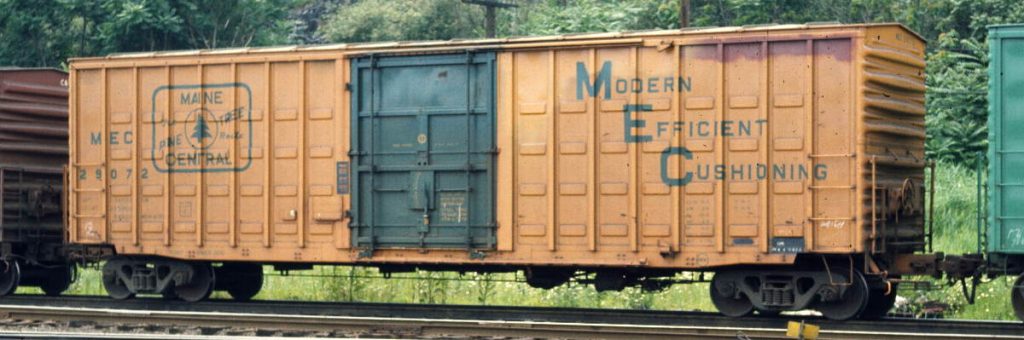
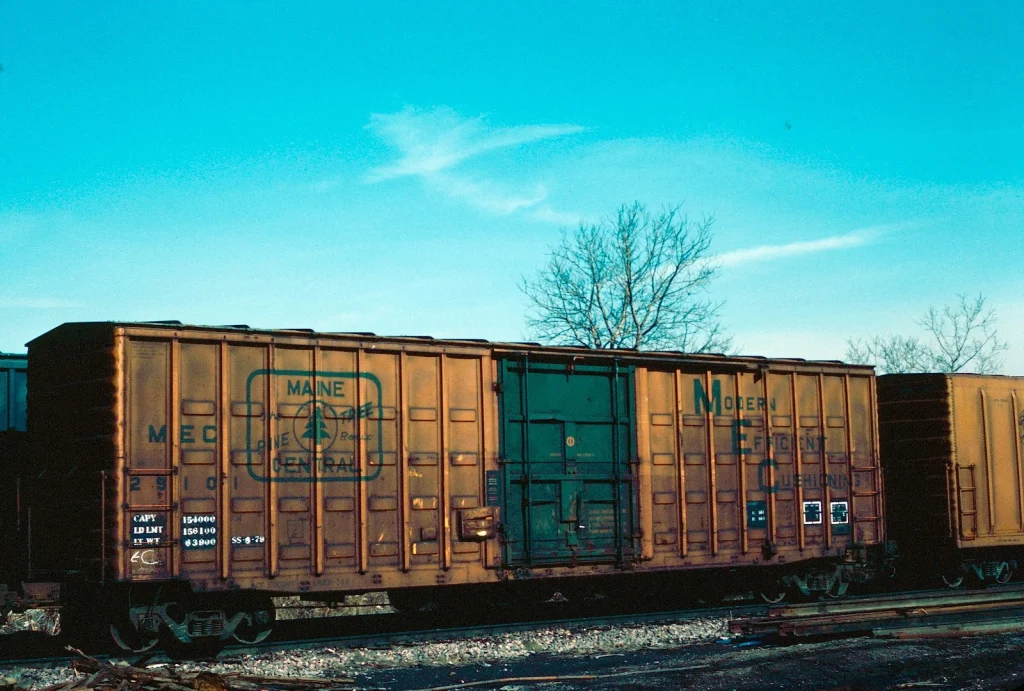
| MEC 29000–29229 | 50′ Boxcar | (250) ACF Lot 11-06174, built 1/70. 50’6″ IL, 10’11” IH. 9′ plug door, waffle side. Yellow Built 8–9/1970 by American Car & Foundry (Lot 11-06174). 50 ft 6 in inside length, 10 ft 11 in inside height. Equipped with 9 ft plug doors and waffle sides. Delivered in yellow with green lettering. (29230-29249 renumbered into 27000-27019?) Photos: RCP MEC 29033, RCP MEC 29058, CFCG MEC 29061, RCP MEC 29072, CFCG MEC 29068, CFCG MEC 29103, RCP MEC 29116, CFCG MEC 29119, RCP MEC 29129, CFCG MEC 29141, RCP MEC 29168, CFCG MEC 29160, CFCG MEC 29211, CFCG MEC 29219, RCP MEC 29229. |
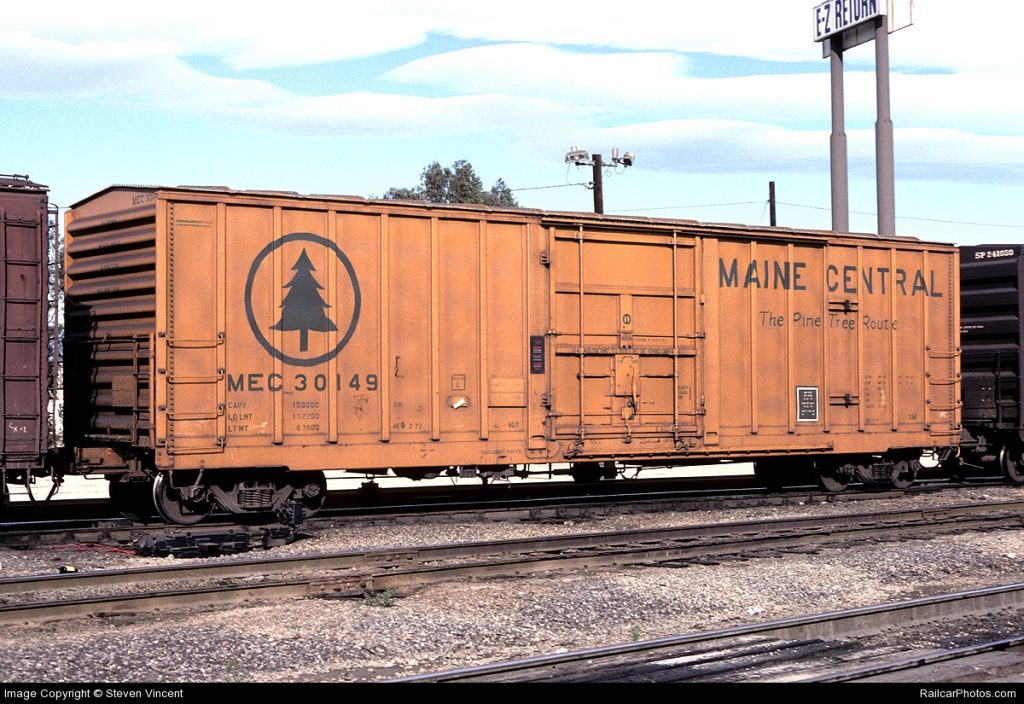
| MEC 30000–30249 | 50′ Boxcar | (250) Built 1–3/1973 by Berwick Forge & Fabricating (Lot 17600). Modern cars. Photo: RCP MEC 30149. |
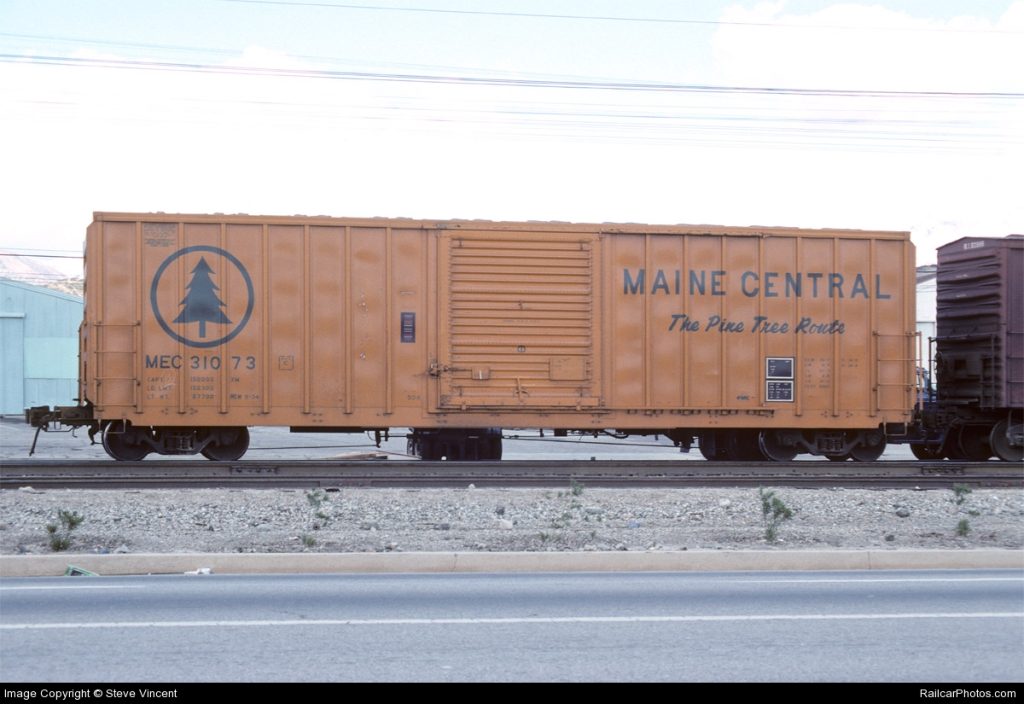
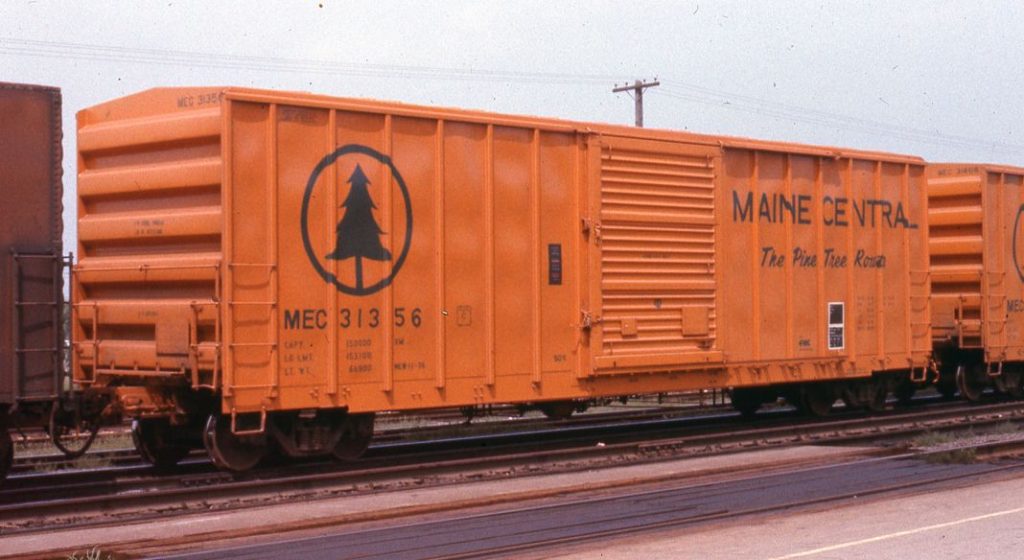
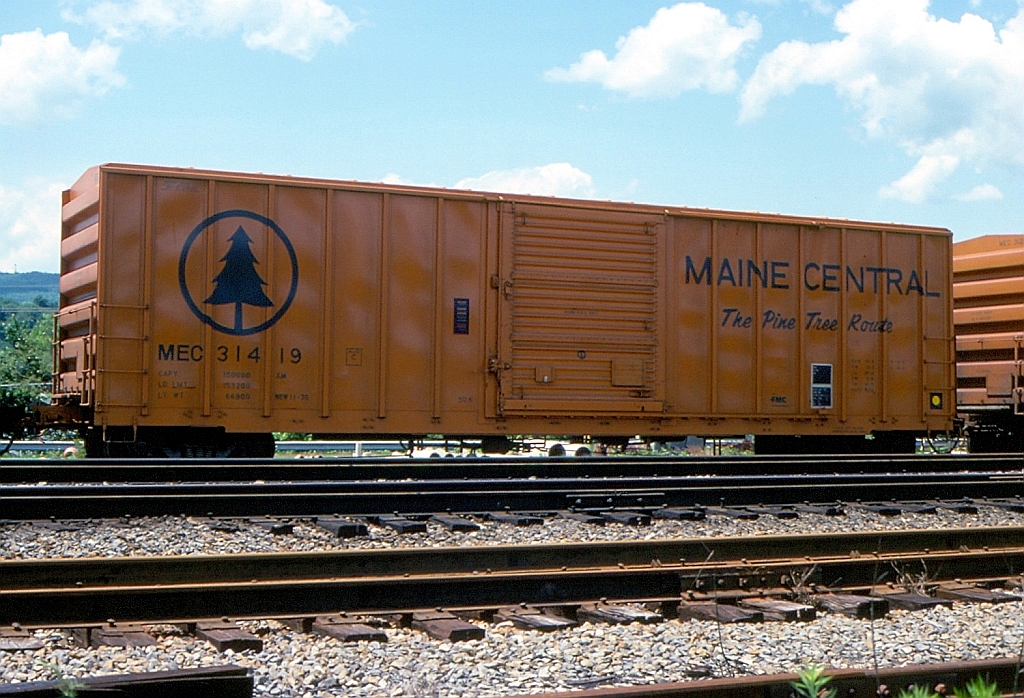
| MEC 31000–31249 | 50′ Boxcar | (250) Built 9/1974 by FMC (Lot 17611). Photos: RCP MEC 31073, CFCG 31095. |
| MEC 31250–31749 | 50′ Boxcar | (500) Built 10–12/1976 by FMC (Lot 17660). Photos: RCP MEC 31093. Models: Athearn |
| MEC 31750–31899 | 50′ Boxcar | (150) Built 11/1978 by FMC (Lot 17977). Photos: RCP MEC 31752, RCP MEC 31752, RCP MEC 31755, RCP MEC 31759, RCP MEC 31760, RCP MEC 31765, RCP MEC 31769, RCP MEC 31774, RCP MEC 31775, RCP MEC 31777, RCP MEC 31783, RCP MEC 31788, RCP MEC 31792, RCP MEC 31794, RCP MEC 31795, RCP MEC 31797, RCP MEC 31799, RCP MEC 31803, RCP MEC 31804, RCP MEC 31809, RCP MEC 31811, RCP MEC 31818, RCP MEC 31829, RCP MEC 31831, RCP MEC 31838, RCP MEC 31840, RCP MEC 31841, RCP MEC 31850… Models: |
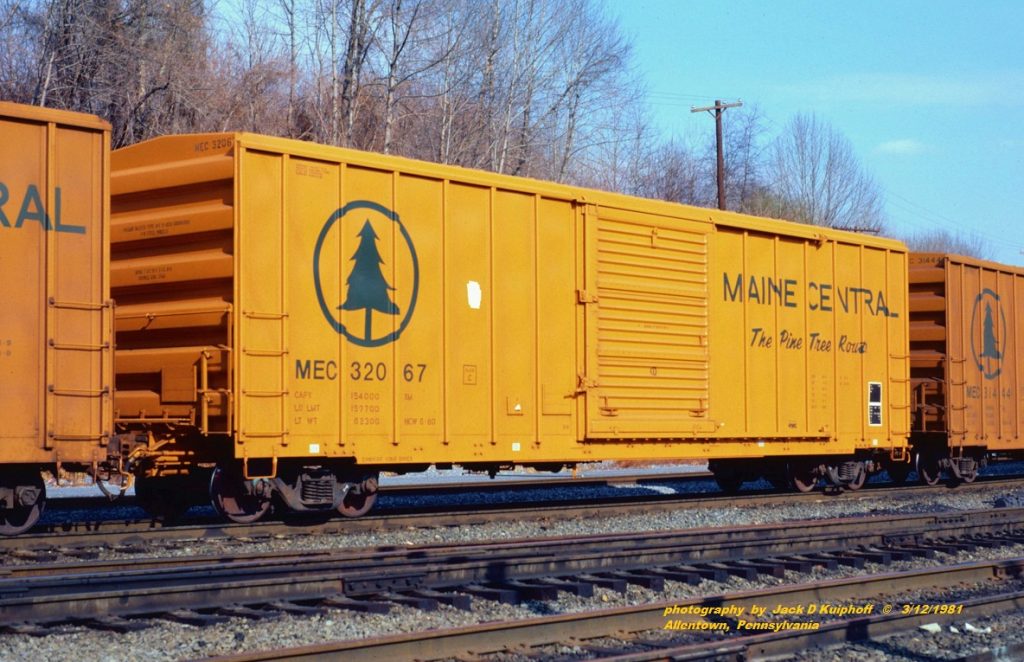
| MEC 31900-32149 | 50′ Boxcar | (250) Built 5–6/1980 by FMC (Lot 18175). These 50′-6″, 75 ton, box cars featured 10″ EOC Freightmaster cushioning, lading band anchors, 10′ sliding doors and 5347 ft3 capacity. Models: Athearn |
| MEC 35000–35199 | 50′ Boxcar | (200) Built 6–7/1981 by Berwick Forge & Fabricating (Lot 46800). These 50′-6″, 75 ton featured 10′ Superior sliding doors and 5277 ft3 capacity. |
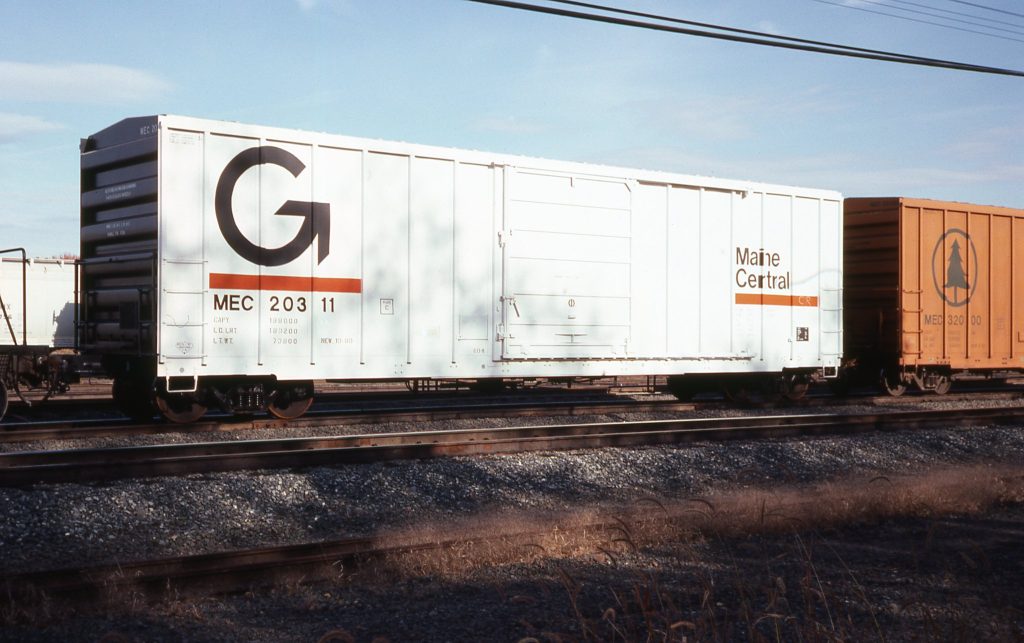
Gondolas
Gondolas on the Maine Central were a mixed group ranging from 1930s Bethlehem drop-bottom cars to modern 1970s Evans-built 50-footers. Many were later rebuilt for ore, pulpwood, or limerock service, making them one of the most versatile fleets on the roster.

| Nos. | Type | Notes |
|---|---|---|
| MEC 1100–1174 | Gondola | Built October–November 1975 by Evans–SEICO (Order 1263A). 50 ft inside length. Modern general-service gondolas originally purchased for copper ore traffic from the Callahan Mine on the Calais Branch. Following the mine’s rapid closure, the cars were reassigned to general freight service across the Maine Central system. Photos: RCP MEC 1103, RCP MEC 1107, RCP MEC 1118, RCP MEC 1122, RCP MEC 1125, RCP MECC 1136, RCP MECC 1137, RCP MECC 1138, RCP MECC 1143, RCP MECC 1148, RCP MECC 1161, RCP MECC 1164, RCP MECC 1166. Models: MEC 1104 Atlas 50 004 696 ★, MEC 1123 Atlas 45533 ★. |
| MEC 3153–3167 | Gondola | Built 1/1937 by Bethlehem. 41 ft 6 in inside length, 6 ft inside height. Drop-bottom gondolas with wood side extensions. |
| MEC 3200–3299 | Gondola | Built 1/1937 by Bethlehem. 41 ft 6 in inside length, 4 ft 8 in inside height. Drop-bottom gondolas. |
| MEC 3300–3449 | Gondola | Built 1/1939 by Bethlehem. 41 ft 6 in inside length, 4 ft 8 in inside height. Drop-bottom gondolas, later used as source stock for ore car conversions. |
| MEC 12000–12042 | Gondola | Built 1/1943 by Bethlehem. 52 ft 6 in inside length, 3 ft 8 in inside height. Open fishbelly gondolas painted black with white lettering. Ex–Norfolk & Western, leased 1969. |
| MEC 13000–13039 | Gondola | Built 1/1937 by Bethlehem. 41 ft 6 in inside length, 4 ft 8 in inside height. Solid-bottom gondolas. |
| MEC 13050–13069 | Gondola (Ore) | Converted 1968 from MEC 3200–3449 series. Originally built 1/1937, 41 ft 5 in inside length, 4 ft 7 in inside height. Solid-bottom gondolas fitted with roofs for ore service. |
| MEC 13070–13099 | Gondola (Ore) | Converted 1968 from MEC 3200–3449 series. Originally built 1/1937, 41 ft 6 in inside length, 4 ft 8 in inside height. Solid-bottom gondolas fitted with roofs for ore service. |
| MEC 17000–17149 | Gondola | Built 1/1939 by Bethlehem. 41 ft 6 in inside length, 3 ft 4 in inside height. Low-sided gondolas for general and limerock service. Painted black with white lettering. Many later rebuilt as pulpwood cars (see MEC 1700–1774, 1900–1914). |
| MEC 17009, 17045, 17096, 17101, 17146–17147 | Gondola (Limerock) | Built 1/1939 by Bethlehem. 41 ft 6 in inside length, 3 ft 4 in inside height. Limerock gondola with 8 ft door. Painted black with white lettering. |
| MEC 17024 | Gondola (Limerock) | Built 1/1939 by Bethlehem. 41 ft 6 in inside length, 3 ft 4 in inside height. Limerock gondola with 7 ft door. Painted black with white lettering. |
Hoppers
Open hoppers on the Maine Central roster were mainly twin and triple offset-end designs built by Bethlehem in the 1930s and 1940s. Some served their entire lives in coal and ore traffic, while others were rebuilt into covered hoppers for grain or cement service.


| Nos. | Type | Notes |
|---|---|---|
| MEC 1800–1826 | Open Hopper (Triple) | Built 1/1932 by Bethlehem. 36 ft 9 in inside length, 8 ft 3 in inside height. Offset-end triple hoppers. |
| MEC 1803, 1813, 1827–1829 | Open Hopper (Triple, donor) | Converted 1963 into covered hoppers for grain service (MEC 2600–2604 series). Originally built 1/1932, offset-end triple hoppers. |
| MEC 3700–3848 | Open Hopper (Twin) | Built 1/1936 by Bethlehem. 33 ft inside length, 7 ft 5 in inside height. Offset twin hoppers painted black with a small yellow herald. |
| MEC 3850–3949 | Open Hopper (Twin) | Built 1/1941 by Bethlehem. 33 ft inside length, 7 ft 5 in inside height. Offset twin hoppers. |
Covered hoppers
Covered Hoppers on the Maine Central roster were mainly used for cement and grain service, with conversions from older open hoppers supplemented by new cars from ACF, Bethlehem and Pullman-Standard.
A particularly unusual feature of the fleet was a group of four former open hoppers, Nos. 2300–2303, converted for specialised clothespin traffic associated with Foster Manufacturing. Painted green with yellow lettering, their offset hopper construction and unusual enclosed bodies made them quite unlike the more conventional covered hoppers on the MEC roster.

The cars carried wooden clothespins from Foster Manufacturing at Mattawamkeag, initially in dedicated service to Thompson’s Point in Portland, an assignment that was lettered on the sides of the cars. They were later also used to serve Foster’s plant at Wilton, where the clothespins were unloaded through the hopper bottoms. Round covers were fitted to the discharge hatches and large pipes, reportedly around 18 inches in diameter, connected to each bay in turn, allowing the load to be pneumatically conveyed into storage bins within the mill.
Although superficially similar, the four cars were not identical. 2300 and 2301 formed an identical pair, converted in 1959 from MEC 3868 and 3931 respectively. Both donor cars had been built in January 1941 and measured 33 ft inside length by 9 ft 2 in inside height, giving the pair a noticeably lower profile than the later conversions. Each had a cubic capacity of 2,565 cu ft.
2302 was converted in 1960 from MEC 3855, another January 1941-built car. It retained the 33 ft inside length but was substantially taller at 10 ft 9 in inside height, increasing its cubic capacity to 3,120 cu ft. 2303, converted in 1967 from MEC 3945, was also 10 ft 9 in inside height but measured 34 ft inside length, with a capacity of 3,187 cu ft. Nos. 2302 and 2303 also differed from each other in details including their roof arrangements. All four cars were rated at 110,000 lb capacity.
The difference in dimensions is particularly apparent when the four cars are seen together, with the lower 2300 and 2301 contrasting noticeably with the taller 2302 and 2303.
MEC 2400 and 2401 were also January 1941-built cars measuring 34 ft inside length by 10 ft 9 in inside height, and were likewise employed in “clothespin” service.
Elsewhere in the covered-hopper fleet, later PS-2 cars in the 2475–2509 series provided more conventional capacity for cement traffic, while a small group of 1932-built triple hoppers was converted in 1963 for grain service as the 2600-series.


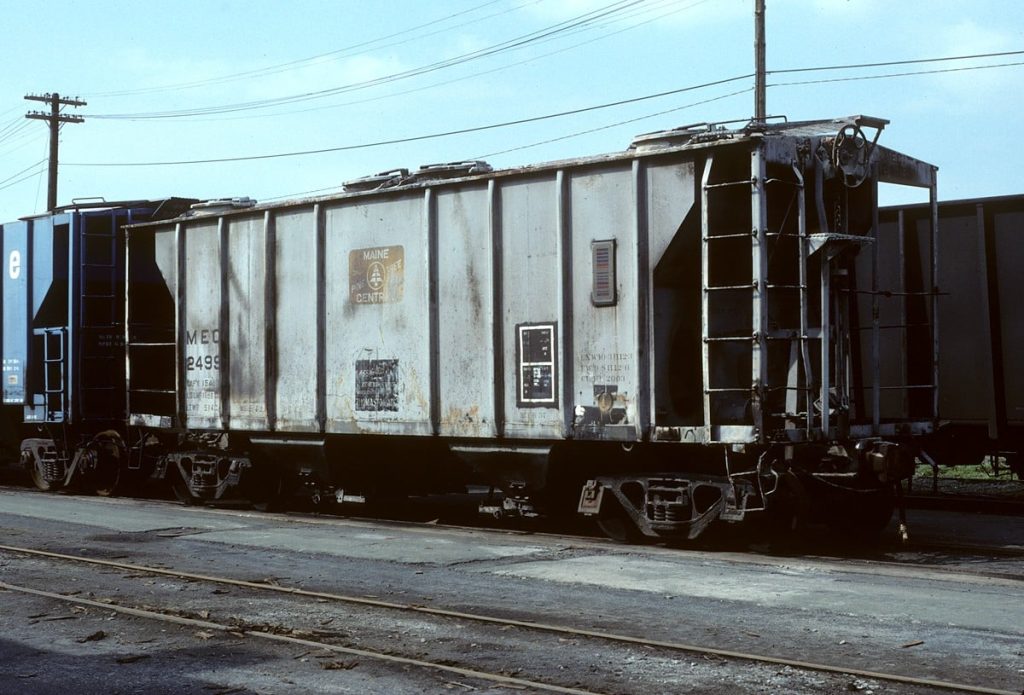
| Nos. | Type | Notes |
|---|---|---|
| MEC 2300–2301 | Covered Hopper | Converted 1959 from MEC 3868 and 3931. Originally built 1/1941, 33 ft inside length, 9 ft 2 in inside height. Offset hoppers for “clothes pin” service. Painted green with yellow lettering. 110,000 lb capacity; 2,565 cu ft. |
| MEC 2302 | Covered Hopper | Converted 1960 from MEC 3855. Originally built 1/1941, 33 ft inside length, 10 ft 9 in inside height. Offset hopper for “clothes pin” service. Painted green with yellow lettering. 110,000 lb; 3,120 cu ft. |
| MEC 2303 | Covered Hopper | Converted 1967 from MEC 3945. Originally built 1/1941, 34 ft inside length, 10 ft 9 in inside height. Offset hopper for “clothes pin” service. Painted green with yellow lettering. 110,000 lb; 3,187 cu ft |
| MEC 2400-2401 | Covered Hopper | Built 1/1941. 34 ft inside length, 10 ft 9 in inside height. Offset hoppers in “clothes pin” service. Painted green with yellow lettering. |
| MEC 2406, 2408–2409 | Covered Hopper | Rebuilt 1934 from earlier designs; retired 1968. 31 ft 8 in inside length, 9 ft 11 in inside height. Cement service. Painted black with white lettering. |
| MEC 2410–2419 | Covered Hopper | Built 4/1942 by American Car & Foundry (Lot 2338). 32 ft 3 in inside length, 9 ft 8 in inside height. Cement service with window, 10 square hatches. Painted gray with black lettering. |
| MEC 2420–2429 | Covered Hopper | Built 1/1942 by American Car & Foundry. 32 ft 3 in inside length, 9 ft 8 in inside height. Cement service with window, 10 square hatches. Painted gray with black lettering. |
| MEC 2430–2444 | Covered Hopper | Built 1/1947 by American Car & Foundry. 35 ft 2 in inside length, 9 ft 8 in inside height. Cement service with wind-deflected 8 square hatches. Painted gray with black lettering. |
| MEC 2445–2459 | Covered Hopper | Built 11/1952 by Pullman-Standard (Lot 8070). 35 ft 2 in inside length, 9 ft 8 in inside height. Cement service with 8 square hatches. Painted gray with black lettering. |
| MEC 2460–2474 | Covered Hopper | Built 10/1953 by Bethlehem Steel Car Co. 33 ft 10 in inside length, 10 ft 3 in inside height. Cement service. Painted gray with black lettering. |
| MEC 2475–2489 | Covered Hopper (PS-2) | Built 7/1954 by Pullman-Standard (Lot 8195B). 35 ft 3 in inside length, 9 ft 8 in inside height. PS-2 design for cement service with 8 round hatches. Painted gray with black herald. |
| MEC 2490–2509 | Covered Hopper (PS-2) | Built 6/1957 by Pullman-Standard (Lot 8360). 35 ft 3 in inside length, 9 ft 8 in inside height. PS-2 design for cement service with 8 round hatches. Painted grey with black lettering. |
| MEC 2510–2514 | Covered Hopper | Details of builder and build date unknown. |
| MEC 2600–2604 | Covered Hopper | Converted 1963 from MEC 1803, 1813, 1827–1829. Originally built 1/1932, 38 ft 2 in inside length, 11 ft 10 in inside height. Offset-end triple hoppers adapted for grain service. Painted gray with black small herald. |
Flat Cars
Flat cars on the Maine Central roster were used for a variety of services, from piggyback trailer loading to bulk commodities like gypsum. Many were rebuilt from older gondolas or pulpwood cars, while others were delivered new from builders such as Bethlehem and Greenville. Bulkhead flats appeared in the late 1950s and early 1960s, some converted from existing cars to handle specialised traffic.
| Nos. | Type | Notes |
|---|---|---|
| MEC 202–216 | Flat Car | Built 1/1960 by Bethlehem. 50 ft 7 in inside length. |
| MEC 217–236 | Flat Car | Built 1/1932 by Bethlehem. 51 ft 10 in inside length. |
| MEC 251–253 | Flat Car | Converted 1969 from MEC 211–213. Originally built 1/1944, 53 ft 10 in inside length. |
| MEC 401–403 | Flat Car (Piggyback) | Converted 1958 from MEC 3200-series gondolas. Originally built 1/1937, 42 ft 2 in inside length. Piggyback service. |
| MEC 7399 | Flat Car | Converted from MEC 7271 pulpwood car. Originally built 1/1932, 42 ft 1 in inside length. |
| MEC 7401 | Flat Car | Built 1/1953 by Greenville. 53 ft 6 in inside length. Black with white lettering. |
| MEC 7450–7451 | Bulkhead Flat | Built 1/1959 by Chicago Freight Car Co. 48 ft 6 in inside length, 10 ft inside height. Bulkhead flat. |
| MEC 7452–7454 | Bulkhead Flat | Converted 1961 from Central Railroad of New Jersey gondola 1001-series. Originally built 1/1961, 48 ft 6 in inside length, 10 ft inside height. Bulkhead flat. |
| MEC 7455–7459 | Bulkhead Flat | Converted 1963 from MEC 7595–7599. Originally built 1/1961, 49 ft 11 in inside length, 7 ft 11 in inside height. Bulkhead flat. |
| MEC 7460–7464 | Bulkhead Flat | Converted 1965 from MEC 7590–7594. Originally built 1/1961, 49 ft 11 in inside length, 10 ft inside height. Bulkhead flat. |
TOFC / Intermodal Cars
Maine Central operated a fleet of 89-foot flush-deck intermodal flatcars for TOFC Trailer-on-flatcar and container-on-flatcar (COFC) service. By the early 1980s, the 105000-series included cars built by both American Car & Foundry and Pullman-Standard, with equipment acquired second-hand from several sources. These were all-purpose TOFC/COFC cars, capable of handling a variety of trailer and container configurations.
| Nos. | Type | Notes |
|---|---|---|
| MEC 105001–105050 | 89′ TOFC/COFC Flatcar | (50 cars) Built 9/1978 by American Car & Foundry (ACF) as 89 ft 4 in flush-deck, all-purpose TOFC/COFC flatcars. Acquired second-hand from PW (Pullman Transport Leasing Company), a freight-car leasing fleet rather than an operating railroad. |
| MEC 105051–105075 | 89′ TOFC/COFC Flatcar | (25 cars) Built 1/1979 by Pullman-Standard as 89 ft flush-deck, all-purpose TOFC/COFC flatcars. |
| MEC 105076–105125 | 89′ TOFC/COFC Flatcar | (50 cars) Built 12/1978–2/1979 by Pullman-Standard as 89 ft flush-deck, all-purpose TOFC/COFC flatcars. Acquired from Southern Pacific in 9/1982; originally PW cars. |
Pulpwood Cars
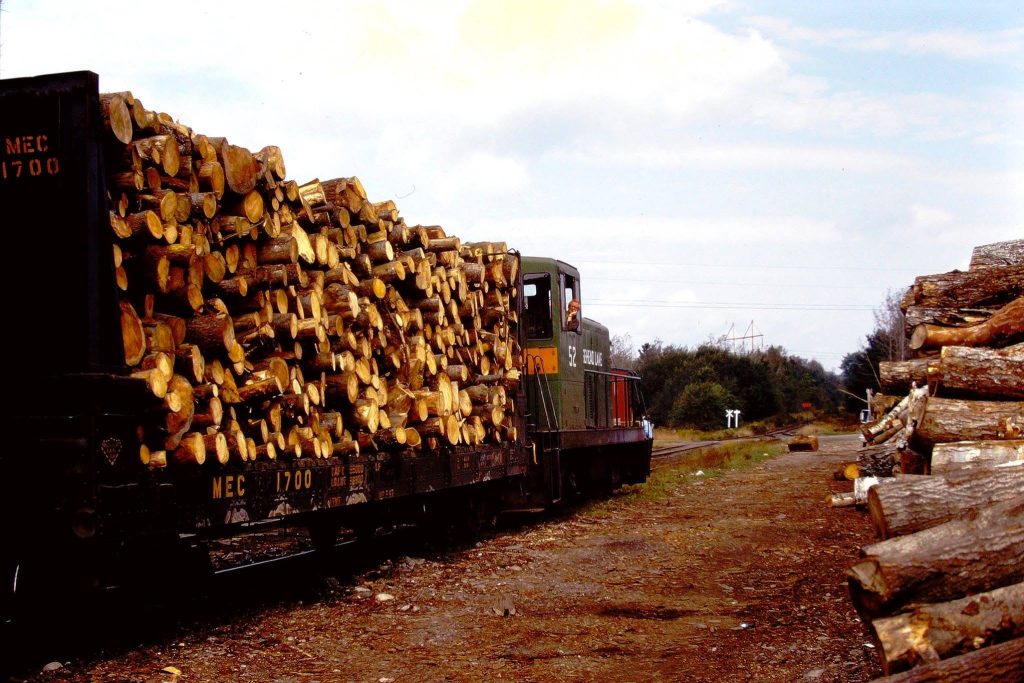
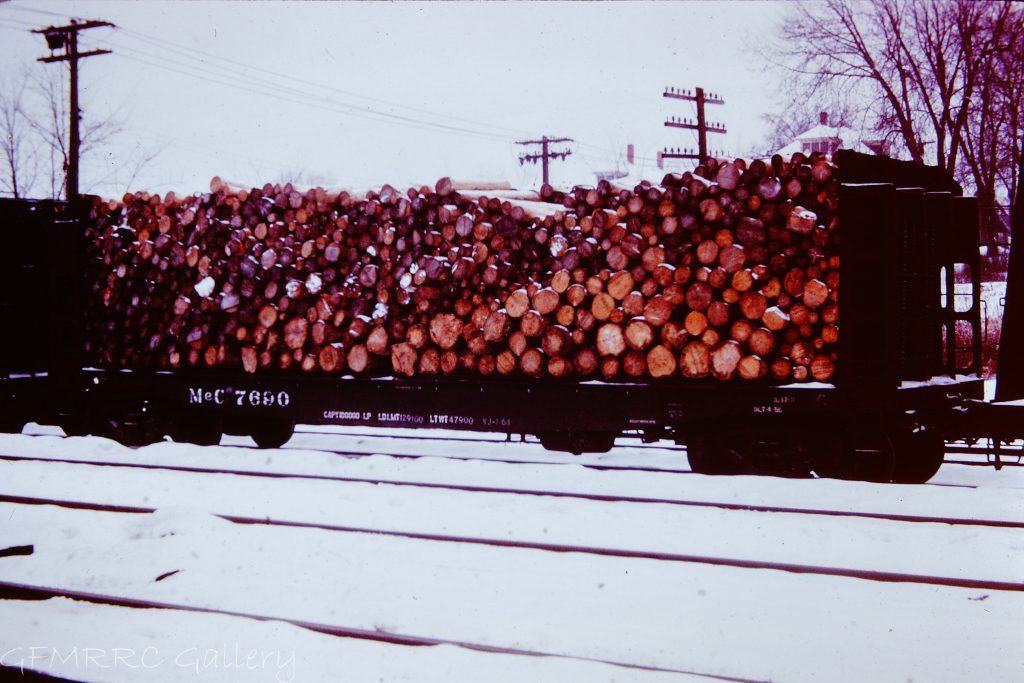
Pulpwood cars were designed specifically for hauling short 4-foot logs cut for the paper industry. Unlike standard flatcars or gondolas, these cars had bulkheads or modified box bodies to contain the irregular logs securely during transit. The Maine Central rostered several distinct designs over the years:
- Early conversions of boxcars with their roofs removed and sides raised, creating open-top pulpwood boxes.
- Bulkhead flats built new or rebuilt from gondolas, fitted with wood or steel floors.
Because pulpwood was both heavy and rough-handling, these cars were simpler and sturdier than later high-capacity woodchip cars. Where woodchip cars were about volume, pulpwood cars were about strength and restraint — their role was to move thousands of cords of logs from Maine forests to the region’s pulp and paper mills.

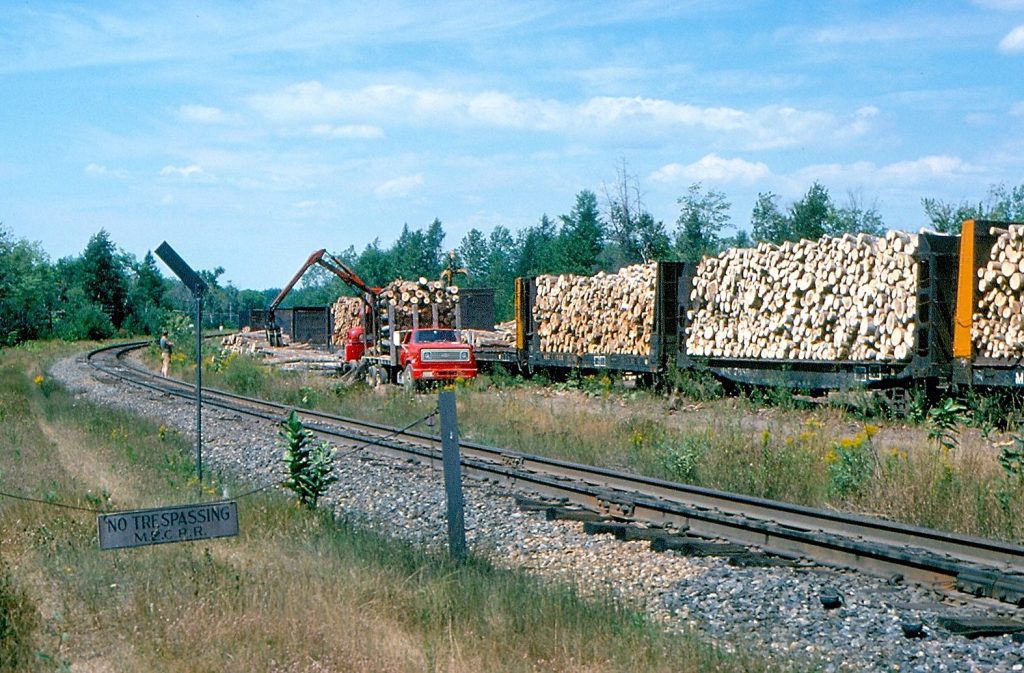


| Nos. | Type | Notes |
|---|---|---|
| MEC 200-201 | Pulpwood Car (Skeleton) | Built 1/1944. 50 ft 1 in inside length, 8 ft 3 in inside height. Skeleton bulkhead flat with flat floor. |
| MEC 1400–1599 | Pulpwood Car | Built 1/1964 by Magor Car Co. 64 ft between outside bulkheads, 8 ft 2 in inside height. Centre bulkhead flat, painted black with yellow lettering. Models: N Scale Kits, Highball Graphics Photos: RCP MEC 1470. |
| MEC 1700–1749 | Pulpwood Car (Bulkhead Flat) | Built 1/1967. 40 ft 5 in inside length, 8 ft 4 in inside height. Bulkhead flat with wood floor, painted black with yellow lettering. Converted from MEC 17000–17149 low-side gondolas. |
| MEC 1750–1774 | Pulpwood Car (Bulkhead Flat) | Built 1/1968. 40 ft 5 in inside length, 8 ft 4 in inside height. Bulkhead flat with wood floor, painted black. Converted from MEC 17000–17149 low-side gondolas. |
| MEC 1900–1914 | Pulpwood Car (Bulkhead Flat) | Built 1/1968. 36 ft 9 in inside length, 8 ft 4 in inside height. Bulkhead flat with wood floor, painted black with yellow lettering. Converted from MEC 3100–3114 gondolas. |
| MEC 6850–6909 | Pulpwood Car (Open Top Box) | Converted 1961 from MEC 14000 series. Originally built 1/1937, 40 ft 5 in inside length, 9 ft 3 in inside height. Open-top car with 6 ft door. Ex-MEC 4248 with roof removed and sides extended by 1 ft between 1961–64. Retired by 1968. |
| MEC 6900 | Pulpwood Car (Open Top Box) | Converted 1967 from MEC 9000–9049 series. Originally built 1/1939, 42 ft inside length, 9 ft 4 in inside height. 6 ft door, open-top box conversion. Painted green with yellow large herald. |
| MEC 6910–6934 | Pulpwood Car (Open Top Box) | Converted from MEC 16000–16284 series. Originally built 1/1947, 40 ft 7 in inside length, 9 ft 4 in inside height. 6 ft door, open-top box conversion. Painted green with yellow large herald. |
| MEC 6940–6986 | Pulpwood Car (Open Top Box) | Converted from MEC 55500–55561 series. Originally built 1/1944, 40 ft 7 in inside length, 10 ft 4 in inside height. 6 ft door, open-top box conversion. |
| MEC 6987–7000 | Pulpwood Car (Open Top Box) | Converted batch. Originally built 1/1937, 40 ft 5 in inside length, 9 ft 3 in inside height. 6 ft door, open-top box. |
| MEC 6990 | Pulpwood Car (Experimental) | Experimental conversion. 41 ft 9 in inside length, 8 ft 8 in inside height. Four-door wood box. |
| MEC 6992, 6993, 6998 | Pulpwood Car | Converted from 35000 series boxcars. 40 ft 9 in inside length, 8 ft 8 in inside height. Four-door wood box. |
| MEC 7550–7589 | Pulpwood Car (Bulkhead Flat) | Built 1/1961 by Thrall. 49 ft 3 in inside length, 7 ft 7 in inside height. Bulkhead flat with grid floor, painted black with yellow lettering. |
| MEC 7600–7649 | Pulpwood Car (Bulkhead Flat) | Built 1/1954 by Bethlehem. 45 ft 9 in inside length, 8 ft 1 in inside height. Bulkhead flat with grid floor. |
| MEC 7660–7677 | Pulpwood Car (Bulkhead Flat) | Built 1/1954 by International Steel. 45 ft 9 in inside length, 8 ft 2 in inside height. Bulkhead flat with grid floor. |
| MEC 7680–7699 | Pulpwood Car (Bulkhead Flat) | Ex-D&H, acquired 1964. Originally built 1/1956, 38 ft 2 in inside length, 8 ft inside height. Bulkhead flat with grid floor, painted black with white lettering. |
| MEC 7900 | Pulpwood Car (Bulkhead Flat) | Converted from MEC 7013 gondola. Originally built 1/1932, 40 ft 6 in inside length, 8 ft 4 in inside height. Bulkhead flat with wood floor. |
| MEC 7901 | Pulpwood Car (Bulkhead Flat) | Converted from MEC 17069 gondola. Originally built 1/1939, 41 ft 6 in inside length, 7 ft 5 in inside height. Bulkhead flat with wood floor. |
| MEC 7902 | Pulpwood Car (Bulkhead Flat) | Converted 1964 from MEC 17052 gondola. Originally built 1/1939, 41 ft 6 in inside length, 7 ft 5 in inside height. Bulkhead flat with grid floor. |
| MEC 7905–7909 | Pulpwood Car (Bulkhead Flat) | Converted 1967 from MEC 3300–3349 gondolas. Originally built 1/1939, 43 ft 1 in inside length, 8 ft 4 in inside height. Bulkhead flat with grid floor. |
| MEC 9600 | Pulpwood Car (Converted Box) | From MEC 9200 series boxcars. Originally built 1/1964, 50 ft 7 in inside length, 9 ft 10 in inside height. One 9 ft door installed, open-top conversion, painted green with large herald. |
Woodchip Cars
Woodchip cars were developed to move lightweight, high-volume woodchips produced as a by-product of sawmills and used in paper production. Unlike pulpwood cars, which carried heavy 4-ft logs, these cars needed capacity rather than strength. To achieve this, the Maine Central converted standard boxcars and hoppers by removing the roofs, extending the sides, or adding racks, creating tall-sided cars able to carry far more volume.
The result was a family of cars that looked ungainly compared to regular freight stock, but they were essential for the bulk, low-density traffic moving from Maine’s sawmills to its pulp and paper mills. Their light loads meant they often ran in long blocks, visually distinct with their high sides and, in some cases, hinged plywood doors.
| Nos. | Type | Notes |
|---|---|---|
| MEC 1890–1893 | Woodchip Car | Converted 1963 from MEC 3500–3504 series. Originally built 1/1932, 41 ft 3 in inside length, 13 ft 2 in inside height. Quad hopper with wood side extensions. |
| MEC 1896–1899 | Woodchip Car | Purchased from BAR in 1960. Originally built 1/1932, 40 ft 8 in inside length, 13 ft inside height. Three-bay hopper with steel side extensions. |
| MEC 55500–55561 | Woodchip Car | Converted 1964 from MEC 4000, 5000, and 14000 series boxcars. Originally built 1/1944, 40 ft 5 in inside length, 12 ft 6 in inside height. Open-top boxcars with extended sides. |
| MEC 56001–56005 | Woodchip Car | Converted 1963 from MEC 36000–36300 series (boxcars?). Originally built 1/1932, 40 ft 6 in inside length, 9 ft inside height. Open top with 8 ft door. |
| MEC 56050–56052 | Woodchip Car | Converted 1966 from MEC 5000–6003 series. Originally built 1/1932, 40 ft 7 in inside length, 12 ft 6 in inside height. Open top with 8 ft door and extended sides. |
| MEC 57000–57017 | Woodchip Car | Converted 1966 from MEC 9000–9049 series boxcars. Originally built 1/1939 by Magor to the AAR 1932 design, 50 ft 7 in inside length, 12 ft 6 in inside height. Open-top rack cars for woodchip service with extended 2 ft 10 in sides, roofs removed, and sliding doors replaced by hinged plywood doors. Painted green with yellow lettering. |
Woodpulp Cars
Woodpulp cars were insulated boxcars designed to carry processed pulp — baled or rolled sheets of semi-finished paper stock — from mills to finishing plants. Unlike pulpwood cars (for 4-ft logs) or woodchip cars (for loose chips), these needed tight temperature control and protection from moisture. The Maine Central rostered several groups, mostly rebuilt from older boxcars, that were lined, insulated, and often sealed for pulp service.

| Nos. | Type | Notes |
|---|---|---|
| MEC 2100-2109 | Insulated Woodpulp Car | Converted 1959–1960 from Magor AAR 1937 boxcars. Insulated woodpulp cars rebuilt for woodpulp service. Photos: RRPA MEC 2102, RRPA MEC 2105. |
| MEC 2119-2124 | Insulated Woodpulp Car | Insulated PS-1 converted from 6500–6759 series in 1966–67. |
| MEC 2125-2133 | Insulated Woodpulp Car | Insulated PS-1 converted from 6500–6759 series in 1961. Photos: RRPA MEC 2130. |
| MEC 2134-2146 | Insulated Woodpulp Car | Insulated PS-1 converted from 6500–6759 series by 1965. |
| MEC 2150-2175 | Insulated Woodpulp Car | MGR AAR 1937 boxcars converted 1959–60 to insulated woodpulp cars. |
Miscellaneous Cars
| Nos. | Type | Notes |
|---|---|---|
| MEC 1–2 | 50′ Reefer, Mechanical | Built 1/1965 by Pacific Car & Foundry. 50 ft inside length, 8 ft 11 in inside height; 57 ft over length. Mechanical reefers painted yellow with green lettering. Photos: RCP MEC 1. Models: MEC 1 Athearn 11105 ★. |
| MEC 300–304 | Tank Car | Built 1/1932 by UTLX. 30 ft 5 in inside length, 10 ft 5 in inside height. 10,000-gallon insulated tank cars with steam coils, painted black with white lettering. |
| MEC 715–716 | Tank Car | Built 1/1932. 33 ft 4 in inside length, 11 ft 1 in inside height. 10,000-gallon tank cars painted black with white lettering. |
| MEC 57013 | Rack Car | Converted 1966 from MEC 9000–9049 series boxcars. Originally built 1/1939, 50 ft 7 in inside length, 12 ft 6 in inside height. Scrap auto body rack service. |
- Highball Graphics F-101 – Maine Central Harvest Yellow 50′ Boxcars
- Highball Graphics F-102 – Maine Central Pine Green 53′ Mill Gons

More Information
- Sweetland, David R., and Stephen Horsley. Northern New England Color Guide to Freight & Passenger Equipment. Morning Sun Books, 1995.
Epilogue
By the early 1980s, the shape of MEC’s freight roster told the story: paper paid the bills, and everything else was built around it. The 1930s Magor steel cars and early PS-1s were either rebuilt into something useful (pulpwood, woodchip, woodpulp) or pushed off the property. The yellow era brought cushioned 50-footers and then the FMC/Berwick fleets that finally met the loading, damage, and interchange demands of modern paper traffic.
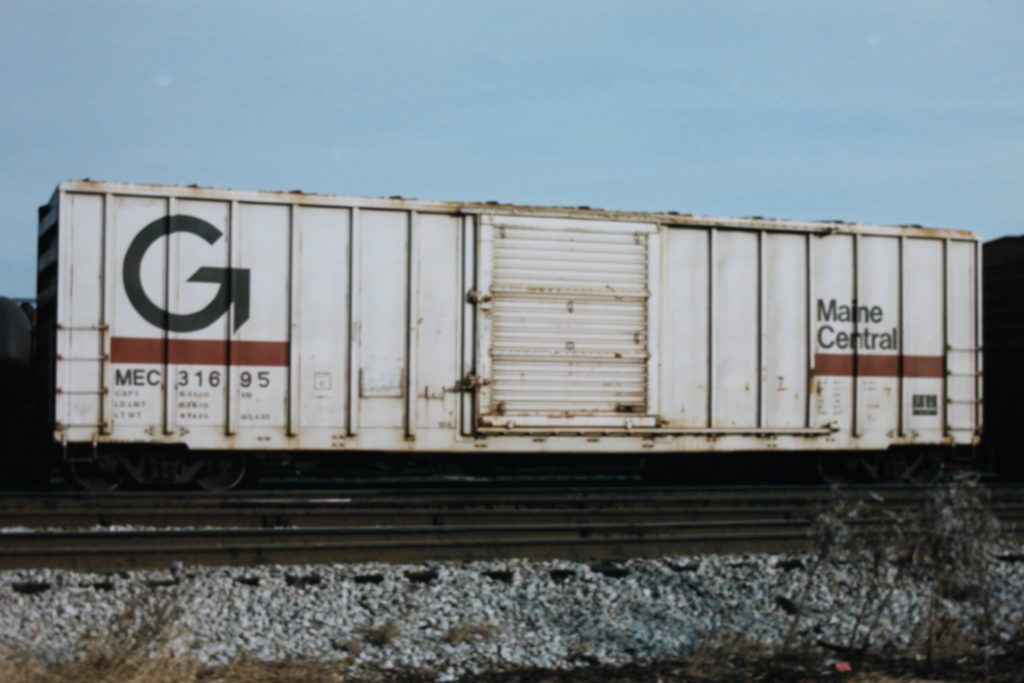
Guilford’s arrival accelerated rationalisation. Oddball conversions and small speciality pools were thinned, lease fleets cycled out, and standardisation won. The “Prime Mover of Maine Industry” slogan faded with the last green holdouts, and the pragmatic yellow that defined the 1960s–1980s paper boom became the visual memory most people have of MEC freight.
Not much survived intact. A handful of cars trickled into MOW service or museums; most were scrapped, sold, or quietly re-marked into anonymity. For historians and modellers, the paper trail—shop cards, lease stencils, lot numbers, and the scars of every conversion—matters as much as the paint. It’s messy, inconsistent, and very MEC: use what you’ve got, make it work, and keep the mills fed.
Fabulous photographic record!
What I don’t see in your site are photos of the clothespin cars… specifically #’s 2301 2302 2303.
Have only seen one or two of #2302. Might you have others?
Thank you.
Pierre in Camden Maine.
Thank you, Pierre! Your comment prompted me to do a bit more digging, and I’ve now updated the page with several photographs of the clothespin cars, including 2301, 2302 and 2303. There are some particularly useful views showing the differences between the cars, which I hadn’t appreciated before.
I’m continually amazed and very grateful that so many people took the trouble to photograph freight cars at the time, and that they and others have since shared those photographs online for the rest of us to study and enjoy. Without them, putting together pages like this would be considerably more difficult!
Thanks again for getting in touch, and I hope the new additions are useful.
Fantastic writeup! Do you know what the MEC/Guilford wood pulp fleet looked like in the 1990s? The cars you mention here don’t seem to be in use by that timeframe. Would it be former newsprint cars that had been displaced by the FMC fleet?
Thanks for your kind comment, Ben.
That’s slightly beyond the period I’ve focused on here, which is really up to the mid-1980s, so I’ve not looked in detail at the Guilford-era fleet.
Best of luck with your research. It’s a really interesting period to dig into. I’d be very happy to add more to this page if you uncover anything.
So far no luck finding more information on the Guilford wood pulp fleet, but it looks like a lot of the 2100 series woodpulp cars were scrapped in 1990.
https://www.rrpicturearchives.net/railroads/maine-central/MEC/rollingstock/range/2100