The Class 26s were created under the British Transport Commission’s modernisation plan, which required a broad range of pilot scheme diesel locomotives so that British Railways could evaluate different power and transmission systems. Birmingham Railway Carriage and Wagon Company (BRCW) supplied twenty locomotives in the Type B category, later known as Type 2. These locomotives were numbered D5300 to D5319. They were powered by Sulzer 6LDA28-A engines producing 1,160 horsepower, with steam heating equipment for use on both passenger and freight duties. A DC generator and four Crompton Parkinson traction motors provided the traction, giving good low speed haulage capability and a top speed of 80 mph. They were also equipped with Blue Star multiple working equipment from new so that one driver could control more than one locomotive on heavy trains.
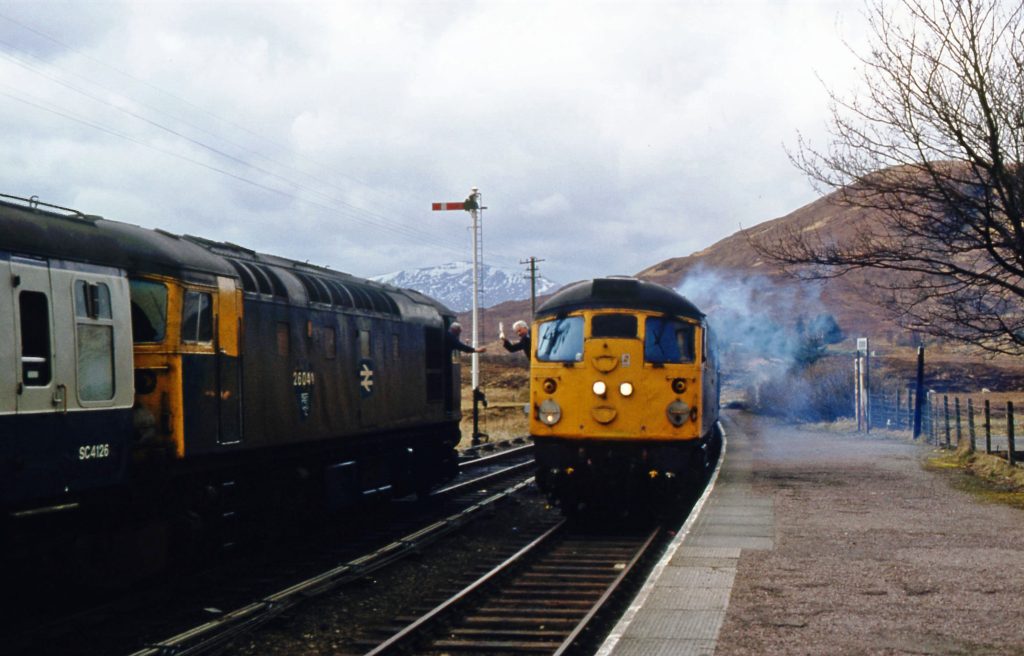
The first locomotive, D5300, entered service on 30 July 1958 at Hornsey depot on the Eastern Region. The other nineteen followed by March 1959. All twenty were initially based at Hornsey for work on suburban and parcels trains on the Great Northern lines into King’s Cross. Shortly after delivery, D5303 was sent on loan to Inverness for trials during the winter of 1958. Its strong performance on steep gradients and lightly built Highland routes impressed the Scottish Region. A further twenty seven locomotives were ordered as a result and these, numbered D5320 to D5346, were delivered directly to Haymarket and Leith.
Under the TOPS system the first twenty became Class 26/0 while the later Scottish batch became Class 26/1. Their success in Scotland also led to a larger follow up order for an uprated design that eventually became the separate Class 27 fleet. From these beginnings the Class 26s went on to become one of the most important diesel fleets in Scotland for more than thirty years.

Once established in Scotland the Class 26s were allocated mainly to Haymarket in Edinburgh and Inverness, although there were brief periods based at Dundee and Kittybrewster as requirements changed. Around the Central Belt they worked stopping passenger services, parcels and local freight. On the Highland Main Line they often hauled heavy overnight trains in pairs or sometimes trios over the summit at Druimuachdar. They also worked the remote single line routes to Kyle of Lochalsh and to Wick and Thurso. They were not glamorous locomotives but they were reliable and essential in connecting remote parts of the country.
The first batch, D5300 to D5319, were transferred north after their London trials but they largely remained a Central Belt fleet. Through the 1960s and 1970s they worked suburban and local duties around Edinburgh and Fife and were seldom seen north of Perth in regular service. The later production batch, D5320 to D5346, became the dominant Highland machines. These locomotives worked the Kyle of Lochalsh and Far North lines as a matter of routine and in TOPS days most of the locomotives later numbered 26008 to 26046 could be found on those workings.
There was one short-lived exception. In 1959 six of the production locomotives, D5330 to D5335, were loaned back to Hornsey to cover for unreliable Class 21s. This brief period of Great Northern operation ended quickly and by April 1960 the entire class had been reallocated to Scotland, where they remained for virtually their entire careers.
The production locomotives included several improvements suited to Scottish duties. They were delivered with snowplough brackets and with recesses in the cab sides so that tablet catching equipment could be mounted for single line working. They also had sliding cab windows rather than droplights, making them more weather resistant. At the front end the multiple working jumpers were arranged higher and more angled and the air pipes were moved to sit inside the buffer shanks rather than below them. Round buffers were used instead of the oval buffers fitted to the pilot scheme batch. These are all quick visual clues to the origin of a particular locomotive.
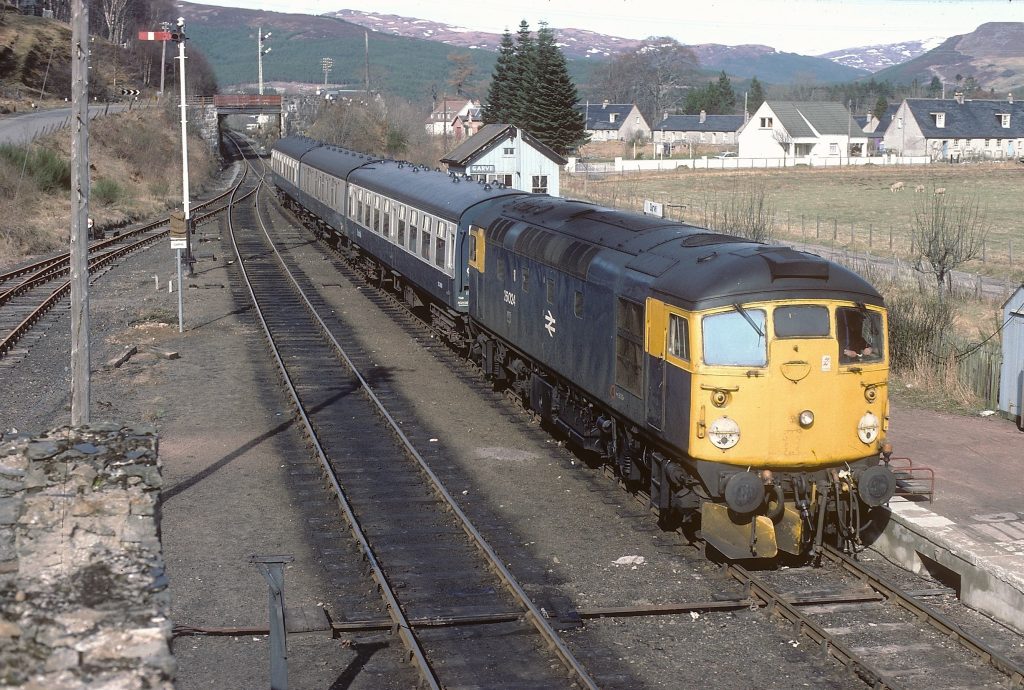
Throughout the 1960s and 1970s the Class 26s were central to operations across the north of Scotland. They handled stopping trains to Kyle of Lochalsh, mail and passenger services to Wick and Thurso and a wide range of freight south of Inverness. In the early 1980s large numbers of Class 37s arrived in the Highlands. Their greater power and more modern equipment made them better suited to the heaviest trains and steepest gradients, so the Class 26s were steadily moved to secondary duties. Even so, they continued to appear on Highland services when required. The final booked Class 26 working in the far north was in November 1985 when 26038, paired with 37263, hauled a passenger train from Wick. After that point the Highlands were regarded as Class 37 territory and the Type 2 era north of Inverness was effectively over.
Liveries changed markedly during the careers of the Class 26s. They entered service in BR Brunswick green with white cab window surrounds and a light body stripe that suited the optimism of the modernisation era. Small yellow warning panels were added soon afterwards and a few locomotives later gained full yellow ends while still green, including D5335. Full repaints into BR blue began in 1966 and by the early 1970s the blue and yellow combination had become universal. During the same period the windows in the cab side doors were plated over and painted yellow, which made the front ends appear visually deeper. In the sectorisation era several locomotives carried freight grey finishes that reflected their allocated traffic pools. In the final months of the class’s working life two locomotives returned to green as a nod to their origins and to mark the closure of Eastfield depot, signalling the end of a long chapter of Scottish diesel traction.
There were relatively few changes to the fleet during the 1960s. The main exception was in 1967 when D5300 to D5306 were fitted with dual braking equipment for Merry go round coal traffic in the Fife area. Their steam heat boilers were removed as part of this conversion. Numbering changes followed later. Between 1973 and 1974 the fleet was renumbered into the 26xxx series. Most simply replaced their 53xx number with 260xx. The dual braked group were renumbered into a single block for ease of identification. D5320 took the vacant number 26028 after D5328 had been withdrawn.
All locomotives were built with folding disc route indicators and a communication door in the middle of each cab front. The doors were plated over in the early to mid 1970s. During refurbishment in the early 1980s the disc equipment and the white lamps behind the centre discs were removed. Some locomotives lost only the side discs to begin with, but eventually all discs disappeared.
Headlight changes began in 1976 when twelve Inverness based Class 26s were fitted with twin sealed beam headlights. These locomotives were 26015, 26022, 26030, 26032, 26035, 26038, 26039, 26041, 26042, 26043, 26045 and 26046. A further three locomotives received a single centre headlight. These were 26021, 26024 and 26044. Changes were not entirely consistent. For example, 26038 originally gained twin headlights but later had them removed and a single centre light fitted. One of the more unusual modifications applied to the class was seen on 26018, a pilot scheme machine that received snowplough brackets and ploughs in the late 1970s, although no other member of its batch was treated in that way.
Withdrawals began in the mid 1970s, mostly due to accident or fire damage, at a time when surplus locomotives meant repairs were not justified. Most of the remaining fleet received refurbishment in the early 1980s and the class was at that time expected to remain in service into the next century. Traffic reductions in Scotland, particularly following the closure of Ravenscraig steelworks in 1991, cut short those plans. The last Class 26s were withdrawn in October 1993, bringing to an end a career that had lasted thirty five years.
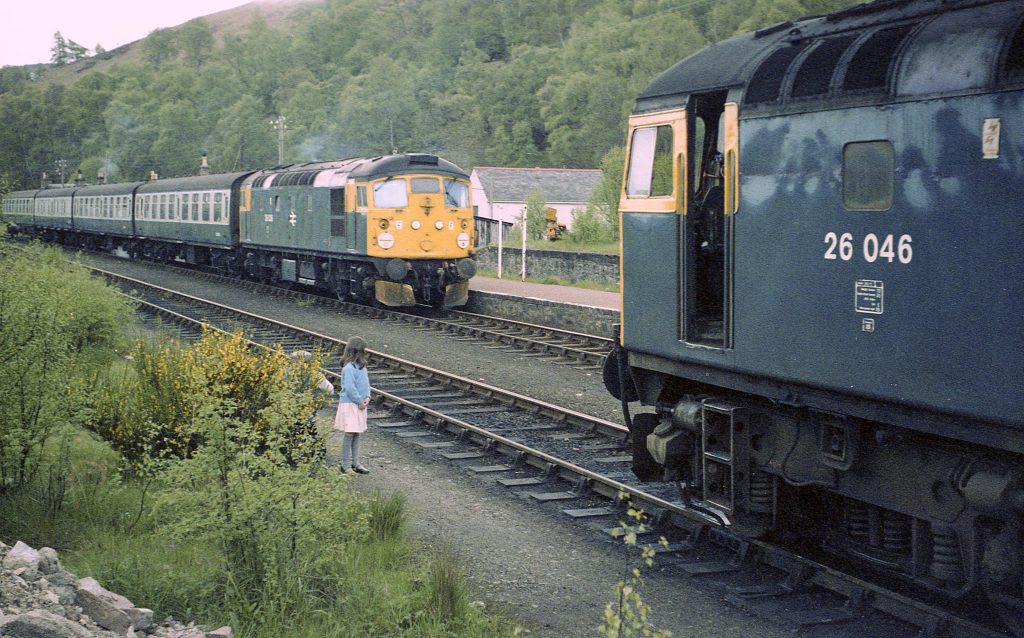
Thirteen Class 26s have been preserved. Several are operational in Scotland and others run on heritage railways in England. Their preservation allows the class to be appreciated in a way that everyday service did not always encourage. They were dependable and vital working locomotives that made a significant contribution to rail transport in Scotland.
26001 / D5301https://6lda.wordpress.com/test-history/26001d5301/26002 / D5302 (K)https://6lda.wordpress.com/test-history/26002d5302/26003 / D5303https://6lda.wordpress.com/test-history/26003d5303/26004 / D5304
https://6lda.wordpress.com/test-history/26004-history/26005 / D3505
https://6lda.wordpress.com/test-history/26005d5305/26006 / D5306
https://6lda.wordpress.com/test-history/26006d5306/26007https://6lda.wordpress.com/test-history/26007d5300/./ D5300- 26008 / D5308 – ?
https://6lda.wordpress.com/test-history/26008d5308/ 26009 / D5309
https://6lda.wordpress.com/test-history/26009d5309/26010 / D5310
https://6lda.wordpress.com/test-history/26010d5310-history/26011 / D5311https://6lda.wordpress.com/test-history/26011d5311/- 26012 / D5312
https://6lda.wordpress.com/test-history/26012d5312/ - 26013 /D5313
https://6lda.wordpress.com/test-history/26013d5313/ - 26014 / 5314 / D5314
https://6lda.wordpress.com/test-history/26014d5314/ - 26015 /D5315 (Achnasheen, Duncraig) BR Blue Twin Headlights
https://6lda.wordpress.com/test-history/26015d5315/ 26016 / D5316https://6lda.wordpress.com/test-history/26016d5316/26017 / D5317https://6lda.wordpress.com/test-history/26017d5317/- 26018 / D5318
https://6lda.wordpress.com/test-history/26018d5318/ - 26019 / D5319
https://6lda.wordpress.com/test-history/26019d5319/ - 26020 / D5320
https://6lda.wordpress.com/test-history/26020d5307/ - 26021 / D5321 (K) – BR Blue Single Headlight
https://6lda.wordpress.com/test-history/26021d5321/ - 26022 – Twin Headlights
- 26023
- 26024 (Achnasheen, K) – Single Headlight
- 5325, 26025 (K) ***
- 26026 (Attadale – on presflos)
- 26027 (K, Achnasheen)
- 26028 (Plockton)
- D5329, 5329 (K)
- 26030 (K) – Twin Headlights
- 5331, 26031 (K, Achnasheen)
- D5332, 26032 (K) – Twin Headlights
- 26033 (Plockton)
- 26034 (Garve)
- D5335/26035 (K) – Twin Headlights
- 5336, 26036 (K)
- 26037 (Duncraig)
- D5338/26038 – Twin Headlights later Single Headlight
- 26039 (K) – Twin Headlights
- 5340 (Achnasheen, K)
https://www.flickr.com/photos/d9006/4631773719/in/set-72157610007241008 - 5341 (Achanalt) – Twin Headlights
- 5342, 26042 (K, Attadale,Achnasheen) – Twin Headlights
- 26043 – Twin Headlights
- 5344 (Achnasheen, K) – Single Headlight
- D5345, 26045 (K, Attadale – on presflos, Achnasheen) – Twin Headlights
- 26046 / D5346 (K) – Twin Headlights, no discs by July 1982
https://www.theironroad.net/DieselElectricLocomotives/Class-26/Class-26-British-Rail
https://www.railscans.co.uk/cl26.htm
Modelling
“Also we are doing 2 types of bogie (inc. leaf spring), and 2 types of bogie steps, plus snowploughs in the pack with the loco, along with customer added roof radio pods (where necessary) etched disc headcodes (where applicable), 2 types of underframe and with / without door window, plated front door, welded front door or hinged front door, plus round / oval buffers and different roof shoulder grilles.”
“Please note that the roof radio pod and snowploughs are, like the headcode discs, customer fit for preference.”
“Super Creep’ 5 pole skew wound motor. Twin flywheels. low friction mechanism. Darkened profile wheel sets. correctly modelled bodies and cab fronts (for alternate versions). correctly modelled drop down or sliding windows. correctly modelled foot alternate bogie steps. correctly modelled alternate leaf spring bogies. directional lighting (different on each model depending on livery). correctly modelled deflector plate on cab roof. NEM651 DCC decoder socket. Correctly modelled alternate fuel tank and air tanks. Customer fitted snowploughs and headcode discs (where appropriate). NEM coupling pocket. Small bogie to chassis clearance. Etched metal see through side grilles with support stanchions correctly modelled behind. Separately applied handrails and windscreen wipers. 2 buffer styles depending on variants produced”
- Dapol ND145 – Class 26 D5301/D5300, BR Green – Rails Special Edition
- Dapol ND145A – Class 26 26015, BR Blue with Full Yellow Ends (no discs)

- Dapol ND145B – Class 26 D5301, BR Green with Small Yellow Warning Panels
- Dapol ND145C – Class 26 26038, Railfreight Red Stripe ‘Scottie Dog’
- Dapol ND145D – Class 26 26007, Railfreight Coal Sector
- Dapol ND145E – Class 26 26011, BR Civil Engineers ‘Dutch’ Grey/Yellow + Six Dogfish Ballast Hoppers
- Dapol ND145F – Class 26 26026, BR Blue with Snowploughs & Headcode Discs
- Dapol ND145FD – Class 26 26026, BR Blue with Snowploughs & Headcode Discs – DCC Fitted

- Dapol ND145G – Class 26 26040, BR Blue with Discs, Snowploughs & Stag Emblem
- Dapol ND145GD – Class 26 26040, BR Blue with Discs, Snowploughs & Stag Emblem – DCC Fitted
- Dapol ND145H – Class 26 D5307, BR Green with Headcode Discs
- Dapol ND145HD – Class 26 D5307, BR Green with Headcode Discs – DCC Fitted
- Dapol ND145J – Class 26 D5326, BR Green
- Dapol ND145JD – Class 26 D5326, BR Green – DCC Fitted
- Dapol ND145R – Pack of 2 Class 26s 26001 and 26007, BR Green – Limited Edition for Rails of Sheffield
- Dapol 2D-028-001 – Class 26 D5316, BR Green
- Dapol 2D-028-001D – Class 26 D5316, BR Green – Digital Fitted
- Dapol 2D-028-002 – Class 26 D5310, BR Green with Small Yellow Panels – As Preserved
- Dapol 2D-028-002D – Class 26 D5310, BR Green with Small Yellow Panels – As Preserved – Digital Fitted
- Dapol 2D-028-003 – Class 26 26024, BR Blue with Scottie Dog Emblem
- Dapol 2D-028-003D – Class 26 26024, BR Blue with Scottie Dog Emblem – Digital Fitted
- Dapol 2D-028-004 – Class 26 26037, Railfreight Red Stripe
- Dapol 2D-028-004D – Class 26 26037, Railfreight Red Stripe – Digital Fitted
- Dapol 2D-028-005 – Class 26 26004, Railfreight Coal Sector
- Dapol 2D-028-005D – Class 26 26004, Railfreight Coal Sector – Digital Fitted
Converting the Dapol Class 26 to 2mm Finescale
This method uses 2mm Scale Association replacement wheelsets designed specifically for the Dapol Class 26, 27 and 33 bogie design. The original wheels are removed from the gear muffs and replaced. No irreversible modifications are involved, so the model can be returned to N gauge in future if required.
Tools and materials required
- 2mm Scale Association back-to-back gauge
- Fine reamer or broach (only if a gear muff is tight)
- Fine tweezers for handling wheelsets and pickups
- Loctite 641 or similar removable bearing retainer (if a wheel is slightly loose)
- Clean, well-lit workspace
Step-by-step conversion
- Remove the bogie from the chassis
Hold the bogie sideframes close to the pivot and pull down firmly until the retaining clip releases and the bogie drops clear. - Detach the wheelsets
Unclip the bogie sideframes from the central gear block. The original wheelsets will lift out easily once the frames are removed. - Withdraw the original axles
Pull the N gauge wheels straight out of the plastic gear muff by hand. Avoid pliers, as the gear muff can be damaged if squeezed. - Fit the new 2mm finescale wheelsets
Push the new axles into the muffs. If the fit is unreasonably tight, lightly ream the muff rather than force the wheel. - Set back-to-back accurately
Use a 2mm Association back-to-back gauge to set the spacing correctly, ensuring the gear muff is central. If a wheel is loose, secure it with a tiny drop of a removable compound such as Loctite 641. - Reassemble the bogie
Clip the wheelsets back into the gear block and refit the sideframes, checking that the wheels turn freely and that the pickups touch the wheel backs. - Refit to the chassis and test
Push the bogie back into its pivot on the chassis block until it clicks home.
Run the locomotive for several minutes in both directions to bed in the new wheelsets.
Your Dapol Class 26 is now converted to 2mm finescale standards and ready for service.
Fitting DCC sound to a Dapol Class 26
- Stay alive
- Zimo MX648; YouChoos SugarCurve7?
1. Cab front, windows and nose
Front windows and surrounds
- Thin down the heavy moulded rubber surrounds on the cab front windows.
- On some locos, remove the rubber surrounds completely to give a flush glazed look.
- Make cab side window surrounds flush with the body where appropriate.
- For later straight-framed cab side windows, alter the frames to suit.
Bodyside windows
- Remove the moulded bodyside window frames and make the glazing appear flush with the body.
- On early machines, enlarge one of the bodyside windows on each side to match prototype differences.
- Retain or remove individual frames per side to suit specific locos.
Doors and nose details
- Re-position door handles to match a chosen prototype.
- Add or refine lamp brackets in the correct positions on the nose.
- Add token catcher boxes or recesses on the bodyside for Scottish single-line locos.
Nose style and headcodes
- Convert to disc headcode style where appropriate:
- Central disc arrangement.
- Standard four-disc arrangement.
- Thin down the discs so they look less chunky.
- Add disc catches around the discs for proper relief.
- Model plated-over nose variants where required.
Headlights
- Add high-intensity headlights in the nose:
- Single centre headlight.
- Twin centre headlights for later machines.
- Integrate these with the headcode discs to match photographs.
Handrails
- Replace moulded nose handrails with separate wire handrails.
- Consider doing the same for any other obvious moulded handrails on the body.
2. Roof and fan area
- Remove the solid moulded roof grille.
- Fit a 3D etched fan and grille unit.
- Use the correct pattern for early locos (e.g. 26001–26019) if you are being fussy about batches.
3. Bodyshell details and small fittings
- Remove the boiler control access hatch where the prototype had it blanked over.
- Add etched or printed works plates and any appropriate nameplates.
- Add depot motifs or crests, for example Highland stag symbols on Scottish locos.
- Adjust or add token catcher recesses and boxes to match a particular number.
4. Underframe, bogies and running gear
Battery boxes and pipework
- Add cable detail to the battery boxes.
- Sharpen up the box detail (extra door lines, small catches).
Bogie style
- Modify bogie steps:
- Tapered steps with leaf-spring bogies for earlier locos.
- Rectangular steps with helical-spring bogies for later locos.
- Emphasise the correct spring type (leaf or helical) with extra detailing.
Speedo cable
- Add a speedo cable to one bogie, routed correctly along the sideframe.
5. Buffers, bufferbeam and couplings
Buffers
- Replace plastic buffers with turned metal versions:
- Oval buffers for early / certain machines.
- Circular buffers for later types.
Bufferbeams
- Decide the level of detail at each end:
- Fully detailed bufferbeam at the “viewing” end.
- Semi-detailed bufferbeam at the “coupling” end.
- Add:
- Vacuum and air pipes.
- ETH jumpers if appropriate to the era.
- Multiple working cables where relevant.
- Screw-link coupling and hook for the fully detailed end.
- Fit snowploughs at one or both ends for winter/Scottish variations.
6. Livery, numbering and batches
Repaints and base colours
- Full respray into more accurate shades of:
- Original BR green.
- BR blue.
- Railfreight grey with white cantrail, etc.
- Correct the cantrail stripe colour, width and position.
Numbers, plates and logos
- Renumber to a specific loco with transfers and etched plates.
- Fit etched works plates.
- Add depot graphics, small warning panels, TOPS panels and data panels as appropriate to the period.
Variant details
- Adjust features to suit the chosen number:
- Disc headcodes vs plated nose vs box.
- Boiler equipment present or removed.
- Style of buffers.
- Bogie step and spring pattern.
- Presence or absence of rubber window surrounds.
7. Weathering, condition and “life story”
General weathering
- Roof soot and exhaust staining around the fan grille.
- Grime and road dirt on bodysides and solebars.
- Underframe weathering on tanks, bogies and pipework.
Typical Class 26 effects
- Lime streaking down the bodysides from wash plants.
- Patchy paint on doors and panels.
- Rust staining at door edges, step brackets and roof panel joints.
End-of-life / scrapline options
- Very faded and patchy paint.
- Paint peeling and rust patches on doors and panels.
- Broken or boarded-over cab and bodyside windows.
- Heavy corrosion around the underframe.
8. Glazing, interior and crew
- Replace or polish glazing to reduce the “thick plastic” look.
- Tidy and paint cab interiors where visible through the big windscreens.
- Add a driver (and secondman if you fancy) in one cab to give it some life.
9. “Core upgrades” that tackle the Dapol compromises
If you want a short, realistic list of things to prioritise, these are the ones that crop up over and over:
- Replace moulded handrails with wire.
- Thin or remove front and side window rubber surrounds.
- Make bodyside windows appear flush.
- Replace the moulded roof fan/grille with an etched 3D assembly.
- Add a speedo cable to the correct bogie.
- Upgrade to turned brass buffers of the right shape.
- Rebuild the bogie steps to the correct style for your chosen loco.
- Properly detail at least one bufferbeam, with pipes, cables and possibly ploughs.
- Convert to disc headcodes where appropriate, with separate discs and catches.
- Respray into accurate shades and renumber to a carefully chosen prototype, matching all the above details.
More Information
- Dunn, Pip. “Terrific Type Twos!” Hornby Magazine, no. 1, Apr.-May 2007, pp. 94-95.
- Green-Hughes, Evan. “The BRCW Type 2s.” Hornby Magazine, Aug. 2014, pp
- Howat, Colin J. Class 25, 26 and 27 Locomotives in Scotland. Amberley Publishing, 2023.
- Marshall-Potter, Paul. “A Scottish Sulzer: Detailing the Heljan Class 26 in 4mm Scale.” Railway Modeller, vol. 58, no. 686, Dec. 2007, pp. 829-831.
- Tayler, A.T.H. BR Locomotives: 2 – Sulzer Types 2 and 3. Ian Allan Ltd., 1984.