The late 1970s marked a remarkable transformation for the Ann Arbor Railroad. After bankruptcy and the cessation of operations in 1976, the State of Michigan preserved the route and appointed the newly formed Michigan Interstate Railroad to operate it as the Ann Arbor Railroad System. Rather than simply maintaining a regional railroad, the new management pursued an ambitious strategy of rebuilding the freight car fleet to generate revenue through nationwide interchange service.
This coincided with a period of unprecedented change across North American railroading. The collapse of Penn Central, the creation of Conrail in 1976, and the rationalisation of freight car fleets by many northeastern railroads created strong demand for modern, reliable boxcars and covered hoppers. The Ann Arbor responded by investing in new equipment from Constructora Nacional de Carros de Ferrocarril (CNCF), Pullman-Standard and Thrall, while also supplementing its fleet with carefully selected second-hand cars from railroads such as the Denver & Rio Grande Western.
Although the Ann Arbor itself operated barely 300 route miles between Toledo, Ohio, and Frankfort, Michigan, its freight cars travelled thousands of miles in interchange service. The railroad’s brilliant red “Ann Arbor Railroad System” livery rapidly became familiar throughout North America, with cars regularly appearing on Conrail, Chessie System, Seaboard Coast Line, Southern Railway, Santa Fe, Southern Pacific, Union Pacific, Burlington Northern, Canadian National, Canadian Pacific and Ferrocarriles Nacionales de México, among many others. It was not unusual for an Ann Arbor boxcar to be photographed in California, Mexico or New England only months after delivery.
The photographs on the following pages illustrate both ends of this story: veteran freight cars inherited from the Wabash and Detroit, Toledo & Ironton eras, alongside the modern equipment that became rolling ambassadors for the reborn Ann Arbor Railroad System during one of the most dynamic periods in North American railroading.
Box Cars
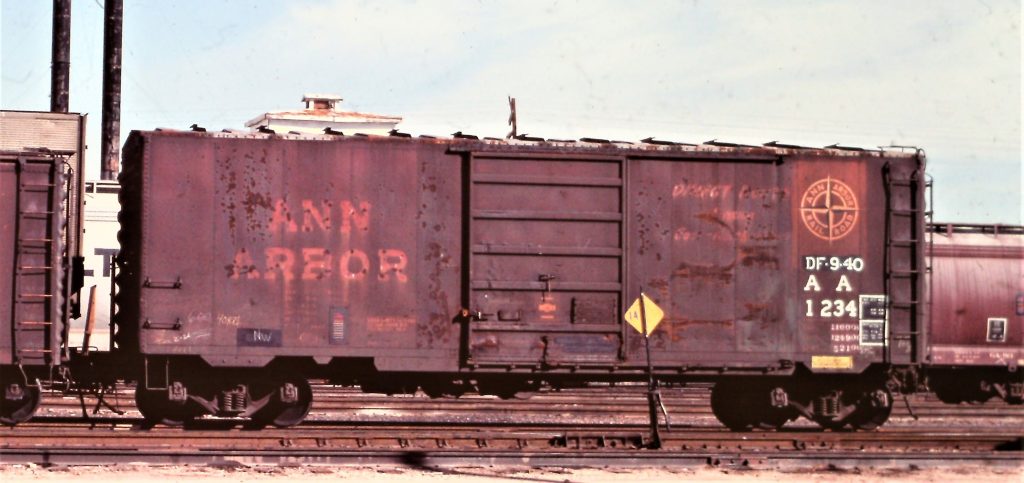
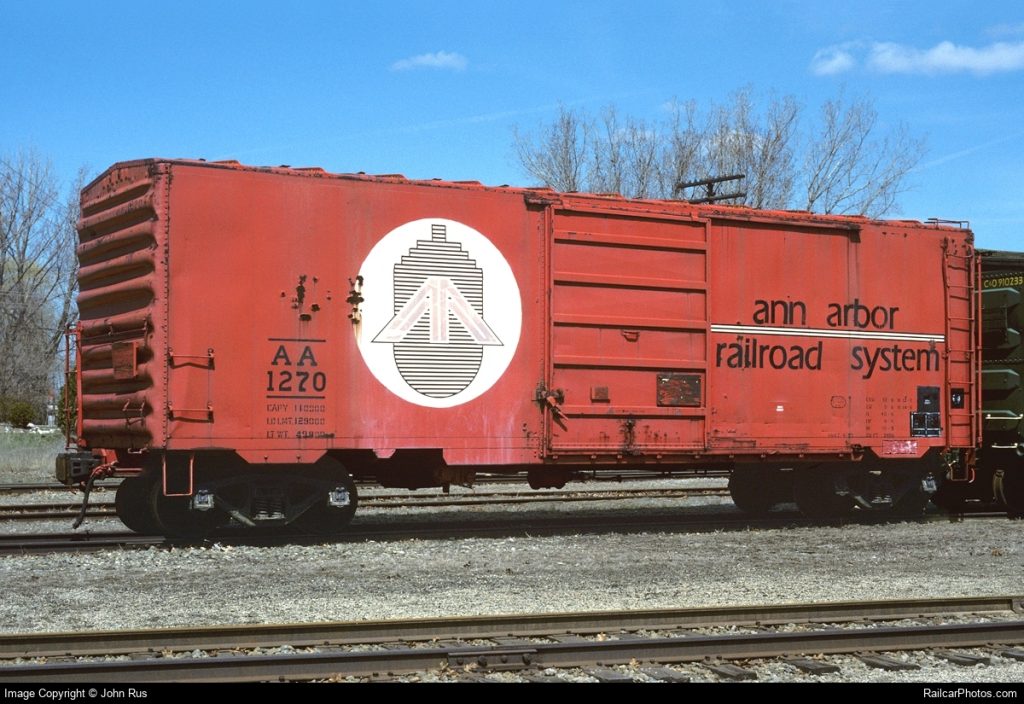
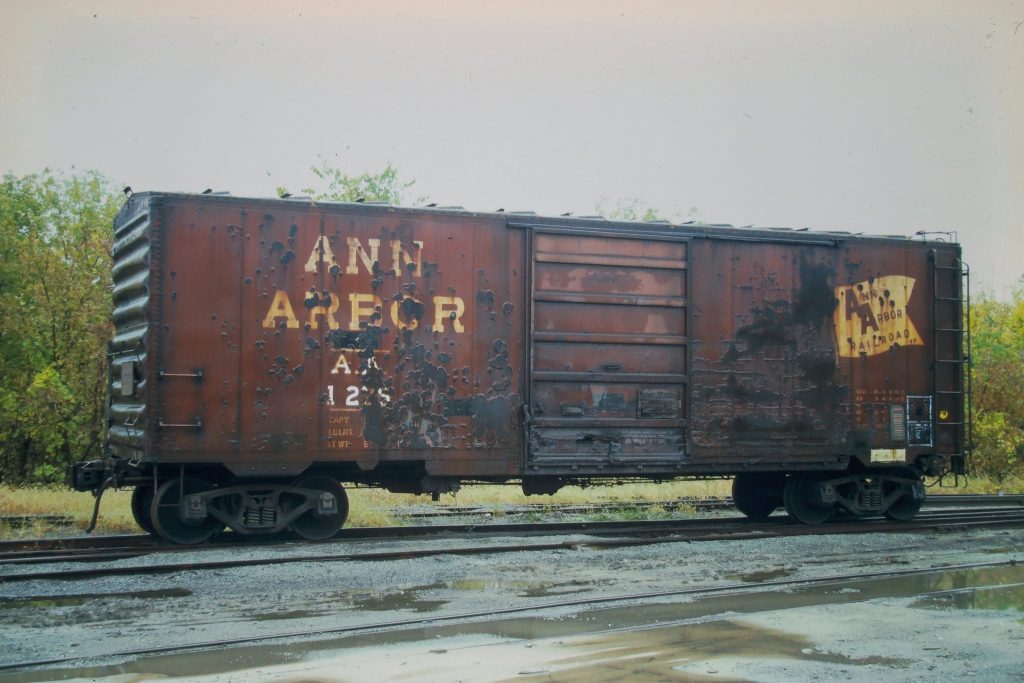
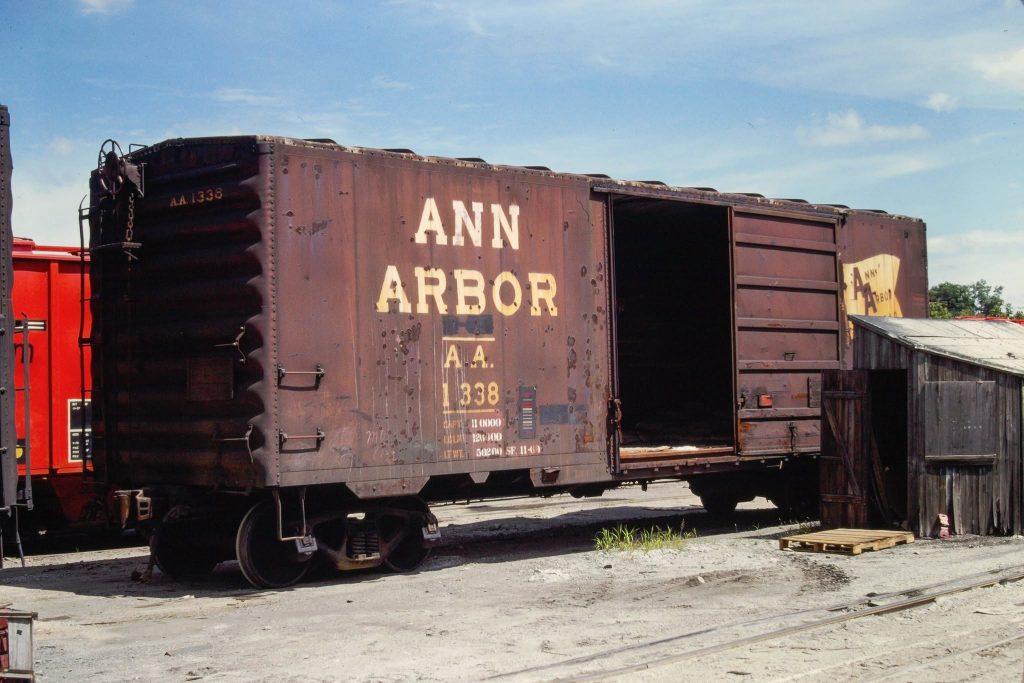
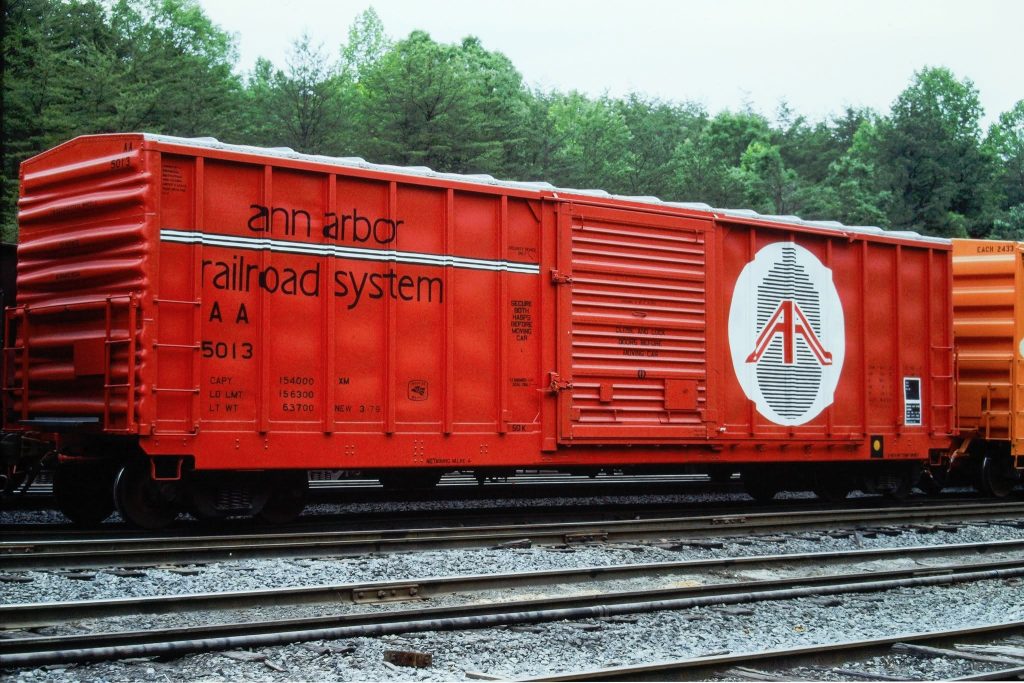
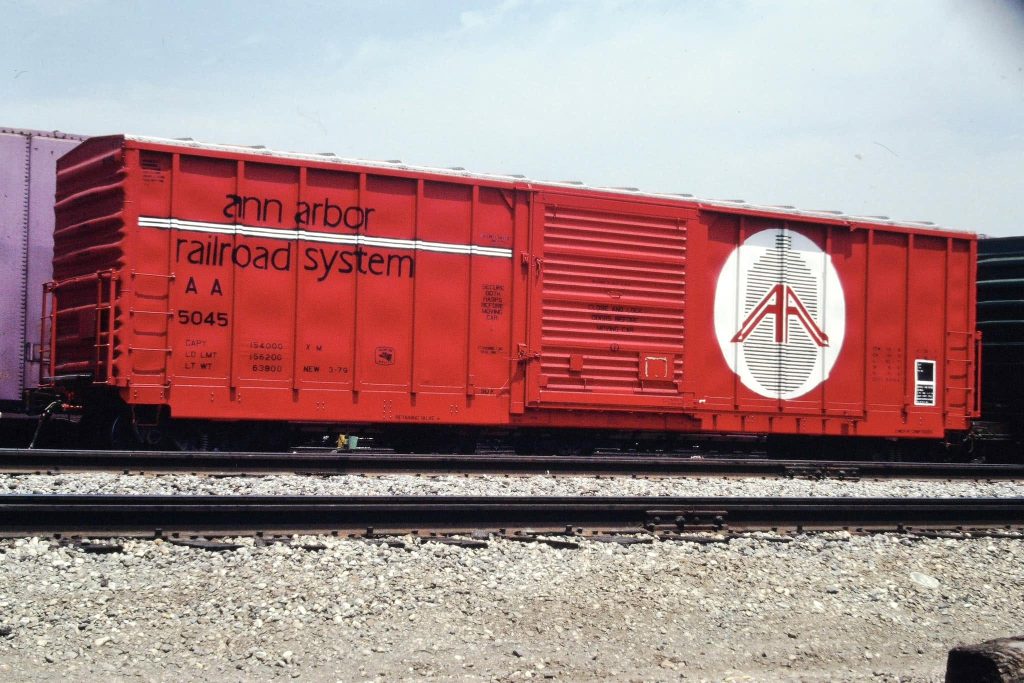
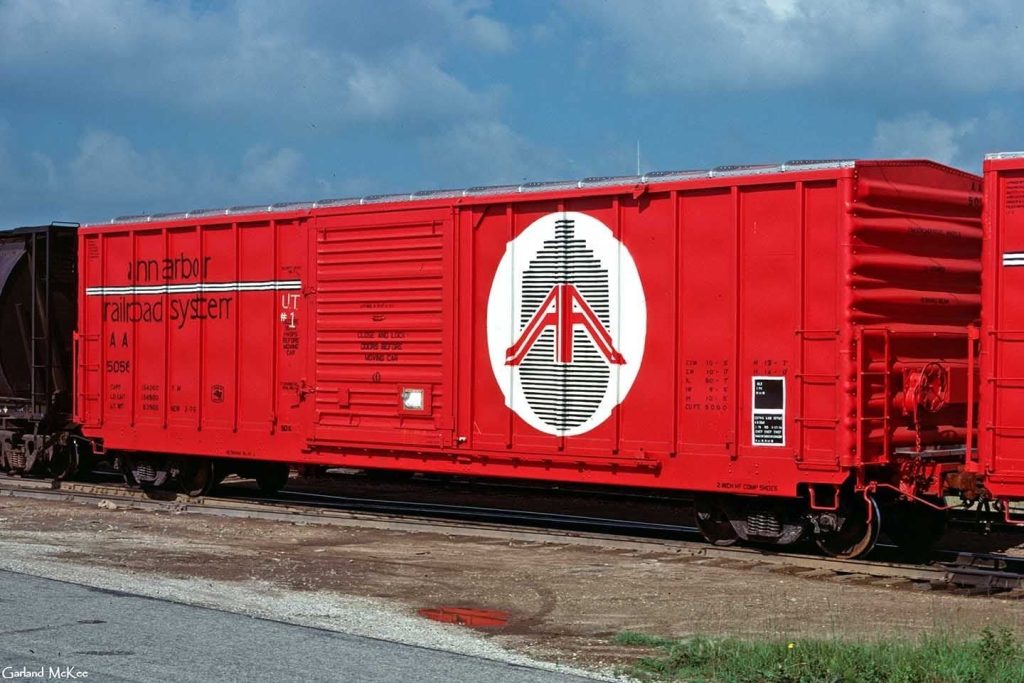
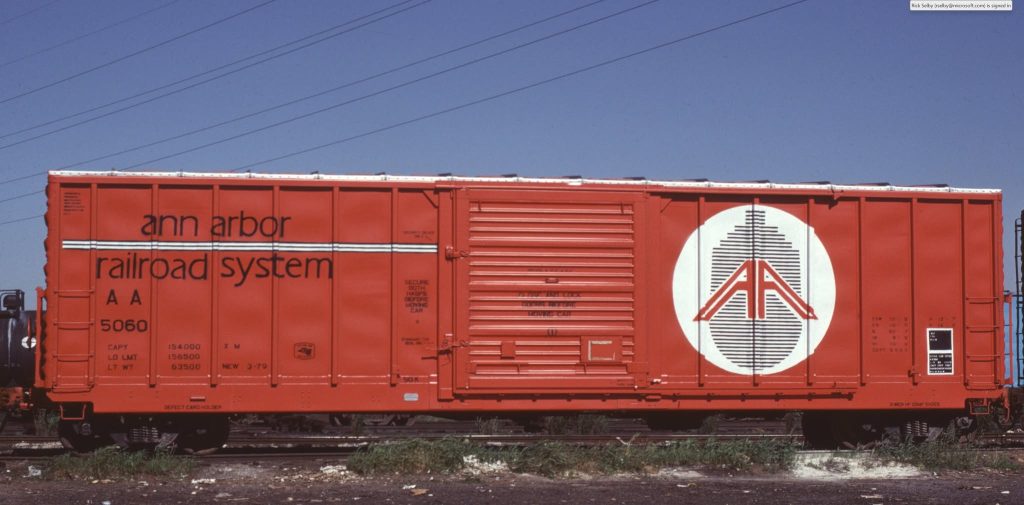
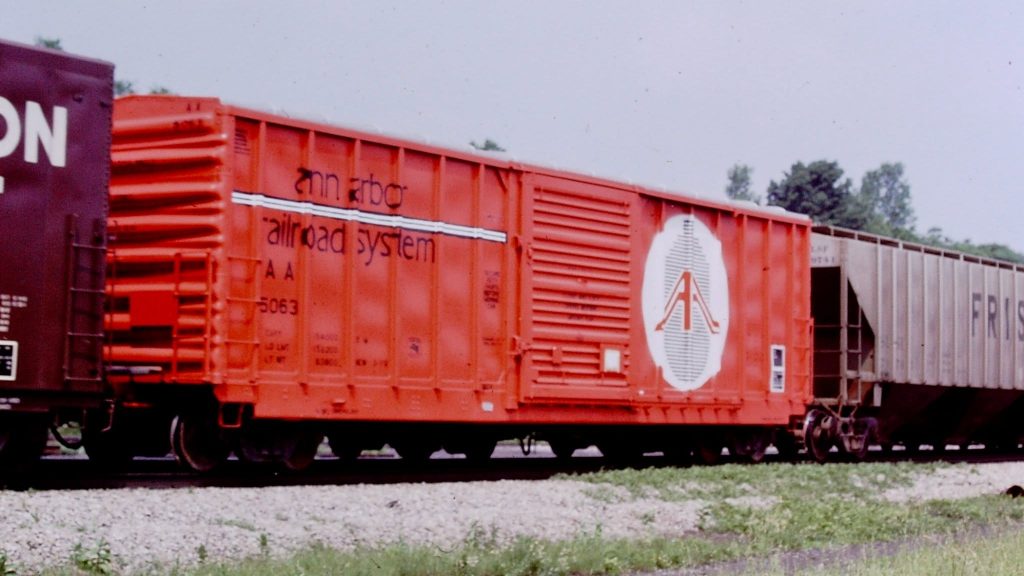
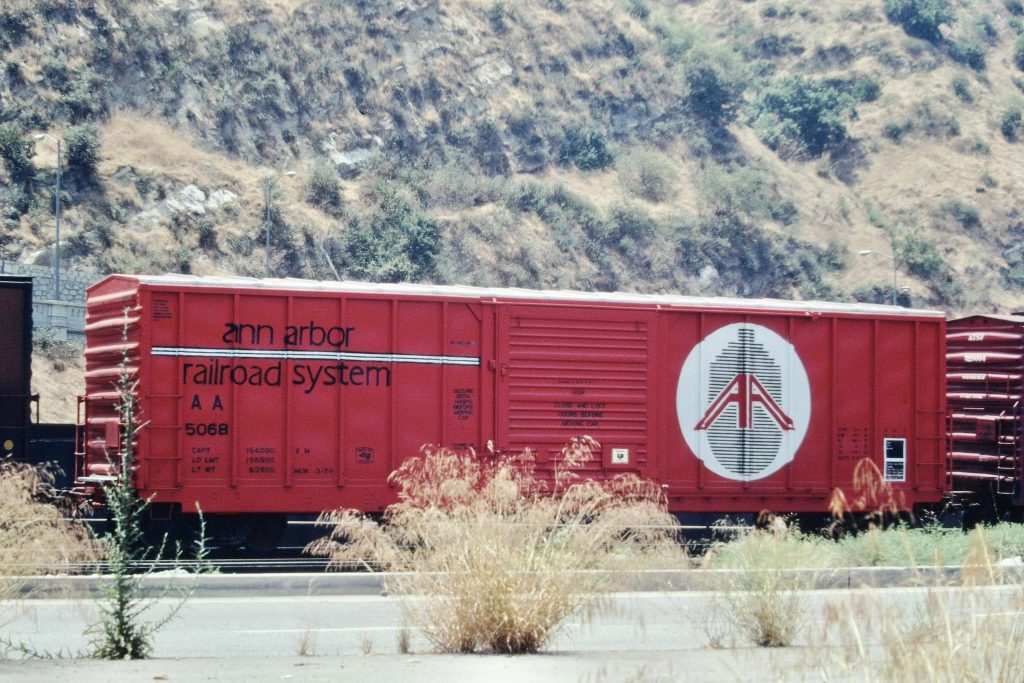
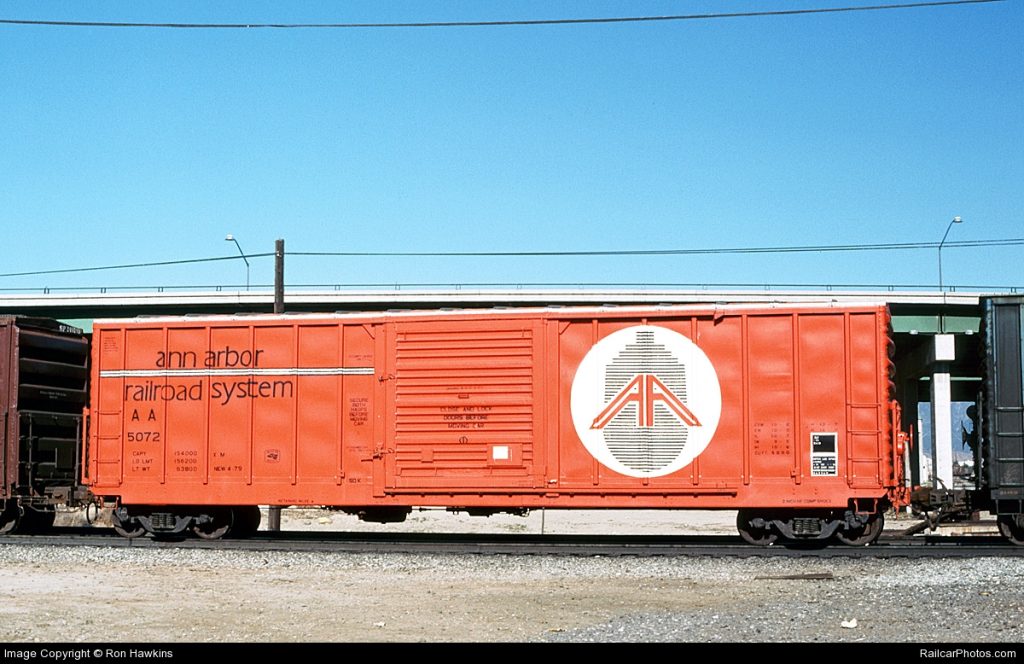
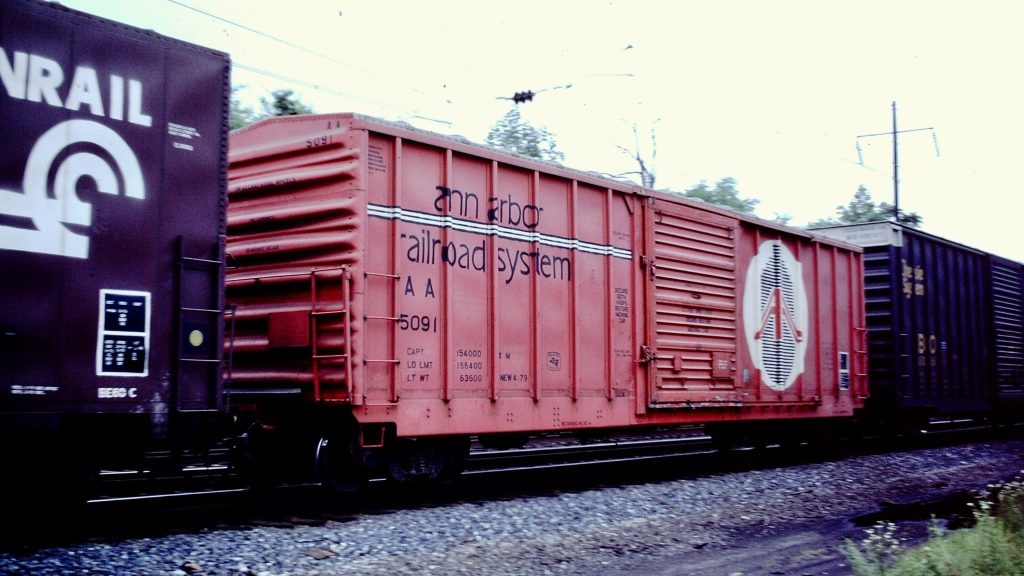
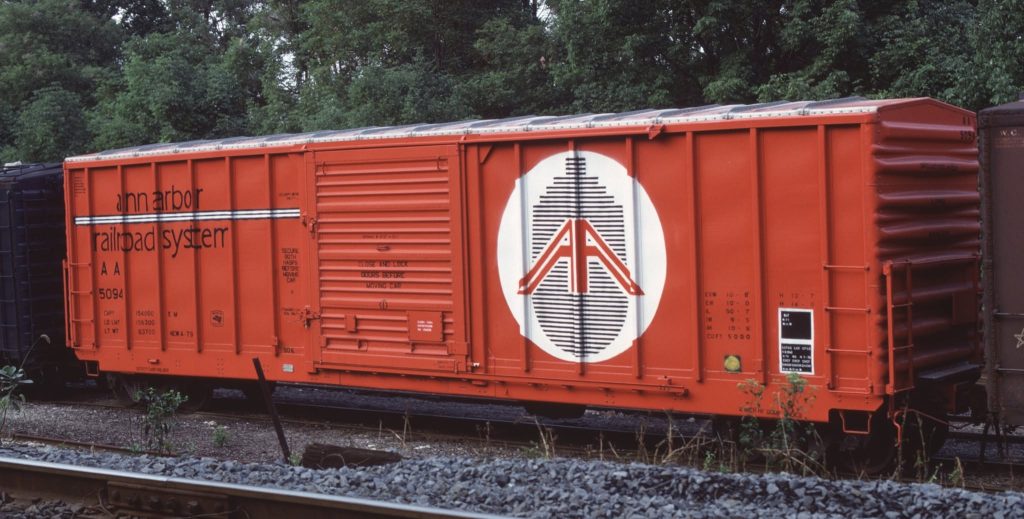
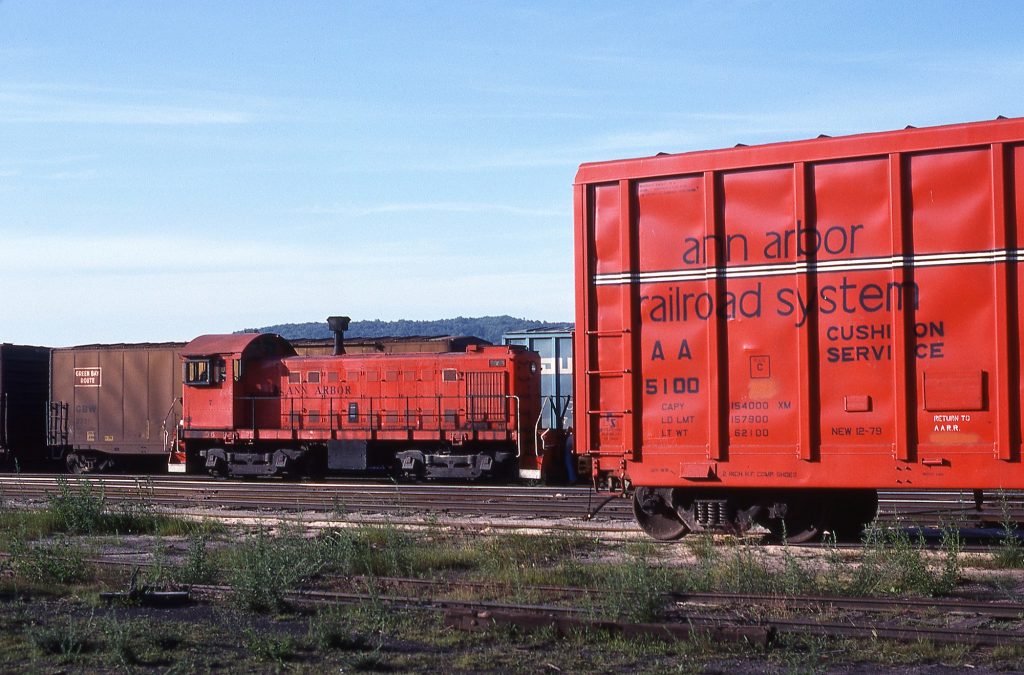
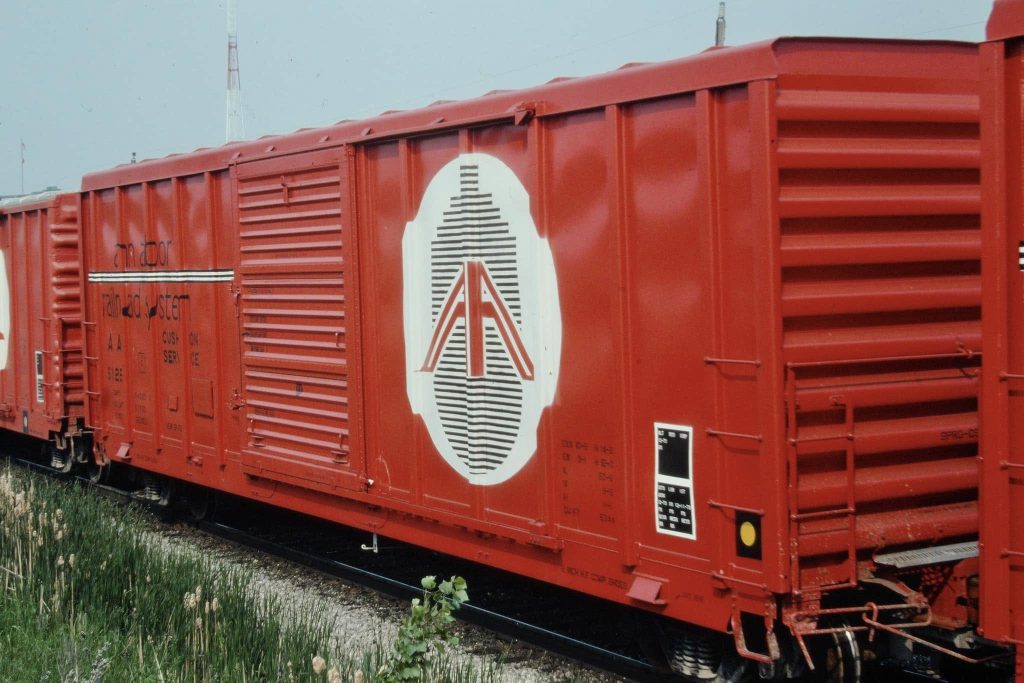
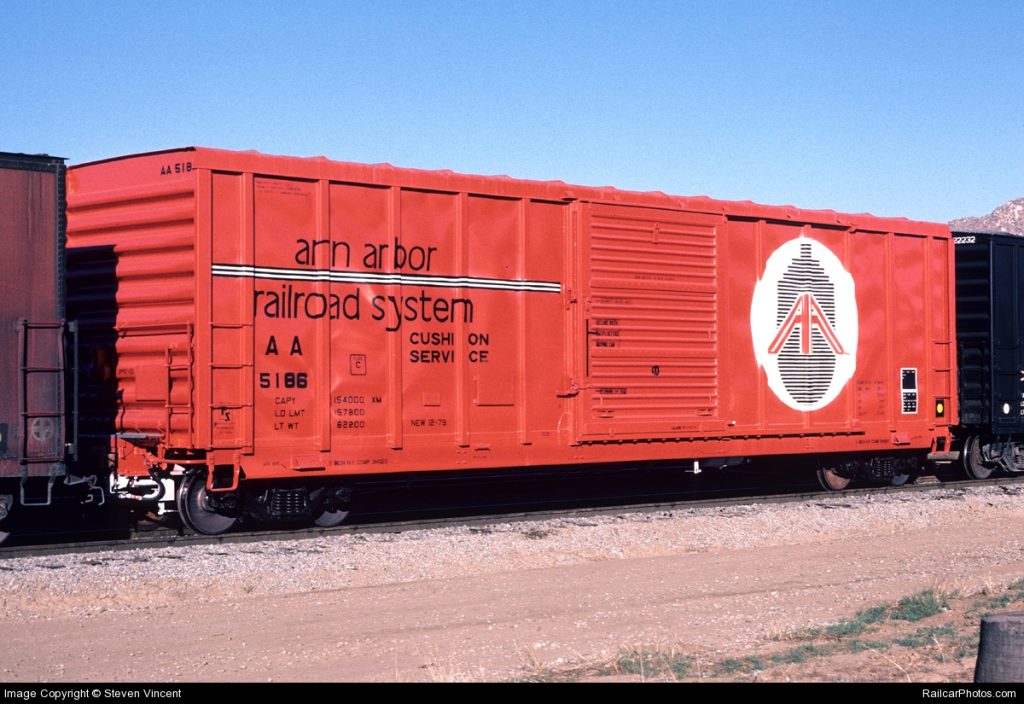
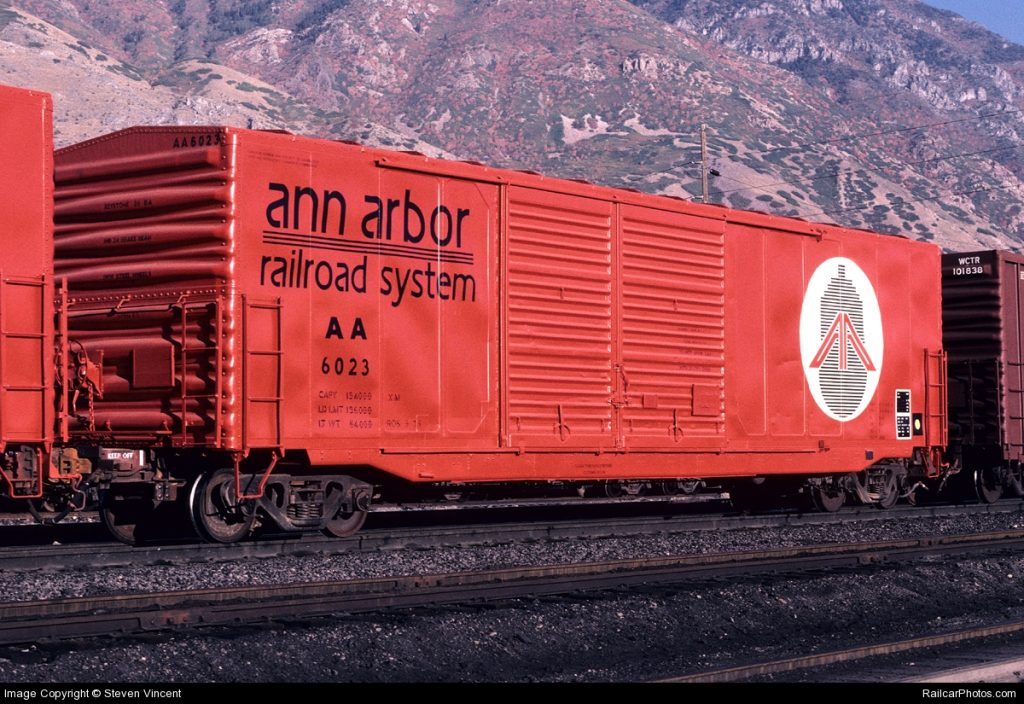
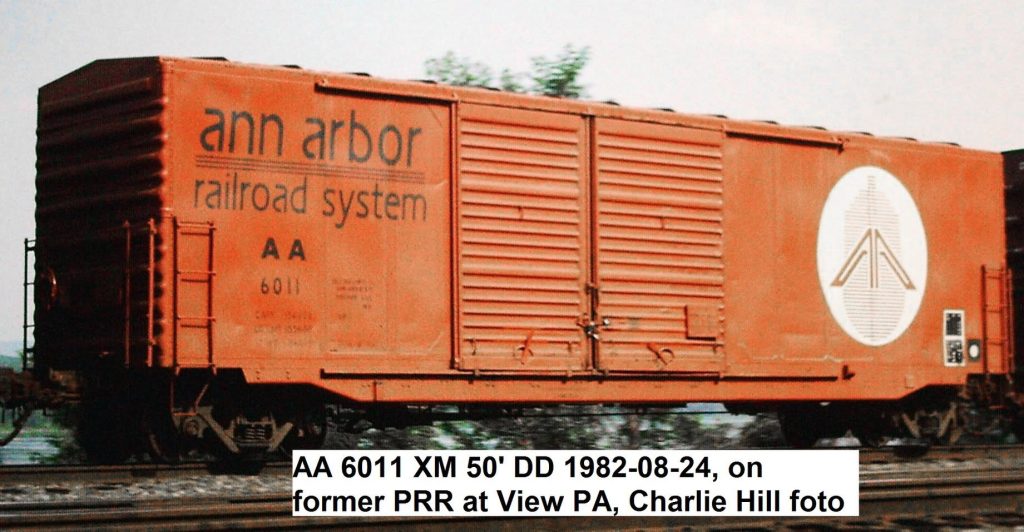
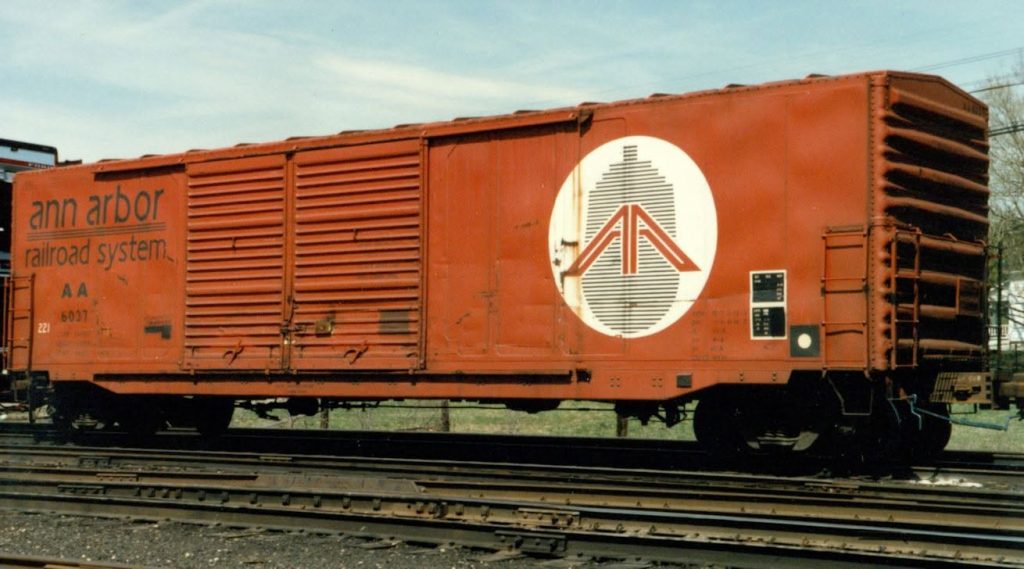
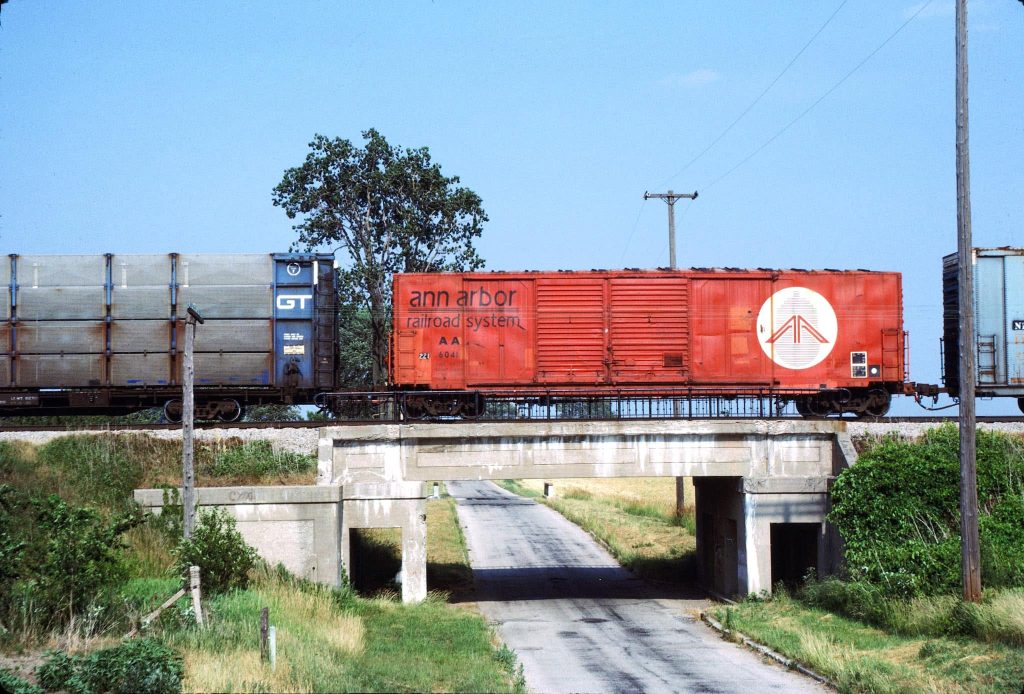
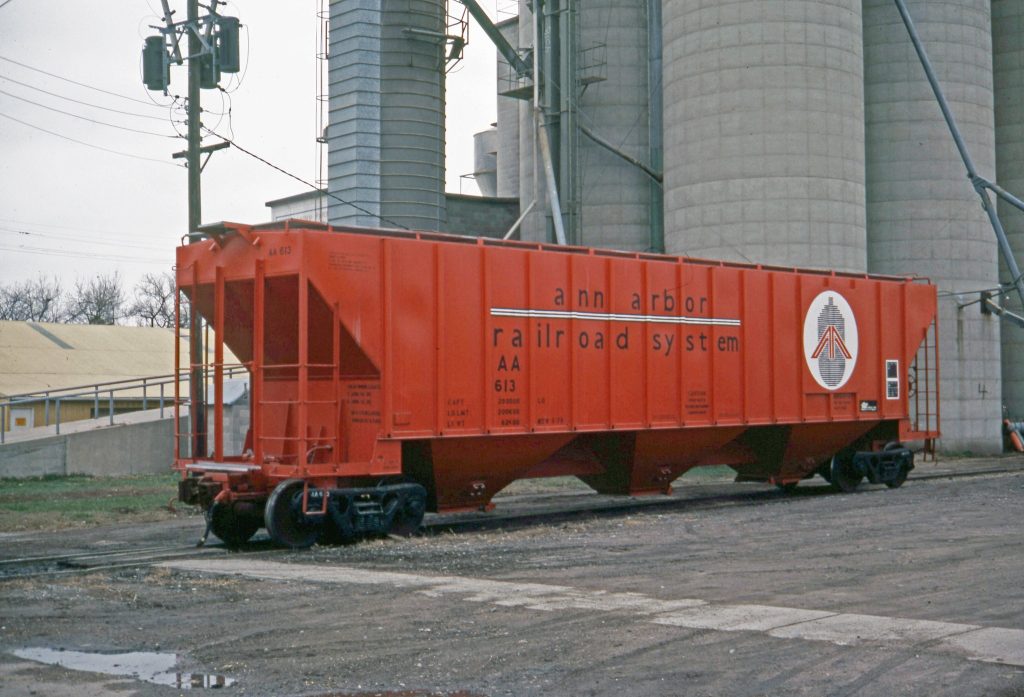
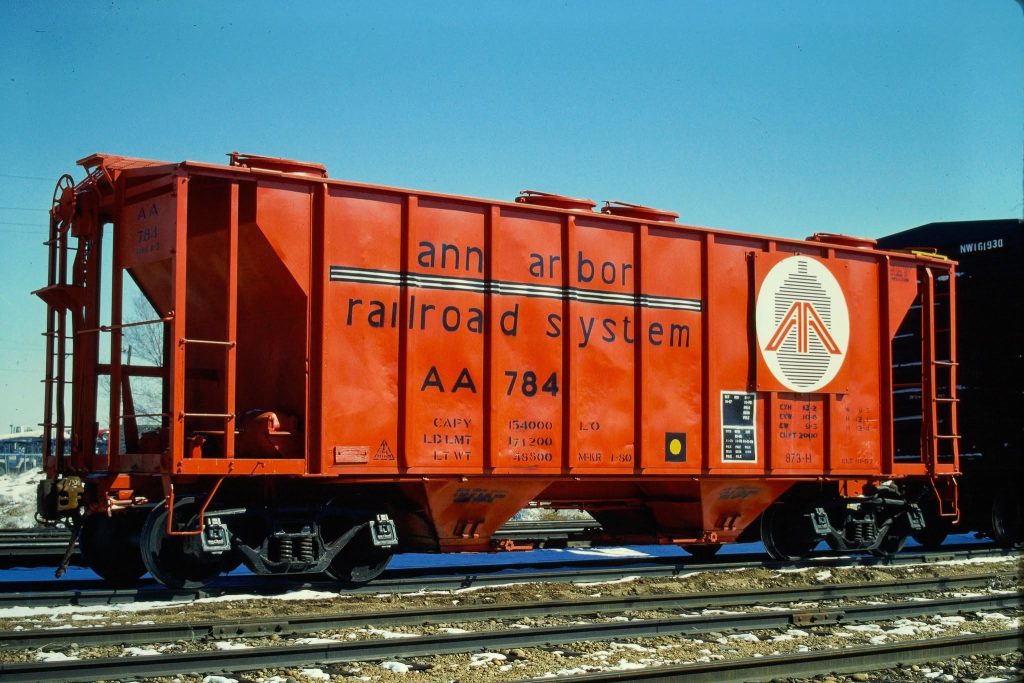
Ann Arbor 40-foot PS-1 boxcar No. 1234 is seen in March 1976, nearly nineteen years after being built by Pullman-Standard in April 1957 as part of the AA 1200-1399 series. Originally delivered in the railroad’s distinctive “Direct Route Linking East-North-West” scheme, the car had since received a DT&I compass herald and been rebuilt for automobile parts service, indicated by the DF-9-40 loading designation for nine belts and forty racks. Still riding on its original friction bearing trucks, the weathered 3,885 cubic foot boxcar represents a type that was rapidly disappearing from interchange service by the mid-1970s. © Robert Warrick Collection Ann Arbor 40-foot PS-1 boxcar No. 1270 stands at Muskegon, Michigan, on 21 April 1993, an extraordinary thirty-six years after being built by Pullman-Standard in April 1957 as part of the AA 1200-1399 series. Repainted into the railroad’s bold corporate red scheme with the large circular “AA” emblem, the veteran 3,956 cubic foot boxcar remained in active service long after many contemporaries had disappeared. Weathering and patched paint hint at decades of hard use, while the striking livery ensured these cars remained among the most recognisable boxcars on North American rails. © John Rus Ann Arbor 40-foot PS-1 boxcar No. 1275 stands at Owosso, Michigan, on 12 October 1985, nearly twenty-nine years after being built by Pullman-Standard in April 1957 as part of the AA 1200-1399 series. The heavily weathered boxcar carries the large 60-inch Ann Arbor pennant herald, a repaint variation applied to a number of the railroad’s freight cars during the 1950s, contrasting with the smaller herald worn by the class when new. Despite extensive paint deterioration, the veteran 3,885 cubic foot boxcar remained in interchange service well into the 1980s. © Peter Hayes Collection Ann Arbor 40-foot PS-1 boxcar No. 1338 stands at Owosso, Michigan, on 13 August 1980, more than two decades after being built by Pullman-Standard in April 1957 as part of the AA 1200-1399 series. With its large Ann Arbor lettering and distinctive Wabash-style pennant still intact, the well-worn 3,885 cubic foot boxcar is a reminder of an earlier era of freight car design, remaining in regular service long after many of its contemporaries had disappeared. © Peter Hayes Collection Ann Arbor boxcar AA 1407 sits out of service at Cadillac, Michigan, in 1985, its weathered paint and rust-streaked sides reflecting years of hard use. Built as part of the railroad’s distinctive fleet of 40-foot boxcars, the car still carries traces of the Ann Arbor Railroad herald despite its faded condition. By the mid-1980s, many older boxcars such as this had become surplus as changes in freight traffic and car utilisation brought an end to their mainline careers. © Thomas Bowers Ann Arbor Railroad System 50-foot boxcar No. 5013 stands nearly new in 1979, having been built by Constructora Nacional de Carros de Ferrocarril (CNCF) in March 1979 as part of the AA 5000-5099 series. The 100-car fleet featured a 5,000 cubic foot capacity and was acquired to modernise the railroad’s general merchandise fleet. Finished in the striking bright red Ann Arbor Railroad System livery with its distinctive circular “AA” emblem, these cars quickly became some of the most recognisable boxcars on the North American rail network. © Peter Hayes Collection Ann Arbor Railroad System 50-foot 6-inch boxcar No. 5045 is seen at Commerce, California, in August 1979, just months after its construction by Constructora Nacional de Carros de Ferrocarril (CNCF) in March 1979. One of the 100 cars in the 5000-5099 series, these 5,000 cubic-foot Plate B boxcars represented a significant investment in modern freight equipment as the revitalised Ann Arbor sought to grow its bridge traffic business. Their striking bright red livery and bold circular AA emblem ensured they stood out wherever they travelled, quickly becoming one of the most recognisable freight car designs of the late 1970s. © Dennis Dave Ann Arbor Railroad System 50-foot boxcar No. 5056 is seen in July 1979, only months after its construction by Constructora Nacional de Carros de Ferrocarril (CNCF) in Mexico. One of 100 cars in the 5000-5099 series, these 5,000 cubic foot boxcars entered service during the spring of 1979 and quickly became ambassadors for the Ann Arbor across the North American interchange network. Finished in the railroad’s striking bright red corporate livery with the oversized circular “AA” emblem, No. 5056 still appears factory fresh, reflecting the railroad’s investment in a modern, high-capacity general merchandise fleet during the late 1970s. Photo by Garland McKee. © Garland McKee Collection Ann Arbor Railroad System 50-foot boxcar No. 5060 stands at Croxton Yard, New Jersey, during October 1979, only months after its completion by Constructora Nacional de Carros de Ferrocarril (CNCF) in March 1979. Built as one of 100 cars in the 5000-5099 series, these 5,000 cubic foot Plate B boxcars were among the newest additions to the Ann Arbor’s freight car fleet and wore the railroad’s bold red corporate livery with the oversized circular “AA” emblem. Their appearance in one of Conrail’s principal eastern classification yards illustrates how rapidly the Ann Arbor’s modern interchange fleet spread across the North American rail network, carrying general merchandise traffic far beyond the railroad’s Michigan home. Photo by Walter Matuch. © Rick Selby Collection Ann Arbor Railroad System 50-foot boxcar No. 5063 passes through Lyons, New York, during the late summer of 1979. One of 100 boxcars in the 5000-5099 series built by Constructora Nacional de Carros de Ferrocarril (CNCF) in Mexico during April 1979, the class represented one of the Ann Arbor’s newest additions to its nationwide interchange fleet. Finished in the railroad’s striking bright red corporate livery with the oversized circular “AA” emblem, these 5,000 cubic foot boxcars were intended for general merchandise service and could be found across North America only months after entering service. Photographed shortly after delivery, No. 5063 still carries its factory-fresh appearance, illustrating the Ann Arbor’s investment in modern freight equipment during the late 1970s. Photo by Guy Wicksall. © Jered Slusser Collection Ann Arbor Railroad System 50-foot 6-inch boxcar No. 5068 is seen at Los Angeles, California, in June 1979, just three months after construction by Constructora Nacional de Carros de Ferrocarril (CNCF) in Mexico. Part of the 5000-5099 series, these 5,000 cubic-foot Plate B boxcars were acquired to support the railroad’s expanding bridge traffic business and quickly dispersed across the North American rail network. The rugged Southern California landscape provides a fitting backdrop to one of the Ann Arbor’s striking new bright red boxcars, whose bold “Ann Arbor Railroad System” lettering and distinctive circular AA emblem made them instantly recognisable wherever they travelled. © Dennis Docken Ann Arbor Railroad System 50-foot boxcar No. 5072 is photographed at Colton, California, on 27 December 1979, only months after being built by Constructora Nacional de Carros de Ferrocarril (CNCF) in April 1979 as part of the AA 5000-5099 series. With its 5,000 cubic foot capacity and distinctive bright red corporate livery, the car exemplified the Ann Arbor’s investment in a modern boxcar fleet. Its presence in Southern California so soon after delivery highlights the extensive reach of North American interchange service, carrying the Ann Arbor’s striking image thousands of miles from its Michigan home. © Ron Hawkins Ann Arbor Railroad System 50-foot boxcar No. 5091 passes through Pennsylvania during July 1981, illustrating how the small Michigan carrier’s modern freight car fleet ranged far beyond its home rails. Built in Mexico by Constructora Nacional de Carros de Ferrocarril (CNCF) in April 1979 as part of the 5000-5099 series, the 5,000 cubic foot boxcar wears the railroad’s distinctive bright red corporate livery with the large circular “AA” emblem. Sandwiched between Conrail and other eastern railroad equipment, No. 5091 demonstrates the reach of the North American interchange network, which regularly carried Ann Arbor freight cars thousands of miles from Michigan. Photo by Guy Wicksall. © Jered Slusser Collection Ann Arbor Railroad System 50-foot 6-inch boxcar No. 5094 appears virtually new in September 1979, only a few months after emerging from Constructora Nacional de Carros de Ferrocarril (CNCF) in Mexico. Part of the 5000-5099 series built in April 1979, these 5,000 cubic-foot Plate B boxcars were purchased to expand the Ann Arbor’s nationwide bridge traffic business following the railroad’s resurgence under Michigan Interstate ownership. Their brilliant red finish, modern “Ann Arbor Railroad System” lettering and distinctive circular AA emblem made them among the most eye-catching freight cars of the era, and they were soon travelling widely across North America in interchange service. © Rod Loder Collection Freshly delivered Ann Arbor Railroad System 50-foot boxcar No. 5100 dominates the foreground at Frankfort, Michigan, on 18 June 1981, while Ann Arbor ALCO S3 No. 7 shunts the yard beyond. Built by Pullman-Standard in December 1979 as part of the AA 5100-5199 series, the 5,344 cubic foot boxcar represents the railroad’s newest freight car design, contrasting with the veteran 660 hp switcher that had been working the Ann Arbor for more than three decades. © Stanley Short Ann Arbor Railroad System 50-foot 6-inch cushioned-service boxcar No. 5129 is photographed at Joliet, Illinois, on 25 May 1980. Built by Pullman-Standard in February 1979 as part of the railroad’s 5100-5199 series, the Plate C car was one of 100 modern 5,344 cubic-foot boxcars acquired to strengthen the Ann Arbor’s bridge traffic business. Finished in the railroad’s striking bright red “Ann Arbor Railroad System” livery with the large circular AA emblem, these cars quickly became ambassadors for the railroad, ranging widely across North America in interchange service and appearing on railroads far removed from their Michigan home. Photo by Diesel Dave. © David Smith Collection Ann Arbor Railroad System 50-foot boxcar No. 5186 is photographed at Highgrove, California, on 27 December 1979, shortly after being built by Pullman-Standard in December 1979 as part of the AA 5100-5199 series. Featuring a 5,344 cubic foot capacity and Plate C clearance, the class represented the railroad’s most modern boxcar design. Less than a month after delivery, No. 5186 had already travelled across the continent, illustrating the extensive reach of North American interchange service while displaying the Ann Arbor’s striking bright red corporate livery in pristine condition. © Steve Vincent Ann Arbor Railroad System 50-foot boxcar No. 5188 is photographed in the Valle de México on 19 February 1982, highlighting the extraordinary distances travelled by North American freight cars in interchange service. Built by Pullman-Standard in December 1979 as part of the AA 5100-5199 series, the Plate C boxcar offered a 5,344 cubic foot capacity and represented the most modern boxcar design on the Ann Arbor roster. Just over two years after delivery, No. 5188 had travelled from its Michigan home to central Mexico, still carrying the railroad’s distinctive bright red corporate livery. © Matt Herson Ann Arbor Railroad System 50-foot cushioned-service boxcar No. 5199 stands at Calumet City, Illinois, on 14 February 1981. Built by Pullman-Standard in December 1979 as the final car in the AA 5100-5199 series, it formed part of a modern fleet of 100 Plate C, 5,344 cubic foot boxcars acquired to compete for high-value, damage-sensitive freight. Finished in the railroad’s striking red corporate livery with the large “AA” emblem, these cars quickly dispersed across the North American interchange network, making appearances far from their Michigan home. © Thomas Golden Ann Arbor Railroad System 50-foot boxcar No. 6023 is seen at Provo, Utah, on 9 October 1979. Built by American Car & Foundry in October 1966 for the Denver & Rio Grande Western as part of the 63300-63499 series, the car was acquired second-hand by the Ann Arbor and renumbered into the 6000-6049 series. Repainted into the railroad’s distinctive bright red corporate livery with the large “AA” emblem, it illustrates the Ann Arbor’s strategy of supplementing its home-built freight car fleet with quality second-hand equipment to expand its presence in the North American interchange boxcar market. The dramatic Wasatch Mountains provide an unmistakable western backdrop, far from the railroad’s Michigan home. © Steven Vincent Ann Arbor Railroad System 50-foot 6-inch double-door boxcar No. 6011 passes View, Pennsylvania, on the former Pennsylvania Railroad on 24 August 1982. Originally built by American Car & Foundry in October 1966 for the Denver & Rio Grande Western, the car was acquired second-hand by the Ann Arbor as part of its 6000-6049 series. Repainted into the railroad’s striking red “Ann Arbor Railroad System” scheme, these 4,941 cubic-foot Plate B boxcars helped expand the railroad’s bridge traffic fleet and soon became familiar sights far beyond Michigan, travelling widely in interchange service across North America. © Charlie Hill Ann Arbor Railroad System 50-foot boxcar No. 6037 is seen after joining the Ann Arbor fleet, still wearing the railroad’s distinctive bright red corporate paint scheme. Originally built for the Denver & Rio Grande Western as part of the D&RGW 63300-63499 series, the car was acquired second-hand by the Ann Arbor and renumbered into the 6000 series. Its 10-foot Youngstown plug door made it particularly suitable for handling paper and other lading requiring improved weather protection, illustrating how the Ann Arbor supplemented its home-built fleet with quality second-hand equipment during the late 1970s and early 1980s. © Jurgen Kleylein Collection Ann Arbor Railroad System 50-foot boxcar No. 6041 crosses a rural highway on the Detroit, Toledo & Ironton Railroad south of Delta, Ohio, in June 1988. Built by American Car & Foundry in October 1966 for the Denver & Rio Grande Western, the car was one of 50 second-hand boxcars acquired by the Ann Arbor and renumbered into the 6000-6049 series. Wearing the railroad’s distinctive bright red corporate livery, No. 6041 reflects the importance of the DT&I connection, which provided the Ann Arbor with a vital gateway to the national rail network and carried its freight cars far beyond Michigan. By the late 1980s, although the railroad itself had changed significantly, these ex-Rio Grande boxcars remained familiar sights in interchange service across the Midwest. © Martin Burk Collection Nos. Type Notes AA 1200-1399 40′ Box Car; PS-1 PS (Lot 8338); 4/1957 AA 1400-1409 40′ Box Car; PS-1 Pulman-Standard, built 1960. AA 5000-5099 50′ Box Car 100 cars. CNCF (Constructora Nacional de Carros de Ferrocarril) 5,000 cu.ft; 1979 AA 5100-5199 50′ Box Car PS 5,344 cu.ft (Lot 1044A); 12/1979. leased from BRAE corp. AA 6000-6049 50′ Box Car ex D&RGW 63300-63499 AA 10000-10019 86′ Box Car Greenville Steel Car Co. (Order 1164B); 1978
Covered Hoppers
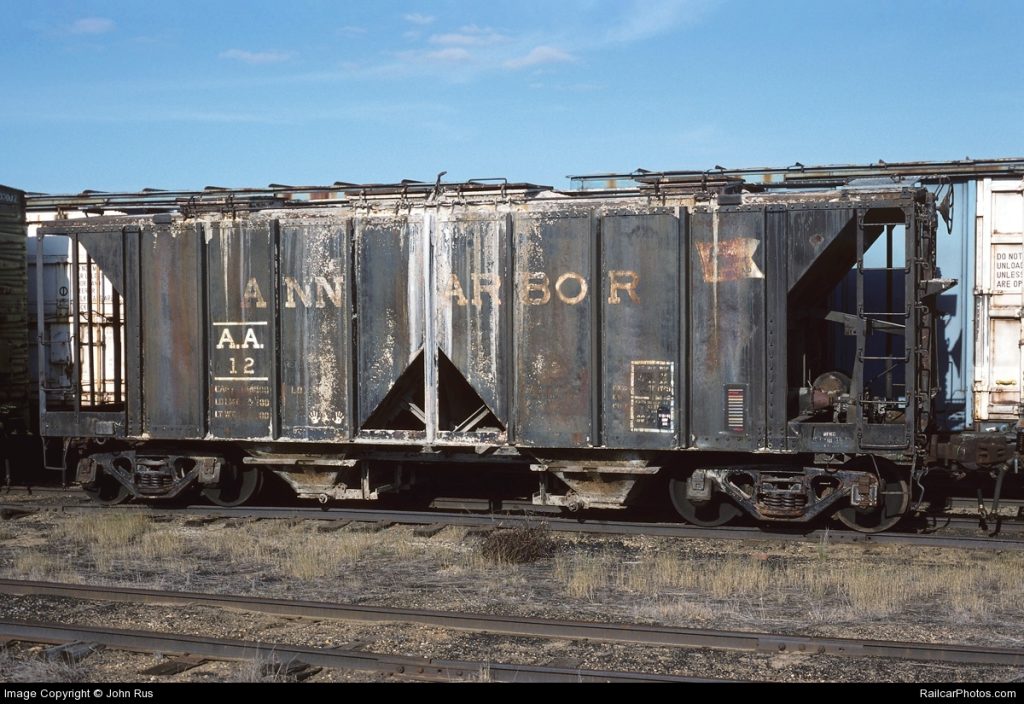
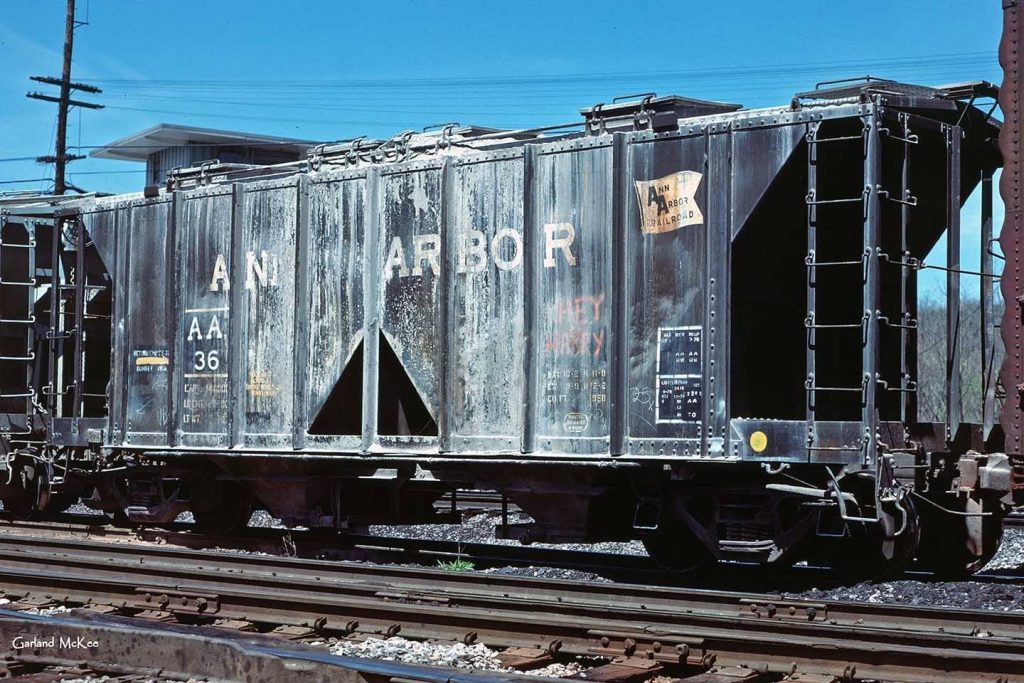
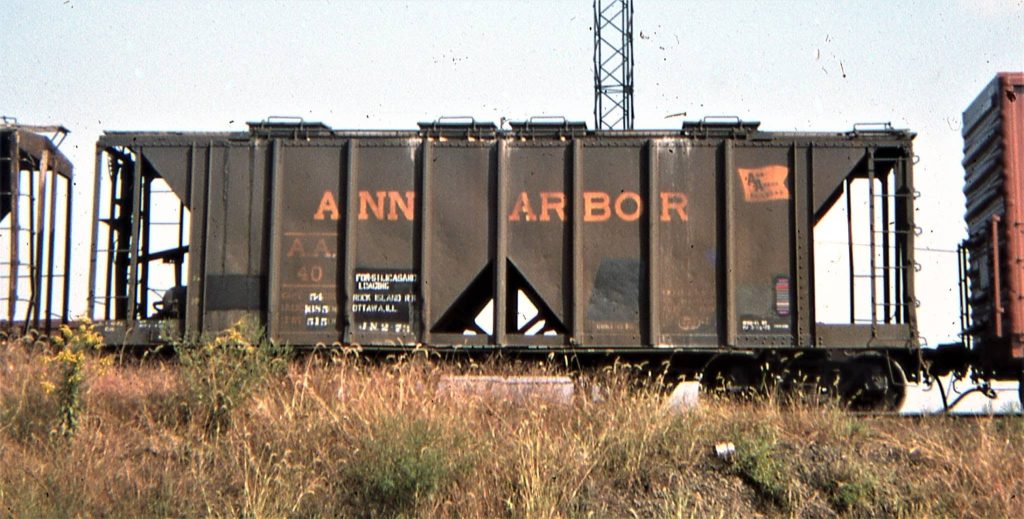
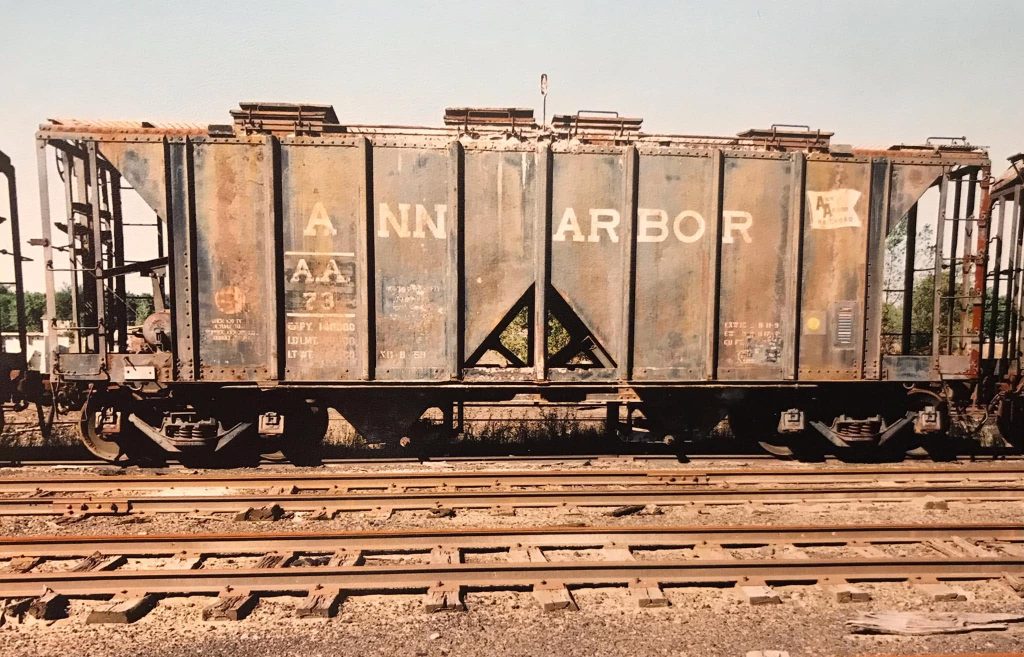
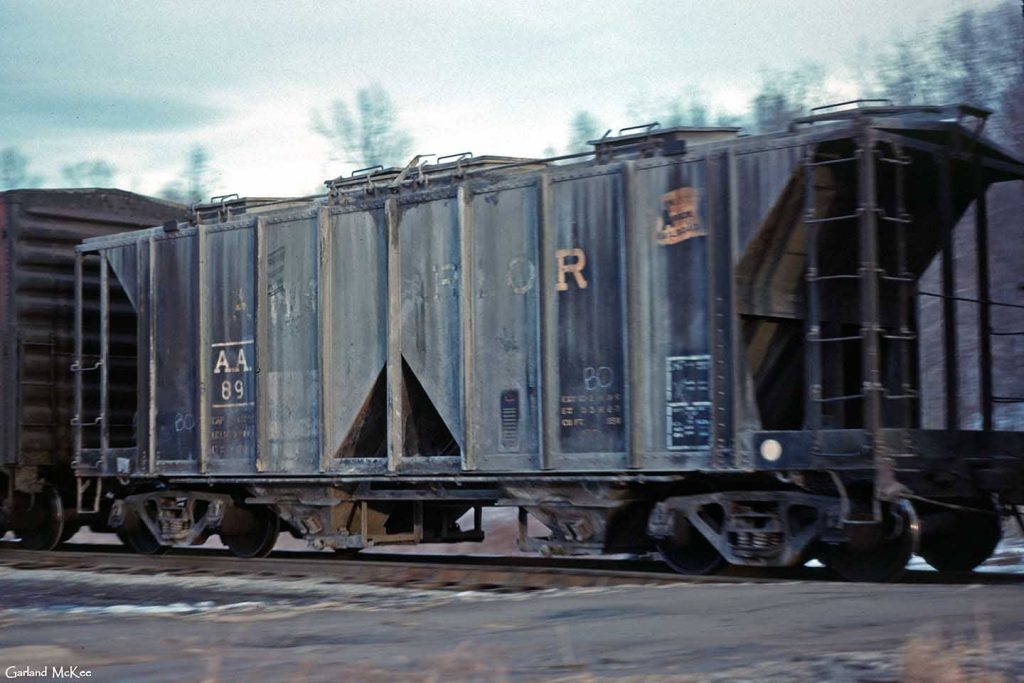
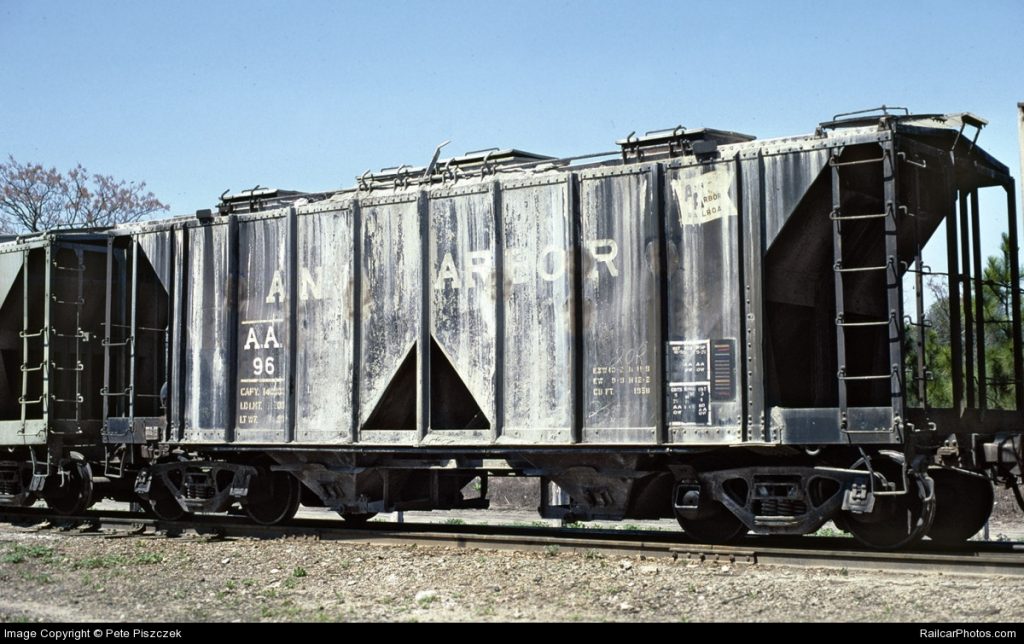
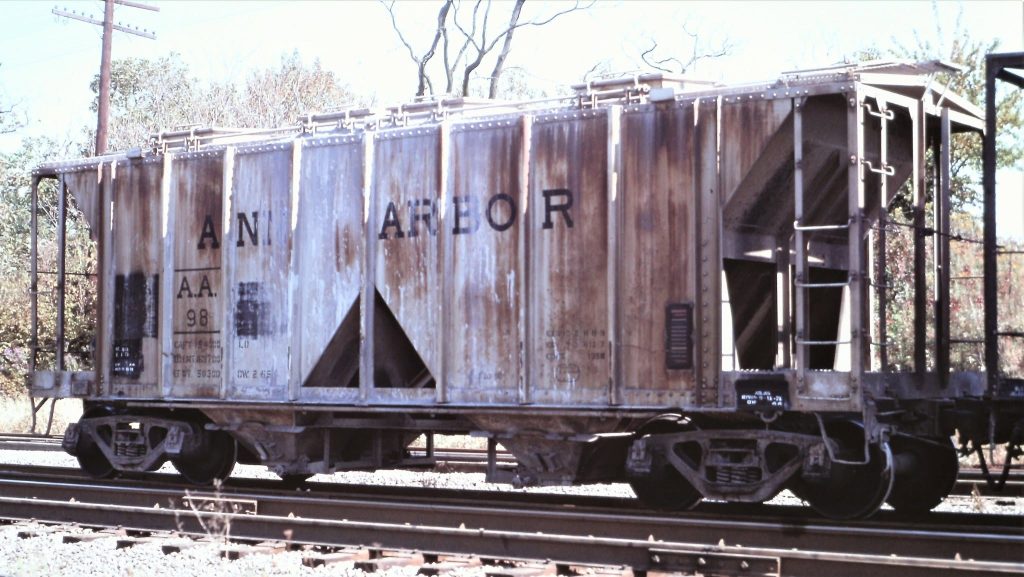
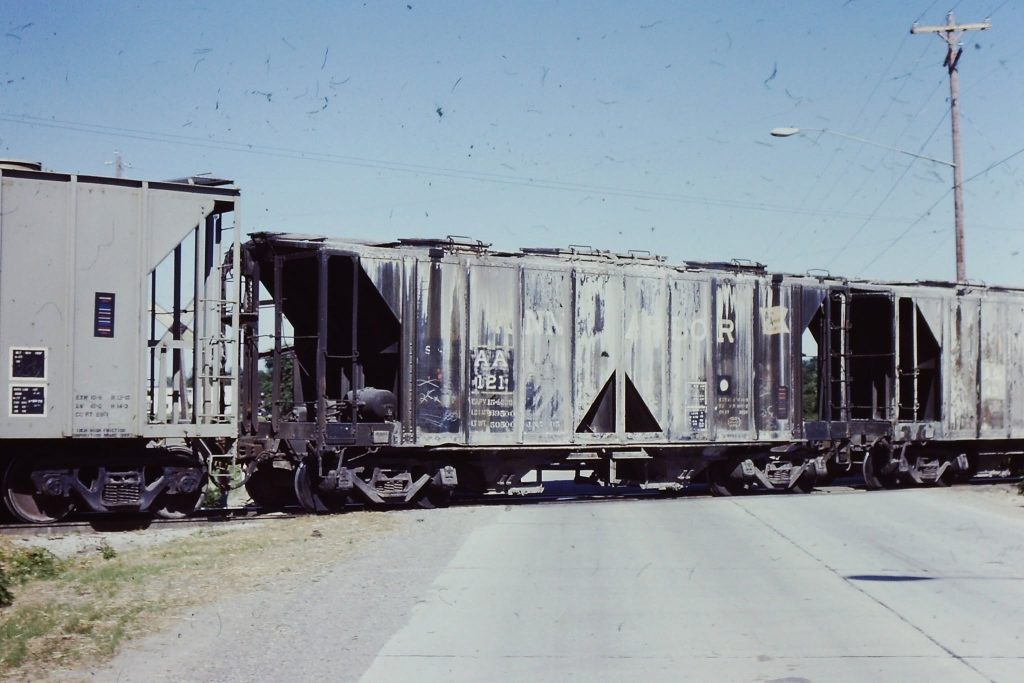
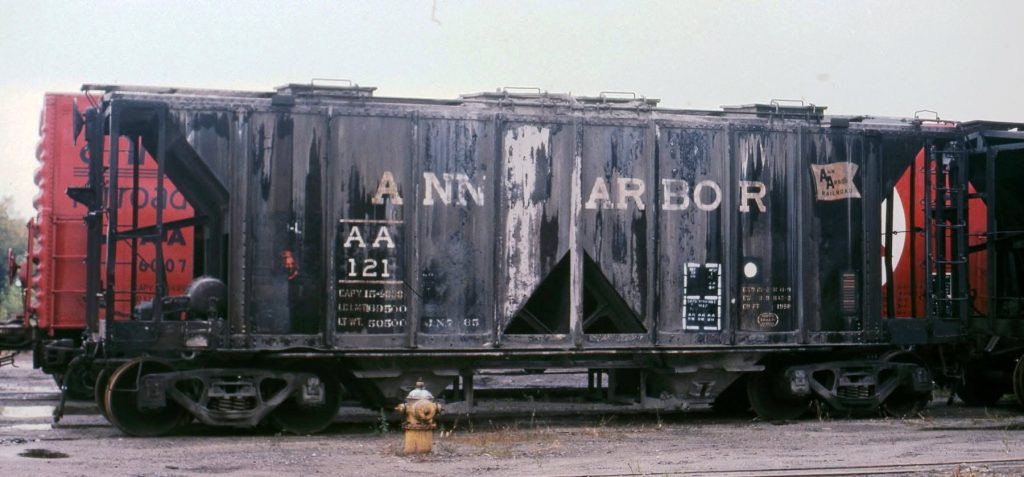
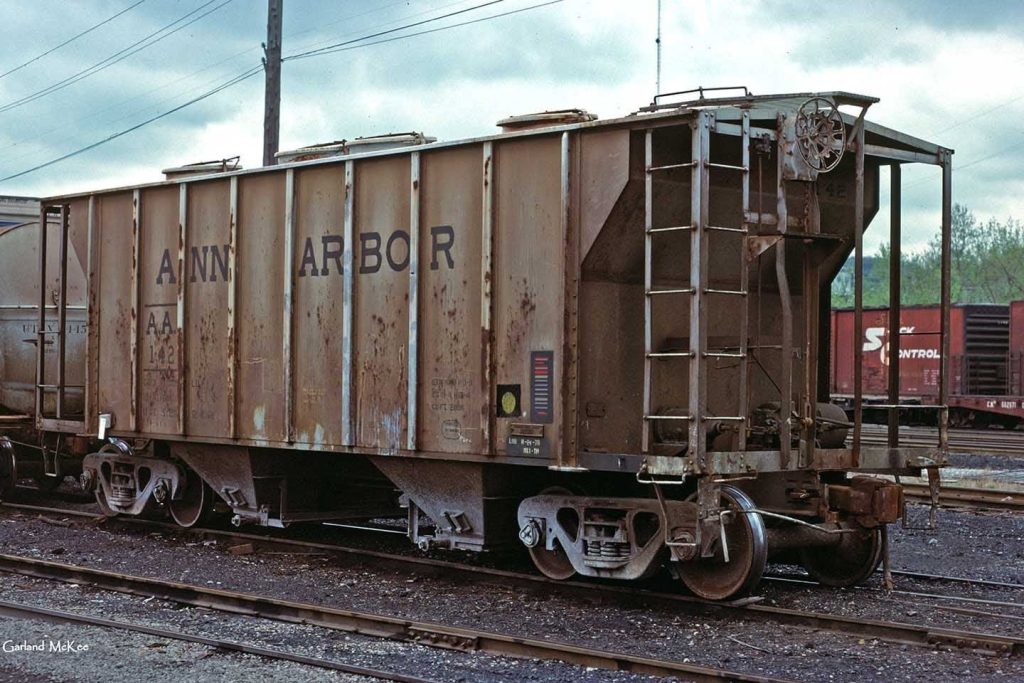
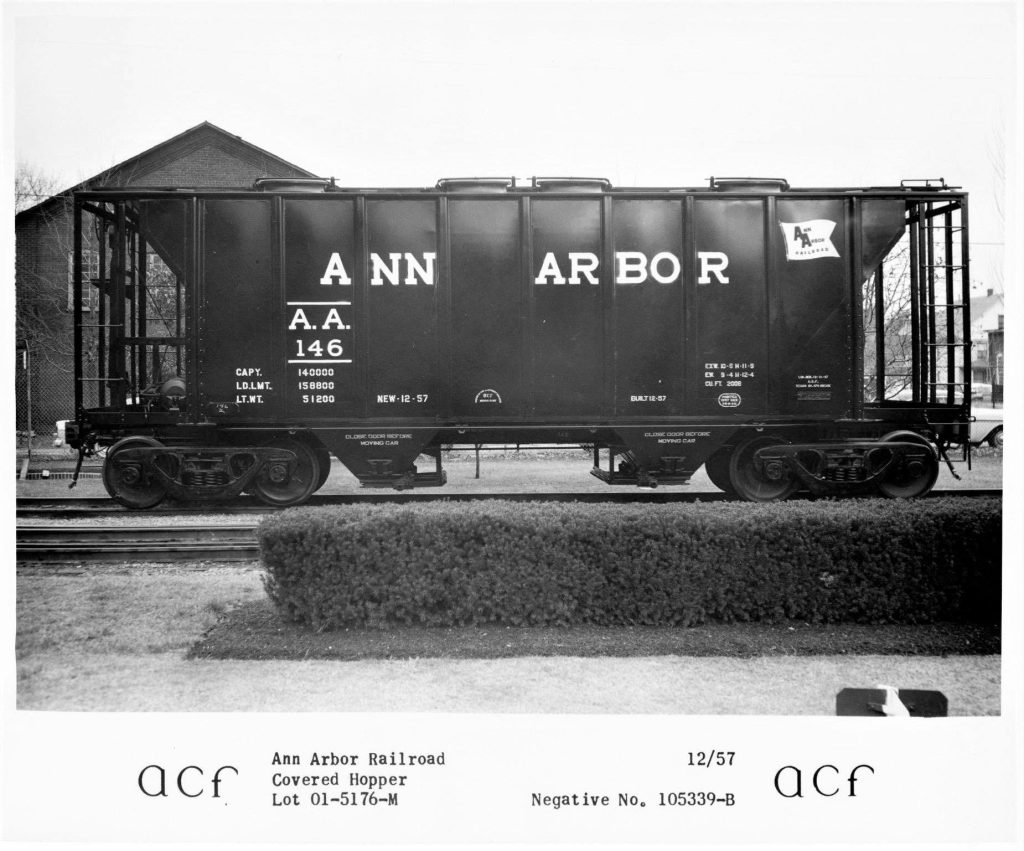
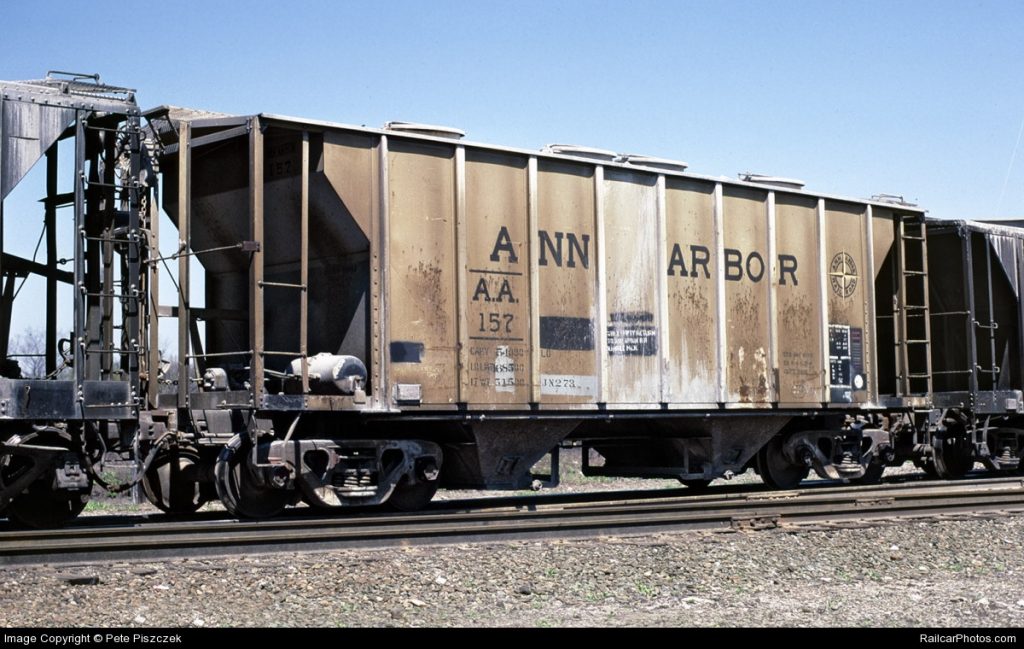
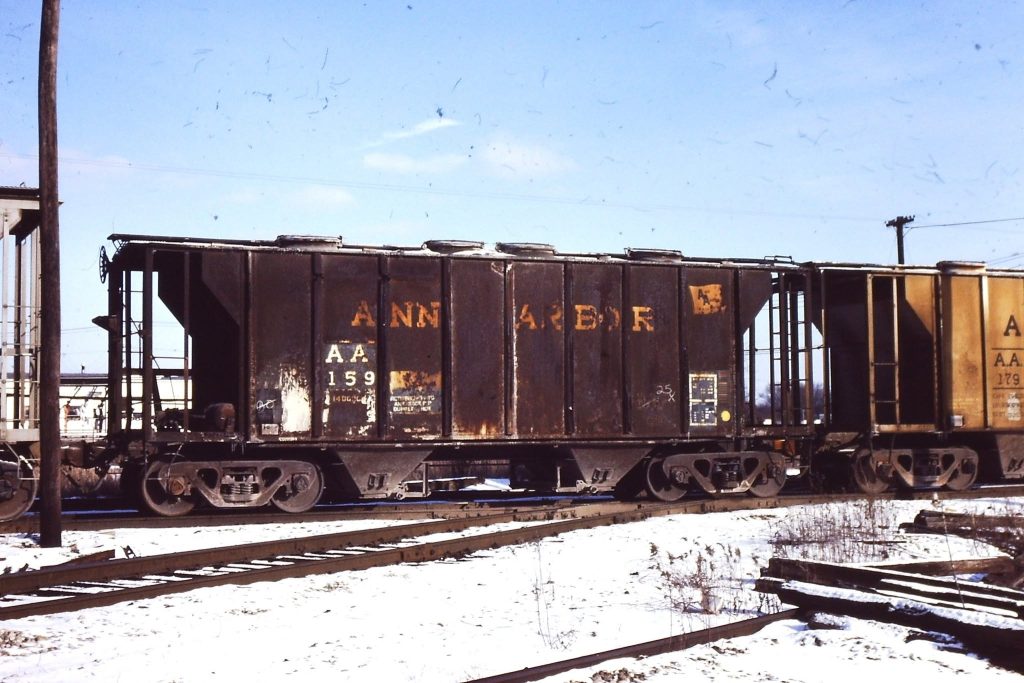
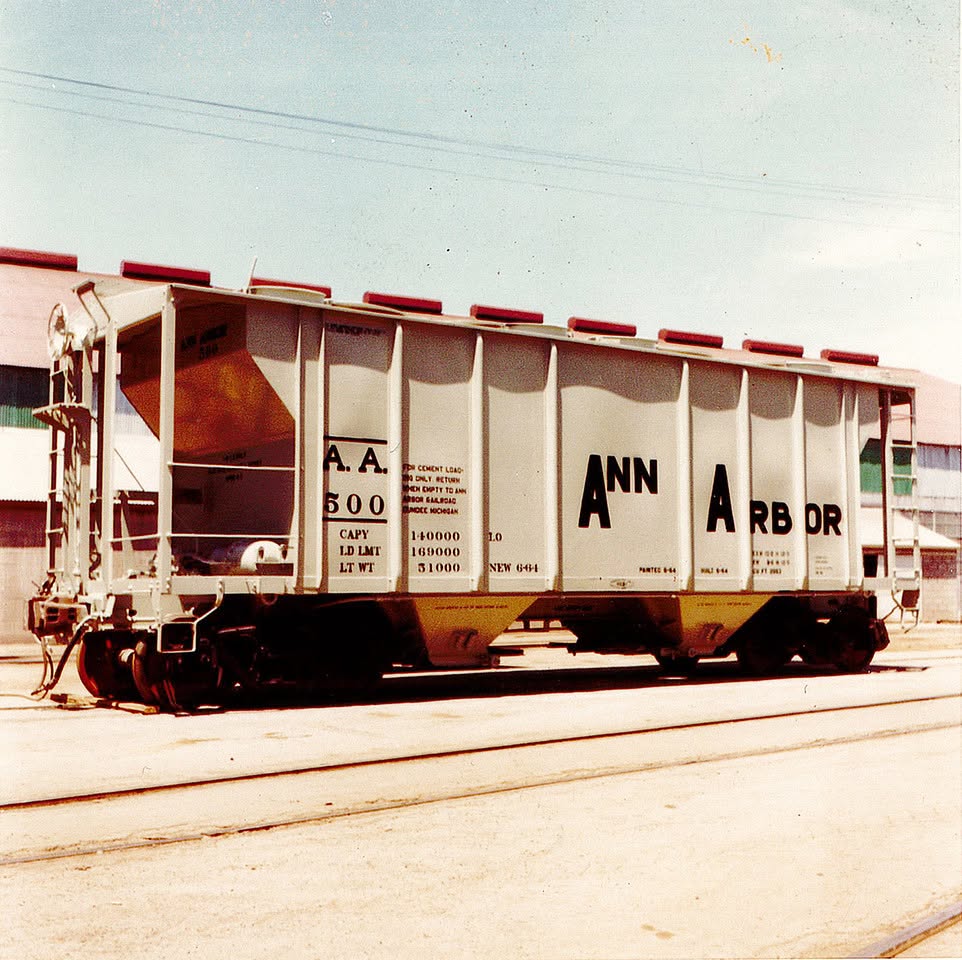
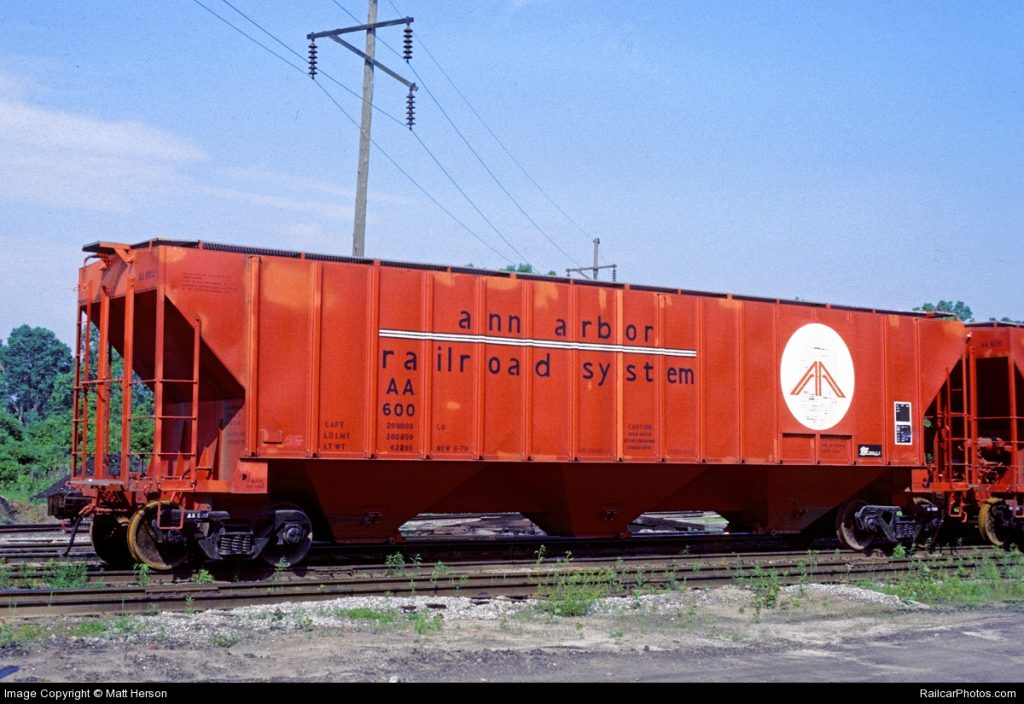
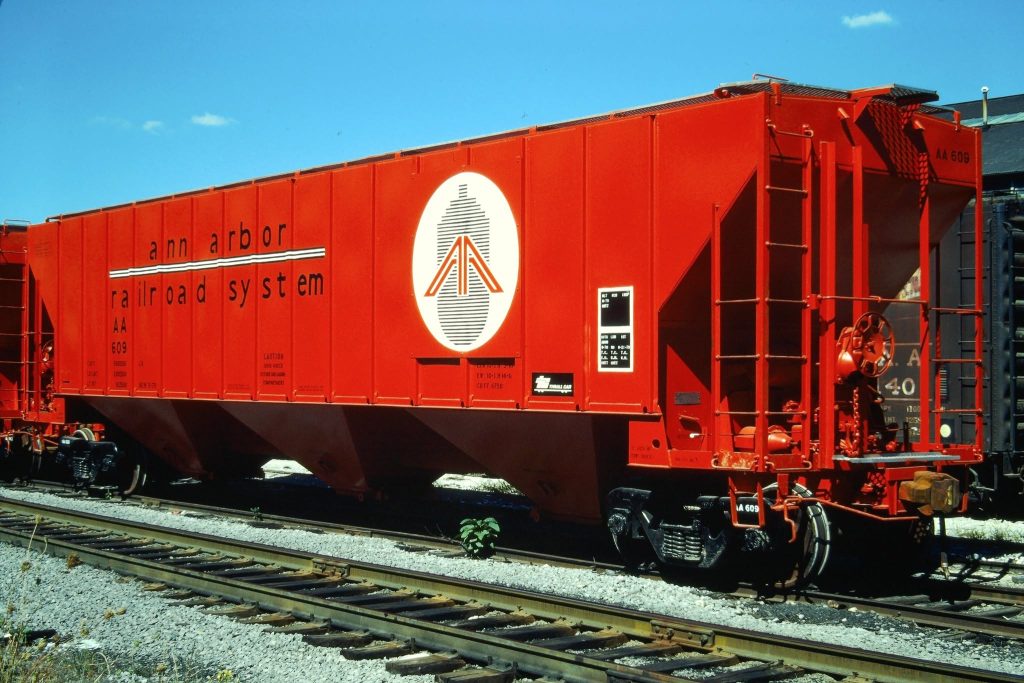
Ann Arbor two-bay covered hopper No. 12 stands at Cadillac, Michigan, on 20 August 1992, more than forty-three years after being built by Pullman-Standard in May 1949 as part of the AA 1-60 series. One of the railroad’s first purpose-built cement hoppers, the 1,958 cubic foot car was acquired to serve the growing traffic of Dundee Cement and later found use in other bulk commodities. By the early 1990s, its faded paint, worn lettering and friction-bearing trucks reflected a remarkable working life spanning four decades. © John Rus Ann Arbor Railroad covered hopper No. 36 stands heavily weathered in April 1980, over three decades after it was built by Pullman-Standard in March 1949 as part of the railroad’s pioneering 1-60 series of 1,958 cubic foot covered hoppers. Originally purchased for cement service from Dundee Cement in Michigan, these distinctive 70-ton cars later found work hauling Yuma sand after the Ann Arbor diversified its traffic base. By the time this photograph was taken, No. 36 carried faded remnants of the original “ANN ARBOR” lettering, the classic flag herald and an ACI barcode label added during the late 1960s, all testament to a long and hardworking career. Although designed for local cement traffic, members of the class occasionally wandered far from home, with examples recorded as far afield as Florida. © Garland McKee Ann Arbor covered hopper No. 40 stands at Elizabethport, New Jersey, around 1976. Built by Pullman-Standard in May 1949 as part of the railroad’s 1-60 series, the 1,958 cubic-foot, two-bay covered hopper was one of 75 cars acquired primarily for cement service. By the mid-1970s, many of these veteran hoppers had been reassigned to sand traffic, particularly following the development of the Yuma sand operation under Detroit, Toledo & Ironton control. Despite being over a quarter-century old, cars like No. 40 continued to range widely in interchange service, their faded lettering and weathered appearance reflecting decades of hard work. © Unknown Ann Arbor two-bay covered hopper No. 78 stands at Cadillac, Michigan, during the mid-1980s, its faded paint bearing witness to decades of hard service. Built by Pullman-Standard in October 1950 as part of the AA 61-135 series, the 77-ton covered hopper was originally acquired for cement traffic serving Dundee Cement before some members of the class later found use in Yuma sand service. By this time, the veteran car had lost much of its original finish but continued to serve the Ann Arbor well over thirty years after construction. © Ken Smith Collection Ann Arbor covered hopper No. 89 rolls through an unidentified location in February 1981. Built by Pullman-Standard in October 1950 as part of the railroad’s 61-135 series, the 1,958 cubic-foot, two-bay covered hopper was originally acquired for cement traffic before many of the class later found a second career hauling Yuma sand under Detroit, Toledo & Ironton control. More than three decades after construction, No. 89 displays the heavily weathered appearance typical of the fleet, with little remaining of its original grey finish as it continued to roam the North American interchange network. © Garland McKee Ann Arbor two-bay covered hopper No. 96 is seen at Sumter, South Carolina, during April 1980, demonstrating just how far the railroad’s cement fleet ranged in interchange service. Built by Pullman-Standard in October 1950 as part of the AA 61-135 series, the 77-ton covered hopper spent its early years handling cement traffic before later finding work in other bulk commodity service. Despite three decades of use, the veteran car still retained traces of its original Ann Arbor lettering and flag herald as it continued to roam the North American rail network. © Pete Piszczek Ann Arbor two-bay covered hopper No. 98 is seen in October 1974 after twenty-four years of cement service. Built by Pullman-Standard in October 1950 as part of the AA 61-135 series, the 77-ton covered hopper was one of seventy-five cars constructed to Wabash specifications for the Ann Arbor’s growing bulk cement traffic. By the time this photograph was taken, the original Ann Arbor flag herald had been removed, the car had received shop work at Owosso in February 1965, and an ACI label had been fitted, reflecting the gradual changes made to the fleet as the cars continued in heavy interchange service. © Robert Warrick Collection Ann Arbor two-bay covered hopper No. 121 rolls past Hallett Tower in Toledo, Ohio, on 25 June 1979. Built by Pullman-Standard in June 1953 as part of the AA 61-135 series, the 77-ton covered hopper was originally acquired for cement service before some members of the class were reassigned to Yuma sand traffic. By this stage, the veteran car displayed heavy weathering, yet continued in interchange service more than a quarter of a century after construction. © Charles H. Geletzke Jr. Collection Ann Arbor two-bay covered hopper No. 121 stands at Owosso, Michigan, in September 1982, showing the effects of nearly three decades of hard service. Built by Pullman-Standard in June 1953 as part of the AA 61-135 series, the 77-ton PS-2 covered hopper was designed primarily for cement traffic. Despite its heavily weathered appearance, the car still carries its original Ann Arbor flag herald and rides on friction bearing trucks, features that were becoming increasingly uncommon by the early 1980s. © Robert Thatcher Collection Ann Arbor covered hopper No. 142 is photographed at Lexington, Kentucky, in May 1979. Built by American Car & Foundry in 1957 as part of the railroad’s 136-185 series, the 2,006 cubic-foot, two-bay covered hopper was originally delivered in grey for cement service before many of the class later found a second career hauling Yuma sand under Detroit, Toledo & Ironton control. By the late 1970s, cars such as No. 142 wore heavily faded paint and rust streaks earned through decades of hard service, yet they continued to roam far beyond Michigan in interchange service. © Garland McKee Fresh from American Car & Foundry, Ann Arbor two-bay covered hopper No. 146 poses for its builder’s photograph in December 1957. Built as part of the AA 136-185 series, the 70-ton CH-29 covered hopper offered a 2,006 cubic foot capacity and was acquired primarily for cement traffic, reflecting the growing importance of customers such as Dundee Cement to the railroad. These cars supplemented the earlier Pullman-Standard cement hoppers delivered in the late 1940s and early 1950s, further modernising the Ann Arbor’s specialised bulk freight fleet. © Robert Warrick Collection Ann Arbor two-bay covered hopper No. 157 is photographed at Sumter, South Carolina, during April 1980, illustrating the wide reach of the railroad’s specialised covered hopper fleet. Built by American Car & Foundry in December 1957 as part of the AA 136-185 series, the 70-ton CH-29 covered hopper was acquired primarily for cement service before later seeing other bulk commodity traffic. By 1980, the veteran car carried a DT&I compass herald in place of its original Ann Arbor flag, evidence of the Detroit, Toledo & Ironton’s influence following its acquisition of the railroad in 1963. © Pete Piszczek Ann Arbor two-bay covered hopper No. 159 passes Hallett Tower in Toledo, Ohio, on 26 January 1980. Built by American Car & Foundry in late 1957 as part of the AA 136-185 series, the 70-ton CH-29 covered hopper was one of fifty cars acquired for cement service as the railroad expanded its specialised bulk traffic fleet. More than twenty years after construction, the weathered car remained in regular interchange service, still wearing traces of its original Ann Arbor lettering and flag herald. © Charles H. Geletzke Jr. Collection Fresh from Greenville Steel Car Company, Ann Arbor two-bay covered hopper No. 500 poses in builder’s condition during 1964. Built in June 1964 as the first of the AA 500-599 series, the 70-ton, 2,003 cubic foot covered hopper was designed primarily for cement service, reflecting the railroad’s commitment to specialised bulk traffic. While these cars spent much of their lives serving industries across Michigan and neighbouring states, they occasionally ranged much farther afield in interchange service. © Michael Stamey Collection Ann Arbor Railroad System covered hopper No. 600 is photographed at Toledo, Ohio, on 29 May 1982. Built by Thrall in August 1979 as the first car of the AA 600-649 series, the 100-ton, 4,750 cubic foot three-bay covered hopper was acquired for grain service as part of Michigan Interstate’s investment in a modern freight car fleet. Less than three years old, No. 600 still presents a pristine appearance in the railroad’s distinctive bright red corporate livery. © Matt Herson Ann Arbor Railroad System 100-ton covered hopper No. 609 stands in fresh paint at Owosso, Michigan, in September 1979. Built by Thrall in August 1979 as part of the AA 600-649 series, the 4,750 cubic foot three-bay hopper was acquired for grain service and reflected the railroad’s investment in a modern freight car fleet following its reorganisation under Michigan Interstate. The class later passed to CRDX ownership, but in this view No. 609 still appears in pristine condition wearing the Ann Arbor’s striking corporate red livery. © Peter Hayes Collection Ann Arbor Railroad System covered hopper No. 613 stands at Chesaning, Michigan, during 1979, shortly after entering service. Built by Thrall in August 1979 as part of the AA 600-649 series, the 100-ton, 4,750 cubic foot three-bay covered hopper was constructed for grain service as part of Michigan Interstate’s modernisation of the Ann Arbor freight car fleet. Set against the towering grain elevators it was built to serve, No. 613 displays the railroad’s distinctive corporate red livery at its freshest. © Martin Burk Collection Ann Arbor Railroad System covered hopper No. 784 is seen at Denver, Colorado, on 1 March 1980. Built by American Car & Foundry in October 1957 for the Pittsburgh & Lake Erie Railroad, the two-bay covered hopper was leased by Michigan Interstate, operator of the Ann Arbor Railroad, in November 1979 for sand service from northern Michigan. Repainted into the railroad’s striking corporate red scheme with the large circular “AA” emblem, the cars remained on the property until 1983 before returning to P&LE ownership. © Peter Hayes Collection Nos. Type Notes AA 1-60 2-Bay Covered Hopper PS (Lot 5947); 3/1949 AA 61-135 2-Bay Covered Hopper PS (Lot 5974C); 10/1950 AA 136-185 2-Bay Covered Hopper AC&F (Lot 11-5176N?); 1957-1958 AA 500-599 2-Bay Covered Hopper Greenville Steel Car Co.; 6/1964 AA 600-649 3-Bay Covered Hopper Thrall; 8/1979 AA 700-824 2-Bay Covered Hopper ex P&LE 1300-1549
Epilogue
The freight cars featured in this chapter represented one of the most visible symbols of the Ann Arbor Railroad System’s revival. While the railroad itself remained a relatively modest regional carrier linking Toledo with northern Michigan, its cars travelled the length and breadth of North America, earning revenue far beyond the railroad’s own rails. For many railfans during the late 1970s and early 1980s, the bright red “Ann Arbor Railroad System” boxcars became an unexpected but familiar sight on trains from New England to California and into Canada and Mexico.
The fleet reflected both continuity and change. Weathered two-bay covered hoppers dating from the late 1940s worked alongside brand-new Mexican-built and Pullman-Standard boxcars, while second-hand cars acquired from larger railroads found a new lease of life in Ann Arbor service. Together, they demonstrated the pragmatic approach taken by Michigan Interstate: invest where it made commercial sense, retain useful older equipment, and maximise the earning potential of every freight car.
The Ann Arbor Railroad System itself was relatively short-lived. In 1982, operation of the state-owned route was divided between several operators, ending the unified system that had emerged following the railroad’s reorganisation. Six years later, a new privately owned Ann Arbor Railroad began operating the southern portion of the line, carrying the famous reporting marks into a new era.
Most of the cars illustrated here have long since disappeared, scrapped after years of hard interchange service. Yet they remain among the most recognisable freight cars of the period. Their distinctive lettering and bold circular “AA” emblem became synonymous with the rebirth of one of America’s most famous short lines, proving that even a railroad of fewer than 300 route miles could establish a presence across an entire continent.