Boxcars






Covered Hoppers

| Nos. | Type | Notes |
|---|---|---|
| VTR 100-450 | Box Car | Incentive Per Diem 100-199. 40′ Box Car, PS-1. PS 40′. The Vermont Railway’s PS-1 40ft boxcars were acquired from the former Rutland Railroad fleet, numbered roughly between 100 and 450. After the Rutland’s closure, the cars were sold to Hudson Leasing and subsequently leased to the newly formed Vermont Railway. They formed the backbone of the line’s early boxcar fleet and became a familiar sight across the region during the 1960s and 1970s. All of the cars were built to the PS-1 design, with a capacity of 100,000lb and a light weight of around 45,000lb. Each had a galvanised steel roof and black ends, giving a practical contrast to the colourful body sides. The majority of the fleet was painted in Forest Green (also known as Thane Green), while a smaller number carried Vermont Red, both colours featuring bold white lettering and the stylised mountain-shaped Vermont Railway logo. Several lettering styles were used. The most common featured the full Vermont Railway title to the right of the doors, as seen on cars such as VTR 176. A small group of cars equipped for loader service carried the yellow “D/F” marking and the XML service designation, with known examples including VTR 286, 293, 427, 440 and 448. Another variation displayed only the word “VERMONT” beneath the logo, found on cars such as VTR 150, 158, 281, 317 and 356. The red cars were comparatively few, with recorded numbers including 133, 156, 206, 259 and 127. Despite their differences in finish, all of these boxcars shared the same clean, functional appearance that characterised the Vermont Railway’s image in its early years. Photos: CFCG 176, CFCG 437 Models: VTR 110 Atlas 50 001 160 ★, VTR 127 Atlas 50 005 772 ★, VTR 128 Atlas 50 001 161 ★, VTR 133 Atlas 50 005 773 ★, VTR 401 Micro-Trains 20200 ★, VTR 289 Atlas 3406 ★, VTR 305 Atlas 2207 ★, VTR 305 Atlas 34060 ★, VTR 341 Atlas 34612A ★, VTR 365 Atlas 34613A ★, VTR 441 Atlas 34064 ★, VTR 444 Atlas 34062 ★, VTR 447 Atlas 34063 ★, VTR 448 Atlas 34061 ★, VTR 505 Atlas 45824 ★, VTR 524 Atlas 45825 ★ |
| VTR 601-620 | Box Car | Incentive Per Diem. The VTR 601–620 series comprised 50ft double-door automobile boxcars acquired second-hand from the Rock Island. They were believed to have originated as single-sheathed automobile or furniture cars, later rebuilt with steel sheathing for added durability. Several design features — such as notched sides at sill height, external bracing over the trucks, poling pockets, and distinctive corner post construction — suggest these cars were converted from earlier composite-bodied stock. The rebuilding may have been undertaken either by the Rock Island or subsequently, before entering Vermont Railway service. By the late 1970s, these cars retained much of their rebuilt appearance and represented a mix of pre-1930s design adapted for extended service life. Models: VTR 617 Atlas 3630 ★ |
| VTR 3501-3550 | Box Car | Incentive Per Diem. Lot 17859. Built 1977-11. 50′ Box Car, FMC 5,077 cu.ft. Photos: RCP 3532 Models: VTR 3501 Atlas 50 005 584 ★, VTR 3527 Atlas 50 005 585 ★, VTR 3548 Atlas 50 005 586 ★ |
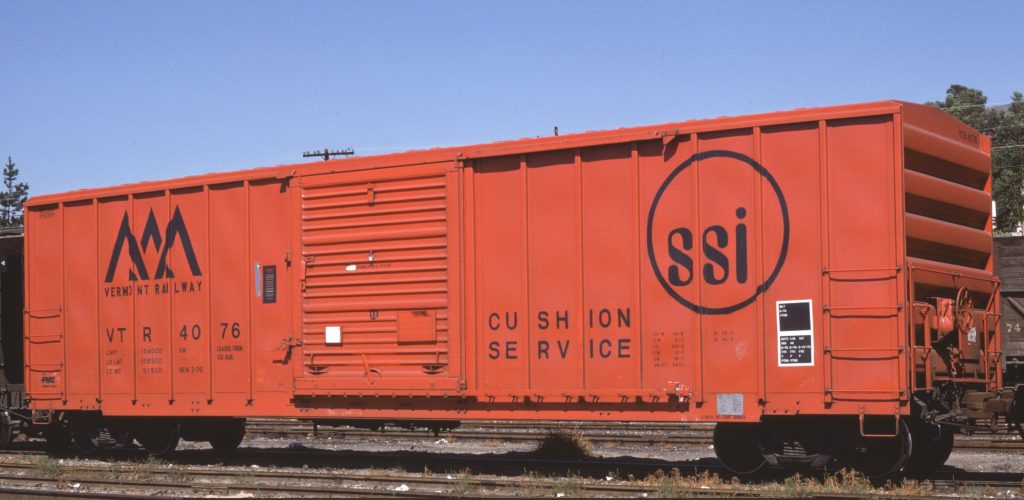
| VTR 4000-4139 | Box Car | Incentive Per Diem. 50′ Box Car, FMC 5,077 cu.ft. Lot 17755. Built 1976-02/03. Photos: RRPA 4014, RCP 4014, CFCG 4016, RCP 4018, RRPA 4050, CFCG 4096 Models: VTR 4088 Atlas 50 003 443 ★, VTR 4112 Atlas 50 003 444 ★, VTR 4139 Atlas 50 003 445 ★ |
| VTR 5100-5544 | Box Car | Built by Pullman-Standard, rebuilt by Reading Shops, Job ____, ___-__. Stretched from 40ft PS-1s by Reading Shops. 50′ Box Car, PS-1. Built by Pullman-Standard and rebuilt by the Reading Company Shops in 1974–75, the VTR 5100-series boxcars were created by cutting and lengthening 40ft PS-1s to 50ft. The rebuilds involved fitting new diagonal-panel roofs, spliced side panels with visible rivet seams, 10ft sliding doors, and non-cushioned underframes. Painted in Vermont Railway green with bold white lettering, these cars became a familiar sight across the eastern United States during the 1970s and 1980s. The shade of green varied between batches and weathered quickly, leading to considerable variation in appearance. Scalecoat produced several experimental mixes to match the colour as it appeared in service. For modelling, a 40ft PS-1 body provides a suitable starting point. The key modifications are the stretched body, diagonal-panel roof, extended side sills, and rivet seams marking the splice lines. Highball Graphics produces appropriate decals, and Archer rivet transfers can be used to capture the rebuilt panel joints. Although originally 40ft cars, the rebuilt VTR 5100-series represented a distinctive transitional design, retaining much of the PS-1’s character while reflecting the economical rebuild practices of the 1970s. Photos: RRPA 5101, CFCF 5132, RRPA 5153, RRPA 5157, RRPA 5158, RCP 5309 |
| VTR 6001-6010 | Covered Hopper | Covered Hopper ACF 3-Bay Centerflow VTR 6001-6010 series built by American Car & Foundry Industries, Lot ___, Oct-78. To SOO series 76650-76659 in 4/97; to GCCX series 76650-76659 in 8/2003. Photos: RRPA 6003, RCP 6006, RRPA 6006 Models: VTR 6006 Athearn 12942 ★, VTR 6008 Athearn 12943 ★ |
| Models: VTR 10410 Atlas 50 000 173 ★, VTR 10436 Atlas 50 000 174 ★ | ||
| VTR 10935–10959? | A small number of Vermont Railway boxcars were seen carrying traces of the Evans Products “The Action Line” scheme. The lettering style and logos match Evans-built USLX cars, indicating they were leased or ex-USLX boxcars later restencilled for VTR. The cars were single plug-door Evans Air-Pak boxcars, approximately 50ft long and Plate C in size. The “Action Line” branding originated with Evans Products in 1968, not with Vermont Railway. Beyond these markings and basic construction details, no further documentation or numbering for this VTR series is known. Photos: 10935, 10940, 10945 | |
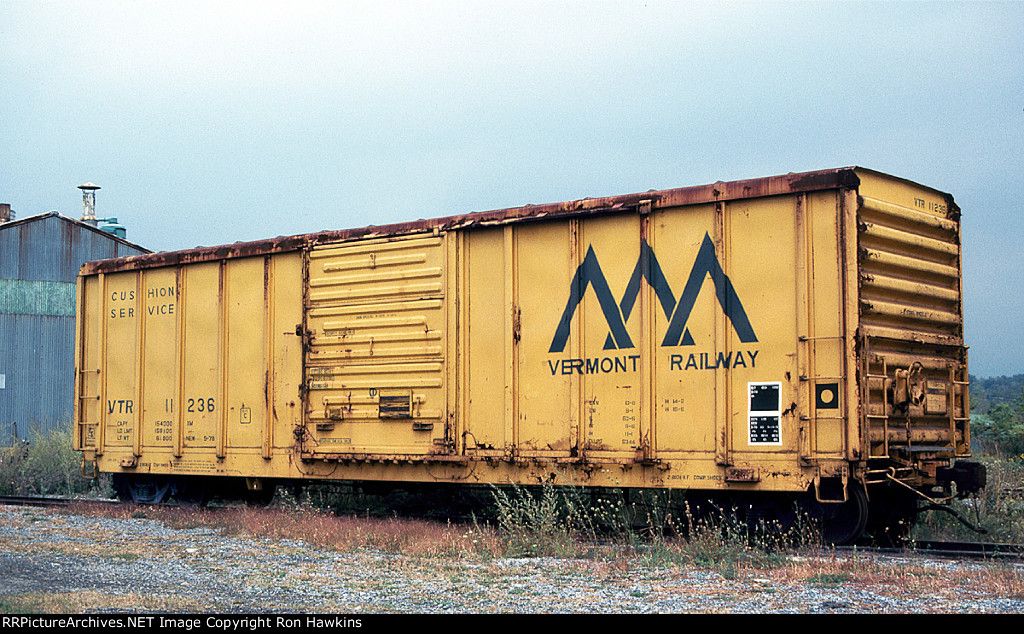
| VTR 11001-11300 | Box Car | Incentive Per Diem. 50’Box Car, PS 5,344 cu. ft. VTR series 11001-11300 built by Pullman-Standard, Lot 9988, Aug-Sep 1978. Photos: CFCG 11115, CFCG 11130, RRPA 11214, RCP 11299 Models: VTR 11361 Atlas 50 001 419 ★, VTR 11375 Atlas 50 001 420 ★, VTR 11382 Atlas 50 001 421 ★ |
| VTR 12001-12200 | Box Car | Incentive Per Diem. 200 cars. FMC 5,347 cu. ft. Photos: CFCG VTR 12024, RRPA VTR 12031 Models: VTR 12021 Fox Valley 8013-1 ★, VTR 12025 Fox Valley 8013-2 ★, VTR 12032 Fox Valley 8013-3 ★, VTR 12035 Fox Valley 8013-4 ★ |
| VTR 13001-13250 | Box Car | Incentive Per Diem. 250 cars. PS 5,344 cu. ft. Photos: RRPA 13045, CFCG 13084, CFCG 13181 |