Train Symbols
The train symbol system differentiates routes, directions, and types of service. Odd numbers were assigned to eastbound trains (designated as “railroad east,” though this didn’t always correspond to true east), while even numbers were used for westbound trains.
- Four-character symbols (e.g., BASP, SPBA) were typically used for long-distance freight operations. These codes combined the first letters of the origin and destination locations, making the route easy to identify.
- Character-number symbols (e.g., RB-1, BR-2) were more commonly assigned to local or regional freight services. In these symbols, the letters represented the main route or key terminals, while the number indicated the direction, schedule, or priority.
This dual system allowed for flexibility in managing both long-haul and local freight operations, simplifying train identification and scheduling.
Long-Distance Freight Symbols
- BASP – Bangor – Springfield, MA “East Wind’
- SPBA – Springfield, MA – Bangor “East Wind”
Local and Regional Freight Symbols
- BR-2 Bangor – Rigby
- BV-1 – Bangor – Vanceboro
- CB-2 Calais – Bangor
- CB-4 Calais – Bangor
- IW-1 Riley – Waterville
- OZ-1 – Gilman, VT – Bartlett, NH
- PB-2 – Newport Junction – Bangor (Miss Piggy)
- QY-2 – Gilman, VT – St. Johnsbury, VT
- RB-1 – Rigby – Bangor
- RY-2 – Portland, ME – St. Johnsbury, VT
- SR-2 Augusta – Rigby local freight)
- VB-2 – Vanceboro – Bangor
- WD-1 headed to Oakland to pick up Mill loads and then on to Rileys for delivery to International Paper mill. DW-2 with Riley’s empties and Leeds Junction pick-us.
- WI-2, the “Wood Job” Waterville-Riley (International Paper)
- YQ-1 – St. Johnsbury, VT – Gilman, VT
- YR-1 – St. Johnsbury, VT – Portland, ME (Rigby Yard)
- ZO-2 – Bartlett, NH – Gilman, VT
Rumford Job
A – Lewiston Lower
B – Bangor
C- Calais
D – Rumford
F – Framingham
G – No. Anson
H – Bingham
I – Rileys (International Paper)
J – Bath
K – Brunswick
L – Leeds Junction
M – Madison
N – Rockland
O – Gilman
P – Newport Junction
Q – Crawford Notch
R – Rigby
S – Skowhegan later Augusta
T – Beecher Falls
V – Vanceboro
W – Waterville
X – Foxcroft
Y – St. Johnsbury
Z – Bartlett
Bucksport Branch
The Bucksport Branch is a historic railroad line in Maine, originally operated by the Maine Central Railroad and now part of the Pan Am Railways system.
Route and Junction
The line begins at Bangor, where it connects with the mainline, and travels south along the picturesque Penobscot River valley, passing through Brewer before terminating at Bucksport.
Historical Background
Chartered in 1873 as the Bucksport and Bangor Railroad, this 19-mile (31 km) branch had its grade surveyed in the autumn of 1872. Construction commenced in the spring of 1873, and by December 21, 1874, trains were regularly running the full length of the line. In 1882, the company was reorganised as the Eastern Maine Shoreline Railway and subsequently leased as the Maine Central Bucksport Branch in 1883.
Passenger and Freight Service
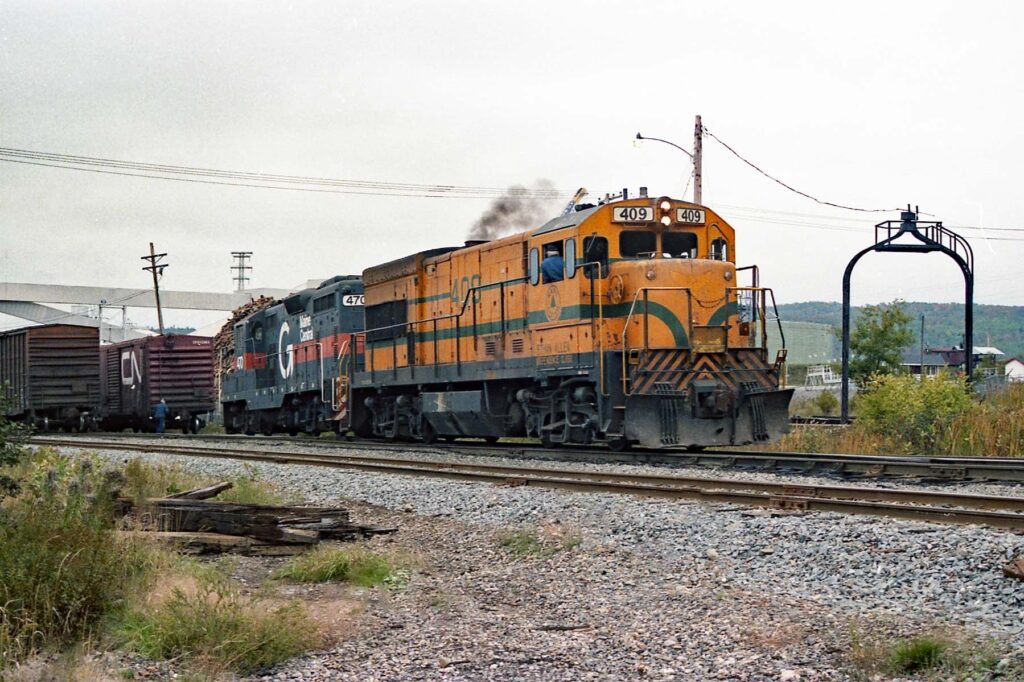
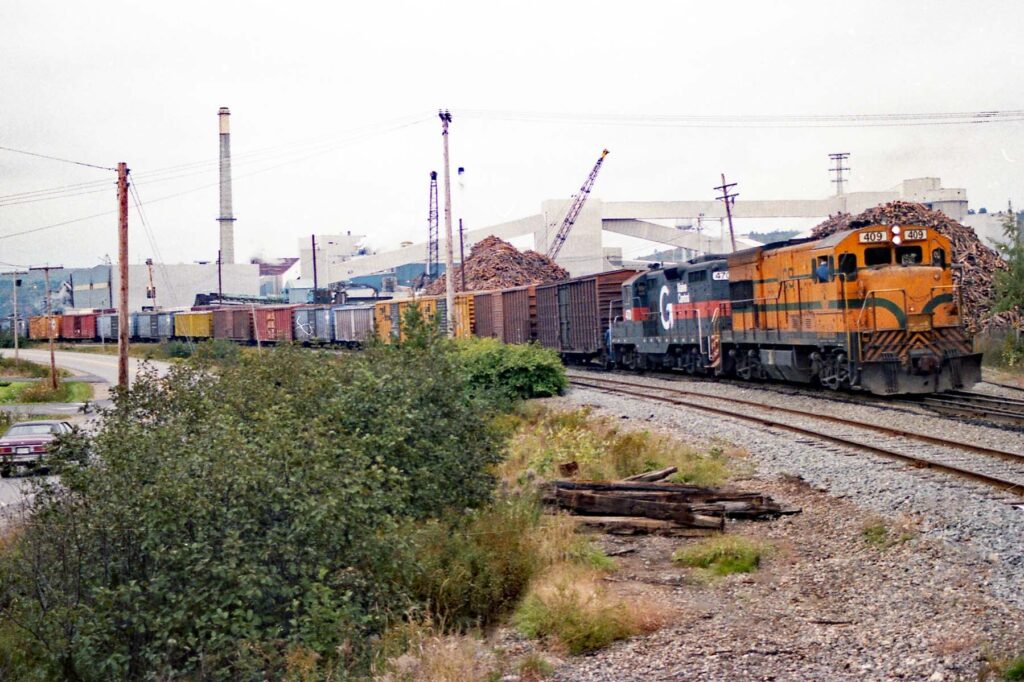
Passenger service on the Bucksport Branch ceased on January 27, 1932. In its later years under Maine Central operation, the line typically saw two freight trains per day, often pulled by a pair of Maine Central’s EMD SW7 and SW9 locomotives. These trains served the paper mill in Bucksport and made stops at the chemical plant in Orrington, providing essential service to another key industrial customer along the route.
- KB-2 Bucksport – Bangor
- KO-1 Bucksport – Old Town
Economic Impact and Recent Developments
For many years, the primary customer of the Bucksport Branch was the paper mill at the end of the line. At its peak, St. Regis Papers in Bucksport was one of the largest employers in Maine. However, the mill has since shut down, leading to a significant decrease in rail traffic.
However, with Verso Paper Corporation shutting down the mill, rail traffic has significantly decreased. The last rail car removal took place on December 11, 2014, with the train consisting of GMTX 3005 and MEC 374 pulling sixteen tank cars and three boxcars. The future of the line depends on attracting a new large customer.