Albula Bahn
Ueli Tscharner, born 6th February 1944, died on 22nd September 2020 at the age of 76.
Ulrich Tscharner built his model railway layout for over 40 years. After his death, his wife would like to sell the work as a whole if possible.
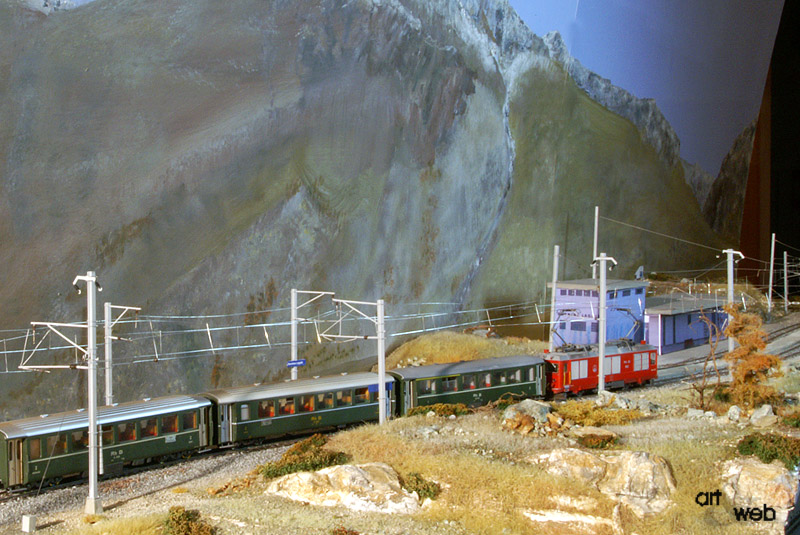
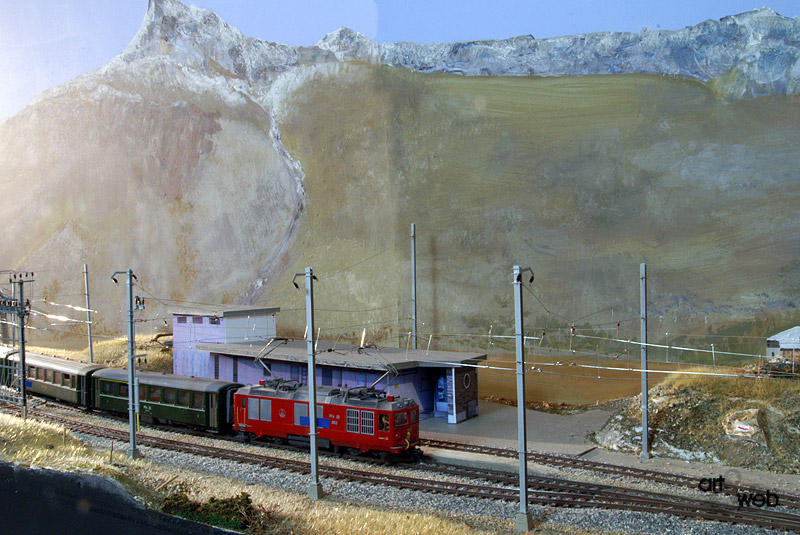
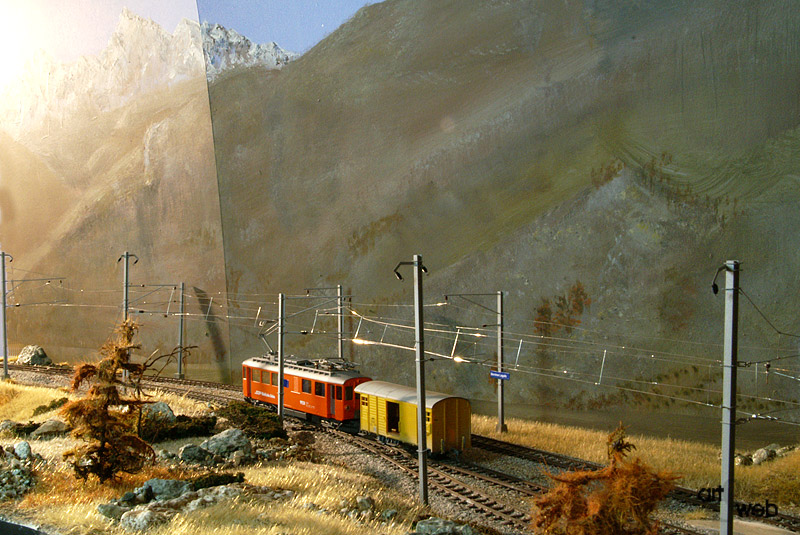
When you step into the basement of this single-family home, you first squint. Are you actually standing on Winkler Boden and not in Celerina, Bergün or in front of the Brombenz Viaduct? Incredibly close to nature and true to detail, model builder Ulrich Tscharner has transferred the Albula and Bernina railways to the 1:87 format.
On 40 square meters, the 100-meter-long rail system in HOm gauge meanders through imposing landscapes, picturesque villages, past thundering waterfalls, construction sites, over viaducts and through tunnels. Many of the subjects tell their own little story. You can see a dog that doesn’t want to cross the tracks, hikers having a picnic along the Bernina Railway, a cattle loading station or day trippers having a coffee on Alp Grüm – everything is in miniature format and created by hand.
As perfect and finished as the system seems, the builder would have had countless ideas for adding to his work. But in September 2020, Winkler Ulrich Tscharner died at the age of 76 after a short illness. He worked on his system for more than four decades.
tinkerers and artists
“After retiring from Swissair, he often spent days tinkering and building in the office and workshop,” says his wife Elisabeth. Calculating the number of hours her husband has invested in his passion is simply impossible. Using the example of the numerous larches, spruces and Swiss stone pines along the route, Elisabeth Tscharner shows what it means to produce every detail yourself from scratch and by hand. She often helped him with this filigree manual work with pieces of wire, acrylic paint, glue, filter floss and paint spray.
Ulrich Tscharner has shared the knowledge and skills he has acquired over the decades on his website www.albulabahn.ch . “My husband kept traveling to the original locations for new inspiration, documenting everything with photographs so that he could recreate it as authentically as possible at home,” says his widow. If there was a Toitoi toilet on a construction site, today it is also part of the same scene in the basement of the Winkler family home. The model builder also painted the scenery himself.
Ulrich Tscharner shared his passion with countless model railway enthusiasts around the world. His website has been visited by over 3 million people to date. “If he sold models from his collection, the orders came from as far away as New Zealand,” says Elisabeth Tscharner. School classes, private individuals and clubs were also welcome guests in the basement of the Winkler family home.
As much as she supported her husband’s passion, she now wants his life’s work to pass into new hands – and if possible as a whole. The first idea – a railway museum run by the municipality – did not materialize. Finding a private buyer will probably not be easy given the dimensions of the system.
Space, some money and idealism are required
Reto Lippuner runs a specialist shop for model-making in Fideris. Ueli Tscharner and he have known each other for many years and have worked together for a long time in the model-building sector. Lippuner knows the system and supports Elisabeth Tscharner with the sale. “Ulrich Tscharner’s life’s work is characterized by extreme attention to detail,” says the expert. A layman will have a hard time distinguishing the model from reality. “You can tell that the builder was an artist by training.” Only high-quality material was used in the system.
Even without counting the countless hours of work, the material and artistic value soon add up to a six-figure range. However, one is aware that the entire work will change hands at a much lower price. “Prospective buyers must therefore have enough space, some money and idealism,” says Lippuner, because it makes little sense to only sell individual parts of the segment system. As a buyer, he thinks not only of private individuals but also of municipalities, museums and public institutions.
Leaving the monumental rail system more or less unnoticed in the basement is not an option for Elisabeth Tscharner: “My husband’s life’s work should continue to bring joy.”
UNESCO route Albula-Bernina Railway – https://www.modell-bahn.ch/forum/index.php?thread/5146-unesco-strecke-albula-berninabahn/
Constructed in a 6.5 x 4.85 m cellar. SB: 75 cm, main network: 100 -115 cm, Berninabahn: 160-170 cm. The main Albula network is set in early autumn, above the Bernina line in late autumn. On the 25th of October 1984, after the insulation and preparation of the basement and the first carpentry work, the foundation stone for the Albulabahn in H0m was laid.
Segments/Modules
Lower Level
- Solis
- Landwasser Viadukt
- Bärentritt
- Brombänz Viadukt – built in 1993 (http://www.albulabahn.ch/archives/4362)
- Cruschetta Galerie
- Bergünerstein
- Bergün – built in 1987
- Val Tuors
- Clix Viadukt
- Spinas
Solis
Solis station is located in the Schinschlucht gorge between Thusis and Tiefencastell, shortly before the Solis Viaduct. Today, it serves as an automatic crossing station, and was once world-famous for its lavish floral displays, which unfortunately no longer exist. On Ueli’s module, the station was recreated exactly as it was in 1998.
Missing photographs:
- View from the old road towards the station approach and the switching hut (🇩🇪 Blick von der alten Landstraße auf die Bahnhofseinfahrt und das Schalthäuschen)
solis60.jpg - Glacier Express with Ge 4/4 III 649 (🇩🇪 Glacier Express mit Ge 4/4 III 649)
solis55.jpg - Glacier Express with Ge 4/4 III 649 (🇩🇪 Glacier Express mit Ge 4/4 III 649)
solis56.jpg - The track maintenance firm Sersa is at work in Solis (🇩🇪 Die Gleisbaufirma Sersa ist in Solis tätig)
solis63.jpg - “Unerhört” travelling by train to Chur (🇩🇪 Unerhört mit Zug nach Chur)
solis68.jpg - Ge 4/4 III 644 “Savognin”, in advertising livery (Televisiun Rumantscha), with the Glacier Express at Solis (🇩🇪 Ge 4/4 III 644 Savognin mit Werbeanstrich (Televisiun Rumantscha) mit dem Glacier Express in Solis)
solis65.jpg - Ge 4/4 II 629 “Tiefencastel” with express train 551 at Solis (🇩🇪 Ge 4/4 II 629 Tiefencastel mit Schnellzug 551 in Solis)
solis64.jpg - A small celebration at the station (🇩🇪 Kleine Feier am Bahnhof)
solis51.jpg - Flower-decked station with the Bernina Express (🇩🇪 Blumenbahnhof mit Bernina Express)
solis43.jpg - Gian Denoth checks on his vintage car (🇩🇪 Gian Denoth schaut nach seinem Oldtimer)
solis70.jpg - Ge 6/6 II 701 “Raetia” leaves the 986 m Solis Tunnel with an express for St. Moritz, passing through Solis without stopping (🇩🇪 Ein Schnellzug nach St. Moritz mit Lok Ge 6/6 II 701 „Raetia“ verlässt den 986 m langen Solistunnel und durchfährt die Station Solis ohne Halt)
PICT4337a.jpg
Upper Level
Layout name: Albula Railway in H0m
Scale: H0m (1:87)
Size: 6.5m × 4.85m
Prototype: RhB main network and Bernina line
Period: Era IV (from 1985)
Layout type: Segmented layout, wall-mounted, MAS 60 standard
Layout height: 90–175 cm
Track: Code 70
Minimum radius: 50 cm
Gradients
- Main network: 3.5%
- Bernina line: 7.0%
Control
- Main network and Bernina Railway: Selectrix – FCC
Missing plans:
Gleiplan-unten-2018-1.jpgGleisplan-oben-2018-copy.jpg
If you previously downloaded these plans and still have a copy on your computer, I would be delighted to include it here. Please leave a comment or send me a message if you are happy to share them.
Pontresina
Ova da Roseg
1.2m x 50cm module. An original 32 m long arched stone viaduct just behind Pontresina.


(🇩🇪 Leere Container der Bernina Recycling AG (BRAG) auf einem ACTS-Tragwagen überqueren die Ova da Roseg an der Berninabahn. Modelle: BEMO, PR-Modell.)
Missing photographs:
- Gmf 4/4 242 with a works train on the Ova da Roseg Viaduct, just beyond Pontresina. (🇩🇪 Gmf 4/4 242 mit einem Bauzug auf dem Ova da Roseg Viadukt kurz hinter Pontresina.)
gmf242-roseg06.jpg - Plattformwagen R-w 8265 at the rear of a regional train to Poschiavo, coupled with R-w 8266. These wagons, purchased from JMR in 1971, have a payload of 35 tons and, thanks to their robust construction, are used mainly for transporting logs. (🇩🇪 R-w 8265 am Schluss eines Regionalzuges nach Poschiavo zusammen mit dem R-w 8266. Diese im Jahre 1971 von JMR beschafften Wagen haben eine Tragfähigkeit von 35 t und werden wegen ihrer robusten Bauart vor allem für den Stammholztransport verwendet. Modelle: D+R)
rw-roseg04.jpg - Golden Autumn: ABe 8/12 3508 travelling on the Bernina line shortly before the Roseg stream, with the larches in their autumn colours turning the Engadin into a spectacular backdrop for the RhB’s red trains. (🇩🇪 Goldener Herbst: ABe 8/12 3508 unterwegs auf der Berninabahn kurz vor dem Rosegbach. Im Herbst färben sich die Nadeln der Lärchen und verwandeln das Engadin in eine unbeschreiblich schöne Kulisse für die roten Züge der RhB.)
3508-Roseg02.jpg - ABe 4/4 II 45 with a short autumnal local train in the Val Roseg, travelling from Pontresina to Alp Grüm (Photo of the Month, November 2014). Models: Bemo. (🇩🇪 ABe 4/4 II 45 mit einem kurzen herbstlichen Regionalzug im Val Roseg, unterwegs von Pontresina nach Alp Grüm (Foto des Monats, November 2014). Modelle: Bemo.)
ABe45-roseg.jpg - ABe 4/4 II 45 en route to Ospizio Bernina. Models: D+R (🇩🇪 ABe 4/4 II 45 unterwegs nach Ospizio Bernina. Modelle: D+R)
ABe45-roseg3.jpg - Ova da Roseg, Punt La Resgia – the newest segments on the upper level. (🇩🇪 Ova da Roseg, Punt La Resgia – die neuesten Segmente auf der oberen Ebene.
Berninabahn.jpg - Ge 2/2 162 – a rare visitor on the north side of the Bernina Pass, photographed on the Roseg stream bridge (Ova da Roseg) near Pontresina. (🇩🇪 Ge 2/2 162 – ein seltener Gast auf der Nordseite des Berninapasses, hier auf der Rosegbachbrücke (Ova da Roseg) bei Pontresina.) Models: Bayard.
ge162-roseg.jpg - ABe 4/4 II 43 crosses the Ova da Roseg Viaduct with the evening regional service to Poschiavo, after a thunderstorm has left the Roseg stream running fast and foaming. (🇩🇪 Nach einem Gewitter führt der Roseg Bach viel schäumendes Wasser, als der ABe 4/4 II 43 mit dem abendlichen Regio nach Poschiavo den Viadukt überquert.)
ABe42-roseg2.jpg
Bernina Ebene
In February 2018, Ueli published an update showing a newly completed scenic segment on the Bernina line. The scene represents the southern approach to Lagalb, a section which had previously existed only as a basic shell on the layout.
The new work closed one of the last remaining gaps on the Bernina plateau, blending the track formation into the surrounding landscape and bringing the area up to the same standard as the completed modules elsewhere on the railway.
The photographs show the segment being built up in layers, starting with the landform shaped from Styrodur (XPS foam), then covered with plaster bandage (🇩🇪 Gipsbinden). The ground colour and texture were developed using layers of earth and soil, before the scene was finished with static grass fibres and bushes. Autumn larches completed the setting, matching the seasonal character of the Bernina section.
Missing photographs:
- ABe 45 leaving Lagalb with a short train (🇩🇪 ABe 4/4 45 ist mit einem Kurzzug gerade aus Lagalb ausgefahren)
ABe45-BeLa-2.jpg - Terrain shaped from Styrodur (XPS foam) (🇩🇪 Gelände aus Styrodur)
BeLasued02.jpg - Plaster bandage applied over the terrain (🇩🇪 Gipsbinden)
BeLasued01.jpg - Earth layer and base ground texture (🇩🇪 Erde)
BeLasued03.jpg - Static grass fibres and bushes added (🇩🇪 Grasfasern und Büsche)
BeLasued04.jpg - Autumn larches in place (🇩🇪 Herbstliche Lärchen)
BeLasued06.jpg
Bernina Lagalb
To mark the 100th anniversary of the Bernina Railway, Ueli built the station of Bernina Lagalb. With its functional technical buildings, it forms an important crossing station and also plays a major role in the power supply on the Bernina line.
The prototype station was opened in May 1962 for the inauguration of the Curtinatsch–Piz Lagalb cable car. As part of the works, the passing loop that had previously been dismantled at Diavolezza was reused. A 1,800 kW rectifier, together with an inverter for feeding regenerative braking current back into the system on downhill runs, improved the power supply on the northern side of the Bernina line. The station remained staffed until 1978.
In model form, the overhead line system was one of the biggest challenges. It is a unique arrangement on the Bernina line, featuring cross-span wire fields reminiscent of German practice.
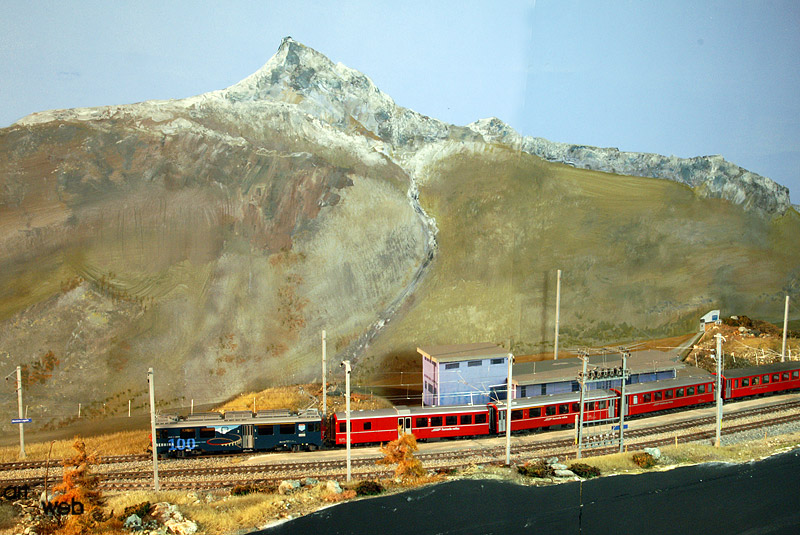
(🇩🇪 ABe 4/4 52 mit RE nach Pontresina.)
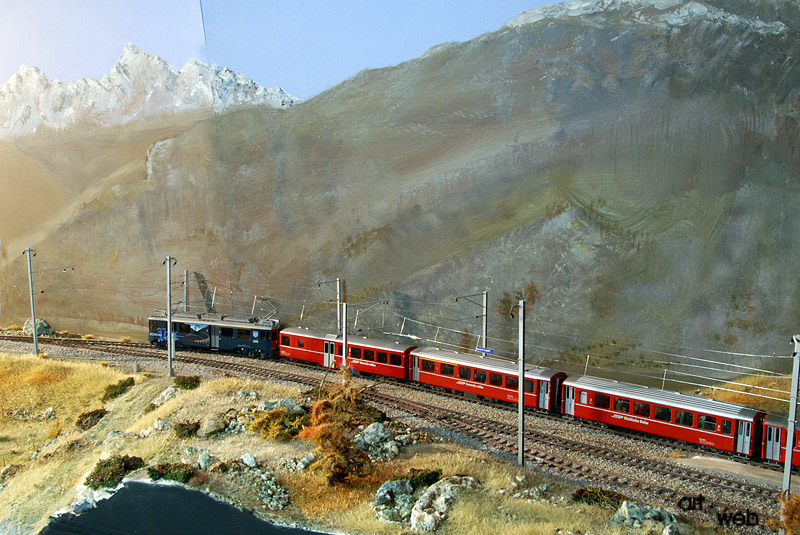
(🇩🇪 ABe 4/4 52 wirbt für das Bernina-Jubiläum.)
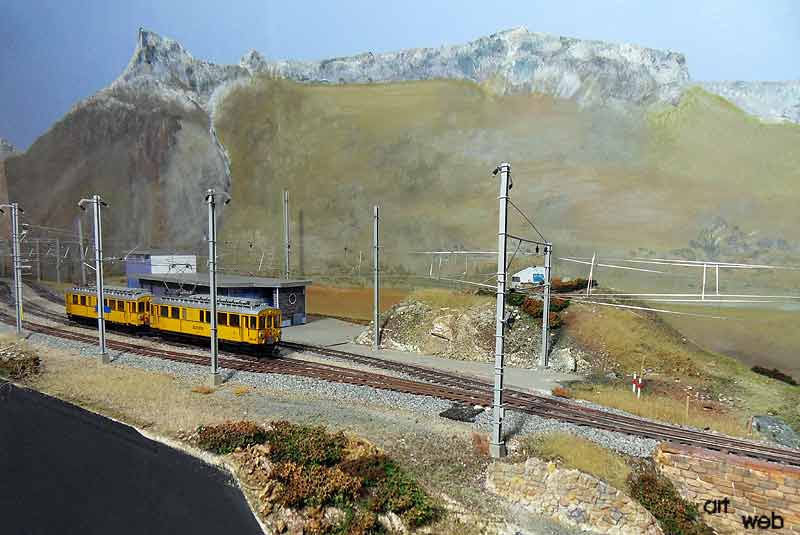
(🇩🇪 Nostalgie-Triebwagen.)
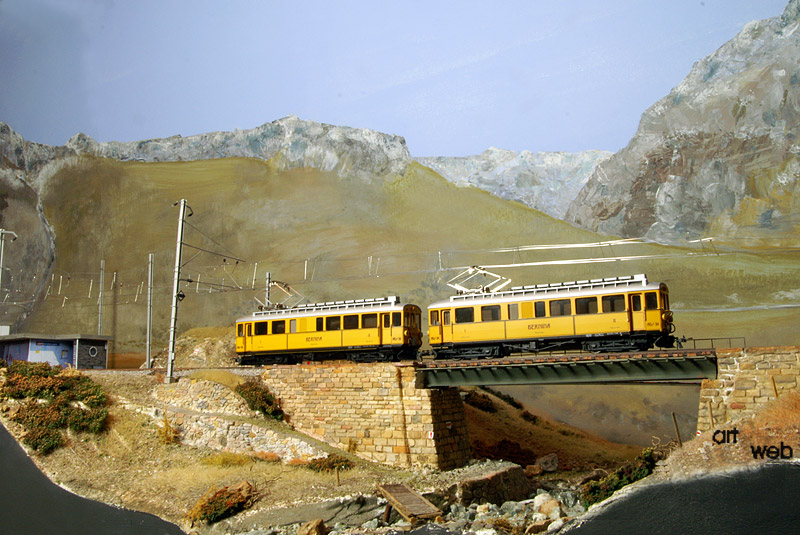
(🇩🇪 ABe 4/4 30 und 34 auf der Brücke über die Ova da Minor.)
(🇩🇪 Bernina Express in den 70er Jahren.)
(🇩🇪 Gem 4/4 82.)
(🇩🇪 Xe 4/4 9924 mit Bauzug.)

(🇩🇪 Ausfahrsignal Richtung Pontresina.)

(🇩🇪 Ausfahrsignal Richtung Ospizio.)
bela-sued.jpg
Berinabach
Poz dal Dragu
Scala
Palü Turn
Alp Grüm
Alp Grüm station is located on the Bernina line at kilometre 27.086, at an elevation of 2,090.8 metres above sea level. It was modelled in 2003 in a slightly shortened form using Art & Web kits. It represents the condition before reconstruction and is equipped with a completely faithful, fully operational overhead line system.

(🇩🇪 Ge 2/2 162 mit einem Bauzug auf Gleis 3.)

(🇩🇪 Die beiden Nostalgietriebwagen ABe 30 und 34 mit einer Gesellschaft unterwegs ins Puschlav.)

(🇩🇪 Gem 4/4 801 und der ABe 4/4 42 mit einem Regionalzug nach Tirano.)

(🇩🇪 Auf dem Rückweg bringen die beiden Triebfahrzeuge den Berninaexpress nach Pontresina zurück.)

(🇩🇪 Ein weiterer Berninaexpress mit ABe 4/4 42 und ABe 4/4 51 mit der Werbung für das Unesco Label)

(🇩🇪 Unterwegs in der Grüm Galerie)

(🇩🇪 Der Zug verlässt die Grüm Galerie Richtung Hospitz, aufgenommen vom Wasserreservoir Alp Grüm)

(🇩🇪 ABe4 30 fährt den herbstlichen Dienst Pontresina – Alp Grüm)

(🇩🇪 Rückfahrt im letzten Abendlicht)

(🇩🇪 Ge 4/4 182 nach der Revision)

(🇩🇪 Zerfallener Crotto in Alp Grüm)

(🇩🇪 ABe 4/4 53 mit Werbung für das Berninajubiläum)

(🇩🇪 ABe 4/4 53 mit BD 2478)

(🇩🇪 Vollmondfahrt auf die Alp Grüm mit ABe 4/4 55)

(🇩🇪 AGR-Mondscheinfahrt Terrasse.)

(🇩🇪 Alp Grüm Station mit Triebwagen ABe 4/4 42 unter der filigranen Fahrleitung mit 0,3 mm Stahldraht.)

(🇩🇪 Gem 4/4 802 vor einem Regio nach Pontresina. Die Lok erhielt 2003 anlässlich einer Revision einen verlängerten Lokkasten mit grösseren Führerständen und Scheinwerfern und ist jetzt als schön detaillierte Neuheit bei Bemo erschienen.)

(🇩🇪 Von Sassal Masone aus betrachtet sieht Alp Grüm aus wie auf einer Modellbahn.)
Missing photographs:
- Alp Grüm in Winter (🇩🇪 Alp Grüm im Winter)
agr2.jpg - Exhibition at Poschiavo Depot for the 100th anniversary of the Bernina Railway, 19 June 2010 (🇩🇪 Ausstellung im Depot Poschiavo beim 100 Jahr Jubiläum der Berninabahn, 19.06.2010)
SDC11054a.jpg - ABe 8/12 3501 at Alp Grüm – ABe 8/12 3501 is operating a short, autumnal regional service towards the Valtellina. Only a few tourists are about, creating a welcome sense of calm, unlike the bustle that accompanies the arrival of the Bernina Express. (🇩🇪 ABe 8/12 3501 in Alp Grüm – Be 8/12 3501 ist mit einem herbstlich kurzen Regionalzug unterwegs ins Veltlin. Nur wenige Touristen sind unterwegs, wohltuende Ruhe also, nicht wie bei der Ankunft des Bernina Express.)
3501-AGR-01.jpg - Overcrowding at Alp Grüm – At 10:59, Bernina Express 951 Chur–Tirano arrives at Alp Grüm. It has a scheduled stop of sixteen minutes here, which the passengers are only too happy to make use of. The horde pours out onto the station forecourt. Some disappear into the restaurant or head for the toilets, others pose in front of the train for the ultimate snapshot, or take selfies. Bernina Express 951. The lady in yellow has already been knocked over. (🇩🇪 Dichtestress in Alp Grüm – 1059 Uhr. Der Berninaexpress 951 Chur – Tirano trifft in Alp Grüm ein. Er hat hier fahrplanmässig 16 min Aufenthalt. Das benutzen die Passagiere gerne. Die Horde ergiesst sich auf den Bahnhofsvorplatz. Einige verschwinden im Restaurant oder auf dem stillen Örtchen, andere posieren vor dem Zug für den ultimativen Schnappschuss oder machen Selfies. Berninaexpress 951. Die Dame in Gelb hat es schon umgehauen.)
AGR-Dichte3.jpg - Train 951 – After a quarter of an hour, boarding resumes, and at 11:15, the train departs. The spectacle is over, and the usual calm returns. (🇩🇪 Zug 951 – Nach einer Viertelstunde wird wieder eingestiegen, 1115 Uhr fährt der Zug weiter. Der Spuk ist vorbei, und es kehrt wieder die gewohnte Ruhe ein.)
AGR-Dichte4.jpg - ABe 4/4 56 “Corviglia” enters track 1 at Alp Grüm with a snowplough (🇩🇪 ABe 4/4 56 „Corviglia“ mit einem Spurpflug Einfahrt auf Gleis 1 in Alp Grüm).
56-AGR-01.jpg - ABe 4/4 52 with snowplough in light snowfall at Alp Grüm (🇩🇪 ABe 4/4 52 mit Spurpflug bei leichtem Schneefall in Alp Grüm)
noel2016.jpg - Alp Grüm station with railcar ABe 4/4 42 beneath the delicate overhead line made from 0.3 mm steel wire (🇩🇪 Alp Grüm Station mit Triebwagen ABe 4/4 42 unter der filigranen Fahrleitung mit 0.3 mm Stahldraht)
42-agr.jpg - ABe 4/4 55 “Diavolezza” at Alp Grüm on the way to Poschiavo (🇩🇪 ABe 4/4 55 „Diavolezza“ in Alp Grüm auf dem Weg ins Puschlav)
abe55-agr3.jpg - Ge 4/4 182 entering Alp Grüm with a special train including nostalgic coaches C 114 “La Bucunada” and BC 110 “Ul Mesolcines” (🇩🇪 Ge 4/4 182 bei der Einfahrt in die Station Alp Grüm mit einem Sonderzug mit den Nostalgiewagen C 114 „La Bucunada“ und BC 110 „Ul Mesolcines“)
182-Agr03.jpg - Ge 2/2 162 arriving at Alp Grüm with an Rp-w; one of the earliest Bernina Railway banking locomotives, built in 1911 and still in active service (🇩🇪 Die kleine Vorspannlokomotive aus den Anfängen der Berninabahn ist mit einem Rp-w in Alp Grüm eingetroffen. Sie wurde 1911 in Dienst gestellt und ist somit die zweitälteste noch im aktiven Dienst stehende Lok der RhB.)
162-Agr-02.jpg - ABe 4/4 II 43 at Alp Grüm – ABe 4/4 II 43 waits for departure towards Pontresina. (🇩🇪 ABe 4/4 II 43 in Alp Grüm – ABe 4/4 II 43 wartet auf die Ausfahrt nach Pontresina.)
abe43-ag04.jpg - ABe 4/4 II 43 and 42 leaving Alp Grüm towards Pontresina, disappearing almost immediately into the Grüm Gallery (🇩🇪 ABe 4/4 II 43 und 42 verlassen Alp Grüm Richtung Pontresina und verschwinden gleich in der Grüm Galerie.)
abe43-42-agr.jpg - ABe 4/4 45 in the Palü Curve on the way to Alp Grüm. (🇩🇪 ABe 4/4 45 in der Palü Kurve unterwegs nach Alp Grüm.)
Abe45-pal.jpg - Trackwork on the layout at Alp Grüm. (🇩🇪 Gleisbau.)
gleisbau.jpg - The old turnout is being removed. (🇩🇪 Die alte Weiche wird entfernt.)
agr115.jpg - The trackbed formation is ready. (🇩🇪 Das Planum ist bereit.)
agr116.jpg - The new turnout is installed. (🇩🇪 Die neue Weiche wird eingebaut.)
agr119.jpg - Fits perfectly. (🇩🇪 Passt.)
agr117.jpg - The new ballast is being applied. (🇩🇪 Der neue Schotter wird eingebracht.)
agr120.jpg The ballast profiling machine is positioned. (🇩🇪 Die Profiliermaschine wird in Stellung gebracht.) agr121.jpg- Profiling the track ballast. (🇩🇪 Profilierung des Gleisbettes.)
agr122.jpg - On 28 May 2010, a load test run to Alp Grüm took place with Ge 4/4 182. (🇩🇪 Am 28.05.2010 fand eine Lastprobefahrt mit Ge 4/4 182 nach Alp Grüm statt.)
agr123.jpg
If you previously downloaded these photographs and still have copies on your computer, I would be delighted to include them here. Please leave a comment or send me a message if you are happy to share them.
Bahnkilometer Bkm 74.3
Bogen
Brüggli
Punt La Resgia
Lower Berninabach Bridge
at km 18.5 / Untere Berninabachbrücke beim km 18.5
If you previously downloaded these photographs and still have copies on your computer, I would be delighted to include them here. Please leave a comment or send me a message if you are happy to share them.
Baseboards
Plywood (poplar 10 – 12 mm) for the box side walls, and previously also plywood for the end boards, today mainly blockboard 19 mm.
(MOROP MAS60 120 x 50 cm modules)
Track
Rails: Code 70
Minimum radius: 50 cm
Gradient: Main network 3.5%
Bernina line 7.0%
Legacy
Ueli Tscharner (d. 2020) was one of the foremost figures in Swiss metre-gauge railway modelling, particularly of the Rhätische Bahn. Working almost entirely alone, he produced large-scale layouts and station models of exceptional accuracy, capturing specific locations and periods with a level of prototype fidelity rarely matched by individual modellers. His work stood out not just for its atmosphere, but for its precision in structure, detailing, and understanding of the railway he modelled.
Alongside his layouts, Tscharner produced highly specialised components and models under the Art & Web label. These were originally developed for his own use and later made available in very small numbers. Much of this work relied on complex moulds, fine castings, and extensive hand fabrication, including catenary structures built from sheet, rod, and tube. The methods involved were labour-intensive, technically demanding, and closely tied to Tscharner’s own skills and experience.
Following his death, the future of these models and production techniques remains uncertain. Reproducing them to the same standard would require exceptional craftsmanship, deep prototype knowledge, and a willingness to invest significant effort for little commercial return. As a result, Tscharner’s work is now widely regarded as both technically outstanding and effectively irreplaceable, securing his position at the very forefront of Swiss metre-gauge modelling.