A rural station can involve a great deal of work if you want to scale it consistently down to 1:160. Andreas Mayer took on this challenge. The result was not just a convincing scene, but a layout built around repeatable methods: finescale hand-laid track, disciplined colour, and a slow accumulation of small, ordinary details. Just as importantly, Rambach demonstrates how far N gauge can be pushed without resorting to gimmicks: prototype geometry, believable signalling, and scenery built up in layers rather than “finished” in a single pass.
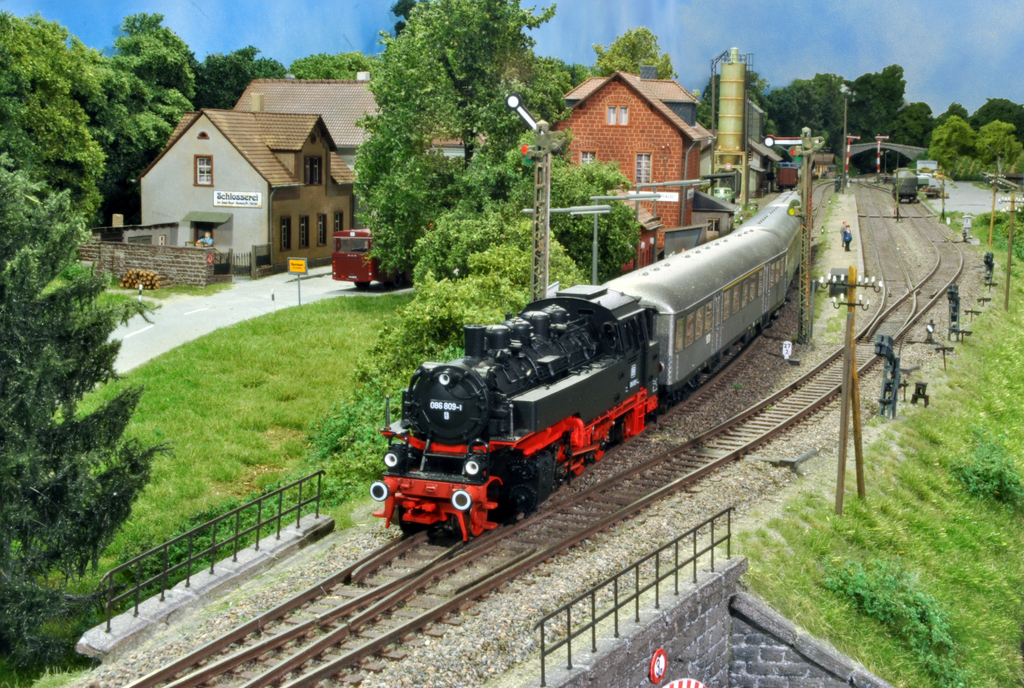
It is one of those hot late-summer days in the early 1970s in the Federal Republic of Germany. Willy Brandt is the Chancellor. The heat shimmers over the oil-soaked sleepers of a Bundesbahn in transition. It almost feels as if you can still smell the exhaust of the steam-hauled express train that thundered through here minutes ago – the lingering steam of a Class 23 or 82 from Kaiserslautern depot hanging invisibly above the dusty ballast. Steam is no longer dominant, but it has not yet vanished either. Perhaps these were among the last of their kind, before a Class 212 or 216 would take over one of the remaining token services on this line. Rambach’s “time” is not fixed to a single day, but the mood is consistent: the early 1970s, when steam still feels nearby, yet diesel traction is already normal.
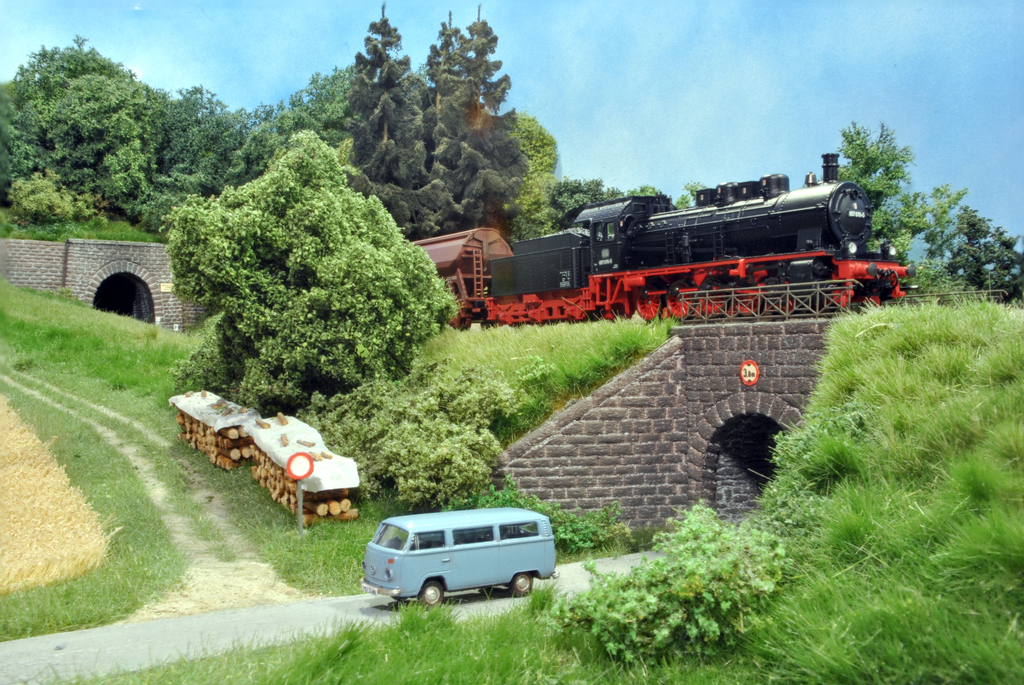
Ahead of us, half-hidden by overgrown vegetation, lies the portal to the Rambach Tunnel, framed by the red sandstone of the Westrich – a now largely forgotten corner of the Karlsruhe Federal Railway Division. Lime streaks bleed softly from between the roughly hewn stone blocks, and the tunnel nameboard, proudly stating a length of 327 metres, bears witness to the slow decay of the infrastructure.
This could be a diary entry by a railway photographer searching for the last steam locomotives in Rambach – if Rambach were not a pure model railway fiction.
In reality, Rambach is built on three segments with a total length of 3.25 metres and a depth of 40 centimetres. In N scale, this is sufficient space for a small through station on a downgraded, single-track secondary main line with modest traffic levels. The depth matters: at only 40 cm, every scenic decision has to work hard, especially where roads and sightlines meet the backscene. The layout’s physical presentation was treated as part of that discipline. Rather than a conventional baseboard trestle, Andreas supported the segments on a 50 cm deep IKEA IVAR shelving unit. With the shelving at 124 cm high and the module depth to rail level adding a further 14 cm, the railhead sits at about 138 cm. This height was deliberately chosen: it places the viewer’s eye close to scale, at eye level for N gauge, reducing the “looking down on a model” effect. The effect is simple but deliberate: the viewer looks across the scene at a natural angle, which helps the scale read as “real”. The project began with the landscape segment: a straight stretch of line with a tunnel portal and a small road underbridge, used to prove out materials and finish before the station segments followed.
Andreas’s solution for that backscene is deliberately robust rather than clever: a white-coated hardboard panel about 3 mm thick, glued to the baseboard and flexible enough to bend around corners if firmly fixed while the adhesive cures. The sky and clouds were applied with matt spray paint in pale blue and white, working darker towards the top to create a sense of depth. The solid backscene also allowed low-relief trees to be glued directly onto it, extending the scene without eating into the 40 cm.
The same pragmatic thinking extends into photography. Because N scale offers very limited depth of field at close range, Andreas regularly used focus stacking to produce images that remain sharp from foreground ballast to distant backscene. Early photographs were assembled from as many as eleven individual exposures, combined using Helicon Focus on macOS or Combine ZM on Windows. These images are not “artificially enhanced”; they simply replicate what the human eye expects to see.
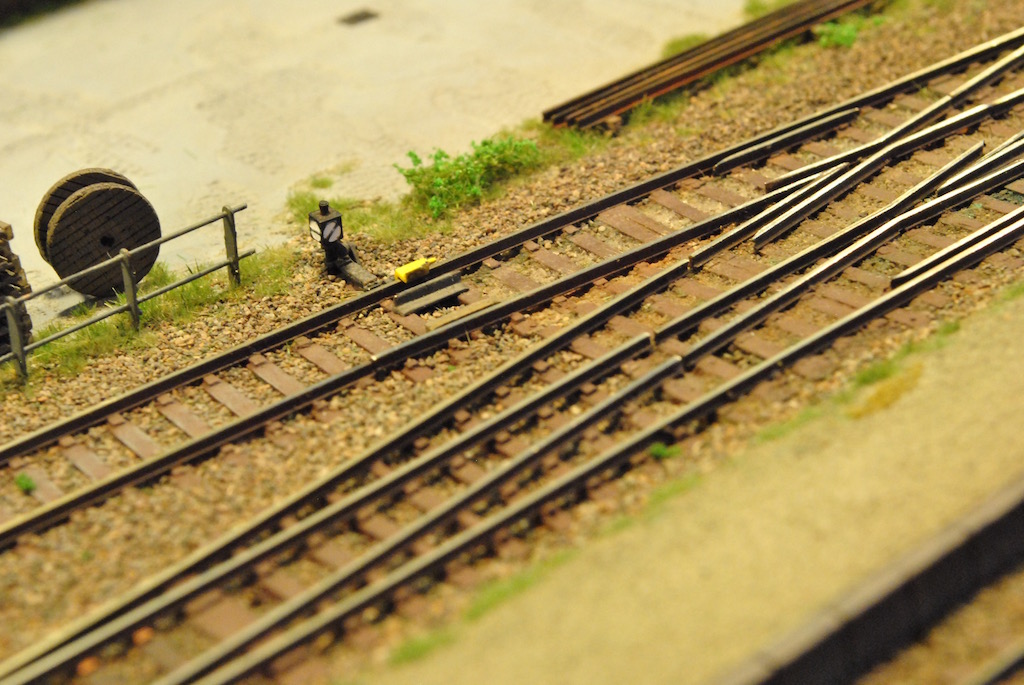
The comparatively generous length of the station results primarily from the use of prototype-correct turnout geometry. The turnouts correspond to real German designs with ratios of 1:9 and 1:7.5, and a minimum prototype radius of around 190 metres. On the real railway, these turnouts were passable at 40 km/h in the diverging route. This faithful execution, together with rail profiles closely scaled to the prototype, can realistically be achieved only at this scale through hand-built track.
It also has knock-on effects: long, gentle geometry pushes the signals and clearance points into places that feel “right”, but it leaves less spare platform length than a set of tight model turnouts would. Andreas acknowledged this trade-off and accepted shorter usable platform lengths in exchange for geometric credibility.
Rambach’s infrastructure was built with the same practicality. For the station segments, Andreas used 16 mm blockboard with an 8 mm chipboard layer for the trackbed, cutting relief openings in the frames and rear panels to reduce weight. This mattered not only structurally, but ergonomically: lighter segments could be handled repeatedly without damage during the long build period. The track plan was temporarily glued down so the trackbed could be cut to match it precisely before the track went down.
For Rambach, this was done using milled Pertinax sleeper strips from Petau, soldered Code 40 rail from Marsilius, and considerable patience and steady nerves. The resulting rail height corresponds closely to prototype proportions and immediately distinguishes the track from standard N-gauge systems. Although Andreas wanted to prove to himself that he could do it, the trackwork phase felt more like endurance than enjoyment, and he looked forward to scenery and buildings far more than to laying and wiring track. The aim was not “finescale for its own sake”, but track that would disappear into the scene rather than dominate it.
His first turnout build was a scale EW190 1:9, assembled from a kit following Jens Emmermann’s instructions. Andreas reckoned on roughly four hours per turnout, including filing work on the rail. This estimate does not include the time spent simply checking geometry and smooth running, which he regarded as essential rather than optional. Even his oldest Arnold stock ran through it cleanly in early tests, which matters: in N, reliability is part of credibility. In Rambach’s case, the last turnout completed was an EW190 1:7.5, built and fitted as the closing piece of pointwork.
To keep the look consistent, sleepers and rail share the same base colour (Revell enamel “Schokobraun” (chocolate brown) No. 84): the Pertinax sleepers were painted before the rail was soldered on, while the rail itself was painted later, once installed. He deliberately avoided airbrushing the enamel at this stage because the paint behaves predictably by brush and is less prone to pooling on tiny sections of rail. Later, in tests, he also rejected an over-grey dry-brushed sleeper finish as unconvincing in close-up, and reverted to a warmer brown sleeper tone (Revell No. 83, Lederbraun (leather)) for a more natural “aged timber” base. Turnouts were treated as their own special case: Andreas even ballasted the sleeper base before soldering the rails in place, because conventional wet ballasting afterwards would leave the point mechanism dangerously exposed to water and glue.
Only once the ballast is down does the final “unifying” layer happen: a very thin airbrushed brake-dust wash, mixed from heavily diluted grey and brown acrylics, which takes the edge off fresh ballast and pulls everything into the grey-brown world of real track. That “brake dust” was not a single fixed recipe either: an early, browner batch proved too orange, so Andreas ended up combining the grey and brown mixes into a thinner, greyer chocolate-brown that he could keep using across segments without obvious colour breaks. Even the infill between the rails was allowed to “pick up” some of this brake-dust tone, so that hard transitions between ballast, sleeper colour, and yard surfaces are softened rather than emphasised.
Ballasting in N is one of those jobs where method matters more than enthusiasm, and Rambach’s trackwork was treated as its own discipline. The ballast itself is a deliberate blend: Koemo R10 and W10 mixed 50/50, echoing the way new, pale stone sits alongside older, rust-brown material on the real railway. Shaping was done dry, slowly and mechanically: ballast was tipped between the sleepers with a small household shaker, then worked into place with a bristle brush cut down to about 2 mm. The brush is held almost upright and pushed firmly “over” the sleepers, so the stones are stuffed between them rather than swept across them. A final pass with a dry fingertip pushes stray grains off the sleeper tops and into the gaps. The same cut-down brush is turned through 90 degrees for the sleeper ends, so the shoulders can be packed without flattening them into a model-like “wedge”. To remove the last grains from the sleeper tops, a stiff bristle brush is used, including a trimmed synthetic brush made specifically for the job.
This stage also reflects a visible change in approach. Andreas was dissatisfied with an earlier ballast choice (minitec “Grandiorit”), which consistently read as sand in photographs. He switched to Koemo Diabas ballast and began mixing lighter material with a lightly rust-patinated grade to avoid a uniform, model-like colour. Before ballasting, he also experimented with ageing the rail and fittings using a brushed-on mix of chemical blackener (Brünierflüssigkeit, noted as Ndetail “Patina braun/grau” in the workshop) and rust pigments, applied after degreasing the rail with isopropyl alcohol.
Fixing the ballast is where Andreas changed approach. A syringe was abandoned after the usual problem: one moment of sticking pressure, and a wave of glue floods the formation, washing away carefully placed stone. Instead, a small pipette bottle from the artist’s shop is used to meter Koemo ballast adhesive in controlled drops. Glue was applied from the outside first and allowed to wick in by capillary action; once the shoulder is thoroughly damp, additional adhesive can be dotted from above without blowing craters into the surface. In short: less force, more control, and far fewer repairs. The result is not just neater ballast, but also less “rework fatigue,” which matters on a layout deliberately built by slow accumulation.
Although the track plan itself is relatively simple, it offers several shunting possibilities. The goods facilities include a loading road, an end loading ramp, a farmers’ cooperative warehouse, and a goods shed. Passenger traffic is handled more modestly: travellers have access to a short asphalted platform at the sandstone-coloured station building, as well as a longer cinder platform. The latter is long enough to accommodate a V100 diesel with four scale-length Silberlinge coaches. Even the platform surface was treated as a period question rather than a default: with concrete “prefab” platform edging (from SpurNeun) suggesting a 1960s modernisation, an asphalt surface becomes the natural companion, although paving and bound gravel were also considered. The platform edge choice also dictates the “feel” of everything beside it: if the edge reads as renewed, the surrounding ballast, weeds, and drain covers need to look like they have accumulated since that renewal, not like they were installed yesterday.
Nine years of construction for countless details
Although Rambach itself is fictional, great emphasis was placed on prototype fidelity. In 1:160 scale, this requires extensive scratchbuilding, a calm hand, and a significant investment of time. Since 2009, the layout has been expanded and refined segment by segment. Andreas often places provisional items, lives with them in photographs, then replaces them later when a better solution appears.
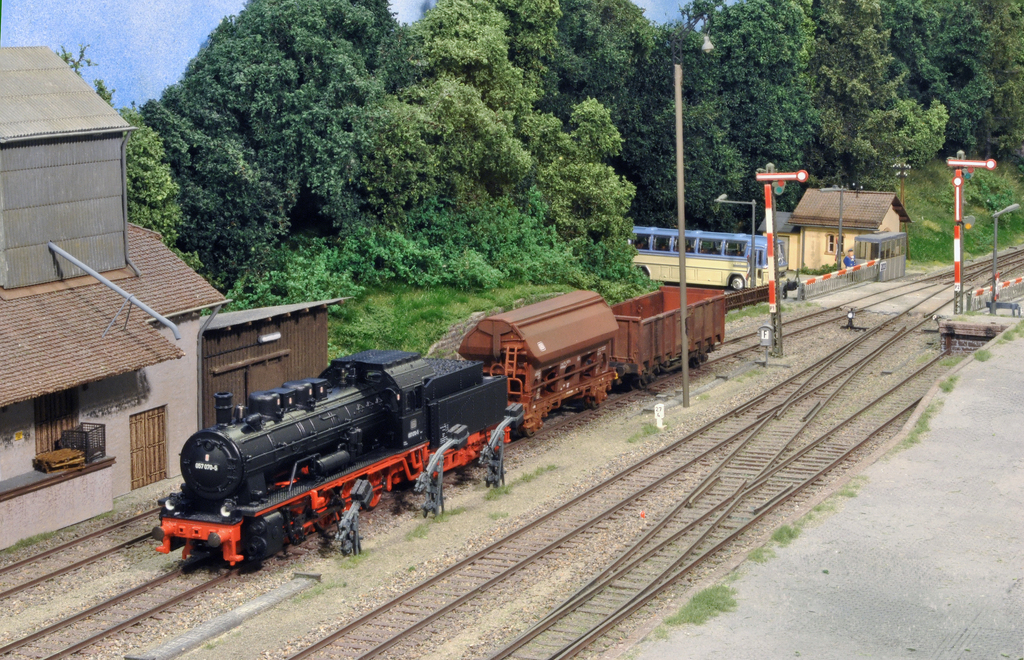
A major focus during construction was the accurate modelling of the permanent way and its associated railway furniture. Train movements are governed by hand-built semaphore signals positioned at the station throat, reflecting Deutsche Bundesbahn practice on lightly trafficked secondary main lines. Local shunting movements are controlled by low-mounted shunting signals, while sidings are protected by Weinert Gleissperren (derailers), preventing unintended wagon movements onto the running line.
Underneath the scenic layer, the same “do it properly, but keep it serviceable” approach applies. Andres operated turnouts by hand using a system borrowed from FREMO practice: an aluminium tube linkage drives the blades via spring steel wire, with a switch on the linkage providing frog polarity and acting as a travel stop. The operating rod is finished with an off-the-shelf furniture knob, and the spring steel wire is held with a simple screw terminal block. The result is neither showy nor complicated, but it is robust, adjustable, and easy to maintain. Wiring was not trivial either. Andreas singled out the half scissors feeding the goods shed and farmers’ warehouse as the hardest early hurdle, with four common crossings needing electrical isolation and switching before reliable running was achieved.
The protective details were not left as “later”: the derailers are functional and were treated as part of the track scene, including the question of how much ballast should sit around them, because a conspicuously “empty” patch looks wrong in close-up. Andreas even caught himself making that exact mistake, leaving an unrealistically clean “halo” around a derailers, then going back and lightly re-ballasting it because the eye immediately reads it as contrived. The eastern exit also gained Weinert tensioning devices for the wire runs, added as a distinct build step once the trackwork had reached a stage where these details would not be damaged by further heavy handling.
A trackside telephone (Fernsprecher) was also added near the derailer. Its exact position sparked the sort of prototype debate Rambach seemed to invite, but the underlying idea is sound: it gives shunting staff a point to communicate or confirm the derailer is secured, and it adds a very DB-looking note of procedure to an otherwise quiet yard. Even when the justification is partly aesthetic, the effect is operational: it suggests rules, keys, confirmations, and the small rituals of a station that still needs to function correctly, even if very little happens there.
The signalling scheme is intentionally sparse. There is no attempt to over-equip the station with unnecessary signals or technical embellishment. Instead, signalling reinforces Rambach’s role as a modest through station, where operational discipline exists, but complexity does not. Even so, signal placement was treated seriously: the available platform length and the desire for prototype turnout geometry inevitably tighten clearances, and Rambach leans on the real-world logic that a small station can be operated without simultaneous moves when space is constrained. Even the pointwork reveals a pragmatic line between prototype and model: the switch lanterns can be rotated for photographs, but they are not mechanically linked to the blades or the switch weight, which remains in its neutral position. This is also where the “infrastructure layer” shows its depth: Andreas planned clearance and stopping points, including Grenzzeichen (Ra 12) fouling point markers for converging tracks, and intended to install them only after ballast had been fully glued and weathered, so they sit properly in the finished formation rather than looking like afterthoughts. In other words, the signalling is not just scenic. It is tied to how trains stop, where they wait, and what is permitted at the throat.
Even the signalling stock evolved the same way. At one point, Andreas described a very specific “interim solution” phase: Weinert signals were the intended end goal, but the soldering and painting workload (and cost) slowed progress. Viessmann N signals were too large, Viessmann Z signals were too small, so he created a hybrid. He shortened an N-signal mast to a measured 50 mm at the wing pivot height to represent roughly an 8 m prototype signal, removed or reduced the most visually heavy lamp components, and used a wing length that matched the 2.2 m prototype dimension. He treated these modified Viessmann signals as a bridge to a later full Weinert fit-out, not as an abandonment of standards, which again matches the Rambach pattern: keep moving, keep credible, improve later.
The mechanical side of DB secondary-line practice is present too. Around the station building, Weinert drahtzug (rodding) channels were considered as part of the design, and the layout includes a small signal box style annex to house the lever frame. The lever frame itself was a piece of cheerful improvisation: Andreas repurposed the wheels from a Kibri platform trolley as cable pulleys, then lit the interior so the “effort” is not wasted once the building is in place.
In all disciplines – trackwork, scenery, and buildings – the aim was realism rather than spectacle.
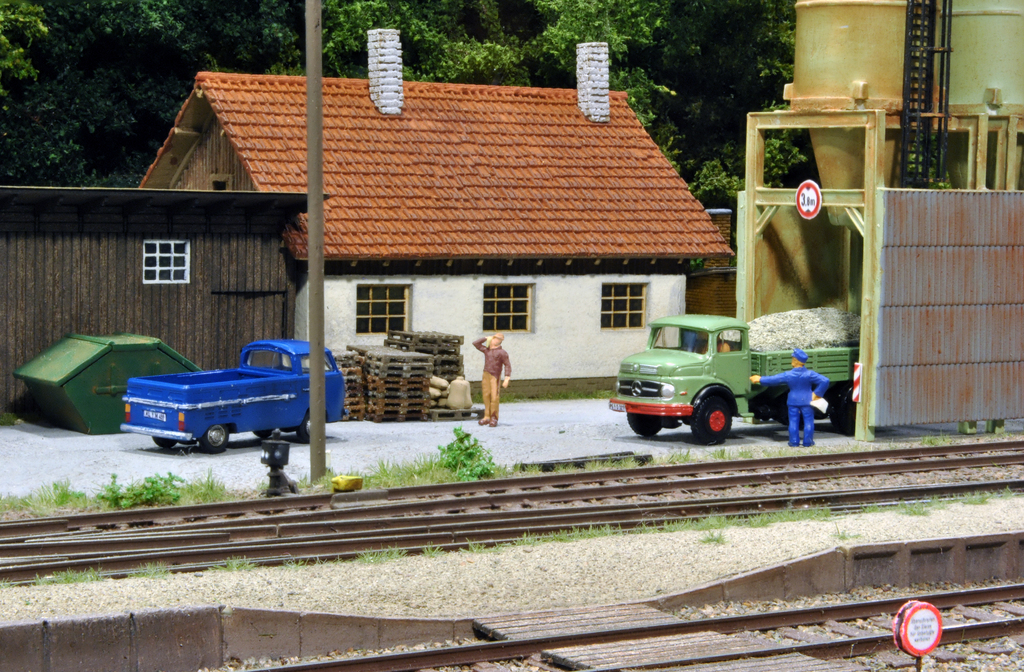
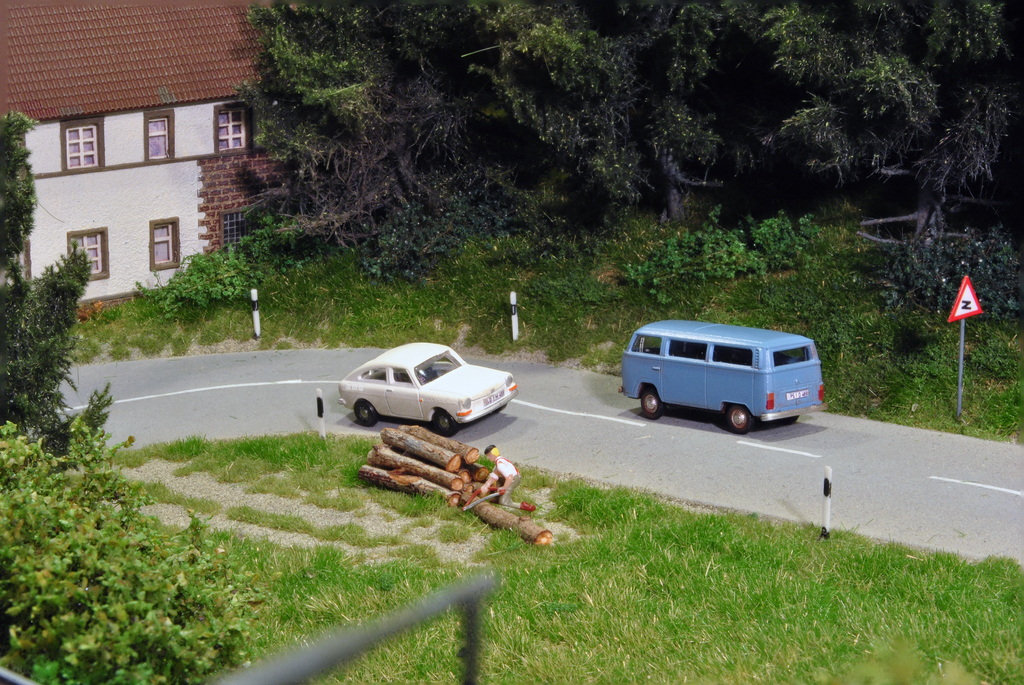
The rural setting is reinforced by everyday scenes: a farmer loading firewood for winter, modest road traffic, and understated infrastructure. There is little activity on the railway or on the roads of the Palatinate countryside. The road junction behind the railway bridge is poorly visible, which explains the warning sign advising drivers to proceed slowly. Even small pieces of “bureaucracy” were treated as scenic texture: road markings were adjusted after feedback, with the tight curve before the underbridge given a continuous centre line and an overtaking prohibition sign planned to match period practice.
Even the level crossing feeds into this “ordinary correctness”: the barriers were not treated as generic accessories, but as finely made items with moving latticework, based on Viessmann components and modified by a specialist builder (a detail that matters in N, because rigid, chunky barriers instantly give the scale away). In the earlier design thinking, Andres also discussed a DB-style barrier with Gitterbehang (hanging mesh), and considered etched parts based on published etch artwork, with the mesh itself formed from 0.05 mm enamelled copper wire. Whether realised exactly as first imagined or not, the intent is consistent: the crossing should read as DB practice, not as a toy accessory.
The approach to the backscene is similarly pragmatic: a road hitting the backdrop at right angles is hard to disguise in 40 cm of depth, so solutions considered include dropping the road away into a “dip” so the join is not visible from normal viewing angles, rather than trying to paint clever perspective onto an impossible geometry.
For the surfaced areas, the loading road was made from laser-cut cobbles from MKB Modelle, backed with Styrodur. Track infill between the rails was formed from polystyrene strips painted grey, then coated with adhesive and dusted sparingly with fine road grit (Koemo). Andreas’s general approach to paved surfaces elsewhere on the layout is similarly direct: roads were laid out on 1mm XPS foam sheet, while cobbles were scribed using simple hand tools: a scribing needle for the longitudinal joints and a watchmaker’s screwdriver for the transverse joints. “Asphalt patches” are simply the places where no cobbles were scribed, with the transition blended using the blunt side of the same tool. Colour is built up from mixed grey and brown artist acrylics, then toned with a light “dirty grey” dry-brush. When sharper edges are needed than foam naturally gives, card is also in play: thin card can be stiffened with thin cyanoacrylate and then sanded cleanly, producing crisp corners without the softness that can creep in with Hartschaum. This same “choose the material for the edge you need” attitude also shows up in small scenic structures, such as lamps, bins, and other yard furniture, where purchased parts, 3D prints, and scratchbuilt items are mixed without any one method becoming a dogma.
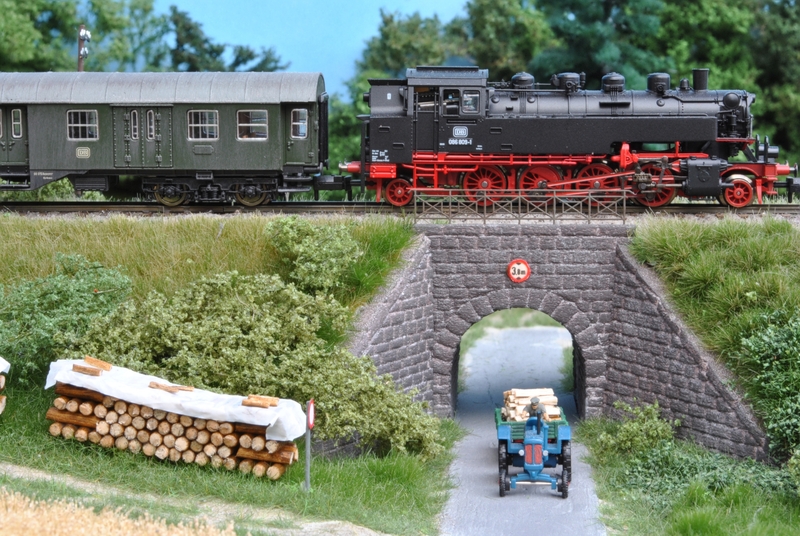
The landscape base itself followed the same practical logic. For rough shaping, Andreas built a simple hot-wire cutter from resistance wire and a coping-saw frame, using it for quick, clean cuts in XPS foam. The remaining profiling was done with a wood rasp. Some key structures, including the stone-arch road bridge, were carved from a single block of XPS, with the arch formed using plywood templates as hot-wire guides, then joint lines scribed and the whole piece coloured and weathered in acrylics. The appeal was partly cleanliness: unlike plaster work, scribing foam created almost no mess, and the foam’s fine surface texture helped the finished stonework read naturally once painted.
Colour makes the difference
When it comes to credibility, colour treatment plays a decisive role. Great care was taken to use muted, matte tones throughout. This begins with the ballast, which was given a hint of brake dust using heavily thinned acrylic paint applied with an airbrush, and continues through to the subtle blending of grass fibres.
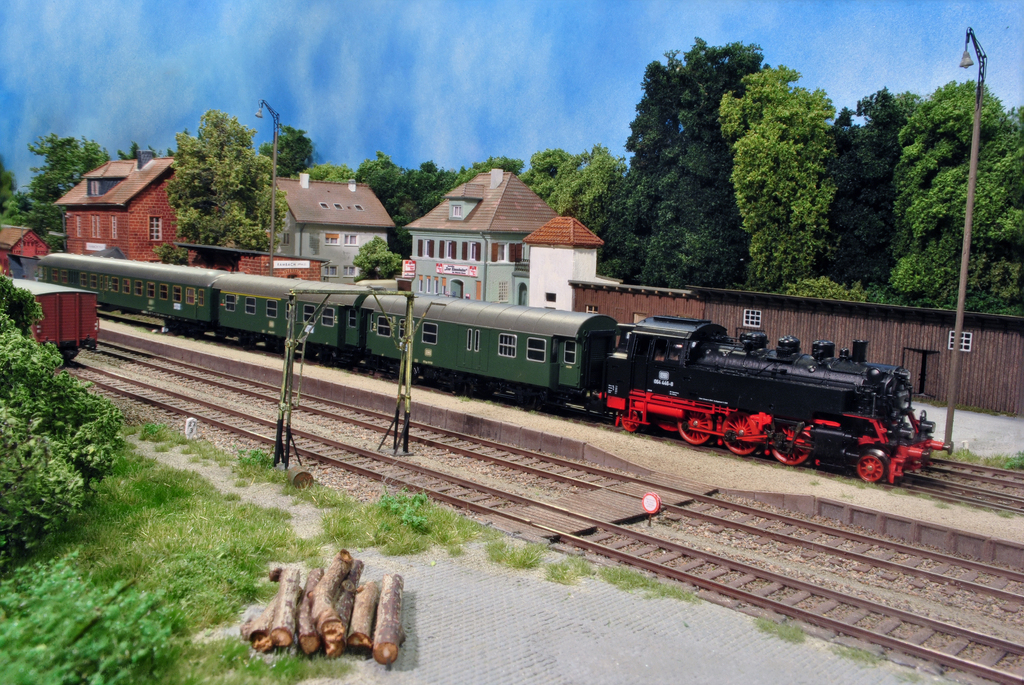
Bright colours were deliberately avoided in the landscape. For electrostatic grass application, no more than two or three shades were used, typically “summer,” “early spring,” and “late autumn” tones from miniNatur. Only through the careful combination of restrained, natural colours in track, buildings, and scenery does the model achieve a convincing overall impression.
The consistently matte finish was a conscious choice, with almost every scenic and structural element painted or airbrushed to avoid any hint of gloss. This preference extended to adhesive choices: Andreas rejected artist’s acrylic emulsion for grassing because it dried too glossy and was too thin for precise placement, and instead favoured Langmesser grass glue because it dries matte comparatively and holds tiny “dots” of glue in shape, even when applied in miniature with a fine brush. When very short fibres are used, the technique becomes almost surgical: Polak 1 mm fibres were sifted and applied in tiny clusters so that ‘micro-tufts’ read correctly at N scale rather than becoming a uniform lawn.
Ordinary buildings feel authentic
The philosophy for buildings is simple: the more ordinary and inconspicuous they are, the more realistic they appear. Rambach is intentionally not a picturesque Alpine or Black Forest village full of decorative architecture. Instead, it is a collection of functional buildings grouped around a station located slightly outside the village itself. That choice is not aesthetic modesty; it is prototype realism: many real stations are surrounded by “nothing special” buildings, and that is exactly why they feel true.
The station building was inspired by the prototype at Offenbach/Queich and realised using laser-cut construction. Andreas’s earlier station-building work also drew directly on the Pfalzbahn tradition, including a model of Godramstein (near Landau), with the characteristic proportions and restrained ornament typical of Palatinate station architecture. The level-crossing keeper’s hut and small metal workshop were designed without specific prototypes but created digitally and cut by laser. The core was laser-cut from drawing card in several thicknesses (MKB). Roof sheets came from architectural modelling supplies (nominal 1:200) and were colour-treated. Ridge tiles were made as strips cut from Noch roof-tile texture foil. The station signs were designed on a computer and printed as photographic prints. Even the exterior wall lamp was treated as a modelling exercise, modified from a Faller kit and painted, while deliberately non-working because a functioning lamp would be oversized at this scale. This “non-working on purpose” stance matters: Rambach values correct proportion over gimmick lighting that would immediately betray the scale.
Many buildings were modified or repainted to individualise them. Added details such as rooftop aerials, signage, house numbers, half-closed shutters, and subtle weathering further enhance realism. The station building, goods shed, and crossing keeper’s hut were scratchbuilt, while most other structures are adapted from laser-cut or plastic kits from manufacturers including MBZ, Noch, Kibri, and MOEBO. Where kit parts were used, they were treated as raw material: repainting, adjusting small details, and reworking edges and surfaces were routine rather than optional. Small “flat” details were often made from paper, not purchased parts: roller shutters, for example, are simply 160 g paper with the slats scored in using the back of a scalpel blade, then painted (a light brown Revell tone) and installed. Likewise, signage was treated as modelling rather than decoration: the station pub’s signs were composed digitally, printed on good photo paper, and built up as physical objects by laminating onto 0.8 mm polystyrene, trimming and filing to fit. Even a cigarette machine was a deliberate detail, not an afterthought. The same applies to “small station” clutter: a grit box, a scratchbuilt timber-post lamp, and the slow accumulation of minor fittings do more for believability than a single showpiece structure. At the level crossing, the barriers themselves are a similar case of “kit as raw material”: they were supplied by Klaus Mannheimer (1zu160 forum) as complete kits based on Viessmann barriers, with the mesh built up by hand. Andreas was able to obtain a pre-assembled demonstration set, which helps explain why the barriers look unusually fine for N. In early development work, even simple buildings were made from what was to hand: greyboard cut from the backs of college pads, or 1 mm card from packaging, designed on the computer, printed full-size, then cut with a sharp scalpel and sealed with matt varnish spray to prevent moisture swelling before painting.
Some of the “ordinary” buildings had very specific origins. One kitbashed house on the Bahnhofstrasse began with Vollmer Post kit 7633 as the basis for its upper walls. Dormer walls were added, gable walls were made using colour-treated Noch texture foil, and the roof was cut from 160 g paper, then faced with Noch texture sheet and painted red-brown. Another town building was created by combining two Kibri “Amselweg” single-family house kits (No. 37041) and adding an extra storey, turning a generic kit into something closer to the 1960s small-town blocks that sprang up across West Germany. Even the choice of windows was treated as a quality decision: Andreas noted that the Vollmer mouldings were among the finest he had used in injection plastic, even if other proportions in the kit were less than perfect. Where no suitable N-scale kit existed at all, he simply designed his own. One early example was a 1920s-style settlement house: drawn on the computer, transferred to 1 mm greyboard, sealed with matt varnish spray, then painted with acrylics. It was consciously treated as “in progress” in photographs, with gaps at the roof and missing fittings like chimney, door, gutters, and downpipes identified as specific next steps rather than ignored.
To avoid visible gaps at ground level, Andreas usually sets buildings into shallow recesses cut to the footprint of each structure, so the walls sit “into” the ground rather than on top of it. It improves the join, and it also allows electrostatic grass to be applied cleanly right up to the edge without awkward field effects. In the goods area, the “ordinary industry” keeps expanding in believable increments: the Raiffeisen goods shed gained a silo and loading structure, and small additions like a scratchbuilt timber-post lamp and a 3D-printed grit box quietly reinforce the sense of a working place that has been adapted over time. Even the buffer stops are treated as “real objects”: Andreas used a laser-cut prellbock kit (sold via SpurNeun, originally by Schlag-Modellbau), then added a track number board and a Sh0 disc, the sort of detail that reads instantly as DB practice. The same incremental realism appears in kitbashing: one key goods building began as an old Arnold goods shed kit (“Rocksdorf”), but was completely re-coloured with acrylics, given a new plaster texture by stippling on a grey-white paste, and re-roofed using Noch sheet material. A silo tower from Walthers (USA) was added to complete the agricultural trading feel, with lettering planned using white rub-down characters for a green decorative band.
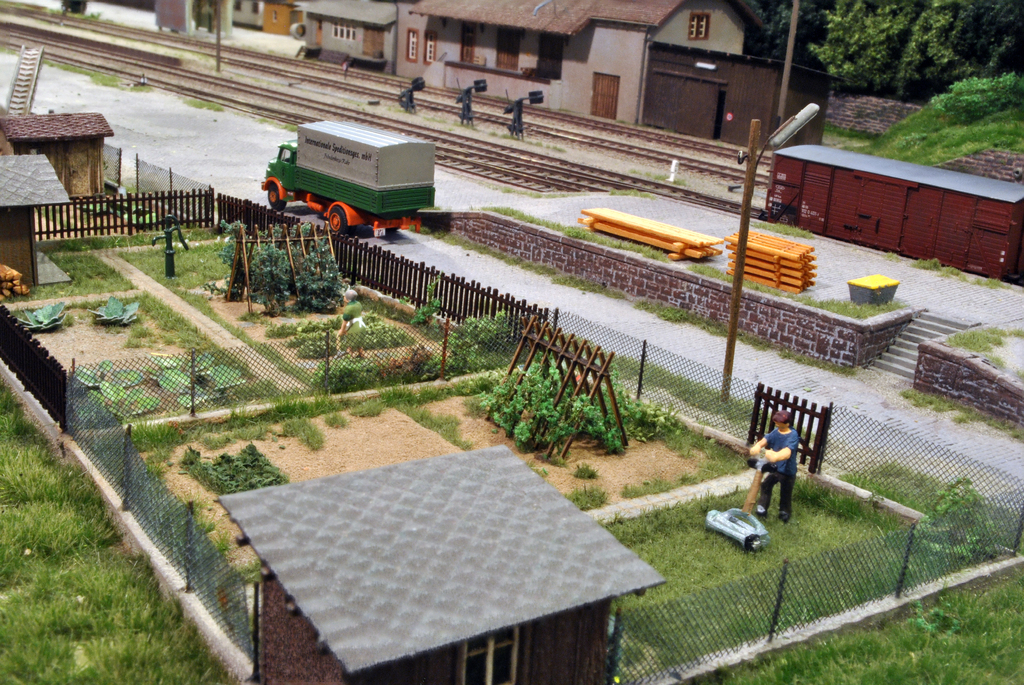
Around the buildings, it is again the small, everyday details that create atmosphere: rusting zinc rubbish bins, salt grit boxes, discarded old sleepers, and carefully tended allotment gardens. Beans, cabbage, and potatoes grow in neat rows. There is even a small grass play area for children. Some of the most convincing “rural” detail is almost throwaway: wood stacks made from stained, cut toothpicks; lightly upgraded Wiking cars with added trims and whitewall tyres; a simple hut made from plain greyboard placed behind a field track. These are quick builds, but they add exactly the kind of mundane specificity that makes a scene feel inhabited.
Even figure choices follow the same “ordinary, but correct” logic. One small example is the tractor driver, which Andreas identified as a Preiser figure (79152, “Bus und Straßenbahnpersonal”), with the bus driver repurposed as a farmer. It is exactly the sort of practical, almost invisible decision that helps N scale read as life rather than miniatures. Even named micro-scenes appear without fanfare: a hunter and dog heading for the nearby Rambach forest; a milk farmer taking a load towards the station; daily life implied rather than staged.
Those allotments are a good example of Rambach’s “process first” approach. The ground levels were built up with thin layers of Styrodur to match the loading road height, coated with ballast adhesive, then dusted with Minitec Parabraunerde. The first grass layer uses 1 mm dark green Polak fibres, applied in small 5 cm by 5 cm patches into diluted PVA (with a drop of washing-up liquid), dotted on with a fine hair brush. A second layer follows in 2 mm fibres, typically a mix of miniNatur “Sommer” and “Frühherbst”, applied irregularly to avoid that newly-carpeted look. Fencing is treated just as seriously: the picket fence is Faller, the garden huts are from Noch and MBZ, and the chain-link fence is a home build using 0.2 mm spring steel wire for posts and blackened Fohrmann wire mesh. Many of the plants are Noch Laser-Cut Minis, but the key step is physical: repeated bending and shaping of the leaves so they stop looking like flat cut-outs. Even the “implied services” are modelled: hand pumps were added (MZZ), and a third plot can simply be “on mains”, which is both practical and faintly humorous in a very German way. Rambach’s fields follow the same logic: when Andreas wanted a convincing cornfield in N, he chose a Polak product specifically because it was the only one that read correctly at scale, even if the stalks leaned slightly in one direction. The viewing angle of the layout meant this “imperfection” could be accepted because it did not interrupt the illusion from normal sightlines.
These ordinary details, so often overlooked, are what give the scene its flavour. After all, how many real railway photos from the 1970s show ornate village fountains – and how many instead show simple grit boxes and neglected infrastructure?
Grass, Weeds, and the “Unimportant” Edges
Much of Rambach’s realism comes from the places that are usually left too neat: the verge, the ballast shoulder, the platform edge, and the gaps between track and road. Andreas typically began with a base coat of Langmesser grass glue and a dusting of Woodland Fine Turf. He then applied a first layer of fibres using miniNatur “Sommer” and “Frühherbst/Spätherbst”, and used darker Polak fibres for trackside and verge areas. For the tiniest weed tufts, 1 mm Polak fibres were applied into pinpoint dots of adhesive using a very fine brush (size 0/2). This is the same “scale honesty” again: in N, the edges should look untidy, but the fibres must stay short enough that they do not become “hedges”.
To avoid clumping with 1 mm fibres, he modified his applicator with an additional fine mesh “sieve” inserted into the head (a piece of Fohrmann copper wire mesh originally purchased for chain-link fencing). This simultaneously sieves and disperses the fibres as they are applied. He also modified his applicator so that the high voltage is connected directly to the mesh, which helps especially with short fibres.
For richer grass, only the tips of an earlier grass layer were re-dotted with adhesive and re-grassed, creating varied height and tone without resorting to unrealistically long fibres. In N, he found 2 mm fibres suitable for most work, with 4.5 mm used only in exceptional cases. The goal is not “long grass”, it is layered texture: short fibres, selectively re-glued and re-applied, so edges become untidy in the way real edges are. That is also why Rambach’s vegetation reads as late summer rather than “model green”: it looks layered, slightly tired, and unevenly maintained.
Rolling stock and operation
Operation is fully analogue, controlled via a Heißwolf controller, allowing very fine speed regulation. As with scenery, the same colour philosophy applies to locomotives and rolling stock: muted, matte finishes are almost always more realistic than glossy, colourful models. Even at the photography stage, that matters: a matt vehicle on matt scenery reads as scale, while a glossy roof or bright plastic edge will give the game away immediately in 1:160. Weathering was approached experimentally and with restraint: after buying pigment powders from Boesner, Andreas applied them dry and worked them into the surface with a soft brush. On a silo wagon, he first painted faint white lime streaks, then softened them with pigment. He also notes a familiar N-scale trap: macro photographs exaggerate contrast and make weathering look heavier than it appears to the naked eye. Long before Rambach’s fleet became “complete”, Andreas sketched out a clear operating and acquisition direction: the stock was being built up specifically around the Epoch III–IV overlap, and he described it as “still modest” but steadily expanding. At that stage, the locomotive fleet included BR 64, BR 24, BR 86, BR 01, BR 62 and a V60 (Fleischmann), BR 93, Köf III and a V100 (Arnold), plus the then-new VT 98 railbus (Minitrix). Coaching and wagon stock included a broad mix of goods wagons and passenger types such as Umbauwagen, Hechtwagen, Schürzenwagen, Silberlinge and Donnerbüchsen from various manufacturers. He also listed the “future wants” in a way that matched the layout’s tone: a V100 from Minitrix, a VT 95 from Fleischmann, and (when available) a MAN railbus from Brekina. Early weathering tests were deliberately done on older stock first, including Arnold wagons, precisely because they were “safe to risk”. The method began with a diluted grey-brown wash, then dry-brushed progressively lighter rust tones. Andreas was not fully satisfied at first, but he treated that dissatisfaction as data, not failure, and planned to introduce airbrush work only after proving a workable direction by brush.
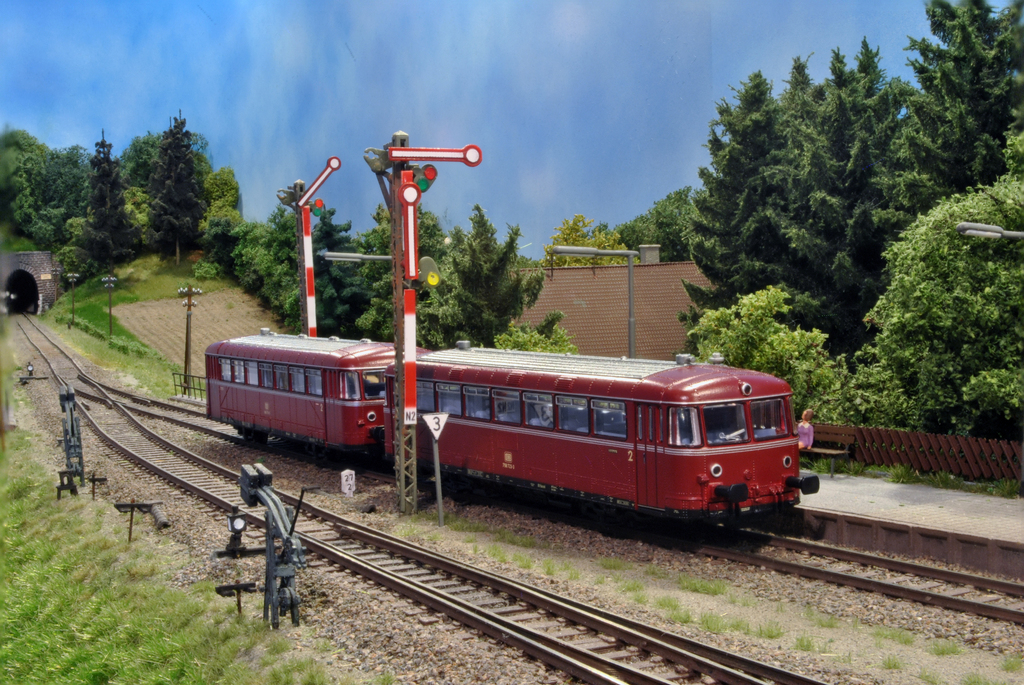
In the coming years, the vehicle fleet will be gradually adapted to match Rambach’s colour palette and carefully weathered. Details such as replacement buffer beams or finer shunter steps are already waiting on the to-do list. Even on ready-to-run models, Andreas was alert to proportion and “shape truth”: on the Minitrix VT 98, he planned corrections made easier by an aftermarket replacement underframe (Eichhorn Modellbau) for the VS trailer, addressing the overly “bulky” appearance created when manufacturers reuse motor-car tooling. He also intended to tone down overly white LEDs to a warmer hue, because lighting colour alone can break period credibility.
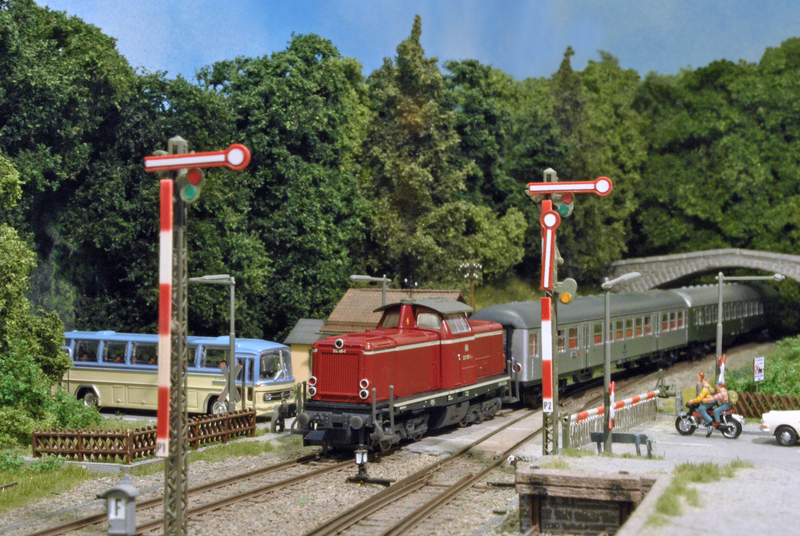
Ultimately, only weathered vehicles will run over the Rambach tracks. The future extension of the line beyond the level crossing is under consideration, depending on space in a new hobby room.
Epilogue
Rambach is not a statement layout. It does not rely on spectacle, grand scenery, or technical excess. Its strength lies in the familiar: a platform edge that has seen better days, a line whose importance has quietly faded, and a station that exists because it still has a purpose, however modest.
In that sense, Rambach is deliberately incomplete. There are details still missing, vehicles yet to be toned down, and scenes that could be refined further. This is not a flaw, but a reflection of the prototype world it echoes. Real branch lines were never finished either; they accumulated layers of change, neglect, improvisation, and care in unequal measure. Rambach follows the same logic: provisional solutions (a too-clumsy signal, an awkward backscene junction, a temporary detail) are tolerated for a time, then quietly replaced when a better method presents itself.
For many viewers, Rambach will resemble places they once knew rather than places they deliberately remember. A station passed through on holiday. A line glimpsed from a car window. A quiet halt where nothing much happened, and therefore everything feels familiar.
If the layout succeeds, it is not because it demands attention, but because it rewards it. The longer one looks, the more it feels less like a model and more like a moment that could have existed. Rambach does not shout. It simply refuses to break character.
And perhaps that is enough.
More Information
- Mayer, Andreas. “Rambach (Pfalz).” Faszination Spur N, no. 1, Verlagsgruppe Bahn, pp. 32–38.