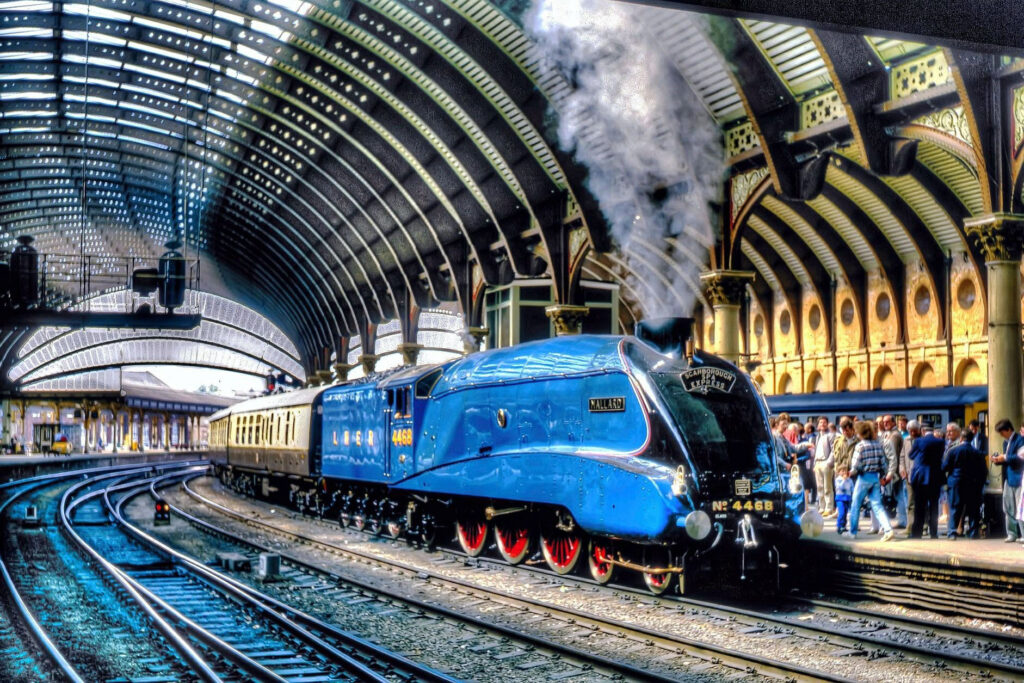
Some layouts aim to capture a railway line, others a region. Peter Kirmond’s 2mm finescale exhibition layout, York, models a single scene, yet does so with such intensity and precision that it stands apart. Inspired by a photograph of Mallard passing beneath the trainshed at York in 1986, the layout recreates the station as it was in the summer of 1937, during the high watermark of the London and North Eastern Railway (LNER).
York is not a traditional exhibition layout. It is not designed for panoramic views or open scenic vistas. Instead, it delivers a tightly composed perspective, placing the viewer on the concourse beneath the vast glazed roof, looking out across the platforms. Every element has been considered to evoke the atmosphere of the major East Coast station in its prime.
More than a technical achievement, York is a modelled experience of time and place. With inventive design, subtle lighting, and meticulous attention to historical detail, Peter has created a layout that immerses the viewer and convincingly captures the atmosphere and rhythm of a busy main line station at the height of the steam era.
Design Concept and Development
York began with a photograph. Peter was looking for an image to confirm the shade of red used on the wheels of blue-painted A4s when he came across a picture of Mallard passing under the roof of York station in 1986. The striking light streaming through the glazed roof caught his attention. If that lighting could be recreated in miniature, it would make for a distinctive and memorable layout.
At the time, Peter had already been planning a 2mm finescale layout set in the 1930s. The original concept was based on Gamston Curve, south of Retford, which shared the broad sweep and scenic backdrop of his earlier 4mm layout Blea Moor. A quarter-scale mock-up confirmed that the design would be visually engaging. However, the scene felt too familiar. A friend’s comment that it was “Blea Moor with cornfields” helped clarify Peter’s own uncertainty. The plan lacked the uniqueness he was looking for.
The photograph of Mallard changed that. York offered a prototype setting with a strong sense of place, clear visual impact, and a design challenge that was both manageable and engaging. Instead of attempting to model the entire station, Peter focused on the 800-foot concourse under the trainshed. In 2mm scale, this was a practical length that could be modelled with just enough compression to fit in a car. The entrance building would be off-scene, and the open-air sections of the platforms would be visible through the ends of the roof, giving the illusion of a full station.
The next hurdle was visibility. In 2mm scale, the real roof columns would be only 30 to 40 millimetres tall, which risked blocking the view. Peter tested the idea by building a mock-up using laminated 10-thou styrene cut on a Silhouette craft cutter. Working from CAD drawings based on Network Rail archives, he designed a structure with complete roof arches at each end, just like the real station, but with the centre sections peeled open to create a practical viewing slot. The result balanced architectural fidelity with exhibition practicality.
The mock-up proved the idea would work. The visual identity of the station was preserved, the effect was compelling, and the concept was clearly original. With that, the York project moved from idea to execution.
Baseboards and Construction
York is built on custom-designed baseboards using 6mm birch plywood with laser-cut curved tops to match the flowing geometry of the real station. This curve, similar to Peter’s earlier Blea Moor layout, creates shifting sightlines that add visual interest and reward prolonged viewing. The boards were engineered with transport, alignment, and durability in mind, combining traditional framing with lightweight materials.
Track is laid using 2mm Association Easitrac components, with soldered joins and PCB sleepers at baseboard ends. These milled sleeper bases ensure accurate alignment and robust mechanical fixing,both essential for reliable operation at this fine scale.
Wiring is equally meticulous. Each rail has twin droppers to maintain continuity even if a joint fails. Power distribution uses adhesive copper tape as a bus bar beneath the baseboards, providing a clean, accessible, and reliable electrical system.
Fiddle Yard Staging and Operation
The hidden staging behind York uses an ingenious folded figure of eight return loop, developed from Peter’s earlier Blea Moor layout and also used on John Aldrick’s Ivybridge. Instead of a traditional ladder-style fiddle yard, this system connects the two scenic tracks at the front of the layout to a continuous single-line loop concealed behind the backscene. Trains appear to pass through the station in both directions, with no visible reversing or turning.
To avoid a flat crossing at the intersection of the loops, the system is arranged on two levels. An imperceptible gradient of approximately 1 in 200, running along the front of the layout, links the upper and lower decks. This allows trains to travel in both directions through the scenic section. With ten trains in circulation, the eleventh seen by the viewer is actually the first returning in the opposite direction. That same train will not reappear going the same way until the twenty-first movement. This approach creates a convincing illusion of through traffic and allows for operational variety with a limited number of consists.
Automation improves operational efficiency. Magnets fitted to vehicles activate reed switches embedded in the track. These switches trigger latching relays that control isolated track sections, advancing the queue by one train each time a movement completes. The system, developed from earlier layouts and proven through regular use, allows up to eighteen full-length trains to be held and managed across both levels of the loop with minimal manual intervention.
The layout is operated using DCC, with carefully programmed acceleration and braking curves. Locomotives enter the station smoothly, pause in a naturalistic way, and depart without sudden changes in speed. Together with the automatic staging and carefully planned sequence of movements, this control system contributes greatly to the realism and rhythm of the scene.
Buildings and the Trainshed
The trainshed is the most visually dominant feature of the layout. Based on historical drawings and period photographs, it captures the scale, proportions, and presence of the real structure, setting the tone for the entire scene. Although removable for transport and access, the roof fits securely in place during operation, framing the station and enhancing the viewer’s immersion.
The structure is built from over 80 etched lateral beams and 27 longitudinal girders, all soldered for strength. Brass support columns, internally reinforced with steel pins, provide stability, while decorative bases and capitals are 3D printed. Awnings over the open-air platform sections complete the architectural ensemble and improve visual continuity. The whole assembly is both robust and finely detailed, a blend of engineering and craftsmanship that reflects the layout’s high standards throughout.
Lighting the interior took several iterations to perfect. Early experiments with LED strips and prismatic diffusers gave way to a more effective solution: frosted clear plastic above the skylights, which produces a diffuse, natural glow. The resulting light avoids glare while evoking the soft daylight that filters through the original station’s iron and glass.
The Grand Parade entrance building is a focal point in its own right. Built from laminated 10-thou styrene cut on a Silhouette craft cutter, it features etched stainless steel details for the window frames, fencing, ticket booth, and departures board. The result is a crisp and accurate miniature of the prototype.
Other structures include a partial model of the station’s rear wall and a fully detailed W.H. Smith kiosk on the platform. The kiosk features plasticard shelving, tiny magazines and newspapers, and painted customer figures, all rendered at 2mm scale. These carefully observed details bring warmth and narrative to the scene, capturing everyday moments within the grandeur of the station.
Locomotives and Rolling Stock
The locomotive and stock roster on York is a carefully curated blend of modified ready-to-run models, bespoke kit construction, and borrowed rakes from trusted collaborators. The chosen setting—York station in 1937—offers a rich variety of working prototypes, and Peter has taken full advantage of this to create a diverse, historically grounded collection.
Gresley’s Pacifics dominate, with multiple A3s and A4s handling East Coast express services. Dapol bodies are retained but significantly improved, with custom-etched valve gear, closer-to-scale handrails, and enhanced detailing. They ride on custom-milled copper-tungsten underframes for weight and mechanical precision, delivering a solid and realistic performance.
The roster also includes a Farish J39 rebuilt with a milled replacement 2mm finescale chassis, part of a broader approach to upgrading N gauge bodies. One of Peter’s key modifications is replacing moulded handrails with 6-thou top-E steel guitar wire, which significantly improves their appearance at this small scale.
Locomotive drive units use 21:1 or 30:1 gearboxes paired with inexpensive Chinese gearmotors. While noisier than the Maxon gearmotors, they are far cheaper and quieten noticeably after running in. These reductions, combined with careful DCC tuning, provide smooth and realistic movement.
Locomotive drive units use 25:1 or 30:1 gear reductions for smooth low-speed operation. While earlier models rely on Maxon motors, more recent ones use cost-effective Chinese motors that quieten with use. DCC provides refined control, with carefully programmed speed curves allowing trains to glide into platforms, pause, and then depart without visible jerkiness.
The varied timetable of a major inter-regional station is well represented. Typical trains include:
- The Silver Jubilee, headed by a streamlined A4 and running in full formation
- LNER teak coaching rakes for express and stopping services
- The Yorkshire Pullman, including the five-coach Harrogate portion, hauled by an ex-NER D20 built by Alan Smith
- Through workings such as the Ports to Ports Express (GWR stock from Swansea to Newcastle) and the LMS Liverpool to Newcastle train, both hauled by A3s
- A Gascoigne Wood to Scarborough coal train, made up of private owner wagons
Coaching stock is drawn primarily from Dapol and Farish ranges, many upgraded with etched sides, finescale bogies, and detailed interiors. The Pullman coaches are based on Hornby/Arnold Brighton Belle stock—an accurate match for 1930s ECML usage.
Freight is represented sparingly but carefully. Wagons are selected to reflect actual traffic flows, including a variety of South and West Yorkshire private owner designs.
York’s operational variety reflects the station’s role as a major junction where services from all four of the pre-nationalisation companies could be seen. Peter’s attention to accuracy in train types and liveries ensures the scene remains both convincing and evocative of its time.
More Information
Epilogue
York is a layout that redefines what a model railway can be. Rather than sprawling scenery or expansive panoramas, it offers an enclosed, concentrated vision: a single station concourse, captured with such intensity that it feels larger than it is. In doing so, it demonstrates how precision, research, and presentation can turn a familiar subject into something fresh and extraordinary.
What Peter Kirmond achieved is not just a model of a place, but an evocation of time. Standing before it, the viewer is transported to the summer of 1937, when steam reigned supreme and York was at the heart of the East Coast Main Line. York is both a technical tour de force and an act of imagination, and it stands as one of the most compelling demonstrations of 2mm finescale modelling to date.