◀ Westbound to Mount Willard Bridge | Mount Willard Section House | Eastbound to Willey Brook Bridge ▶


heart of the notch
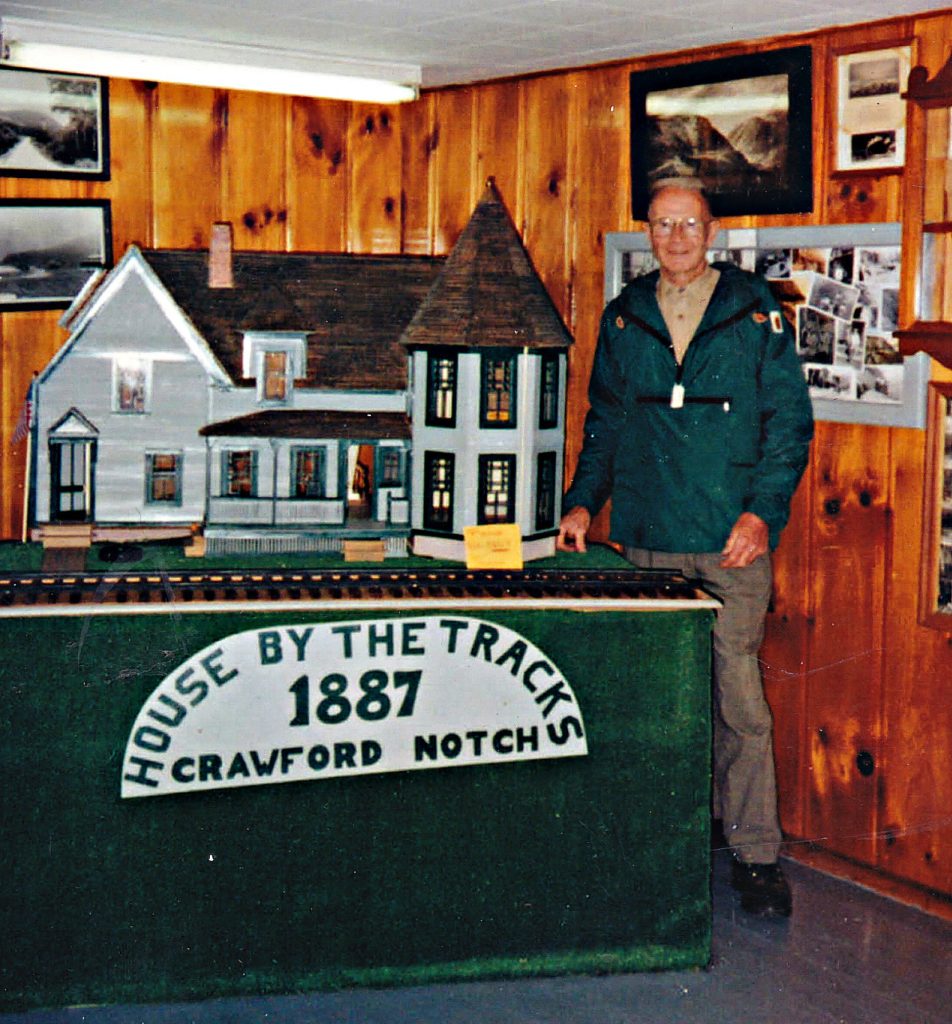
In October 1968, Maine Central announced that after the first snowfall it would burn the famed section foreman’s dwelling perched high on the cliffs of Mount Willard at the end of Willey Brook Bridge. Shortly thereafter there was talk of a group establishing a scenic excursion train in Crawford Notch, so the doomed house received a stay of execution.
But the old building continued to be vandalized, as it was impossible to keep it secure against the souvenir hunter. It was also being used for unauthorized overnight accommodations in the summer months. The threat of personal injury or fire in one of the most scenic forest areas in New England, along with possible damage to track, convinced Maine Central officials.
After a heavy snow cover was built up, the house was burned to the ground on December 13, 1972, ending its 85-year history.
For more than 80 years, the Mount Willard House served as a home for the section foreman and his family, and as a bunkhouse for his crew. For more than half of those years it was occupied by members of the Evans family; section foreman Gordon S. Evans, his wife Hattie, and their four children, all of whom were born there.
Return to the homestead. The two brothers and two sisters returned to the mountainside home of their childhood in September of 1968 and recalled memories of a half century ago.
Raymond W. Evans, Whitefield, N.H., whose middle name is Willard, pointed out the dark recess under the overhanging cliff beside the track. “We called it the blacksmith shop,” he said, “because they told us it was used as a smithy when the rails were being laid.”
Gordon L. Evans, Portland, found the rock where he scratched his name with a nail nearly 50 years before. It was 20 feet up the face of the cliff, but he remembered the handholds in the rock.
Mrs. Mildred Robinson, Portland, found the low outcropping of ledge in the tiny front yard of the old home. “There was a second base,” she said.
Mrs. Enola Ruggles, Littleton, N.H., pointed out the dry culvert under the tracks just a few yards above the house. “When the family left for a couple of days in town, Mother hid her valuables there,” she said.
Mrs. Robinson recalled that every morning all four children would line up 40 feet apart next to the track and as the train slowly labored up the grade the conductor would scoop them up one after the other as the train moved by. It was their only available transportation to school in nearby towns.
The four children also remembered the winter of 1921, when they were snowed in for a week, and they recalled the railroad plow that was buried in a 21-foot drift.
Original Occupant Responds
According to a December 1968 story in the Portland Press Herald about the proposed razing of the house, Mrs. Janet Ross of Forks, Washington, wrote the newspaper saying, “The Notch house was built for James E. Mitchell, my father, who was section foreman for that part of the Maine Central Railroad. Before the house was built we lived about a quarter of a mile up the track. She was 9 years old at the time.”
Mrs. Ross’s father changed his mind, deciding to resign when the superintendent urged him to reconsider, promising to build a house for him at the Mt. Willard location if he would remain. “So Father agreed, the house was built and we (Father, Mother, two brothers and I) moved into it in 1887,” she added.
Through the years a new living room wall hung a large painting of her old home. It is entitled, “The Heart of the Notch.”
The “Heart of the Notch” will remain a pleasant memory to those who lived and traveled in Crawford Notch.
Captions:
- At the turn of the century, Maine Central engine Number 184 with its passenger train and its crew paused for a picture at the Mount Willard House.
- The Four Evans children visited their birthplace in September 1968. Left to right are: Gordon, Mildred, Raymond and Enola.
- The Mount Willard House was burned to the ground on December 13, 1972.
◀ Westbound to Mount Willard Bridge | Mount Willard Section House | Eastbound to Willey Brook Bridge ▶