EMD GP38-2

EMD introduced the GP38-2 in 1972 as part of its “Dash 2” line, an evolutionary step that built on the proven success of the original GP38. With a 2,000-horsepower, non-turbocharged 645 prime mover, the GP38-2 was every bit as versatile and dependable as its predecessor. The real improvements came inside: modular electronics, upgraded wiring, and standardised components that made the locomotives easier to maintain and more reliable in daily service. Externally, they were almost indistinguishable from the GP38, but under the hood they represented a new generation of engineering refinement.

Boston & Maine

In December 1973, the Boston & Maine broke a twelve-year drought in new locomotive purchases with an order for GP38-2s. Delivered in McGinnis blue and white, they were modern by B&M standards and quickly assumed a prominent role across the system. Several were named after New Hampshire political figures, while others carried variations in striping and sill treatment that added variety to the class.

When Guilford Transportation took control in the 1980s, the GP38-2s were gradually repainted into the corporate grey and orange scheme, though a few carried the old blue and white into the mid-decade. Modest rebuilds and detail changes followed, but the type remained a fixture of Guilford operations well into the 1990s.

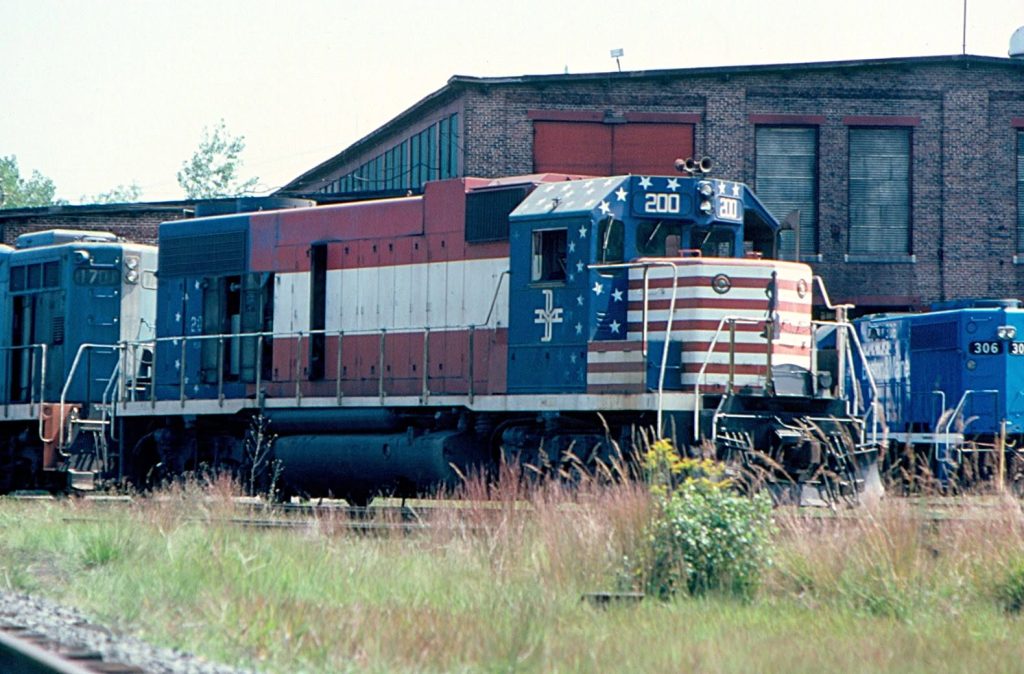
Boston & Maine EMD GP38-2 No. 200, wearing its striking Bicentennial red, white and blue livery, stands at East Deerfield, Massachusetts, on 21 August 1979. Introduced in 1973 to celebrate the United States Bicentennial, the patriotic paint scheme made No. 200 one of the railroad’s most distinctive locomotives. © Bill Rogerson
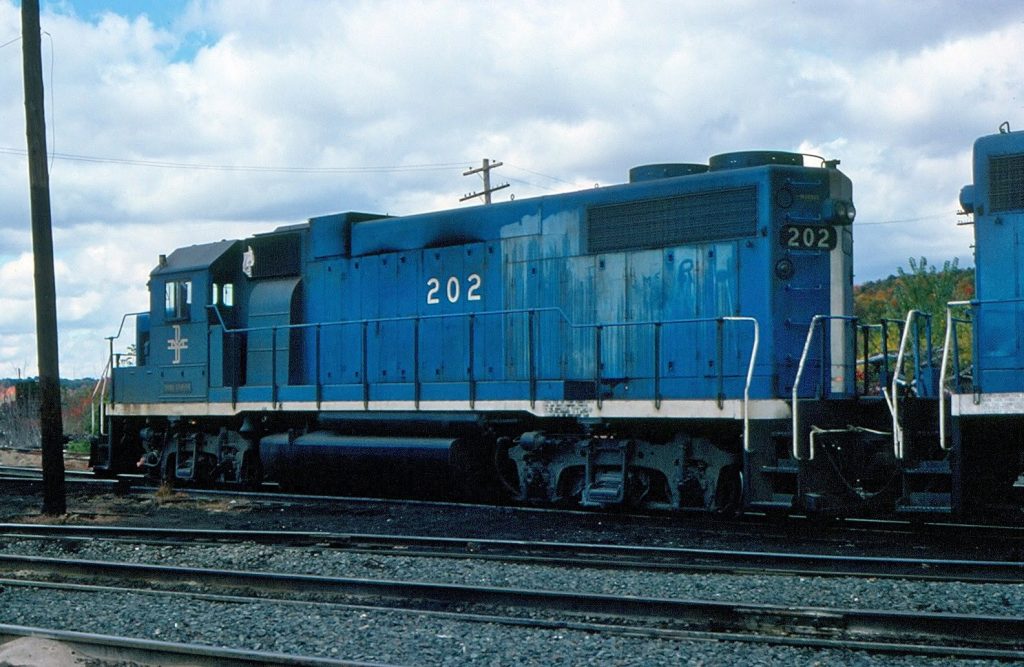
Boston & Maine EMD GP38-2 No. 202 “Daniel Webster” stands at Mechanicville, New York, on 7 October 1978. Built as part of the railroad’s 1973 GP38-2 fleet, No. 202 is seen in its standard blue livery at one of the B&M’s most important interchange yards during the Guilford era’s immediate predecessor. © Bill Rogerson
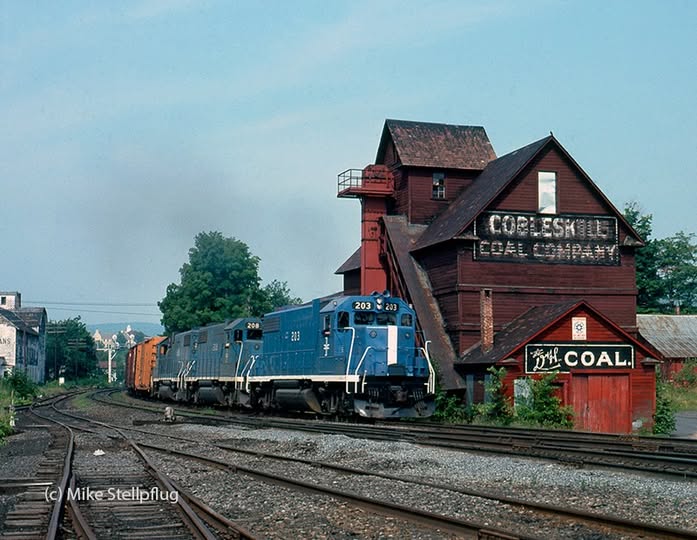
Boston & Maine GP38-2 No. 203 leads freight NE-84 through Cobleskill, New York, on 16 July 1978, with sister No. 208 and another B&M locomotive behind. The train passes the distinctive Cobleskill Coal Company building, once a prominent lineside landmark beside the former Delaware & Hudson main line. The building survived long after the surrounding yard tracks disappeared, but was demolished in July 2026. © Mike Stellpflug
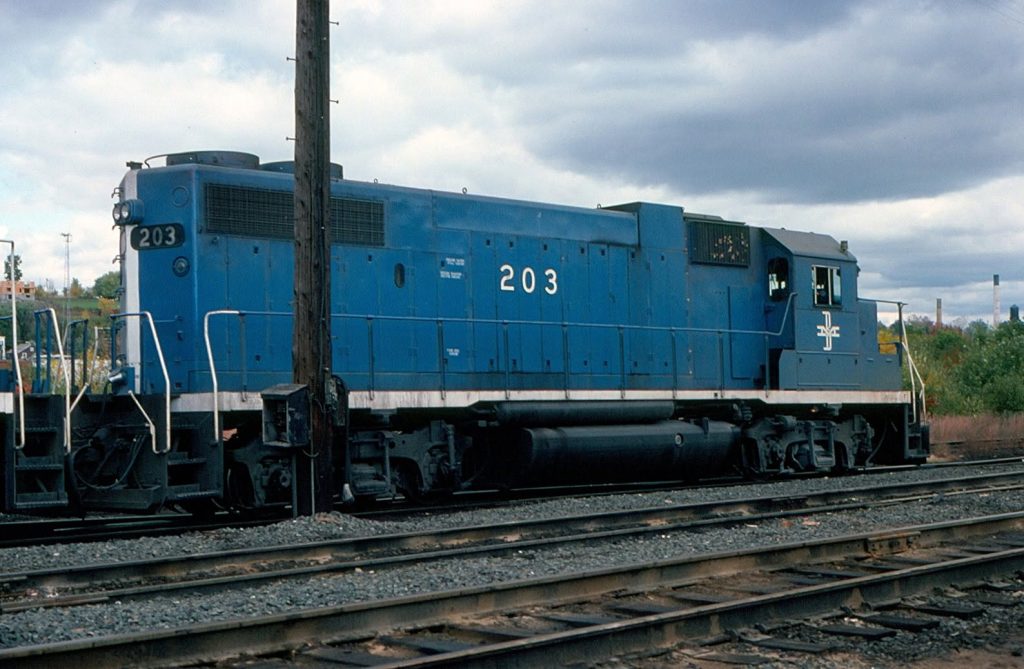
Boston & Maine EMD GP38-2 No. 203 is seen at Mechanicville, New York, on 7 October 1978. One of the railroad’s fleet of 1973-built GP38-2s, No. 203 is pictured in the classic blue and white Boston & Maine livery at the busy interchange yard. © Bill Rogerson
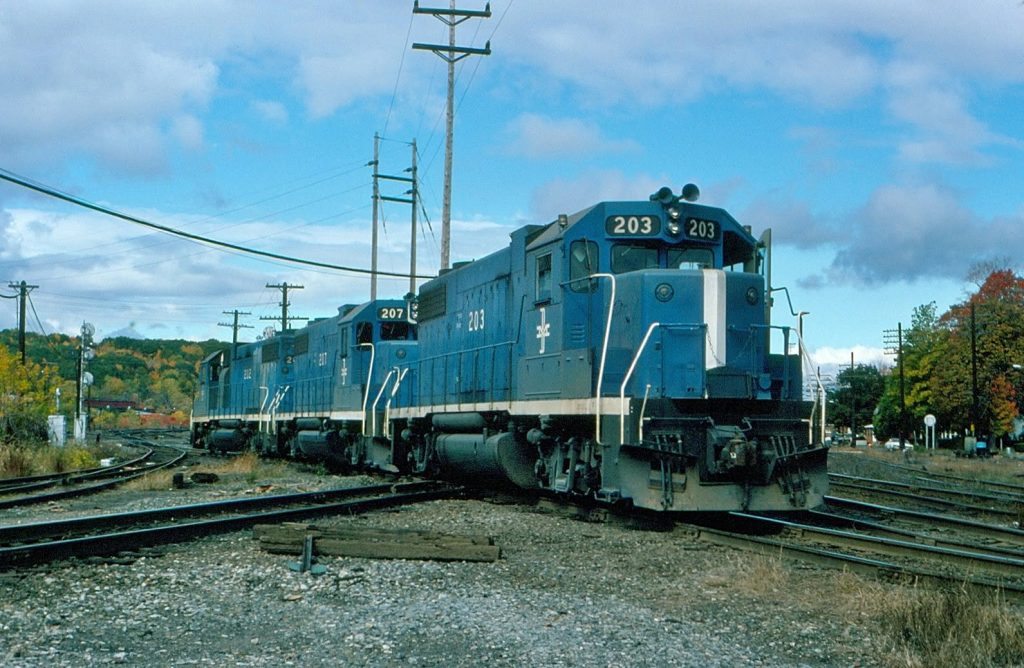
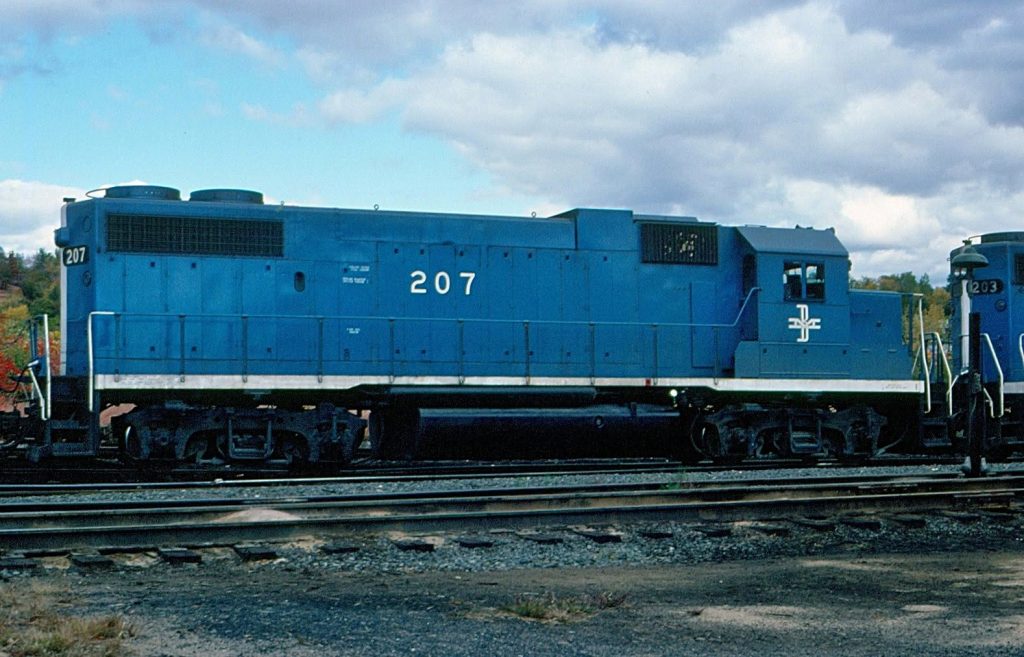
Boston & Maine EMD GP38-2s Nos. 203, 207 and 202 are lined up at Mechanicville, New York, on 7 October 1978. Built in 1973, the trio of four-axle road switchers awaits its next assignment at one of the Boston & Maine’s principal interchange yards. © Bill Rogerson
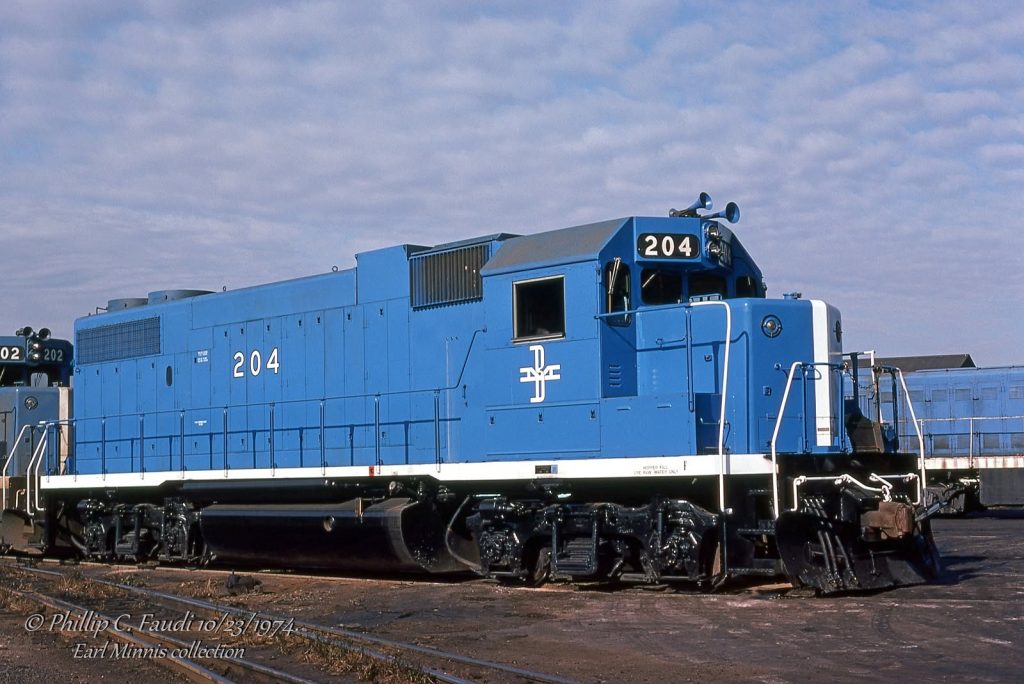
Boston & Maine EMD GP38-2 No. 204 poses for photographer Phillip C. Faudi in Boston, Massachusetts, on 23 October 1974. Built the previous year by EMD, the locomotive still presents a near-factory-fresh appearance in the railroad’s attractive blue and white livery. © Earl Minnis Collection
Boston & Maine EMD GP38-2 No. 207 is pictured at Mechanicville, New York, on 7 October 1978. Built in 1973, the four-axle road switcher wears the railroad’s standard blue and white livery while awaiting its next assignment at one of the Boston & Maine’s principal interchange yards. © Bill Rogerson
A smart-looking line-up of Boston & Maine motive power at Mechanicville, New York, in September 1981. Rebuilt EMD GP18R No. 1850 stands alongside GP38-2 No. 207 and GP40-2 No. 306, all presented in clean blue paint during the final years of Boston & Maine’s independent operation. Originally built as GP18 No. 1750, No. 1850 was rebuilt at B&M’s Billerica Shops, receiving mechanical upgrades and being renumbered into the 1800 series. Renumbering rebuilt locomotives was standard practice on the Boston & Maine, with upgraded GP9s also receiving numbers in the 1800 series. © R.R. Richards Collection
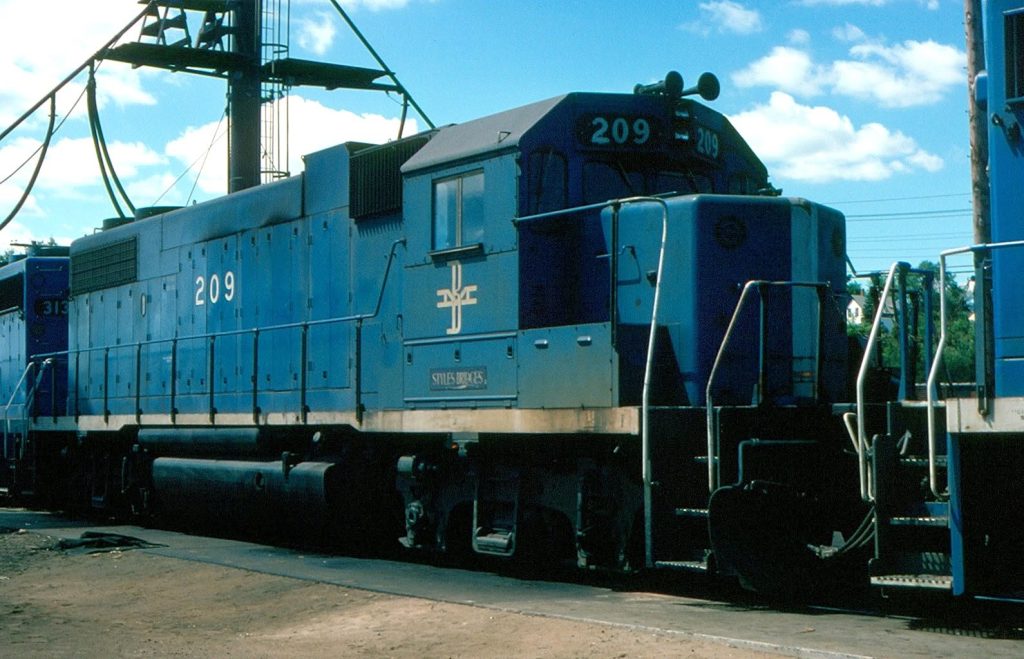
Boston & Maine EMD GP38-2 No. 209, named Styles Bridges, is seen at Rigby Yard in South Portland, Maine, on 21 August 1978. Built in 1973, the locomotive carries the railroad’s standard blue and white livery while awaiting its next assignment at the B&M’s principal Maine terminal. © Bill Rogerson
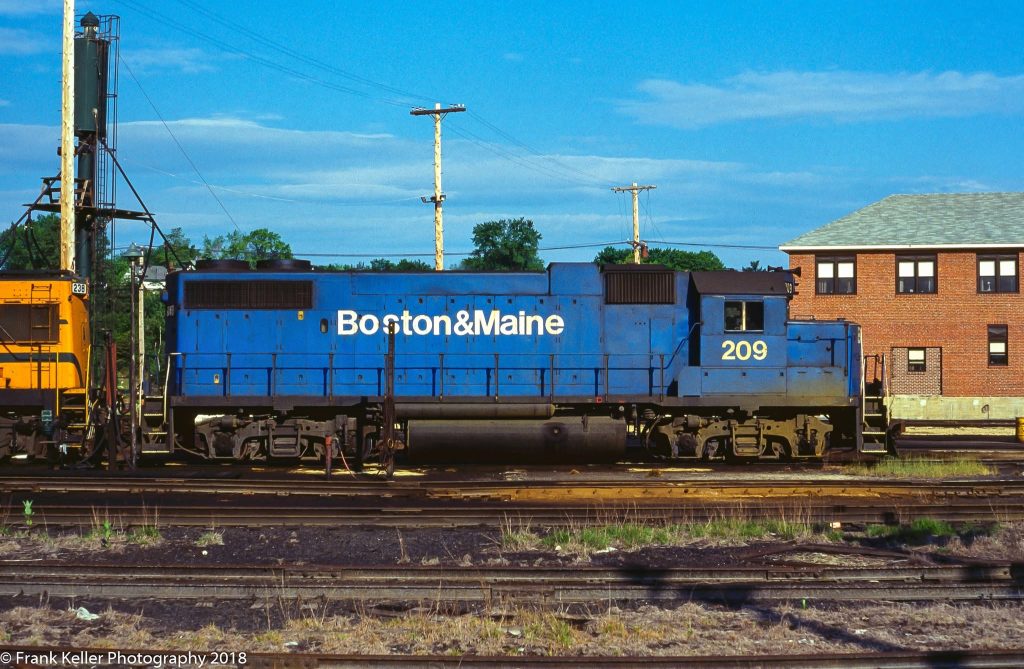
Boston & Maine EMD GP38-2 No. 209 stands beside former Maine Central U25B No. 238 at Rigby Yard, South Portland, Maine, in June 1985. The scene captures the early days of Guilford Transportation Industries, when locomotives from the Boston & Maine and Maine Central could still be found working side by side in their original liveries. © Frank Keller
A kaleidoscope of early-1980s colour at the B&M engine facility, Mechanicville, 26 September 1982. On the turntable, Boston & Maine GP38-2 #211 in classic blue shares the scene with Maine Central U25Bs in Harvest Gold, including No. 231, while B&M RS-3 #1547 sits dead in the background. © Glen Perry
No.LiveriesPhotographsModelling
200Guilford by Dec 1987.RRPAAtlas Blue/White Silver 40 003 606, Gold 40 003 630
201One of only two GP38-2s to have the white nose stripe to include the headlight. Guilford by Nov 1988.RRPA
202“Daniel Webster”. Later “Dustin Dip” treatment with the white sill stripe. Guilford by March 1988.RRPAAtlas Blue/White Silver 40 003 607, Gold 40 003 631
203Later “Dustin Dip” treatment with the white sill stripe.RRPA
204RRPA
205“Hannah Duston”. One of only two GP38-2s to get orange step wells. Guilford by Feb 1989.RRPA
206Later “Dustin Dip” treatment with the white sill stripe. Guilford by Sep 1985.RRPA
207One of only two GP38-2s to have the white nose stripe to include the headlight. One of only two GP38-2s to get orange step wells. Guilford by Dec 1988.RRPA
208Later “Dustin Dip” treatment with the white sill stripe.RRPAAtlas Blue/White Silver 40 003 608, Gold 40 003 632
209“Styles Bridges”RRPA
210“Franklin Pierce”. Guilford by Aug 1988RRPA
211RRPA
212RRPA

Delaware & Hudson

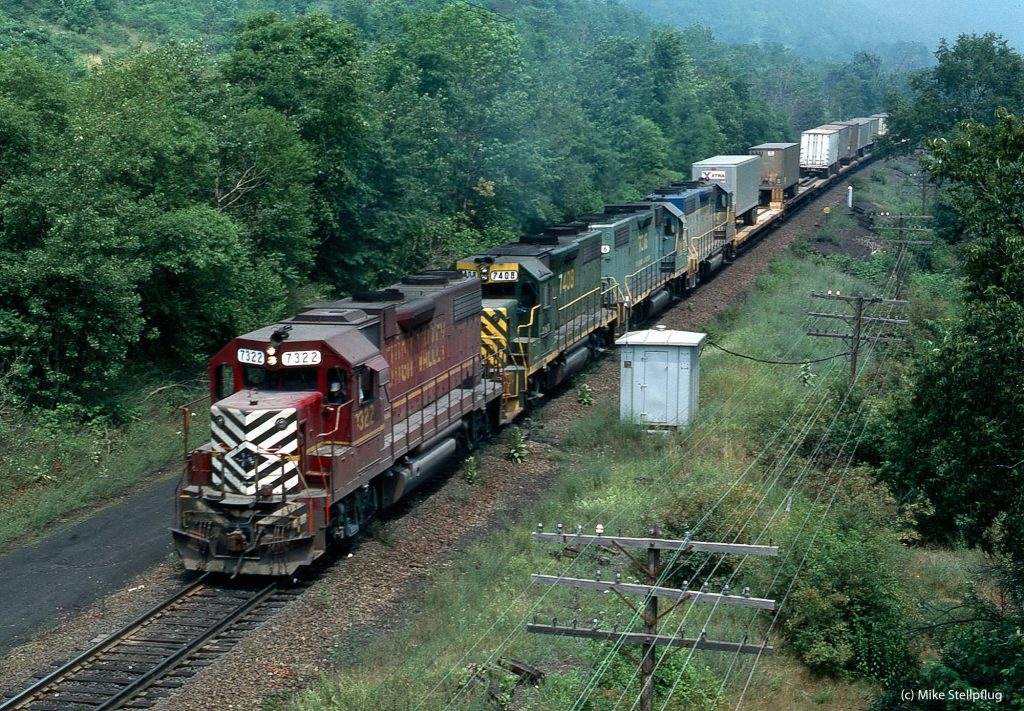
Delaware & Hudson EMD GP38-2 No. 7322 leads a southbound freight through East Worcester, New York, on 22 July 1979. Immediately behind is GP39-2 No. 7408, followed by several other D&H units in a colourful mixed consist, with TOFC traffic stretching away behind through the wooded surroundings. © Mike Stellpflug

Allagash Railway

The Allagash looked to the Dash 2 line in the mid-1970s, following the industry trend toward standardised, reliable second-generation power. The GP38-2 was a natural fit for the railroad, offering the same dependable 2,000-hp non-turbocharged prime mover as the earlier GP38s but with modernised electronics and improved maintainability.

Delivered in 1974–75 and numbered in sequence behind the earlier GP38s, the new power wore Spruce Green with Deluxe Gold lettering and quickly took over front-line assignments from older Geeps and the last surviving cab units. They worked system-wide, from bridge manifests across Maine to pulpwood drags on the northern branches.

No.BuiltLiveryNotesPhotographs
213Allagash Yellow Dip, new herald
214Allagash Yellow Dip, new herald
215Allagash Yellow Dip, new herald
216Allagash Yellow Dip, new herald

Modelling

https://archive.atlasrr.com/NLoco/arc-ngp38-2.htm

Epilogue

The GP38-2s marked a turning point for the Boston & Maine. Arriving in an era of financial strain and deferred investment, they gave the railroad a shot of modernity it badly needed. For Guilford, they became solid, unglamorous workhorses, more reliable than older power and flexible enough for everything from mainline freights to locals. Today, a few survive on short lines and in lease fleets, their blue-and-white heritage long faded but their reputation for steady, uncomplicated service intact.
Post a Comment

Your email address will not be published. Required fields are marked *