EMD GP7 & GP9

The GP7, introduced in 1949, was the first of EMD’s road-switcher line and the forerunner of a dynasty. It carried the same machinery as the F7 — a 16-cylinder 567B engine rated at 1,500 hp — but wrapped in a hood-type carbody that gave crews better visibility and shops easier access to internal equipment. It could do almost anything: heavy freights on mountain grades, suburban passenger turns with a steam generator, yard switching, or standing in for cab units when needed.

The GP9 followed in 1954 with the 567C engine uprated to 1,750 hp. Outwardly near-identical to the GP7, it offered a little more muscle but kept the same winning formula. Together, they set the template for the modern road-switcher. Railroads bought thousands, and they became the everyday diesel: as likely to be found with a short wayfreight on a branch as at the head of a through freight.

Boston & Maine

GP7

No.LiveriesNotesPhotographs
1555Maroon & Gold until at least Apr 1968. Blue Dip by Dec 1969. Large “Boston & Maine” and yellow steps by Nov 1979.Built Sep 1950RRPA
1556Maroon & Gold until at least Dec 1973. Blue Dip by 20 Apr 1978RRPA
1557Maroon & Gold until at least Feb 1972. Blue Dip by Aug 1974RRPA
1558Maroon & Gold until at least. Blue Dip by 21 Apr 1976RRPA
1559Maroon & Gold until at least. Blue Dip, white sill stripe includes fuel tank skirt (only one to get this) by 22 Mar 1969. Black fuel tank skirt by 24 Feb 1974. Orange steps by 7 Oct 1978.RRPA
1560Maroon & Gold until at least. Blue Dip and orange steps by 4 Sep 1980.
1561Maroon & Gold until at least. Atlas Maroon & Gold Standard 40 002 168, DCC 40 002 187.RRPA
1562Maroon & Gold until at least. RRPA
1563Maroon & Gold until at least. RRPA
1564Maroon & Gold until at least. RRPA
1565Maroon & Gold until at least. Atlas Maroon & Gold Standard 40 002 169, DCC 40 002 188.RRPA
1566Maroon & Gold until at least. RRPA
1567Maroon & Gold until at least. RRPA
1568Maroon & Gold until at least. RRPA
1569Maroon & Gold until at least. RRPA
1570Maroon & Gold until at least. Atlas Maroon & Gold Standard 40 002 170, DCC 40 002 189.RRPA
1571Maroon & Gold until at least. RRPA
1572Maroon & Gold until at least. RRPA
1573Maroon & Gold until at least. RRPA
1574Maroon & Gold until at least. RRPA
1575Maroon & Gold until at least. RRPA
1576Maroon & Gold until at least. RRPA
1577Maroon & Gold until at least. RRPA

GP9

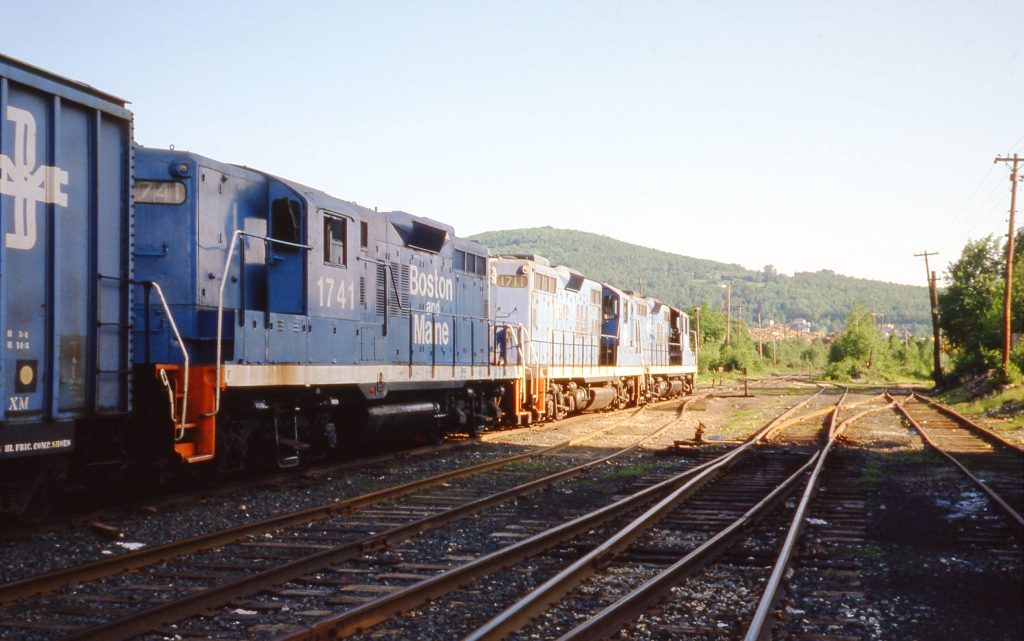
Boston & Maine EMD GP9 No. 1711 switches freight cars at Portland, Maine, on 25 July 1989, under Guilford Transportation Industries ownership. The locomotive wears the faded blue “Boston and Maine” scheme, with weathering and grime reflecting its hard-working yard duties in the railroad’s later years. © Greg F. Brewer
No.LiveriesNotesPhotographs
1700Atlas Blue & White Standard 40 000 425, DCC 40 000 452.RRPA
1701RRPA
1702RRPA
1703RRPA
1704RRPA
1705RRPA
1706RRPA
1707RRPA
1708RRPA
1709RRPA
1710RRPA
1711RRPA
1712
1713
1714
1715
1716
1717Atlas Blue & White Standard 40 000 426, DCC 40 000 453.
1718
1719
1720
1721
1722RRPA
1723RRPA
1724RRPA
1725RRPA
1726RRPA
1727RRPA
1728RRPA
1729RRPA
1730RRPA
1731RRPA
1732Atlas McGinnis Blue NEN-1.RRPA
1733The last McGinnis “Bluebird” until August 1982.RRPA
1734RRPA
1735RRPA
1736RRPA
1737RRPA
1738RRPA
1739RRPA
1740RRPA
1741RRPA
1742RRPA
1743RRPA
1744RRPA
1745RRPA
1746RRPA
1747RRPA
1748RRPA
1749Atlas McGinnis Blue NEN-2.RRPA
1750RRPA
1751RRPA
1752RRPA
1753RRPA
1754RRPA
1755RRPA
1756RRPA
1757RRPA
1758RRPA
1759RRPA

Maine Central

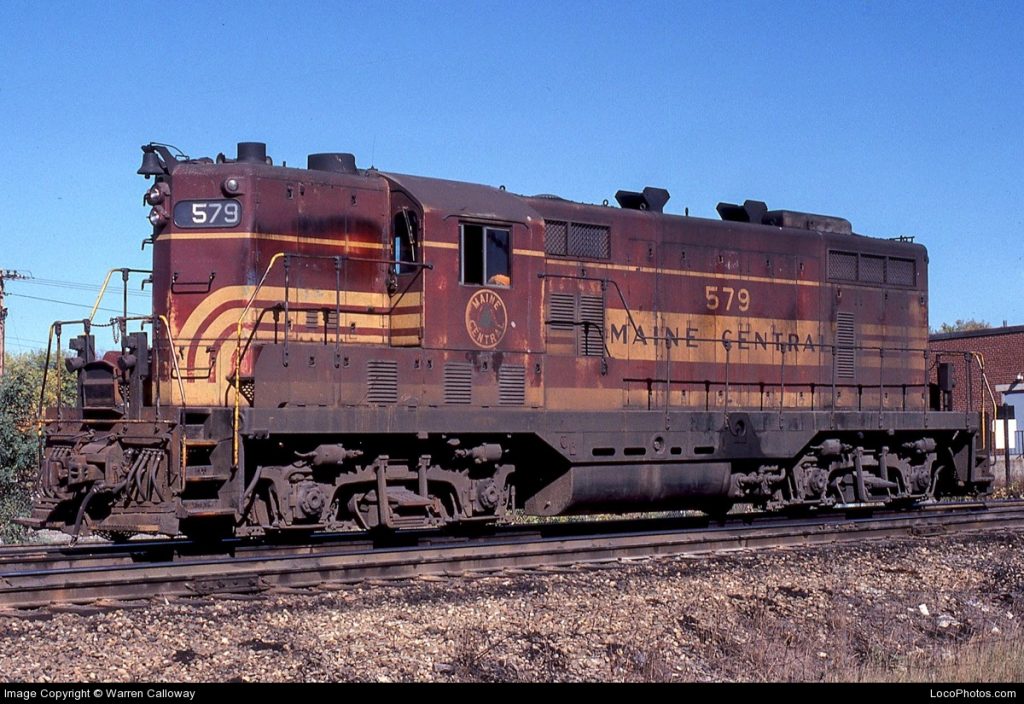
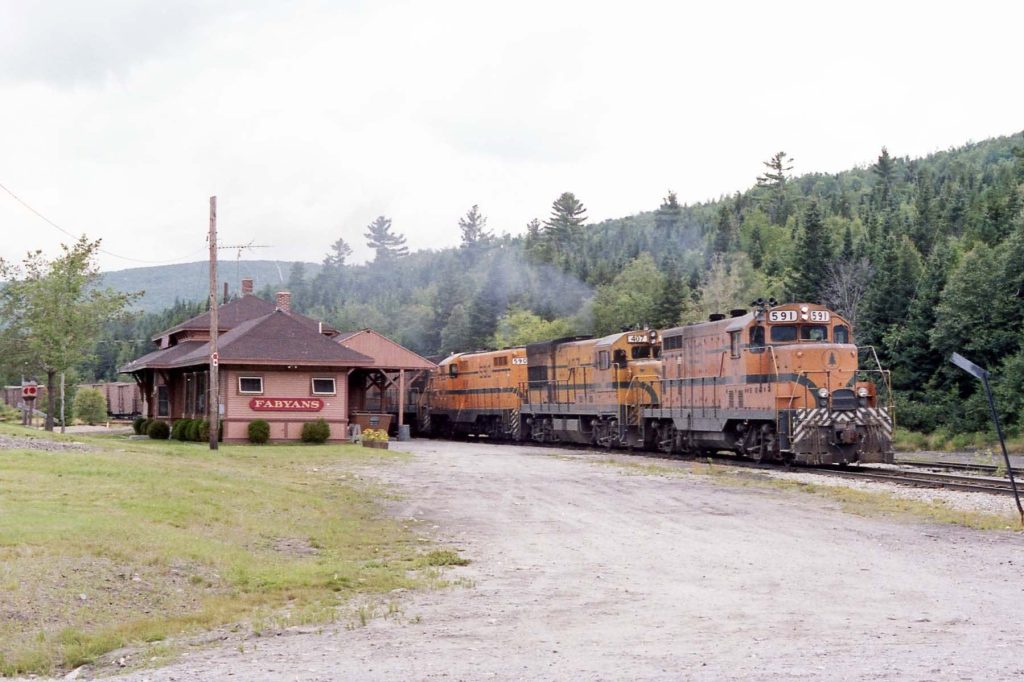
On the Maine Central, the GP7s were nothing short of transformative. Ordered in several batches, they quickly replaced steam, worked every corner of the system, and became the everyday face of railroading in New England. Delivered in maroon and gold or pine green, they later cycled through Harvest Gold and finally Guilford grey. Waterville shops rebuilt many with chop-noses from the early 1970s onwards, keeping them useful long after second-generation GP38s and U18Bs had taken the main line work.

The original twenty units were joined in 1978 by four second-hand GP7s from the Louisville & Nashville (renumbered 590–593) and in 1981 by a single GP9 from the Algoma Central, built as late as 1963. Several carried steam generators when new, visible by the extra fittings on the short hood, but these were long out of use by the time Guilford arrived. A handful of survivors escaped the scrapper and can still be found on tourist or short-line duty today.

class DRS-3a = MU & dynamic brakes (561-569)
class DRS-3b = MU & steam generator (571-580)
class DRS-3d = steam generator

Maine Central GP7 No. 561 stands in a yard at South Portland, Maine, wearing the railroad’s maroon and gold livery, with sister unit No. 563 visible behind. The scene captures everyday diesel operations in the early 1970s, with weathering and grime reflecting regular freight service on the MEC system. 1972. © Unknown
On 17 April 1977, Maine Central GP7 No. 561 stands at St. Johnsbury, Vermont, wearing the classic maroon and gold livery. A Burlington Northern boxcar is visible behind, highlighting interchange traffic typical of the period. © Bob Sheridan
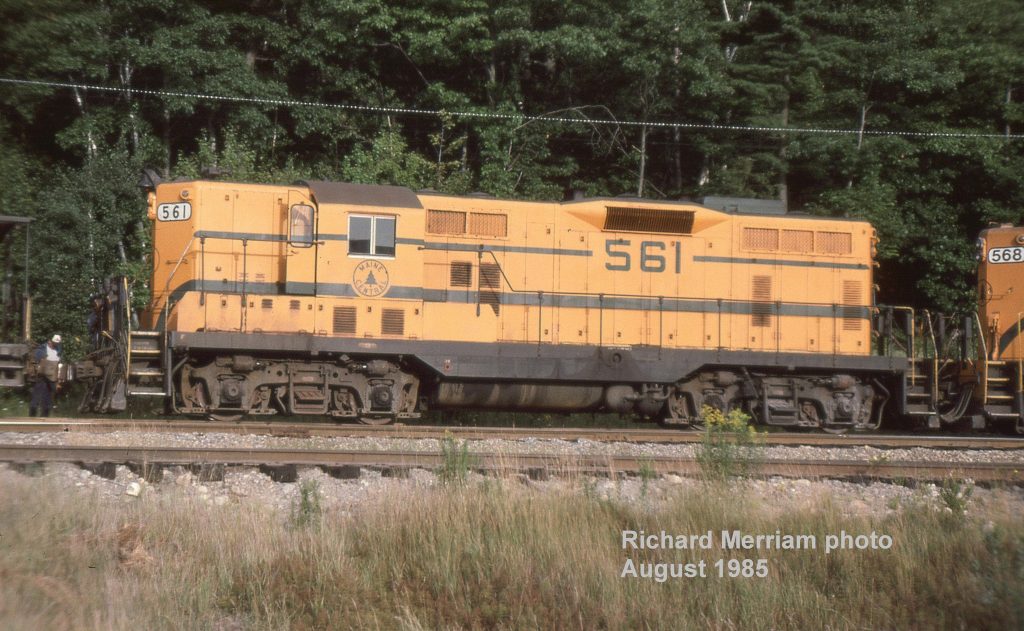
On 13 August 1985, Maine Central GP7 No. 561 stands at Bucksport, Maine, in Harvest Gold and black livery, with sister unit No. 568 partially visible at right. © Richard Merriam
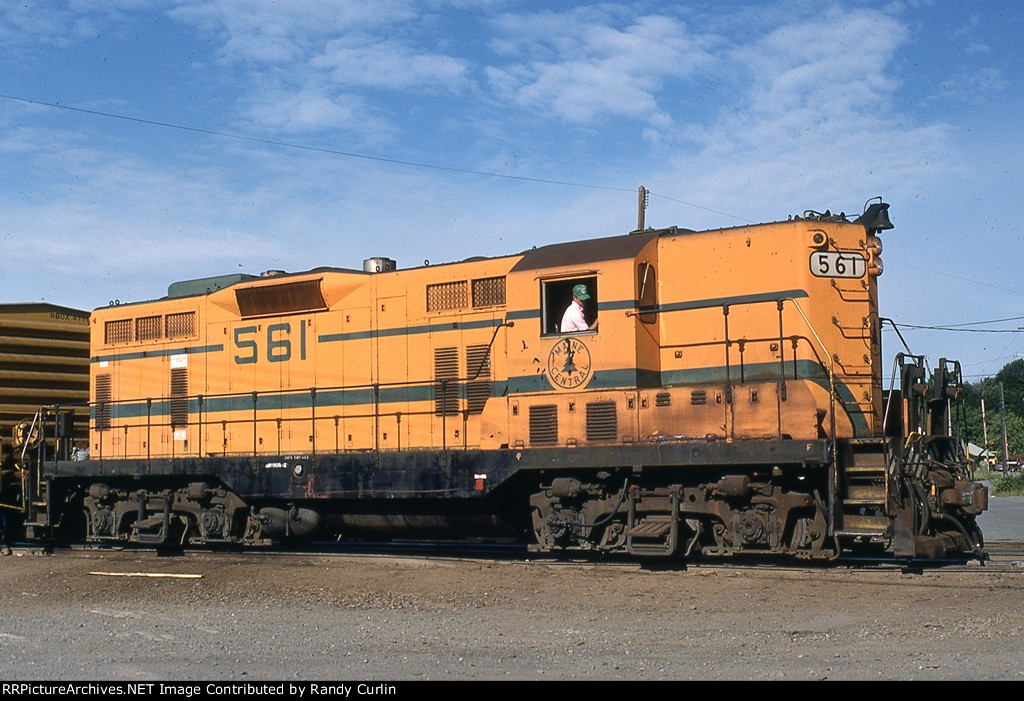
Maine Central GP7 No. 561 in Harvest Gold and black livery stands at Bangor, Maine, with a crew member visible in the cab on 24 August 1988. © Richard Louderback
On 11 June 1976, Maine Central GP7 No. 562 stands at St. Johnsbury, Vermont, in Harvest Gold and black livery. Buildings of the town rise behind the locomotive, including prominent church spires overlooking the yard. © Richard Merriam
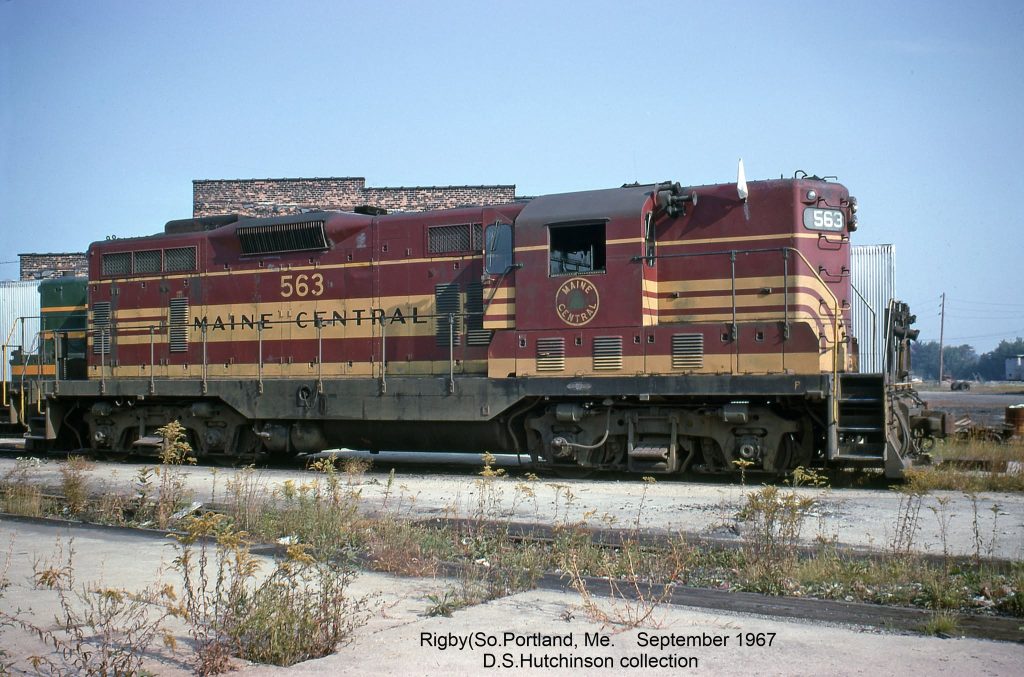
Maine Central GP7 No. 563 at Rigby Yard, South Portland, Maine, in June 1976. From the Henry Allen Collection. © James Boudreaux
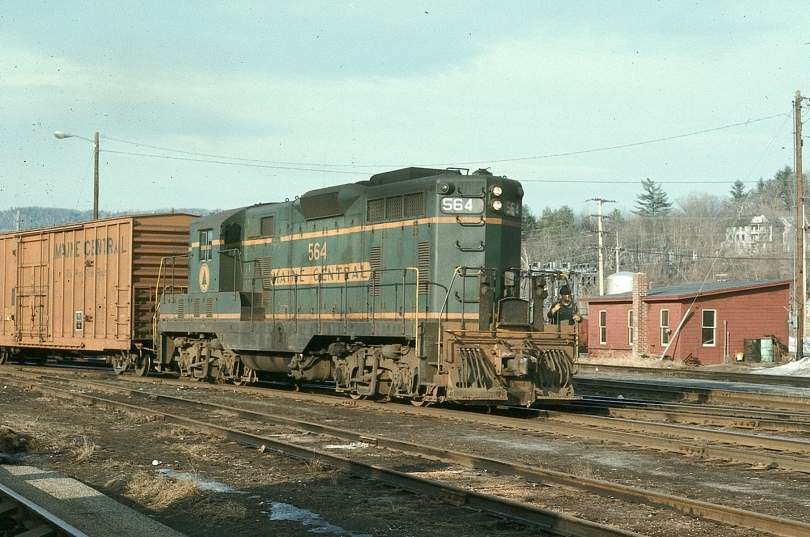
Maine Central GP7 no. 564 shuffles a boxcar through the yard at St. Johnsbury in July 1976. Wearing one of several variations of the green and gold scheme carried by the class in this period, the veteran road-switcher handles local work in a yard that remained busy with interchange traffic. © Brian Nicholson
Maine Central EMD GP7 No. 565 stands at St. Johnsbury, Vermont, on 12 July 1979, in a heavily weathered Harvest Gold scheme. The locomotive carries large cab-side numerals and the rectangular Maine Central herald on the short hood. © Bill Rogerson
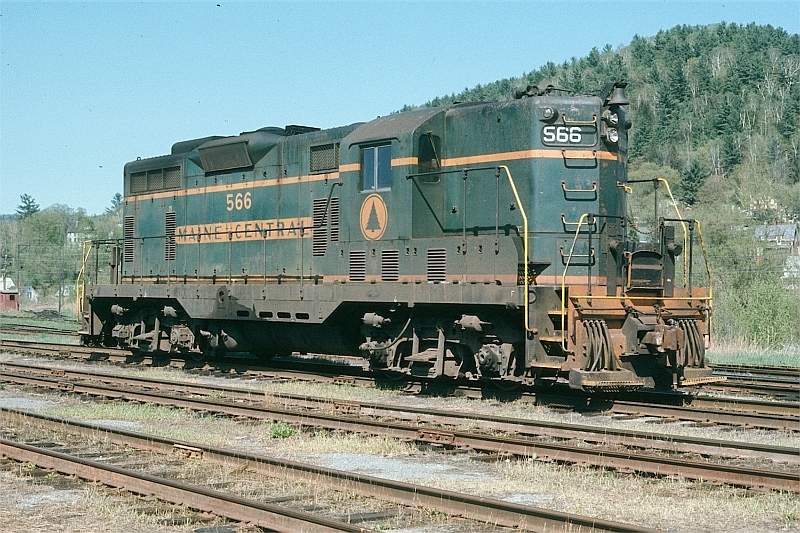
Maine Central GP7 no. 566 stands in the yard at St. Johnsbury in May 1975, wearing the road’s green and gold scheme typical of the era. One of the veteran first-generation road-switchers, it handled local and yard duties at this important junction with Canadian Pacific and the St. Johnsbury & Lamoille County, just a few years before Mountain Division through service came to an end. © Brian Nicholson
A Maine Central local freight, led by EMD GP7 No. 567, works through Waterville, Maine, on 22 August 1978. The train includes a load of pulpwood, reflecting the core traffic that sustained the railroad, while yard activity continues in the background. A BFI (Browning-Ferris Industries) rear-loading refuse truck stands beside the yard office, possibly a Mack cab-over. If anyone can confirm the make and model, it would be great to know. © Bill Rogerson
Maine Central EMD GP7 No. 567 stands at Calais, Maine, in July 1982, wearing the familiar harvest gold and green livery. The locomotive is shown in a yard setting alongside service equipment, with a caboose to the right and the surrounding townscape visible beyond. © Greg F. Brewer
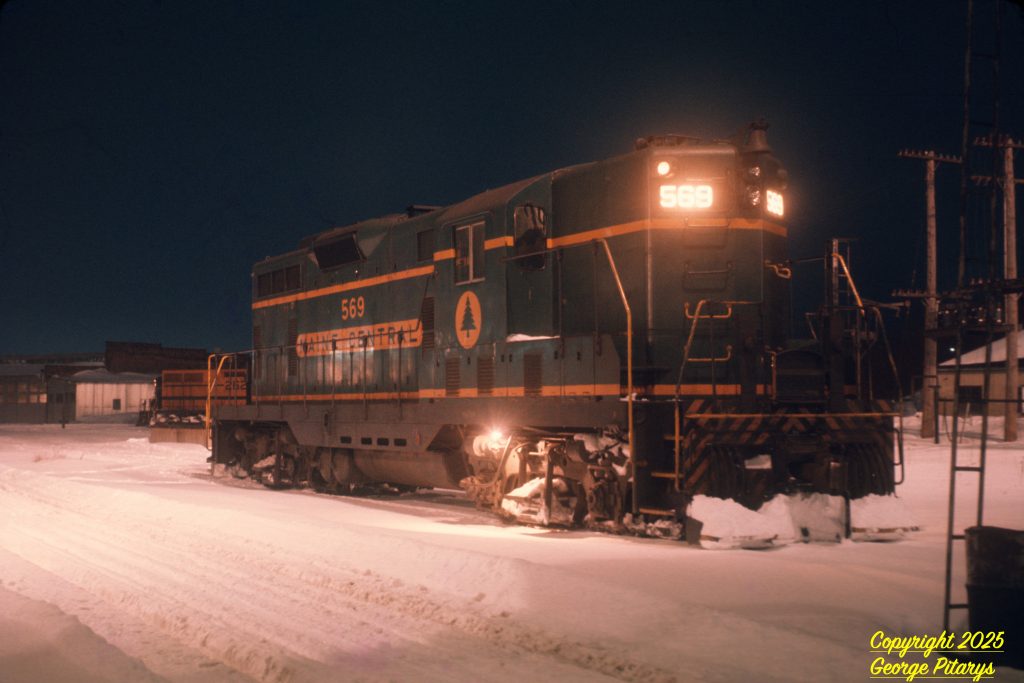
Maine Central GP7 no. 569 stands at Rigby Yard, South Portland, Maine, on the night of 18 February 1972. Fresh snow lies across the yard as the locomotive idles under yard lights, its numberboards and ground light glowing in the winter haze. A classic view of first-generation power in everyday service, captured during a quiet moment on a cold Maine night. © George Pitarys
Maine Central GP7 No. 569, in simplified Pine Green, leads sister unit 565 westbound past Tower Two at Rigby Yard in August 1972. © Glen Perry
Maine Central GP7 no. 569 leads westbound XW-2 through Corinna, Maine, on 10 January 1978, with sister GP7 no. 573 trailing. The train is made up largely of pulpwood loads bound for the International Paper mill at Rileyville and will soon reach Newport Junction to head west for Waterville. Snow-covered fields and a low winter sky set the scene on the lightly built Foxcroft Branch, a line later abandoned and lifted. © Don Marson
Maine Central EMD GP7 no. 569, in worn Simplified Pine Green, leads an eastbound freight past CP-Mills, 4.6 miles from Portland on the Mountain Division near Westbrook, Maine, in the early 1980s. “CP” denotes a Controlled Point, while “Mills” takes its name from Cumberland Mills. A blue Boston & Maine boxcar trails immediately behind, with a string of sand hoppers behind, possibly moving as a detour off the Conway Branch. The train passes a General Railway Signal searchlight signal marking the end of CTC territory. © Jack Hughes
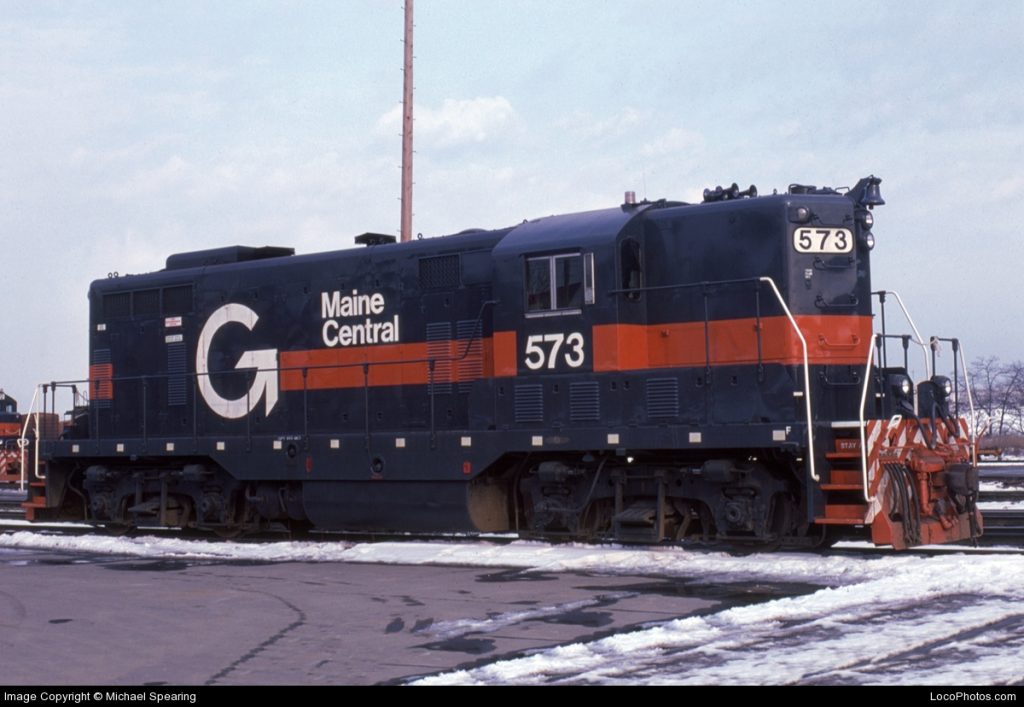
Maine Central GP7 no. 569, in Guilford “G” livery but lettered for the Delaware & Hudson, stands at Mechanicville, New York, on 11 January 1984 while crew attend to the MU hoses in deep winter conditions. Behind is Maine Central GP7 no. 573, also lettered for the Delaware & Hudson. Snow and ice cling to the locomotives and trackside equipment, capturing the harsh realities of operations during the early Guilford era. © Glen Perry
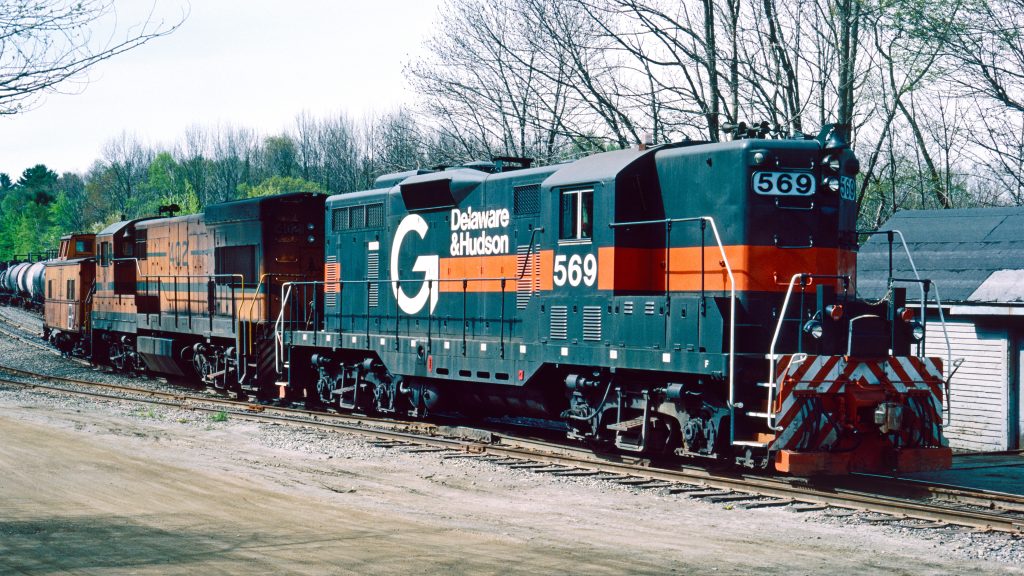
Maine Central GP7 no. 569, in Guilford “G” livery but lettered for the Delaware & Hudson, works at Bucksport, Maine, on 19 May 1984. Immediately behind is Maine Central U18B no. 402 General John Stark, one of the railroad’s “Independence Class” units. Tank cars are standing in a siding behind the buggy. © Glen Perry
WH-1, the Waterville–Bangor Hill Yard through freight at Oakland, Maine, in March 1971. This was the last Maine Central unit repainted into green before the switch to Harvest Gold, with GP7 No. 578 next through Waterville after a wreck and chop-nose rebuild. © George Melvin
Maine Central GP7 no. 571 stands with a caboose at Lewiston, Maine, on 24 August 1978. Immediately behind the locomotive is a Trailer Train flatcar carrying a highway trailer, a reminder of the growing importance of TOFC traffic even on secondary lines. One of the road’s dependable early road-switchers, the GP7 remained a mainstay of local and yard work into the late 1970s, its Pine Tree Green scheme well suited to the workaday setting. The lightly overgrown yard and caboose bring the scene firmly into the everyday rhythm of Maine Central operations in this period. © Bill Rogerson
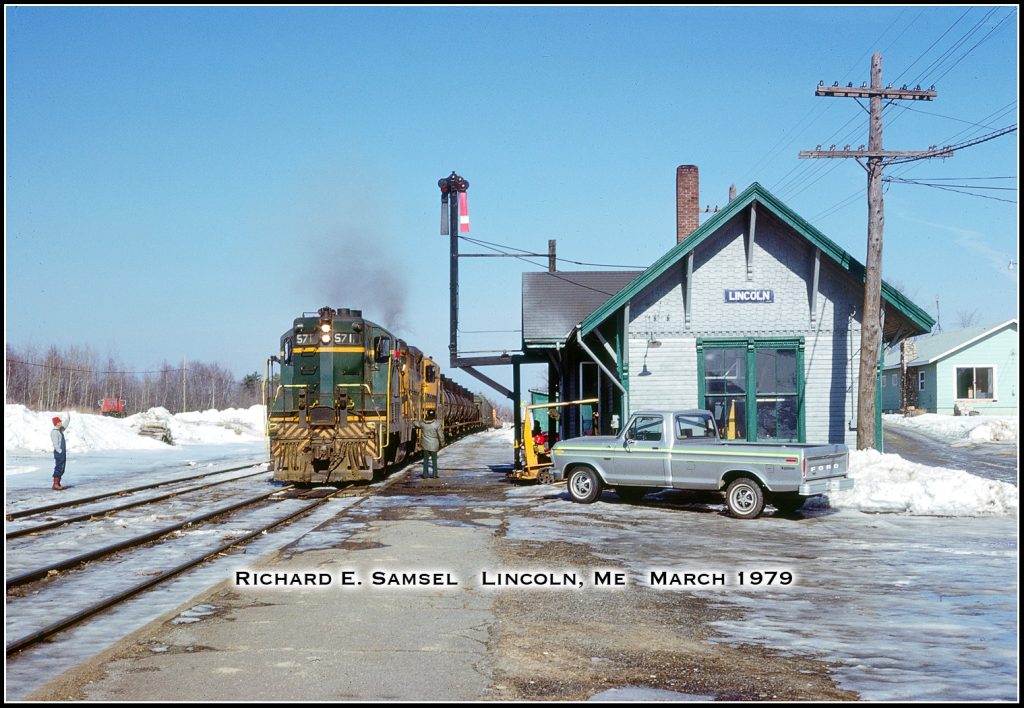
Maine Central GP7 no. 571 leads a westbound freight past the station at Lincoln, Maine, in March 1979, as a crew member stands ready with an order hoop. Despite the clear order board, trains could still receive paperwork on the move, particularly when maintaining momentum was important for the stiff climb west toward Pollard Brook. The exhaust and posture of the train suggest it is moving at speed, reflecting the need to keep tonnage rolling. The locomotive wears Maine Central’s green scheme with yellow striping, standing out against the snow-covered scene, while the station building and parked Ford pickup firmly place the moment in everyday late-era operations. © Richard E. Samsel
GP7 No. 571 stands at St. Johnsbury on 30 May 1980. It was the first of eleven Maine Central GP7s delivered with steam generators, visible by the stack on the short hood and boiler water fill under the “N” in Maine. By this date, the equipment was likely out of use. © Richard Merriam
Maine Central GP7 No. 572 at Newport Junction, Maine, in 1982. By this time, only sister unit 573 retained water tanks for its steam generator, while 572 had lost its own and no longer carried steam-heating equipment. The locomotive had been repainted in the original green-and-gold “heritage” scheme in 1978. © Michael Shufelt
Photographed by Steven M Geisler at the Maine Central engine facility, Rigby Yard, South Portland, in June 1976. With the crew’s cooperation, locomotives were positioned for better photographs, capturing a representative mix of GP7, GP38, and U18B power then in use. © Steven M Geisler
GP7 No. 580, the last Maine Central unit to carry the Boston & Maine–inspired maroon and gold scheme, shunts cars at Waterville in 1980. © Michael Shufelt
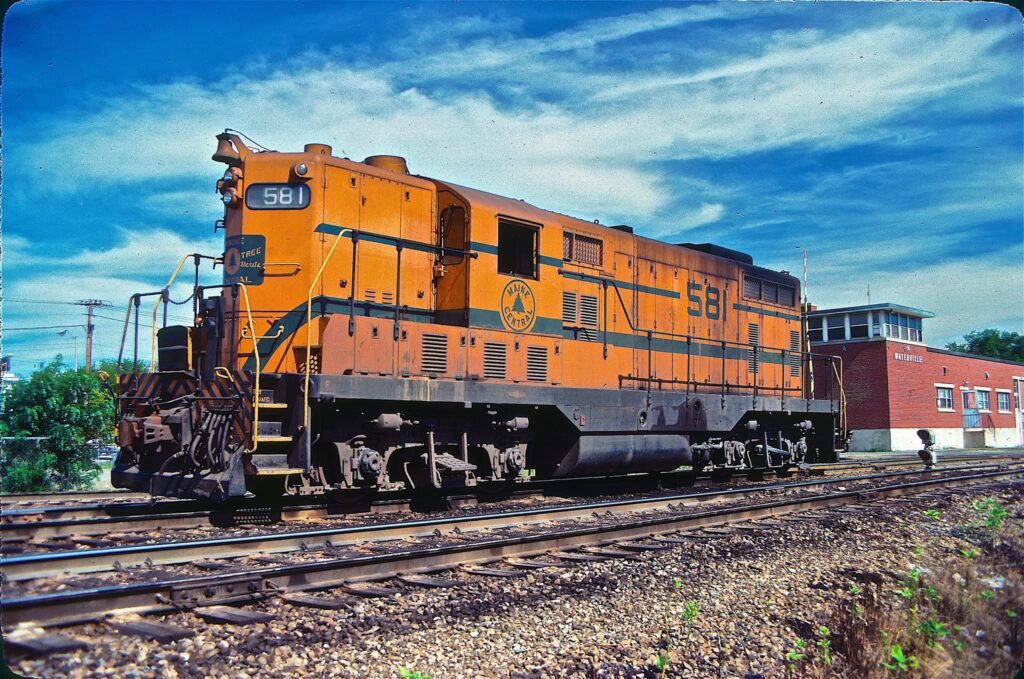
Maine Central EMD GP7 #581 (formerly Portland Terminal #1081) at Waterville, Maine, summer 1978. Equipped with a steam generator for passenger service. © William Johnson
No.LiveriesNotesPhotographsModelling
561Maroon & Gold until at least Dec 1979, Harvest Gold by April 1980Class DRS-3a, Built Oct 1950, Serial 12362. Springfield Terminal #22 in 1988. East Penn Railroad #22 Nov 1997.  It was sold as AF Railway Industries Inc #22 in 2007.RRPAAtlas 48045 Maine Central (Maroon/Gold) June 2001 Collection.
562Maroon & Gold until at least May 1973, Harvest Gold by April 1975Class DRS-3a, Built Oct 1950, Serial 12363. Springfield Terminal #23 in 1988. Larry’s Truck Equipment #23 Dec 1998.RRPAAtlas 48063 Maine Central (Harvest Gold/Pine Green) June 2005 Wishlist.
563Maroon & Gold until at least Aug 1973, Harvest Gold by Jan 1976Class DRS-3a, Built Oct 1950, Serial 12364564. Springfield Terminal #24RRPA
564Maroon & Gold, Simplified Pine Green by Sep 1967.Class DRS-3a, Built Oct 1950, Serial 12365. Rebuilt with chopped nose and renumbered #470 in Dec 1982. RRPAAtlas 48046 Maine Central (Maroon/Gold) June 2001 Collection.
565Maroon & Gold. Pine Green & Gold by 1956, until at least Jul 1972. Harvest Gold by Nov 1974.Class DRS-3a, Built Oct 1950, Serial 12366. Springfield Terminal #14 in Feb 1987, retired in Jul 1990. Scrapped Oct 1995.RRPAAtlas 48064  Maine Central (Harvest Gold/Green) June 2005 ★Collection.
566Delivered in Pine Green & Yellow. Simplified Pine Green by Mar 1969 until at least Oct 1981. Harvest Gold by Feb 1982.Class DRS-3a, Built Nov 1953, Serial 19041.RRPAAtlas 40 000 419 Maine Central (Pine Green/Gold) November 2011 . Atlas 40 000 448 Maine Central (Pine Green/Gold) DCC November 2011 Wishlist.
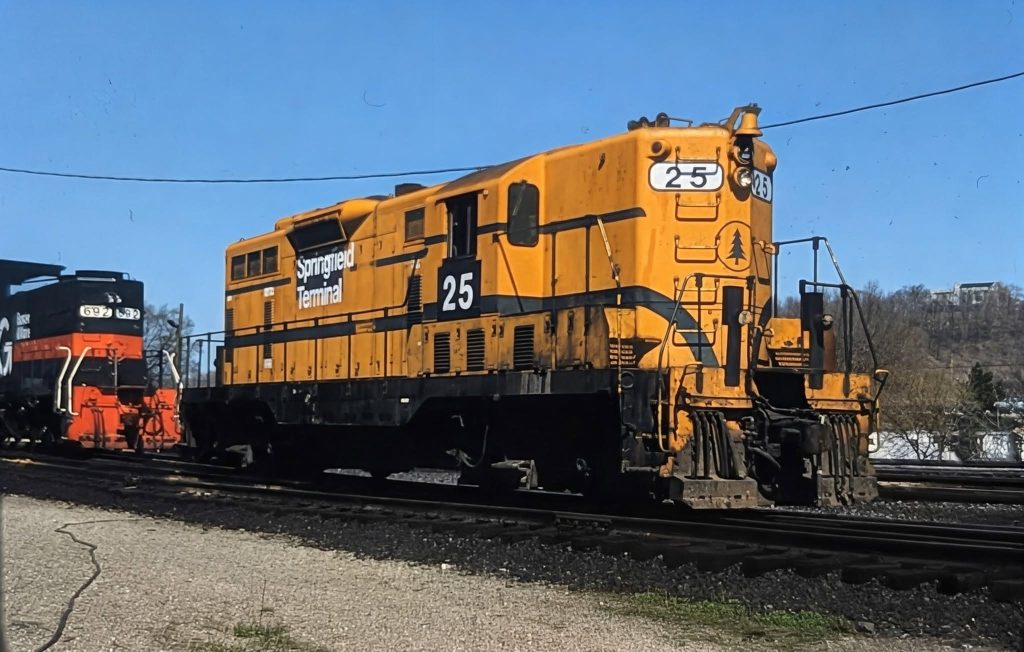
567Delivered in Pine Green & Yellow. Harvest Gold by Jul 1978.Class DRS-3a, Built Nov 1953, Serial 19042. Springfield Terminal #25.RRPA
568Delivered in Pine Green & Yellow. Harvest Gold by May 1979 until at least May 1984.Class DRS-3a, Built Dec 1953, Serial 19302. Springfield Terminal #15 in 1987.RRPAAtlas 40 000 420 Maine Central (Pine Green/Gold) November 2011 . Atlas 40 000 449 Maine Central (Pine Green/Gold) November 2011 DCC Wishlist.
569Pine Green & Yellow. Simplified Pine Green
Guilford Grey in Jan 1984 lettered for Delaware & Hudson until 1988.
Class DRS-3a, Built Dec 1953, Serial 19303. Delaware & Hudson #569 Jan 1984; Springfield Terminal #26 in 1988; Retired Nov 1993; Scrapped Jul 1994 by Industrial Marine Service at Waterville, ME.RRPAAtlas 40 000 421 Maine Central (Pine Green/Gold) November 2011 Wishlist.
571Delivered in Maroon & Yellow, retained until at least Feb 1967. Simplified Pine Green in the late 1960s until at least Aug 1981.Class DRS-3b, Built Sep 1950, Serial 12367. Rebuilt with chop nose as MEC 471RRPA 
572Maroon & Gold. Sponsored repaint by the 470 Railroad Club of Maine by Sep 1979 until at least Oct 1985.Class DRS-3b, Built Sep 1950, Serial 12368. Springfield Terminal #16 Feb 1987. Larry’s Truck Equipment #16 Dec 1997.RRPA
573Mr Miller’s Engine. In early 1963 was painted in a unique scheme with three wide yellow stripes instead of the curved “cat’s whiskers.” Repainted by Sep 1977 with another unique Pine Green “layer cake” paint scheme with silver trucks as Maine Central’s last steam-generator-equipped locomotive. Repainted in original Maroon & Gold following a wreck on 28 Oct 1981. Guilford Grey by Feb 1983. Crash in East Concord Vt. 1987.Class DRS-3b, Built Sep 1950, Serial 12369. Regular performer on the Guilford Office Car Special (OCS). To Delaware & Hudson 573 Jan 1984; to Springfield Terminal 27 in 1988; Conway Scenic Railroad 573 Apr 1996.RRPA
574Maroon & Gold, Pine Green & Gold by Oct 1963. Harvest Gold in Aug 1972.Class DRS-3b, Built Oct 1951, Serial 14755. Chop nose/Short hood lowered at MEC’s Waterville shops in Aug 1972. Springfield Terminal #13 1987, retired Jul 1996. Scrapped.RRPA 
575Maroon & Gold until at least Jun 1977. Harvest Gold by?Class DRS-3b, Built Oct 1952, Serial 17416. To Springfield Terminal 17 1987, retired Nov 1993. Scrapped Aug 1994 by Industrial Marine Service at Waterville, ME.RRPA 
576Maroon & Gold until at least Jan 1973. Harvest Gold by Aug 1978.Class DRS-3b, Built Oct 1952, Serial 17417. Springfield Terminal #28RRPA
577Maroon & Gold until at least Dec 1977. Harvest Gold by Jan 1981.Class DRS-3b, Built Oct 1952, Serial 17418. Springfield Terminal 19 in 1987; to Larry’s Truck Electric 12th Dec 1997; to Tube City, Inc./Olympic Mill Service Division 18RRPA
578Maroon & Gold. Rebuilt and painted Harvest Gold in Jan 1972.Class DRS-3b, Built Oct 1952, Serial 17419. Rebuilt with chopped nose Jan 1972.RRPA
579Maroon & Gold. Rebuilt and painted Harvest Gold in Oct 1980.Class DRS-3b, Built Oct 1952, Serial 17420. Rebuilt with chopped nose Oct 1980. Retired in 1985; Midwest Steel & Alloy 15th Mar 1988, scrapped.RRPA
580Maroon & Gold. Last GP7 wearing original maroon paint in the Fall of 1982. Harvest Gold by Jul 1983.Class DRS-3b, Built Oct 1952, Serial 17421. Springfield Terminal #19 1987. Larry’s Truck Equipment #19 Jan 1998. Rail Switching Services RSSX 19.RRPA
581Maroon & Gold. Harvest Gold by Jul 1976.Class DRS-3d, Built Dec 1950, Serial 13533. Ex Portland Terminal 1081, to MEC in Dec 1956 (or Mar 1957?). Passenger equipped. Springfield Terminal #20 1987. Retired Oct 1995. Scrapped.RRPA 
590Harvest Gold Class unknown, Built Feb 1953, Serial 17770. Louisville & Nashville #439. Purchased by Maine Central 1978, rebuilt as #590. Springfield Terminal #10 Jan 1987. Larry’s Truck Equipment #10 Oct 2002. Rail Switching Services RSSX #10.RRPA 
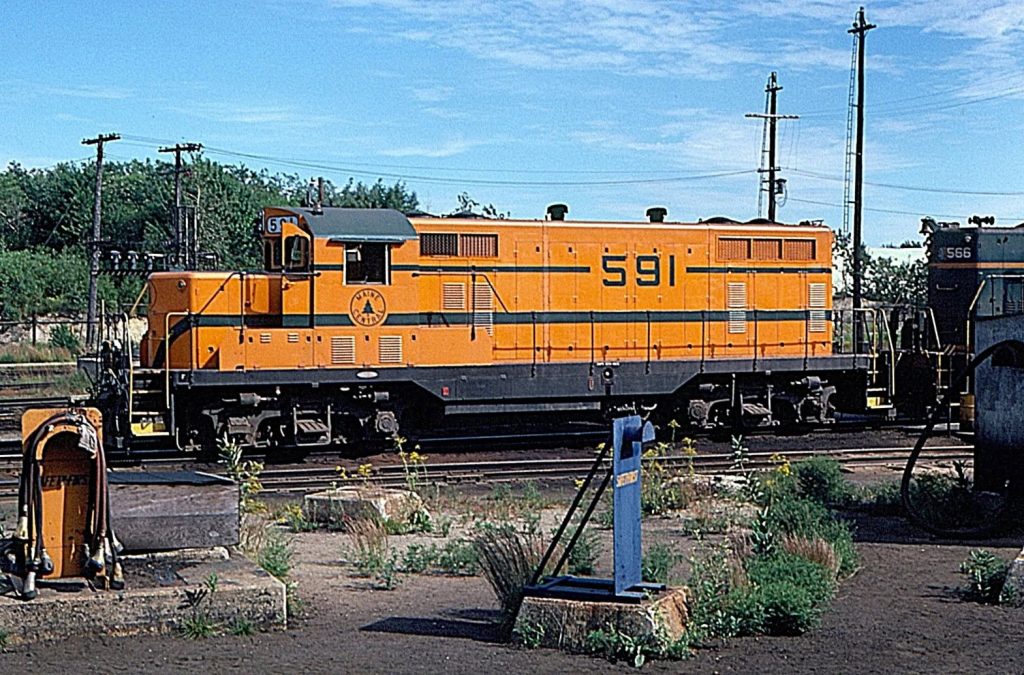
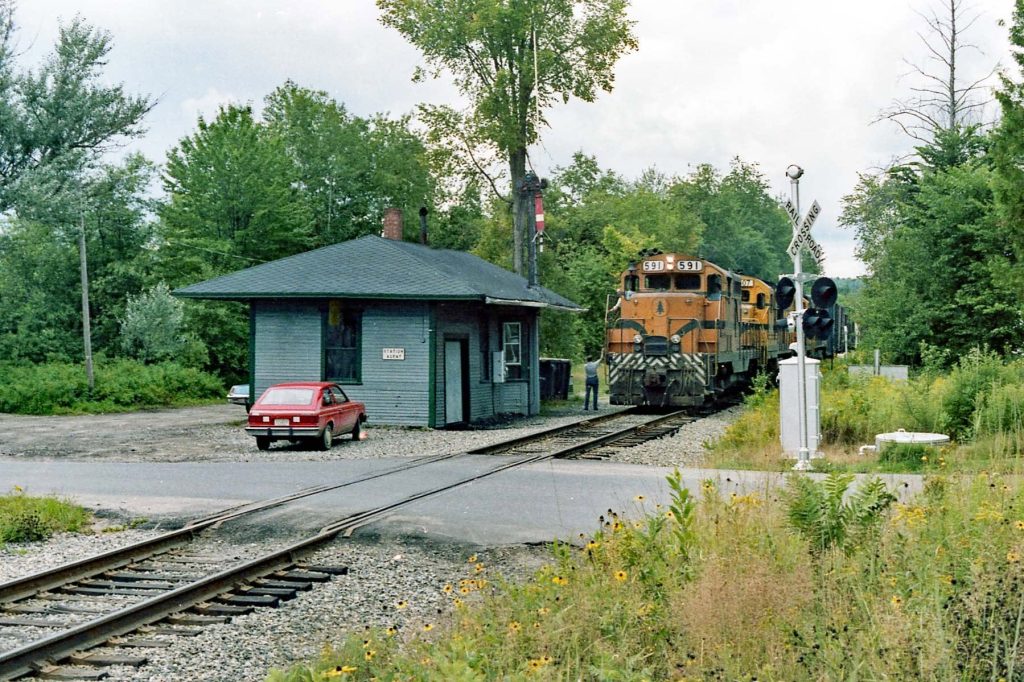
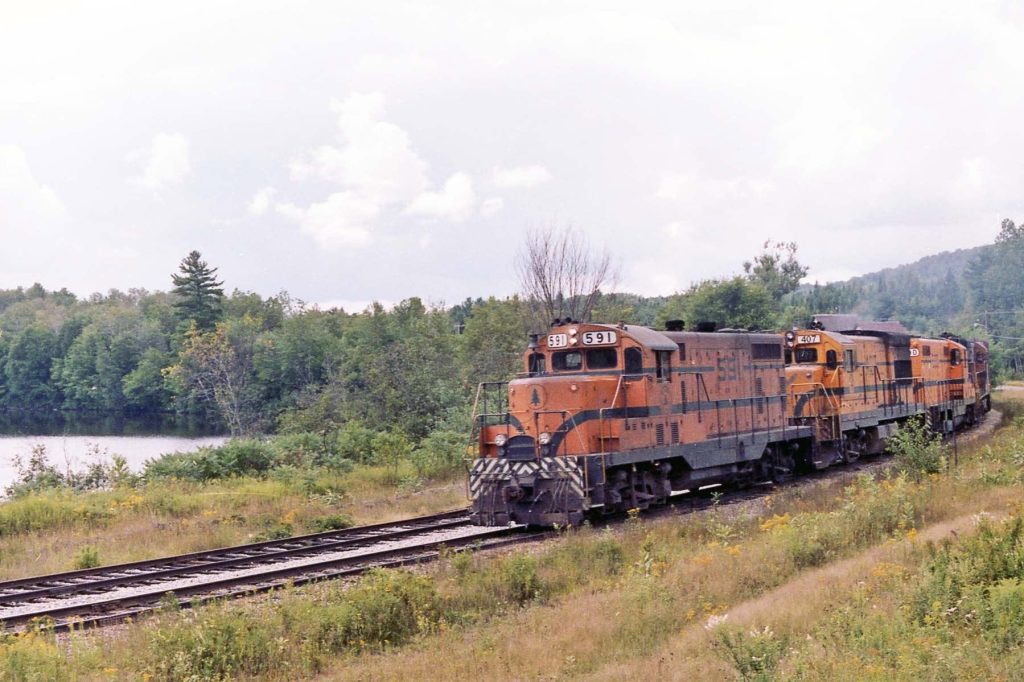
591Harvest GoldClass unknown, Built Feb 1953, Serial 17764. Louisville & Nashville #433. Purchased by Maine Central 1978, rebuilt as #591. Springfield Terminal #11 Jan 1987. Retired Jan 1990. Scrapped 1993.RRPA
592Harvest GoldClass unknown, Built Mar 1950, Serial 8872. Chicago & Eastern Illinois #203, #68 in 1967 and became Louisville & Nashville #388 in 1969. Purchased by Maine Central and rebuilt in 1978 as #592. Springfield Terminal #12 Jan 1987. Niagara & Western New York Railroad #592 Apr 2002. Rail Trusts Equipment as RTEX 592 2003.RRPA

GP7r (Rebuilt)

From the early 1970s the Maine Central began rebuilding selected GP7s at Waterville shops with chopped noses, improving visibility and extending their usefulness. Over a span of more than a decade five locomotives were rebuilt, with the work ranging from simple nose lowering to full cab replacements. These “GP7r” conversions became a familiar sight across the system in the 1970s and 1980s, many later passing into Guilford and Springfield Terminal service.

GP7 No. 578, Waterville’s first chop-nose rebuild, leads GP7 No. 572 at Brunswick yard on a hot August day in 1974, working RS-1 Rigby–Augusta. © Bryan Saul
Maine Central EMD GP7 no. 574 stands at Rigby Yard, South Portland, Maine, during the summer of 1980. The locomotive received its chopped short hood at Waterville Shops in August 1972. © Bill Rogerson
Maine Central’s rebuilt EMD GP7 No. 574 shunts cars at Waterville in 1980. © Michael Shufelt
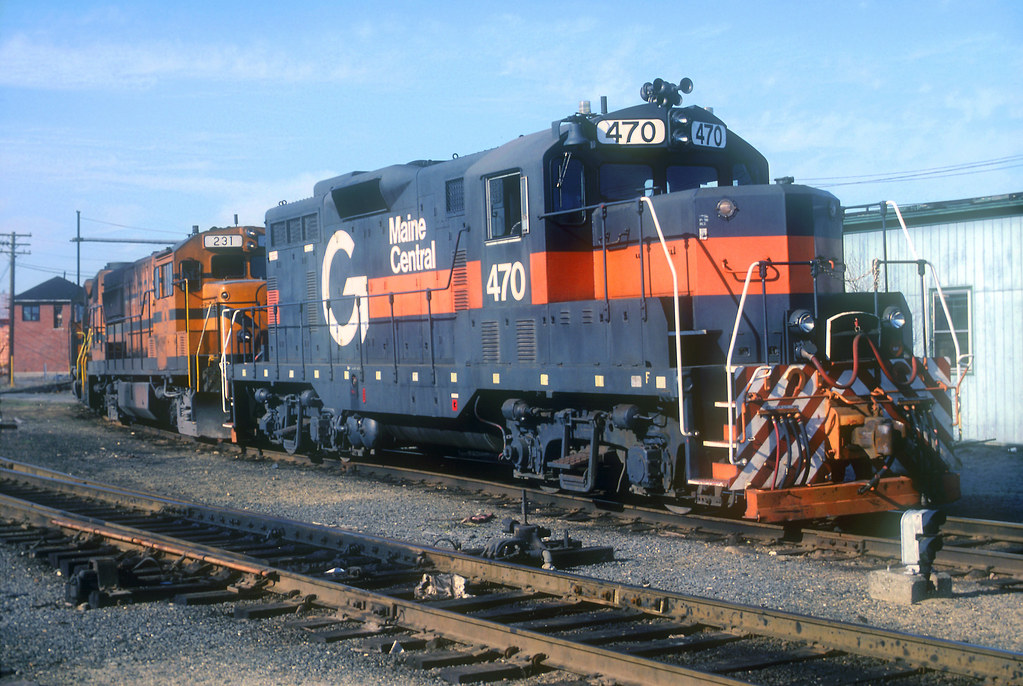
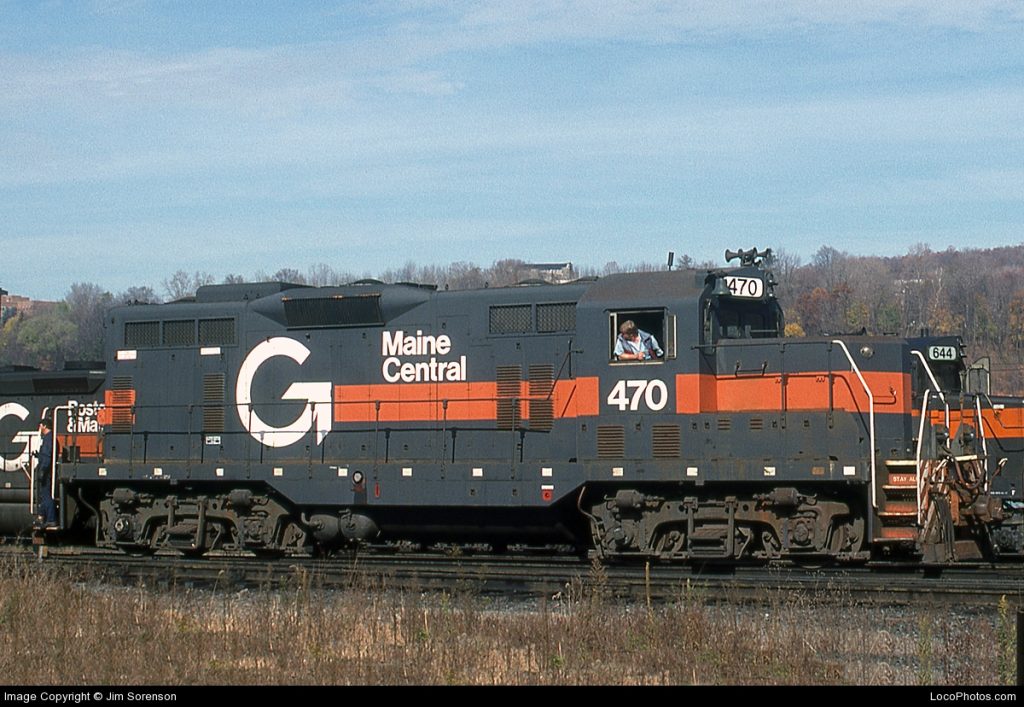
Maine Central’s rebuilt GP7u No. 470 stands at South Portland, Maine, on 7 May 1984 in Guilford paint. © Chuck Zeiler
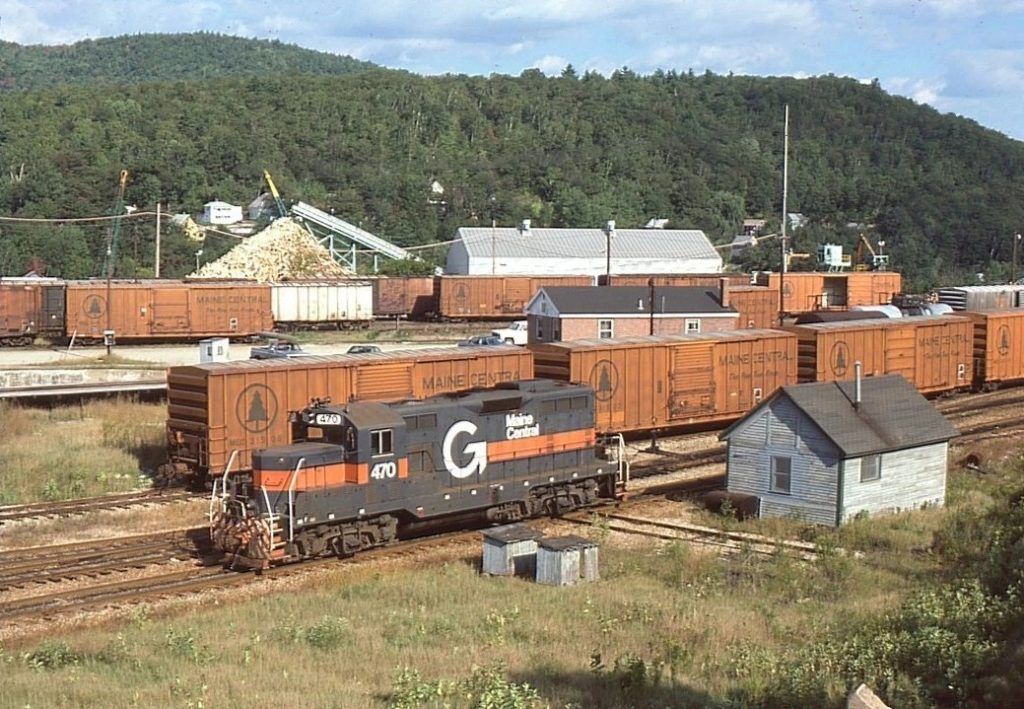
Maine Central No. 470 switching at Rumford, Maine, 1985. © Brian Bartlett
Maine Central GP7 No. 470 switching the paper mill at Rumford, Maine, October 1988. © Ron Wood

In order of ‘chopping’…

No.LiveriesNotesPhotographsModelling
578Harvest GoldChopped nose Jan 1972.RRPA
574Harvest GoldChopped nose Aug 1972RRPA
593Class unknown, Built Apr 1950, Serial 8878. Chicago & Eastern Illinois #209, #74 in 1967 and became Louisville & Nashville #393 in 1969. Purchased by Maine Central in December 1978. I don’t believe it ran on the MEC until chop nosed in July 1980. Traded with EMD in 1988.RRPA
579Chopped nose Oct 1980. Retired in 1985; Midwest Steel & Alloy 15th Mar 1988, scrapped.RRPA
470Guilford GreyEx MEC GP7 564. Regular performer on the Guilford Office Car Special (OCS). To Boston & Maine 470 in 1990; to CDOT 470;  Quebec Central RG5 “J M Giguere” Apr 2002; to Les Aciers Remi Latulippe in 2015, scrapped Aug 2015.RRPA
471Guilford GreyClass unknown, Built Apr 1950, Serial 8878. Chicago & Eastern Illinois #209, #74 in 1967 and became Louisville & Nashville #393 in 1969. Purchased by Maine Central in December 1978. I don’t believe it ran on the MEC until chop nosed in July 1980. Traded with EMD in 1988.RRPA

GP9

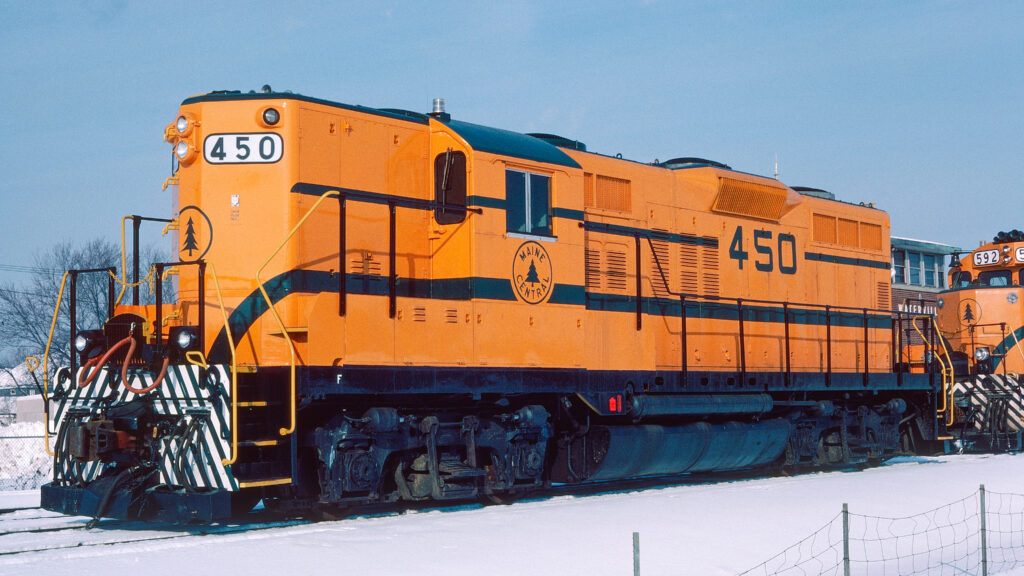
Maine Central’s only EMD GP9, #450 (ex-Algoma Central #171), photographed at Waterville on 26 December 1981. Acquired in June 1981, it later went to Springfield Terminal as #21 under Guilford ownership. © Glen Perry
No.BuiltSerialLiveriesNotesPhotographs
450Aug 1963Harvest GoldEx Algoma Central 171. Purchased Jun 1981. Became Springfield Terminal #21.RR Pictures Archives

Delaware & Hudson

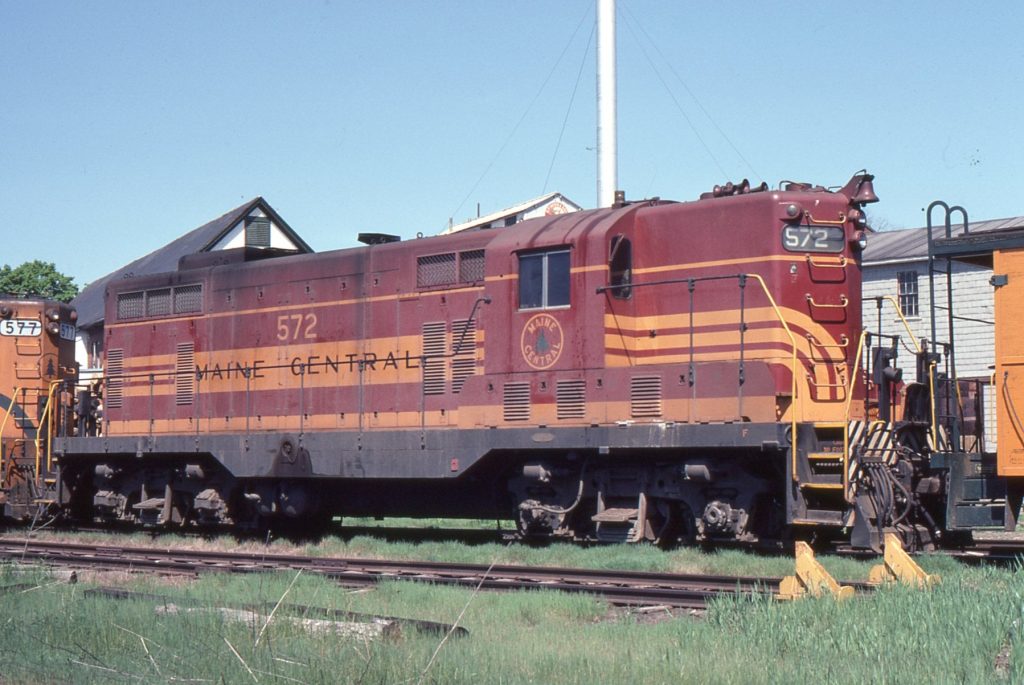
Train BAPO arrives at Waterville in the autumn of 1985 behind Delaware & Hudson GP7 no. 569, a former MEC unit relettered in Guilford paint after the D&H purchase. In the yard sits MEC GP7 no. 572 in its maroon and gold livery, a heritage repaint sponsored by the 470 Railroad Club of Maine in September 1979. © Gordon Smith

Conway Scenic

Conway Scenic 1751 is an EMD GP9 locomotive operated by the Conway Scenic Railroad in North Conway, New Hampshire. Originally built in September 1956 as CO 6128 for the Chesapeake and Ohio Railway, this locomotive has had a long and varied history, serving under multiple owners, including Finger Lakes Railway and Buffalo and Pittsburgh Railroad, before arriving at Conway Scenic. Renowned for its distinctive New York Central paint scheme, 1751 is a popular feature of the railroad’s excursions, often leading scenic and heritage trains through the picturesque White Mountains. Its rich history and classic design make it a favourite among rail enthusiasts and photographers.

No.
1751Sep 1956

https://archive.atlasrr.com/NLoco/arc-ngp7.htm

Allagash Railway

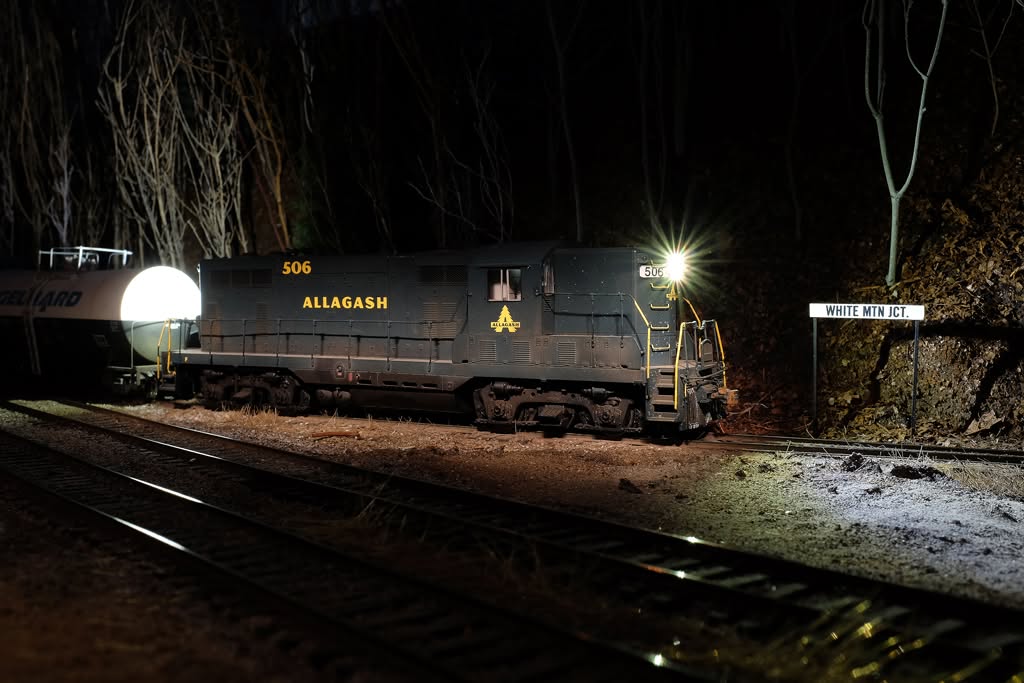
The Allagash placed its first GP7 order in 1950, making the switch from cab units to road-switchers earlier than many New England neighbours. Delivered in Spruce Green with Deluxe Gold lettering, the Geeps quickly took over from F-units on heavy freights and provided the flexibility the road needed on branch lines. A number were equipped with steam generators for passenger turns in the early 1950s.

By the late 1970s, the Kennebec shops had begun chop-nose rebuilds, extending the Geeps’ lives well into the Guilford era. Two units — 507 and 508 — were chopped in 1981, at a time when the railroad was moving back to solid green after years of yellow dip. The 507 emerged in an experimental scheme with yellow handrails and stanchions, while the 508 wore the final pre-Guilford arrangement. Both became signature locomotives of the late Allagash.

No.BuiltSerialLiveryNotesPhotographs
5011950–51Spruce Green & Deluxe Gold; later Yellow dipFirst Allagash GP7s; some steam-generator equipped; traded or rebuilt in 1970s
5021950–51Spruce Green & Deluxe Gold; later Yellow dipFirst Allagash GP7s; some steam-generator equipped; traded or rebuilt in 1970s
5031950–51Spruce Green & Deluxe Gold; later Yellow dipFirst Allagash GP7s; some steam-generator equipped; traded or rebuilt in 1970s
5041950–51Spruce Green & Deluxe Gold; later Yellow dipFirst Allagash GP7s; some steam-generator equipped; traded or rebuilt in 1970s
5051950–51Spruce Green & Deluxe Gold; later Yellow dipFirst Allagash GP7s; some steam-generator equipped; traded or rebuilt in 1970s
5061950–51Spruce Green & Deluxe Gold; later Yellow dipFirst Allagash GP7s; some steam-generator equipped; traded or rebuilt in 1970s
5071950Solid green with yellow handrails and stanchions (experimental)Home-chopped at Kennebec shops in 1981; last of the original GP7s in service pre-Guilford
5081950Solid green (final pre-Guilford scheme). Home-chopped at Kennebec shops in 1981; paired with 507 as signature late Allagash Geeps
5091952–53Spruce Green & Deluxe Gold; later Yellow dipStandard GP9s; gradually retired or rebuilt
5101952–53Spruce Green & Deluxe Gold; later Yellow dipStandard GP9s; gradually retired or rebuilt
5111952–53Spruce Green & Deluxe Gold; later Yellow dipStandard GP9s; gradually retired or rebuilt
5121952–53Spruce Green & Deluxe Gold; later Yellow dipStandard GP9s; gradually retired or rebuilt
5131952–53Spruce Green & Deluxe Gold; later Yellow dipStandard GP9s; gradually retired or rebuilt
5141952–53Spruce Green & Deluxe Gold; later Yellow dipStandard GP9s; gradually retired or rebuilt
5151952–53Spruce Green & Deluxe Gold; later Yellow dipStandard GP9s; gradually retired or rebuilt

More Information

  • Cook, Preston. Before Guilford: The Delaware & Hudson, Boston & Maine, and Maine Central Railroads. Old Line Graphics, 1988.
  • Marre, Louis. Diesel Locomotives: The First 50 Years – A Guide To Diesels Built Before 1972 (Railroad Reference Series No. 10). Kalmbach Books, 1995, pp. 46-50.
  • Melvin, George F. Maine Central in Color Volume 3. Morning Sun Books, 2008, p.10.
  • Robertson, E. B. (1978). Maine Central Diesel Locomotives. Westbrook, USA: Edwin B. Robertson, pp. 40-53.

Epilogue

For the Maine Central and its neighbours, the GP7 and GP9 marked the moment when the diesel road-switcher became the dominant form. They were versatile, rugged and cheap to keep in service, and they stayed relevant through rebuilds and repaints long after newer power had arrived. Whether in maroon and gold, pine green, Harvest Gold or Guilford grey, the Geeps defined the look of everyday railroading in New England.

Post a Comment

Your email address will not be published. Required fields are marked *