The British Rail Class 22 is one of my favourite diesel locomotive classes. Part of that is probably an instinctive sympathy for the underdog. The class has often been portrayed as a failed design and an example of the mistakes made during British Railways’ early dieselisation. Yet when the historical record is examined more closely, the picture is rather different.

In reality, the locomotives performed the duties for which they were designed reasonably well, with availability figures generally exceeding 80%. Their short careers were due less to inherent faults than to wider policy decisions, the collapse of their manufacturer, and the rapid standardisation of diesel traction that took place during the 1960s. In that sense, Class 22s were less a failure than a casualty of circumstance.
The British Rail Class 22, sometimes nicknamed the Baby Warships, were a class of diesel-hydraulic locomotives built for the Western Region of British Railways between 1959 and 1962. Constructed by the North British Locomotive Company, they formed part of the Western Region’s distinctive fleet of German-influenced diesel-hydraulics that also included the Warship, Hymek and Western classes.

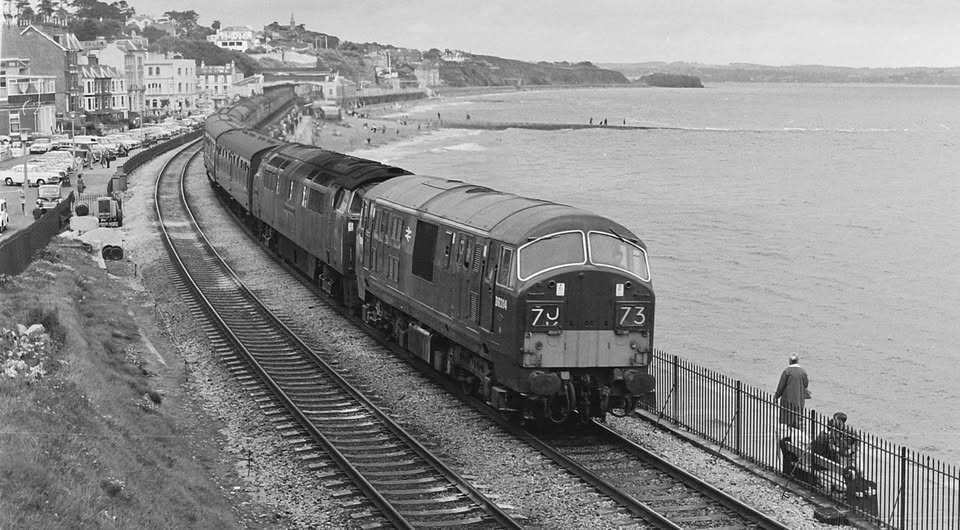
Although relatively small locomotives, the Class 22s became a familiar sight across the West Country during the early diesel era, working both passenger and freight trains from London Paddington to Devon and Cornwall. Their career, however, was relatively short. None survived into preservation, and the entire class had been withdrawn by 1972.
Design And Construction
The origins of the class lie in British Railways’ experimental Pilot Scheme diesel programme of the late 1950s. Under this scheme, a wide range of locomotive designs were ordered from different manufacturers so that their performance could be evaluated in service.
The first locomotive of the class, D6300, emerged from the North British Locomotive Company’s Queen’s Park works in Glasgow in January 1959. The design was closely related to the diesel-electric Class 21 locomotives, also built by North British. The two types were intended to provide a direct comparison between diesel-electric and diesel-hydraulic transmission systems while using broadly similar body designs and the same engine type.

A total of 58 locomotives were constructed between 1959 and 1962, numbered D6300–D6357.
The locomotives were designed as Type 2 mixed-traffic locomotives, intended primarily for secondary passenger services and freight work. In appearance, they resembled the Class 21 diesel-electrics, although the Class 22s were noticeably shorter.
Internally, they shared several design features with the larger Warship diesel-hydraulics, which led railway staff and enthusiasts to nickname them the Baby Warships.
Key specifications included:
| Specification | Details |
|---|---|
| Wheel arrangement | B-B |
| Power type | Diesel-hydraulic |
| Builder | North British Locomotive Company |
| Build dates | 1959–1962 |
| Total built | 58 |
| Power output | 1,000–1,100 hp |
| Transmission | Voith hydraulic |
| Maximum speed | 75 mph |
| Weight | 65–68 tons |
| Fuel capacity | 450 gallons |
The first six locomotives, D6300–D6305, formed the Pilot Scheme batch and differed slightly from the later production locomotives. These early machines were rated at 1,000 hp, while the remaining locomotives received an uprated engine producing 1,100 hp.
Engine
The locomotives were powered by a MAN L12V18/21 V-12 diesel engine. This design originated before the Second World War and had previously been used in German railcars.
In the pilot locomotives, the engine produced 1,000 hp at 1,445 rpm and was fitted with a pressure-charging turbo-compressor driven by exhaust gases. This increased the amount of air entering the cylinders and allowed greater power output from the engine.
Production locomotives received an uprated version of the engine, producing 1,100 hp at 1,530 rpm. Improvements included a revised crankshaft design with larger crank-pin journals, strengthened pistons and modifications intended to reduce torsional vibration at higher engine speeds.

Despite their later reputation, the engines were generally reliable when properly maintained. One issue occasionally noted by maintenance staff was the tendency for fuel to accumulate on top of the engine block if high-pressure fuel pipes were not tightened correctly. This created a potential fire hazard if exhaust sparks were present, but in practice, crews quickly became aware of the issue, and routine preparation checks usually prevented problems.
Transmission
Power from the engine was transmitted through a Voith LT306r hydraulic transmission.
This transmission employed a three-stage torque converter system that allowed the locomotive to accelerate smoothly through different operating ranges. Converter change-over occurred at approximately 25 mph and 50 mph.

Unlike some earlier hydraulic systems, there was no interruption in the flow of power during these changes, allowing the locomotive to accelerate steadily to its maximum speed of 75 mph.
Final drive to the axles was through cardan shafts and spiral bevel gears supplied by David Brown.
Allocations And Operations
The class was concentrated almost entirely on the Western Region, particularly in the West Country.

Typical allocations included:
| Depot | Code | Quantity (1967) |
|---|---|---|
| Old Oak Common | 81A | 20 |
| Bristol Bath Road | 82A | 16 |
| Newton Abbot | 83A | 9 |
| Laira (Plymouth) | 84A | 13 |
Following acceptance trials at Swindon, the first locomotive D6300 was sent to Plymouth Laira in January 1960. Early members of the class were soon working across Cornwall and Devon, often operating in pairs on principal services such as the Cornish Riviera and Royal Duchy.
From these depots, the locomotives worked a wide range of duties including local passenger services, freight workings, secondary passenger trains and empty coaching stock movements.
They were especially common in Devon and Cornwall, where they handled branch line passenger services, local freight and trip workings. A number were also used in the Paddington area, where they moved coaching stock between the main station and Old Oak Common depot.
During the early 1960s, the locomotives occasionally worked as diesel pilots assisting steam trains over the steep gradients of the South Devon banks. This sometimes produced the unusual sight of a relatively small diesel-hydraulic assisting a much larger Castle or King class locomotive.
Early Reliability Problems
Like many early diesel designs introduced during the British Railways Modernisation Plan, the Class 22 suffered from some initial reliability problems, particularly involving engines and transmissions.
Fortunately, the purchase contract allowed locomotives to be returned to the North British Locomotive Works for repair and modification. By the early 1960s, these problems had largely been resolved, and reliability improved considerably.
Availability figures during the mid-1960s consistently exceeded 80%, which was comparable with many contemporary diesel classes.
Later Duties
The Class 22 locomotives were designed primarily for secondary passenger and freight work, and throughout their careers, they were most commonly found on these duties.
With a power output of around 1,000–1,100 hp, they occupied the lower end of British Rail’s Type 2 category.
As more powerful diesel-hydraulics such as the Class 35 ‘Hymek’ and the Warship classes entered service, the Class 22s became the smallest locomotives in the Western Region diesel fleet. They therefore remained largely confined to local passenger services, branch lines and freight workings, particularly in Devon and Cornwall and on former Southern Region lines west of Exeter.
Decline And Withdrawal
The long-term future of the Class 22 was effectively sealed by events beyond the locomotives themselves. In 1962, the North British Locomotive Company, the class’s builder, collapsed. This removed the primary source of technical support and spare parts for the design.
At the same time, British Railways was beginning to reduce the number of locomotive types in service as part of a wider programme of rationalisation following the Beeching Report. The Western Region’s diesel-hydraulic fleet was particularly vulnerable during this period, as standardisation increasingly favoured diesel-electric traction.
Although the Class 22s had settled into useful service by the mid-1960s, the combination of manufacturer collapse and policy changes meant that the class had little long-term future.
Withdrawals began in 1967, when D6301 was condemned in the same year that several of the earlier A1A Warship locomotives were also withdrawn. Over the following years, the class was gradually reduced in number, with locomotives often placed in store before final withdrawal.
In several cases, locomotives passed through multiple cycles of storage and reinstatement, reflecting the fluctuating demand for diesel traction during the late 1960s. Some engines returned briefly to service after months in store before being withdrawn again.
During their final years, the remaining locomotives were increasingly concentrated at Old Oak Common, where they worked empty coaching stock and freight duties around London and the Western Region.
Ironically, several locomotives received heavy maintenance or even a general overhaul shortly before withdrawal. One notable example was D6319, which emerged from Swindon Works in pristine condition on 12 June 1971, only to be withdrawn a few weeks later when further cuts to the diesel fleet were implemented.
By this stage, British Railways was receiving increasing numbers of more standardised diesel-electric locomotives, particularly Class 25 and Class 31 types released from other regions. These gradually displaced the remaining Class 22s from their duties.
The final members of the class remained in traffic into the winter of 1971–1972. On 1 January 1972 the last four locomotives — D6333, D6336, D6338 and D6339 — were withdrawn from service.
None of the locomotives survived into preservation. Many were taken to Bristol St. Philip’s Marsh or Swindon for scrapping shortly after withdrawal, bringing an end to the short but distinctive career of the North British Type 2 diesel-hydraulics.
Liveries
The British Rail Class 22 locomotives appeared in a surprisingly wide variety of livery and front-end combinations during their relatively short careers. Changes in safety requirements, the introduction of the Western Region’s four-character train reporting system, and the transition to British Rail’s corporate blue livery resulted in several distinct appearance variations across the class.
At least six identifiable livery configurations were carried by members of the class:
| Livery configuration | Description |
|---|---|
| Green – no yellow panels | Original condition with traditional disc headcodes |
| Green – half yellow panels with discs | Green livery with small warning panels added |
| Green – half yellow panels with headcode boxes | Modified locomotives fitted with four-character headcode boxes |
| Green – full yellow ends with headcode boxes | Later safety improvements |
| Blue – yellow panels | Early BR corporate blue |
| Blue – full yellow ends | Final BR corporate scheme |
The majority of the class entered service in plain green with disc headcodes and no yellow warning panels, the standard British Railways livery of the late 1950s.
As visibility requirements evolved during the early 1960s, small yellow warning panels were added to the cab ends. In some cases, the locomotives retained their disc headcodes, while others were modified to carry four-character headcode boxes as the Western Region adopted the new reporting number system.
These modifications resulted in considerable variation in the appearance of the class, with locomotives often differing in the exact style and positioning of headcode equipment.
Later in the decade a number of locomotives were repainted into British Rail corporate blue, first with yellow panels and later with full yellow ends.
Because many locomotives were withdrawn relatively early, only a portion of the class received the final blue livery.
Legacy
Although their careers were short and none survived into preservation, the Class 22 locomotives formed a distinctive part of the Western Region diesel fleet during the early 1960s.
Together with the Warships, Hymeks and Westerns, they represented British Railways’ experiment with diesel-hydraulic traction, a technological direction heavily influenced by German locomotive practice.
While the class has often received criticism in enthusiast literature, contemporary records suggest that they performed their intended duties reasonably well. Their disappearance owed more to the collapse of their manufacturer and the rapid rationalisation of diesel classes during the 1960s than to any fundamental design flaw.
For a brief period, they were a common sight across the West Country, handling everything from branch passenger services to freight trains along the coastal lines of Devon and Cornwall.
Today their memory survives through photographs, models and the continuing interest of enthusiasts in the distinctive diesel-hydraulic era of the Western Region.
Modelling
A Class 22 in 2 mm or N gauge can be noticeably improved with a range of relatively small visual upgrades. Common additions include etched North British worksplates, glazed headcode boxes, and a driver figure in the cab to give the model a sense of life. Attention to the buffer beams can also make a big difference, with extra pipework, couplings, and associated fittings providing a far more convincing appearance than the simplified moulded detail typically supplied on the Dapol ready-to-run model. Even treating just one end of the locomotive as the “display” end while leaving the other suitable for coupling can greatly enhance the look of the locomotive in photographs or when leading a train.
Weathering and finish also offer several opportunities for improvement. Many Class 22s developed noticeably faded green paintwork, dusty bodysides, and heavily weathered roofs, particularly around the exhaust area and radiator grilles. Subtle attention to the grilles, window surrounds, cab interior, and underframe can add depth and realism without major alterations to the body shell. Together, these kinds of enhancements help capture the character of the Western Region’s North British Type 2s and allow a 2mm scale model to better reflect the worn, workmanlike appearance these locomotives often carried in service.
| Locomotive | Livery | Catalogue No. (DC) | Catalogue No. (DCC Fitted) |
|---|---|---|---|
| D6311 | BR green with small yellow panels & disc headcodes | 2D-012-008 | 2D-012-008D |
| D6313 | BR green with small yellow panels & headcode boxes | 2D-012-004 | 2D-012-004D |
| D6315 | BR green with small yellow panels & headcode boxes – weathered | 2D-012-013 | 2D-012-013D |
| D6316 | BR green with small yellow panels & disc headcodes – weathered | 2D-012-009 | 2D-012-009D |
| D6318 | BR blue with full yellow ends | 2D-012-001 | 2D-012-001D |
| D6319 | BR green with small yellow panels & headcode boxes | 2D-012-003 | 2D-012-003D |
| D6320 | BR green with small yellow panels & headcode boxes | 2D-012-002 | 2D-012-002D |
| D6324 | BR green with 6 milk tankers – weathered – Dapol Collectors Club Exclusive | 2D-012-006 | – |
| D6325 | BR blue with 6 milk tankers – weathered | 2D-012-007 | 2D-012-007D |
| D6326 | BR green with disc headcodes | 2D-012-010 | 2D-012-010D |
| D6326 | BR blue with full yellow ends | 2D-012-000 | 2D-012-000D |
| D6327 | BR green with small yellow panels & disc headcodes | 2D-012-011 | 2D-012-011D |
| D6328 | BR blue with full yellow ends | 2D-012-014 | 2D-012-014D |
| D6330 | BR blue with full yellow ends – weathered | 2D-012-012 | 2D-012-012D |
| D6331 | BR green with small yellow panels & headcode boxes | 2D-012-005 | 2D-012-005D |
More Information
- “The North British Type 2s: Classes 21, 22 and 29.” Modern Locomotives Illustrated, no. 197, Oct.–Nov. 2012.
- Haresnape, Brian. British Rail Fleet Survey 2: Western Region Diesel-Hydraulics. Ian Allan, 1983.
- Preedy, Norman E., and G. F. Gillham. WR Diesel Hydraulics. Bradford Barton, 1974.
- Reed, Brian. Diesel-Hydraulic Locomotives of the Western Region. David & Charles, 1978.
- Stevens-Stratten, S. W., and R. S. Carter. British Rail Main-Line Diesels. Ian Allan, 1978.
- Strickland, D. C. D+EG Locomotive Directory. Diesel & Electric Group, 1983.