The U25B was General Electric’s first truly successful step into the American road-switcher market after it split from Alco. Announced in 1960 and rated at 2,500hp from its new FDL-16 prime mover, it was a bold, angular machine that came to be known as a “U-boat.” It was the highest-horsepower four-axle locomotive of its day, eclipsing EMD’s GP20, and it introduced several design innovations: a pressurised carbody, centralised air processing, and a rugged, industrial look that pointed to GE’s future dominance.
Between 1959 and 1966, 478 U25Bs rolled out of Erie. They were spread widely across the States, from Southern Pacific and Union Pacific to the New Haven and the Rock Island. Many lasted well into the 1980s, though by then most were second-hand wanderers or rebuilt experiments rather than front-line power. A few survive in preservation, Southern Pacific 3100 still runs at the Southern California Railway Museum, but the majority were cut up when their usefulness was spent.
Maine Central
Maine Central U25Bs nos. 234, 228, 225 and 221 haul eastbound freight RB-1 across Portland’s Fore River Bridge on 26 December 1982. The spectacular four-unit lash-up of former Rock Island “boats” was a sight few could have imagined only a few years earlier, with the rebuilt General Electric units now firmly established as the backbone of Maine Central road freight operations. The train passes beneath the parallel highway bridge against a cold winter sky, while the Mercury Marine sign and waterfront landing emphasise the distinctly coastal setting at the entrance to Portland Harbour. © Glen Perry In 1980, the collapse of the Rock Island presented the Maine Central with an opportunity. Fourteen GE U25Bs, built in 1965, were picked up cheaply and added to the roster as 225–238. They arrived in a kaleidoscope of Rock Island finishes, red, maroon and the unlikely sky blue, and, for a brief time, Rigby Yard played host to this splash of Midwestern colour in a very New England setting.
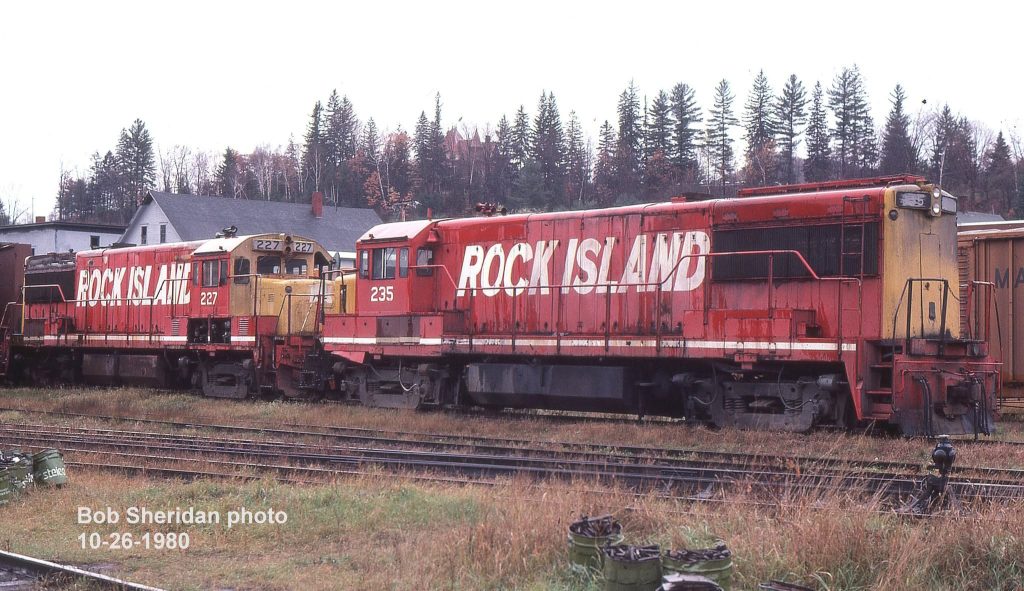
Former Rock Island U25Bs Nos. 235 and 227 are photographed at St. Johnsbury, Vermont, on 26 October 1980 while being delivered to the Maine Central following the Rock Island’s collapse. They were among fourteen U25Bs (225-238) acquired by the railroad, although these two, together with Nos. 233, 236 and 237, would ultimately be used only as a source of spare parts and never enter service. © Bob Sheridan The engines came with quirks too: Rock Island’s “frog eye” cab lights, the forerunners of ditch lights, peered out incongruously from Yankee cabs. Within months, many had been dipped into MEC’s Harvest Gold, and later, after Guilford’s arrival, the cool steel-grey that gave the system a unified, purposeful look. Some went straight for parts, others soldiered on, but together they made a useful stopgap between the GE U18B “Baby Boats” and the later influx of GE U23Bs from the Delaware & Hudson. They were rare visitors to the Mountain Subdivision due to weight restrictions.
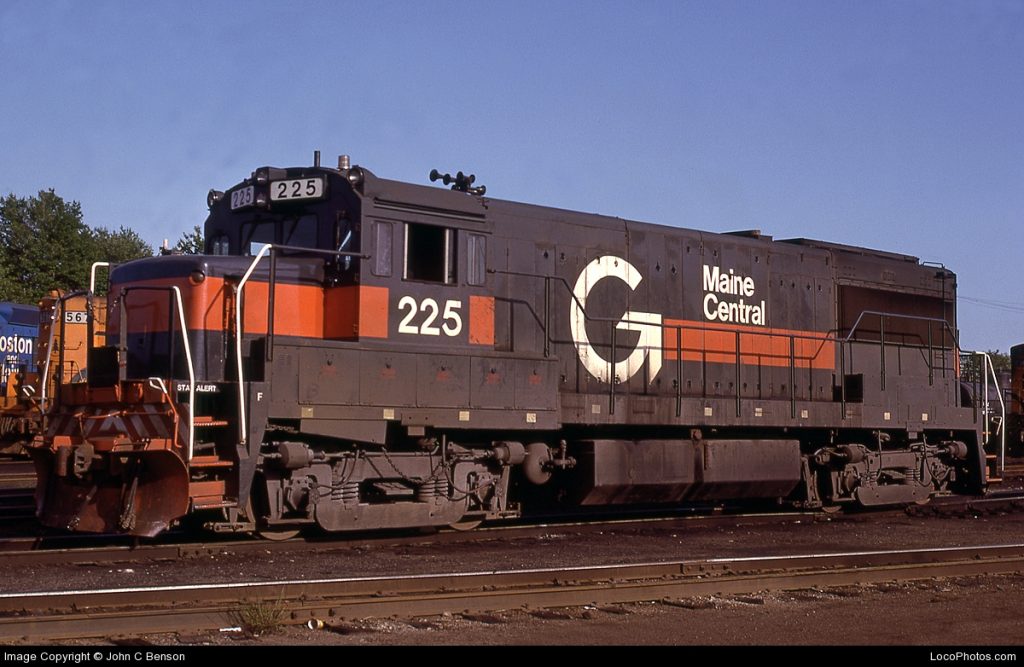
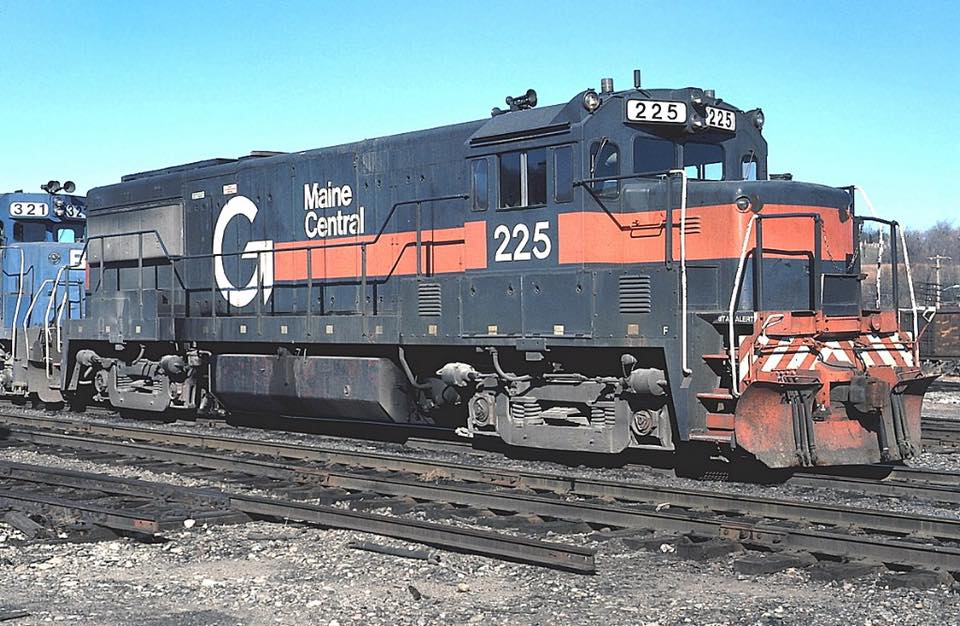
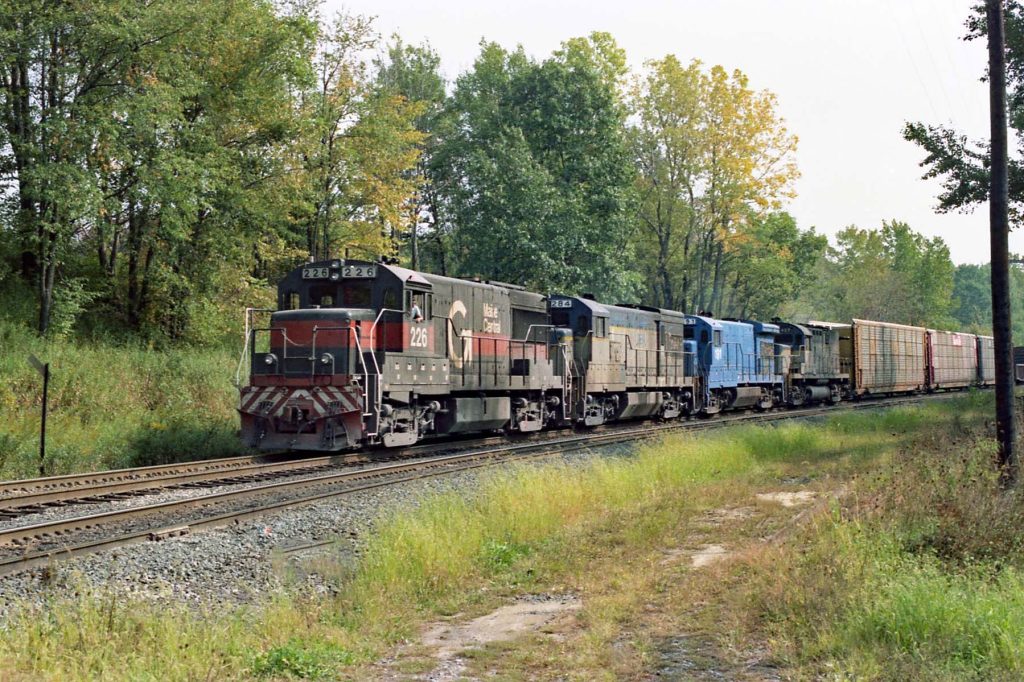
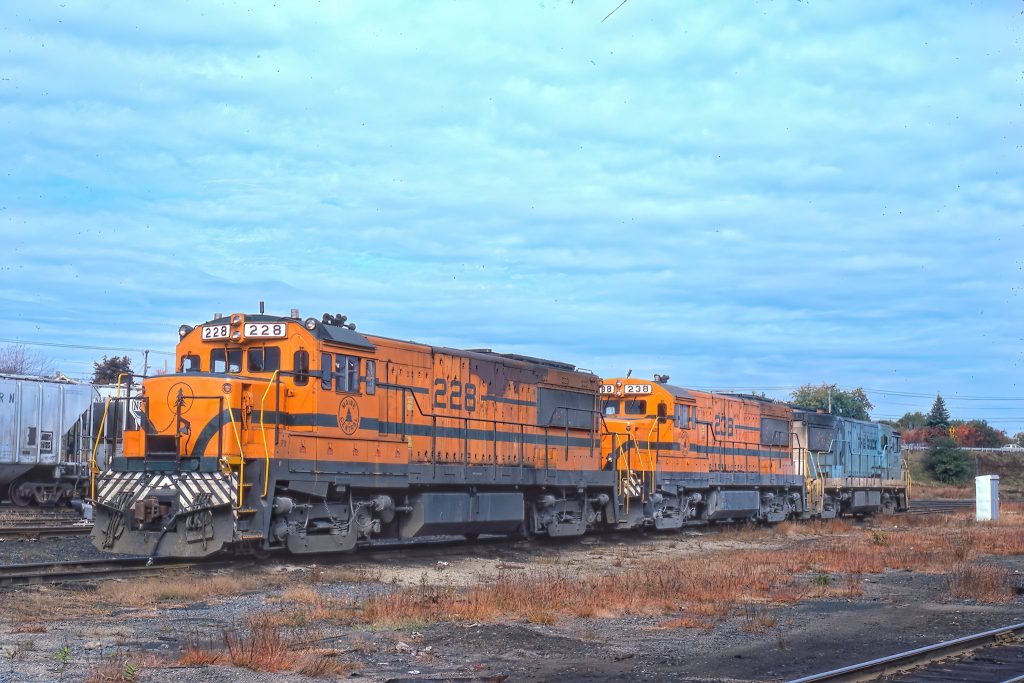
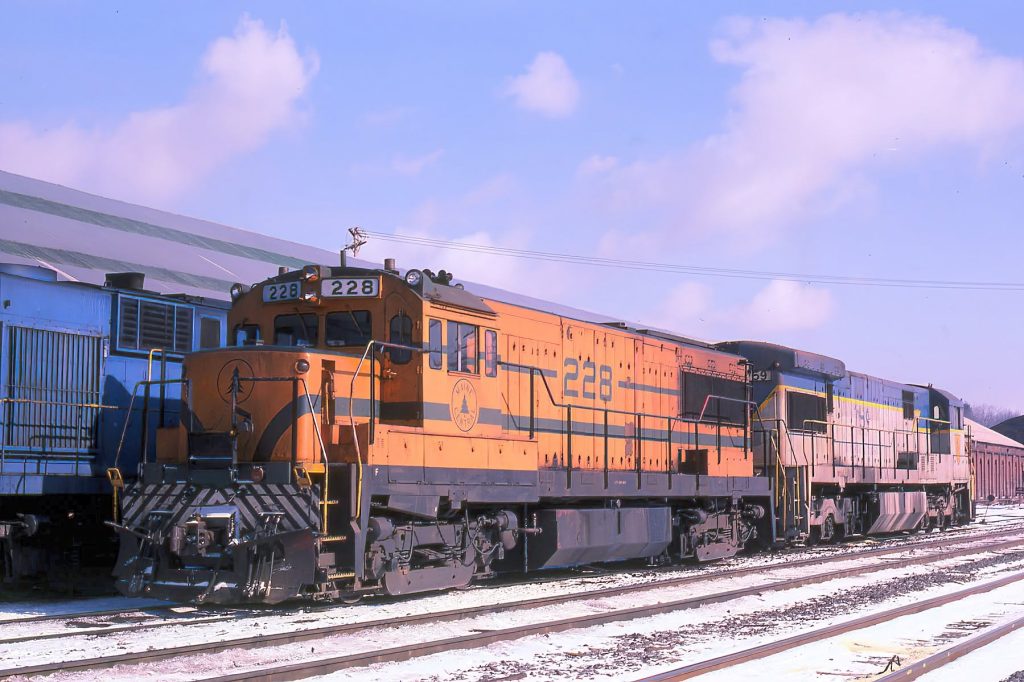
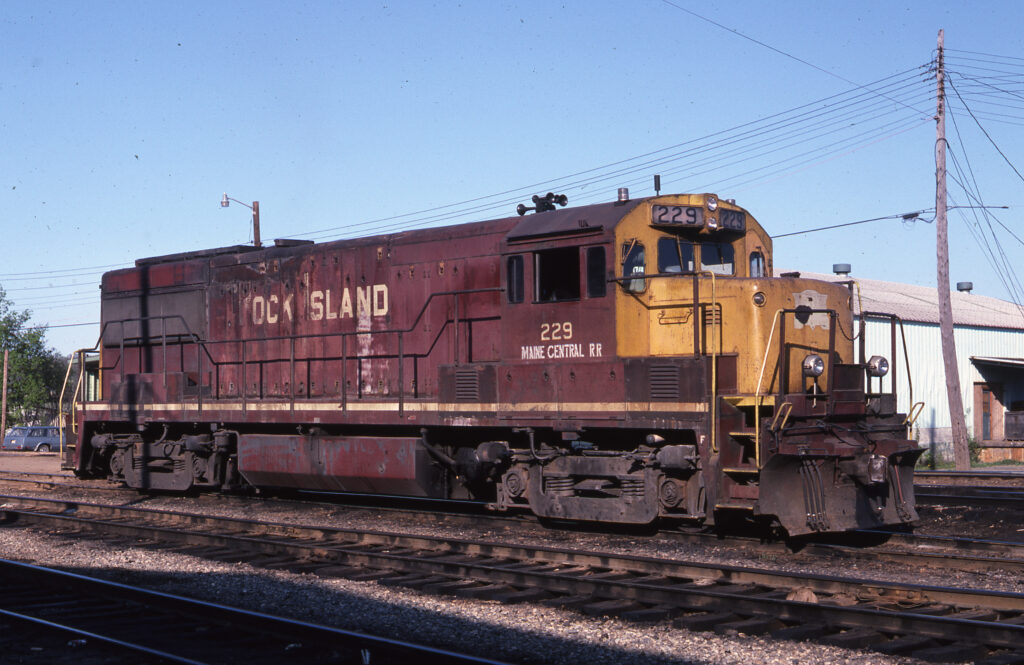
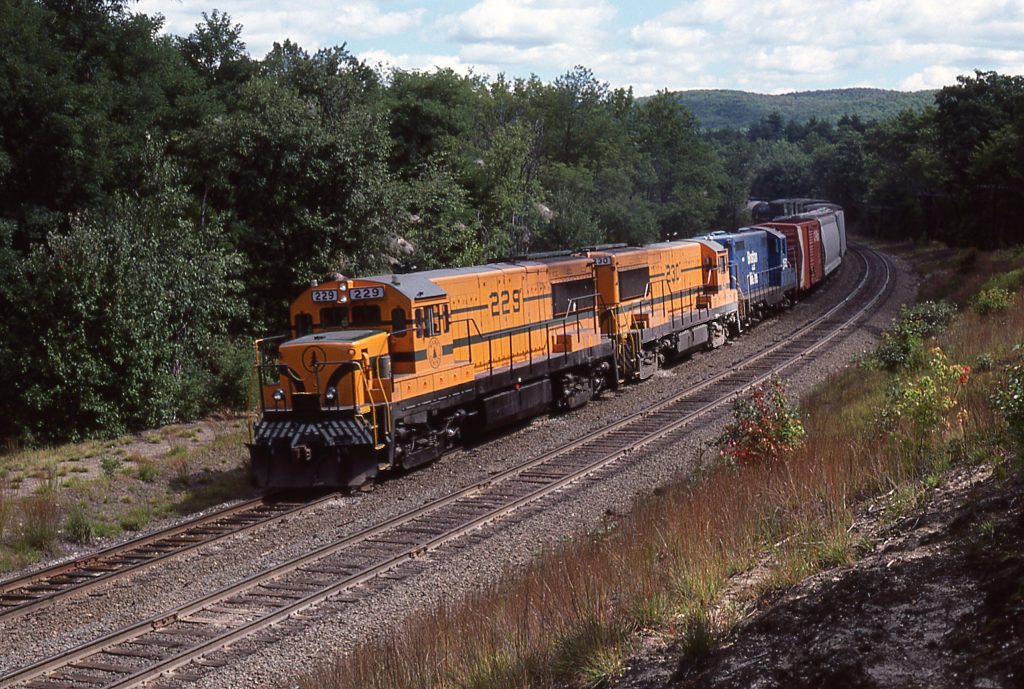
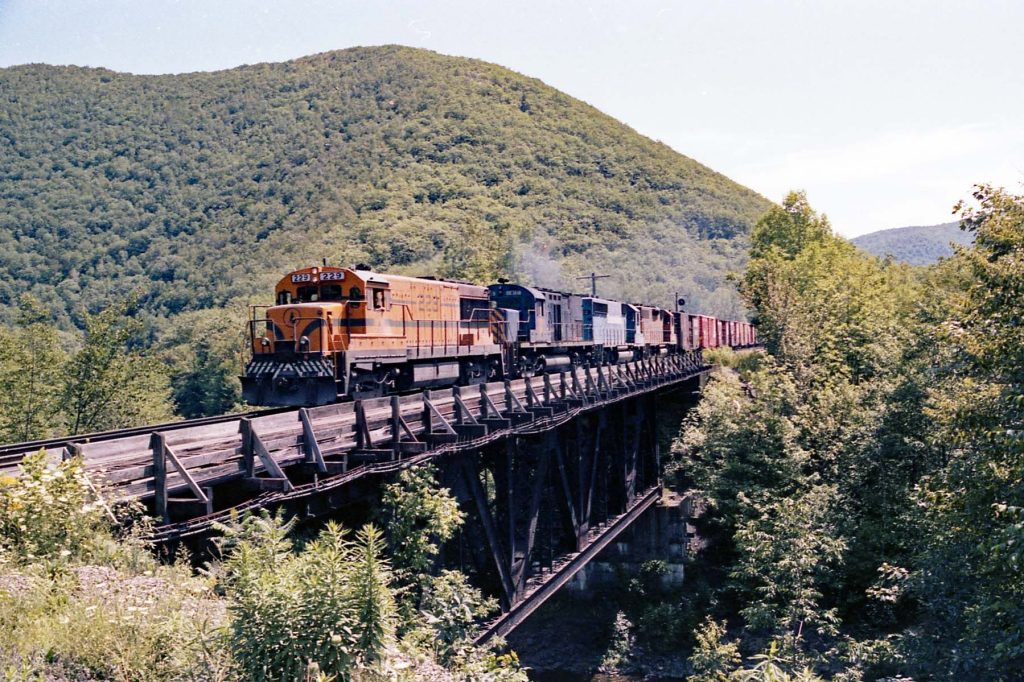
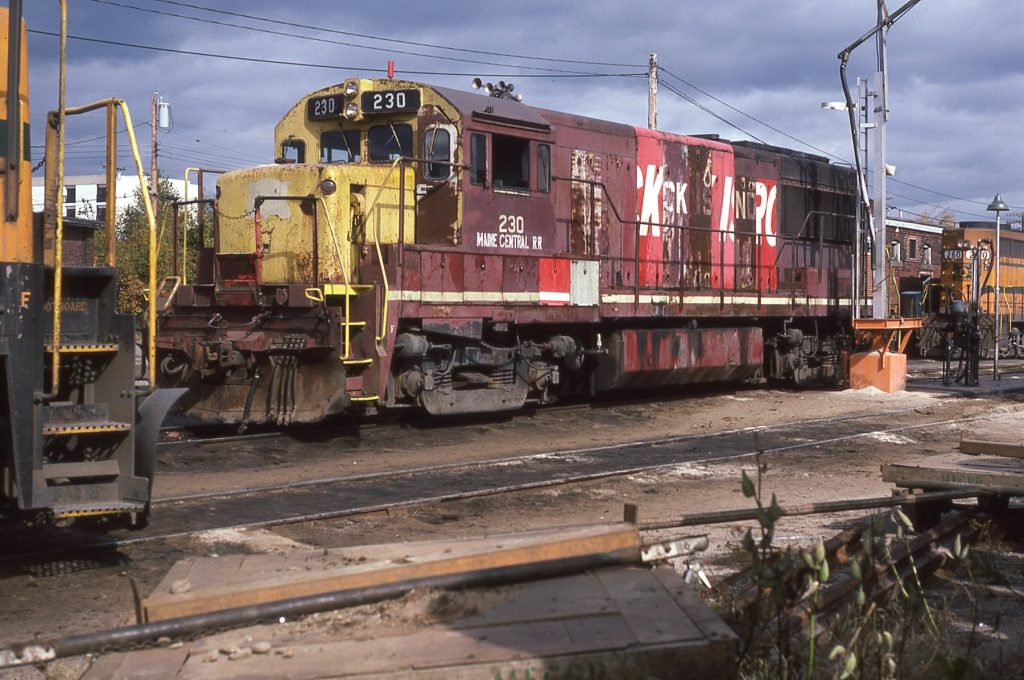
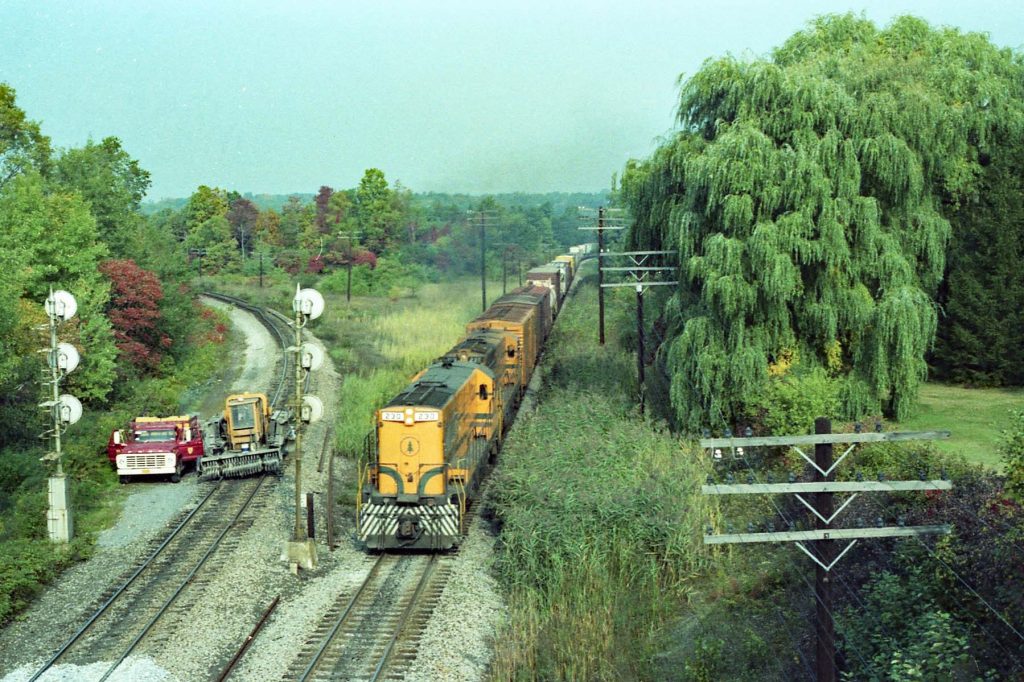
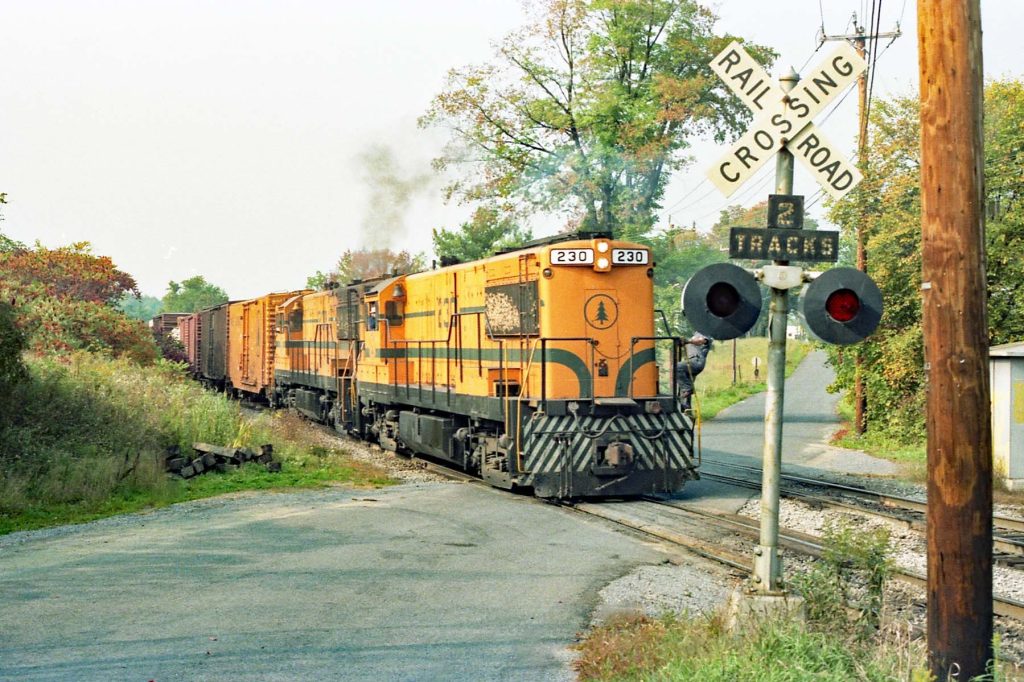
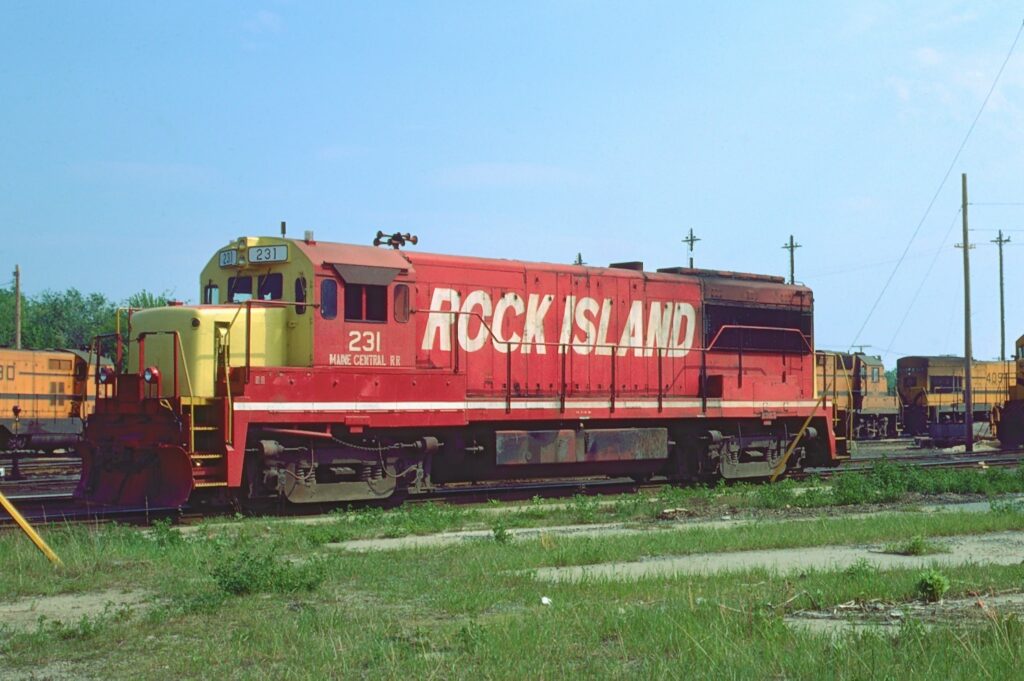
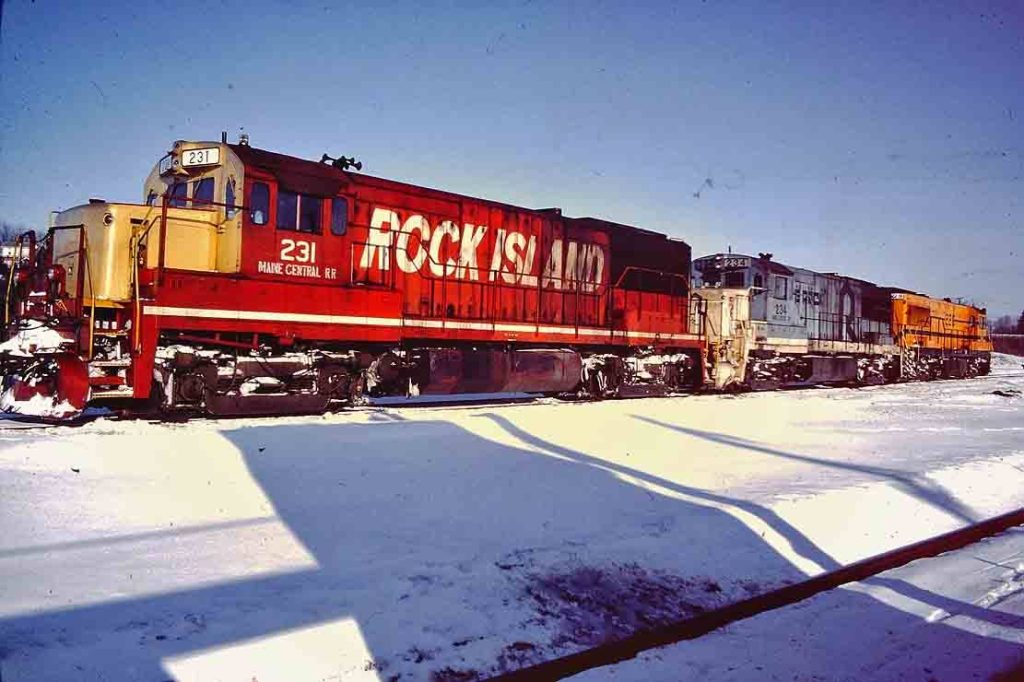
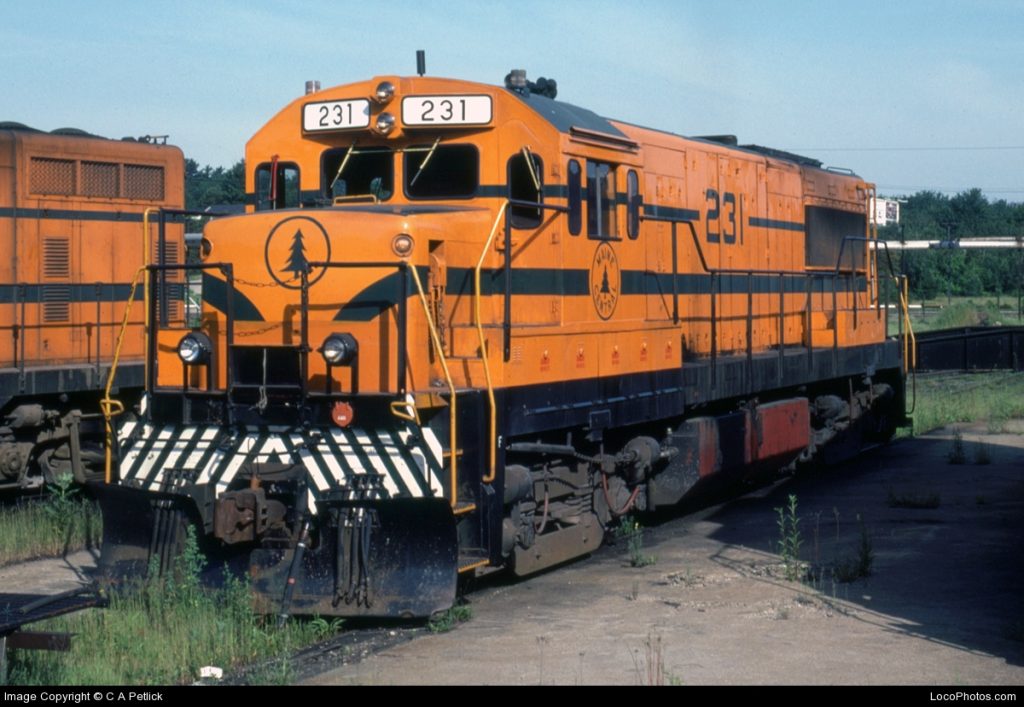
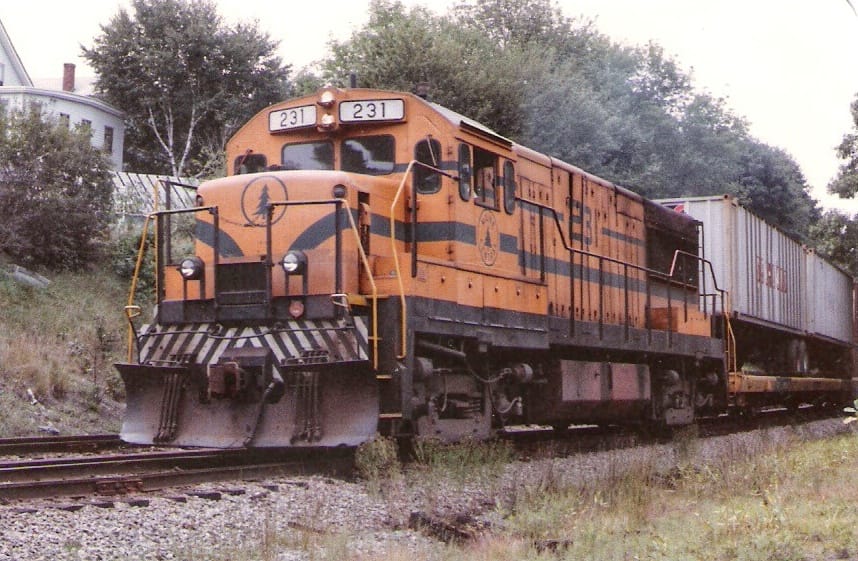
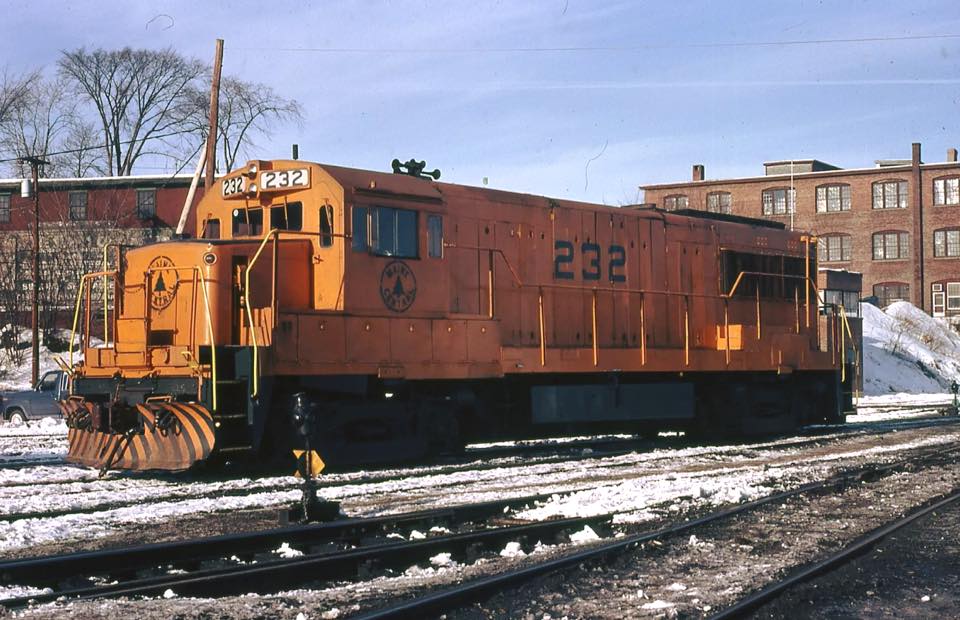
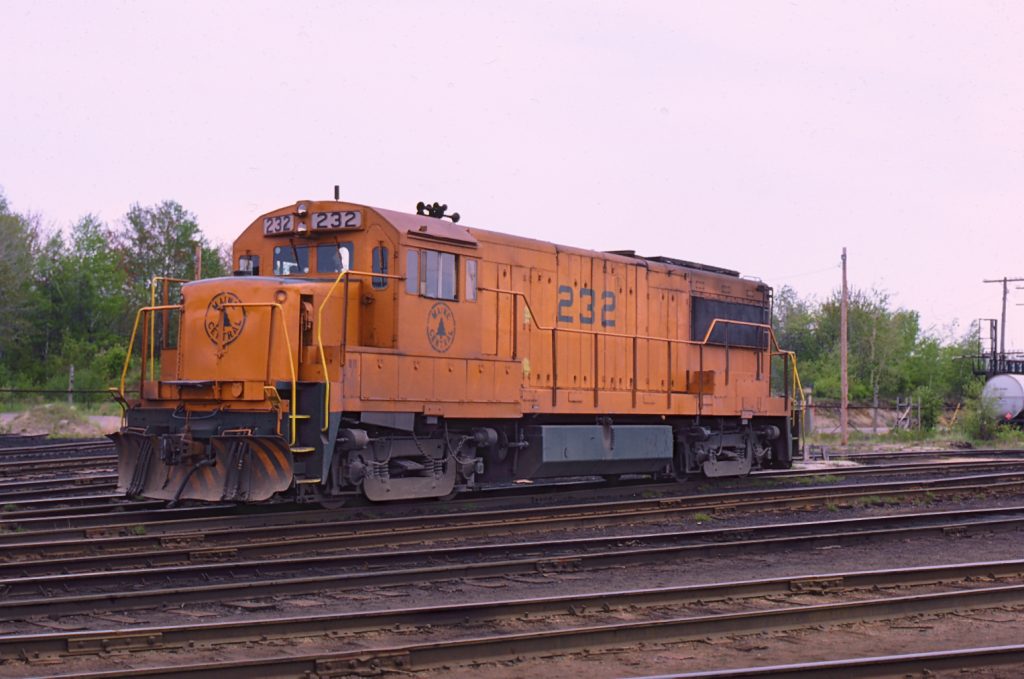
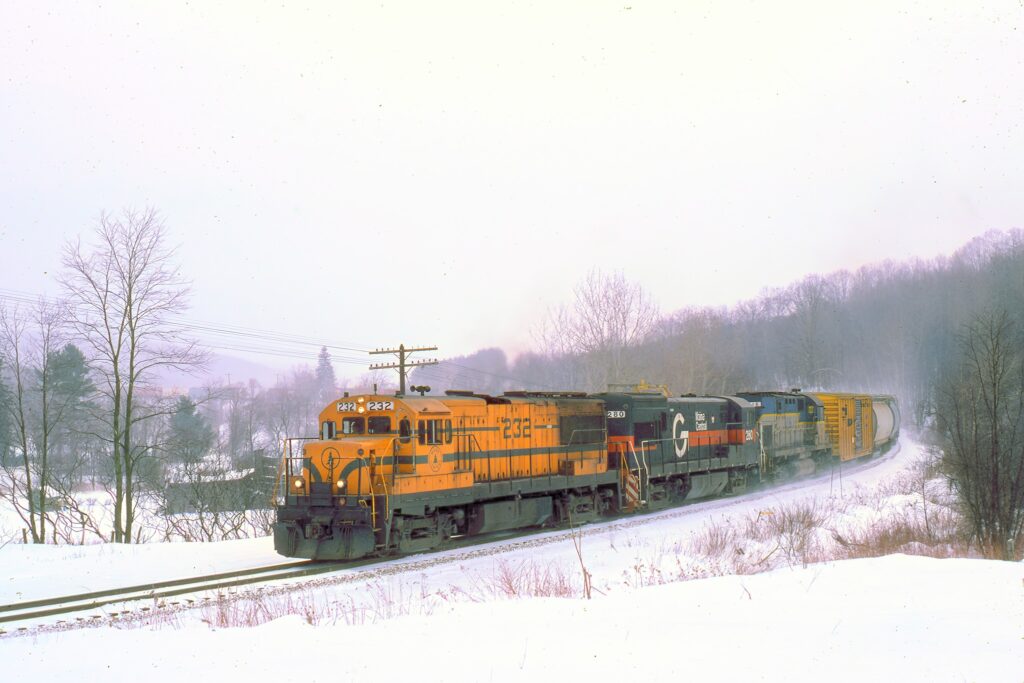
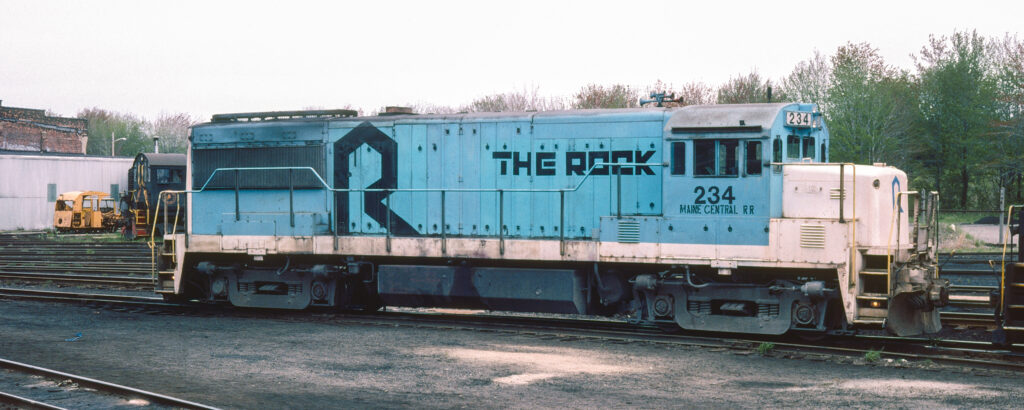
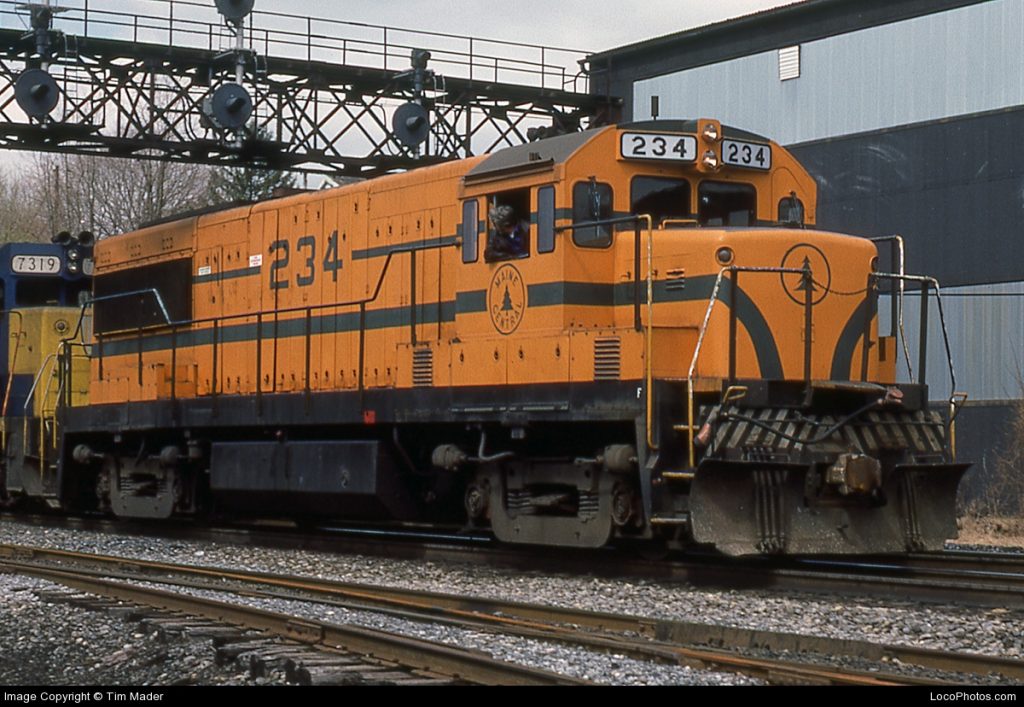
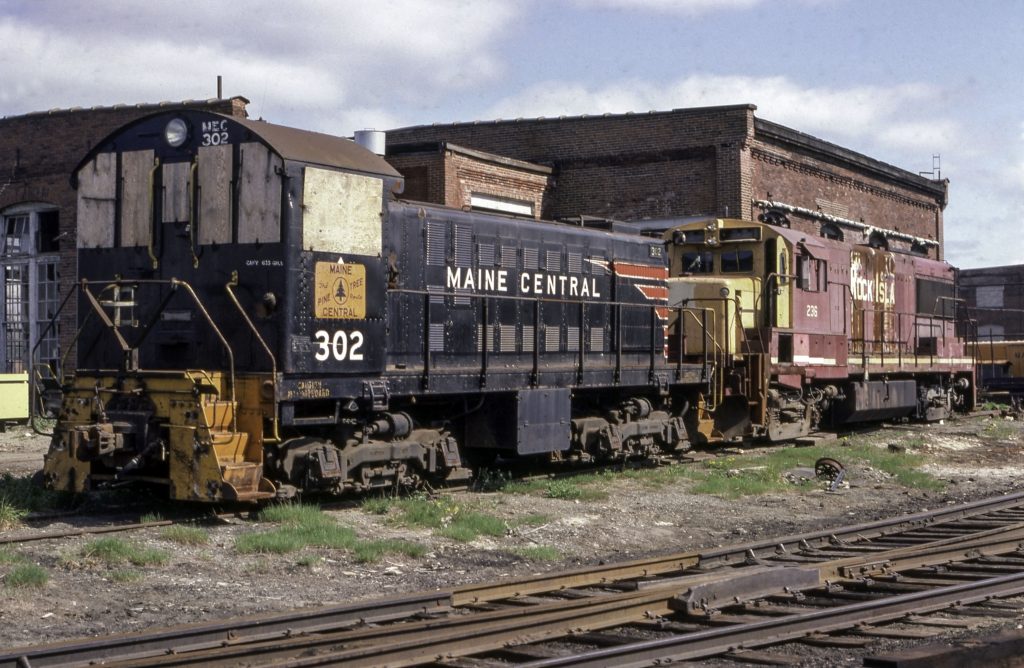
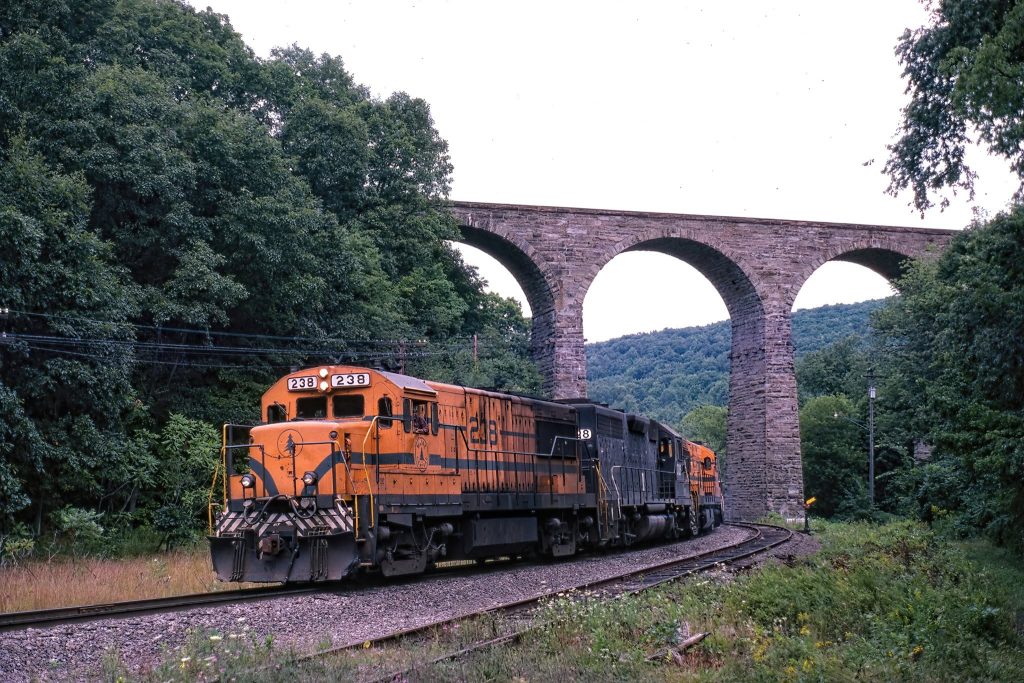
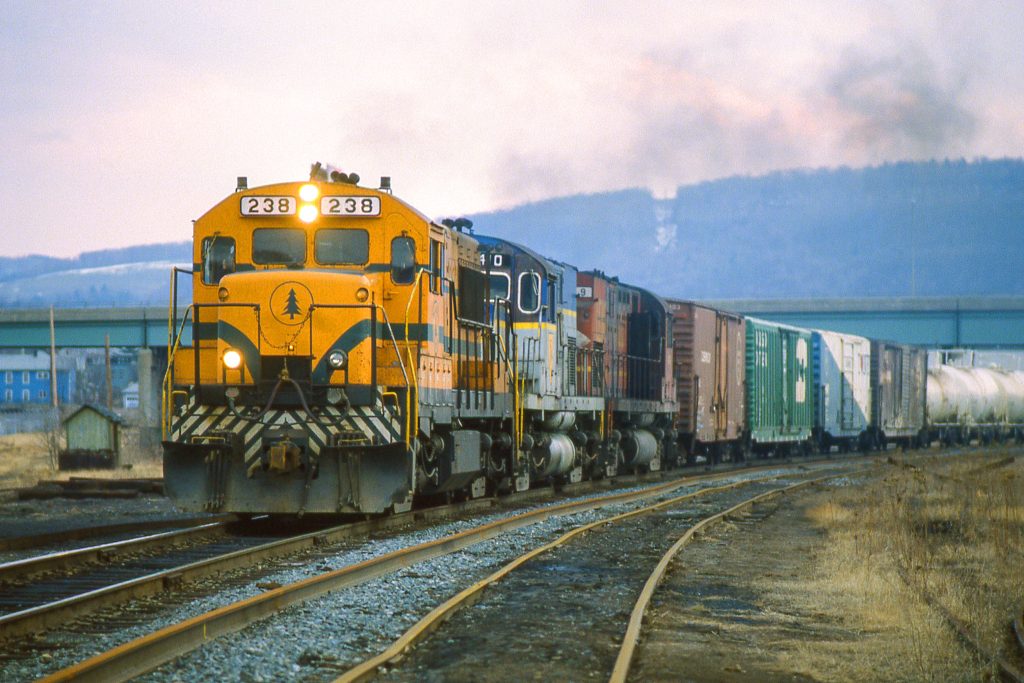
Delaware & Hudson GP39-2 no. 7419 stands alongside Maine Central U25B no. 225 at Boston & Maine’s Lawrence Yard, Massachusetts, in August 1982. The overnight scene captures two pooled-power lash-ups lying side-by-side, one consisting of three D&H EMD GP39-2s and the other of three Maine Central U25Bs. MEC no. 225, still wearing its striking Harvest Gold scheme, contrasts sharply with the blue-and-yellow Delaware & Hudson power under Ken Houghton’s carefully staged night lighting. © Ken Houghton Maine Central U25B no. 225, one of the road’s distinctive “frog eyes” General Electric U25Bs, works as the yard switcher at the north end of Bangor Yard, Maine, during the summer of 1984. Thick black exhaust pours skyward as the Harvest Gold-painted locomotive shuffles boxcars near the grade crossing at Railroad and Front Streets. At the time, Bangor remained an important freight hub for the Maine Central, although much of the yard and surrounding trackage would later disappear following Guilford-era retrenchment. The MEC yard office stood just behind the photographer to the left. © Dwight Mitchell Maine Central U25B No. 225 stands at South Portland, Maine, on 6 July 1983 wearing Guilford Transportation Industries’ black, orange and grey livery. Built by General Electric in September 1965 as Rock Island No. 225, the locomotive became one of a group of second-hand U25Bs acquired by Maine Central during the early 1980s. By this date it had already received Guilford branding, reflecting the growing integration of Maine Central within the Guilford system. The 2,500-horsepower locomotive was a regular performer on freight services across Maine during the decade before being retired in February 1988 and sold for scrap shortly afterwards. © John C. Benson Maine Central U25B No. 225, a former Rock Island unit, stands at Mechanicville, New York, on 3 November 1984. Recently repainted into Guilford grey, the locomotive retains distinctive Rock Island U25B features, notably its original “frog-eye” number boards, a clear clue to its earlier career. © Donny Albertson Maine Central U25B no. 225, repainted into Guilford grey and orange, leads sister no. 234, still wearing Maine Central Harvest Gold, on a southbound Delaware & Hudson manifest beneath a concrete highway overpass at Foster, Pennsylvania, on 11 October 1985. Both locomotives were among the ex-Rock Island U25Bs acquired by Maine Central in 1980. No. 225 still carries the distinctive Rock Island “frog eye” warning lights on the cab roof. © Stanley Short Maine Central GE U25B No. 226 leads train AYBU past Reynolds Crossing, east of Mechanicville, New York, in September 1984. Behind the veteran U25B are Maine Central U23B No. 284, formerly Delaware & Hudson No. 2305 and still wearing its Champlain Blue and Grey Lightning Stripe livery, Boston & Maine U33B No. 191 in the Boston & Maine “Blue Dip” paint scheme, and Delaware & Hudson ALCO C420 No. 407, an impressive mix of General Electric and Alco power on a Guilford Transportation Industries freight. © Gordon Smith Maine Central GE U25Bs 228, 238 wearing Harvest Gold and 234 still in Rock Island Sky Blue at Rigby Yard on 10 November 1981. A gorgeous Kodachrome photograph by Ralph L. Phillips. © Craig Sturgeon Maine Central U25B no. 228 stands alongside sister unit no. 234 during the early Guilford era, both locomotives still showing clear traces of their Rock Island heritage. No. 228 carries the distinctive roof-mounted “frog eye” auxiliary lights fitted by the Rock Island as an early visibility experiment before the widespread adoption of ditch lights. Built in the mid-1960s for the Chicago, Rock Island & Pacific, the pair joined the Maine Central roster following the 1980 purchase of surplus Rock Island U25Bs. Heavy weathering and scorching around no. 228’s exhaust stack hints at the hard lives these first-generation GE road switchers led in New England freight service. Circa 1982. © Cameron Green Maine Central GE U25B No. 228, resplendent in the railroad’s Harvest Gold livery, stands alongside Delaware & Hudson GE U33C No. 759 at Oneonta, New York, on 30 January 1985. By this date, the Maine Central and Delaware & Hudson were both under the control of Guilford Transportation Industries, although each locomotive still carried its distinctive pre-Guilford paint scheme, providing a striking contrast between Maine Central’s vibrant colours and the Delaware & Hudson’s blue, yellow and grey. © Peter Coulombe MEC GE U25B 229, 1981 Bangor, ME. © Preston Cook Ex-Rock Island GE U25B No. 229 at Bangor, Maine, in summer 1982. © Bill Rogerson Maine Central U25Bs nos. 229 and 230, in the road’s Harvest Gold scheme, with Boston & Maine GP7 no. 1562 trailing, lead westbound train POSP past Montague, Massachusetts, in August 1982. Bound from Portland to the Conrail interchange at Springfield, the train is a classic early Guilford-era lash-up, with a mix of Maine Central and Boston & Maine power reflecting the increasing use of run-through and foreign locomotives across the system. The U25Bs, still in full Maine Central colours, head up the train on a warm summer day during a period of rapid change in New England railroading. Kodachrome by Robert C. Barnett. © Steve Carlson C. A. Petlick caught train POSP passing through Lawrence, Massachusetts, on 28 August 1982, led by Maine Central GE U25Bs 229 and 230 in Harvest Gold, with Boston & Maine GP7 1562 trailing behind in distinctive Blue Dip livery. Captured in Kodachrome, the colourful consist reflects the appearance of the Guilford predecessor railroads just before grey became the dominant corporate paint scheme. © Craig Sturgeon Collection. Maine Central GE U25B No. 229 leads a Boston & Maine westbound across the Deerfield River as it approaches the east portal of the Hoosac Tunnel at Florida, Massachusetts, in July 1984. Trailing are Delaware & Hudson Alco C420 No. 415, Boston & Maine GP40-2 No. 312, and Maine Central GP38 No. 254, an eclectic four-unit consist typical of the Guilford Transportation Industries era. © Gordon Smith Having emerged from the Hoosac Tunnel and continued west, Maine Central GE U25B No. 229 leads the same Boston & Maine westbound past St. Mary’s Cemetery at Hoosick Falls, New York, in July 1984. The varied consist of Delaware & Hudson Alco C420 No. 415, Boston & Maine GP40-2 No. 312 and Maine Central GP38 No. 254 reflects the extensive sharing of motive power between Guilford Transportation Industries’ railroads during the mid-1980s. © Gordon Smith Maine Central U25B No. 229 is seen at Buffalo, New York, on 16 February 1985. Built by General Electric in September 1965 for the Chicago, Rock Island & Pacific Railroad as No. 229, the locomotive was later acquired by Maine Central as part of a fleet of second-hand U25Bs purchased to provide additional road power. The locomotive retains Maine Central’s attractive Harvest Gold and Pine Green livery, complete with Pine Tree heralds on the cab sides and nose. Snow clinging to the pilot and steps reflects the harsh winter conditions often encountered in northeastern freight service. No. 229 remained in service until its retirement by Guilford in February 1988, after which it was sold for scrap. © Ray Lackemeyer Fresh out of the Bangor shops on its first day back in service, Maine Central GE U25B no. 230 emerges wearing a patchwork of faded Rock Island maroon, red and primer on 10 October 1981. Built by General Electric in October 1965 for the Chicago, Rock Island & Pacific Railroad, no. 230 was one of fourteen second-hand U25Bs acquired by Maine Central following the Rock Island’s collapse. Rather than waiting for a full repaint, the locomotive was returned to traffic in its heavily weathered former colours, complete with Maine Central lettering, before finally receiving the railroad’s distinctive Harvest Gold livery by August 1982. © Gil Ford Ex-Rock Island GE U25B No. 230 at Bangor, Maine, in summer 1982. © Bill Rogerson Maine Central U25B No. 230 is pictured at Mechanicville, New York, on 5 September 1982. Built by General Electric in September 1965 for the Chicago, Rock Island & Pacific Railroad as No. 230, the locomotive was later acquired by Maine Central as part of its fleet of second-hand U25Bs. Freshly painted in Maine Central’s distinctive Harvest Gold and Pine Green livery, No. 230 presents a striking appearance as it awaits its next assignment in the busy interchange yard at Mechanicville. The 2,500-horsepower locomotive was representative of Maine Central’s efforts to obtain reliable road power economically during a period of changing traffic patterns and financial pressures. It remained in service until retirement by Guilford in February 1988 and was scrapped later that year. © Joseph R. Snopek Maine Central GE U25Bs Nos. 230 and 232, both running long hood forward, lead what is believed to be train SRED (Saratoga–East Deerfield) past CPF478 at the former QG Cabin on the Delaware & Hudson, near Mohawk, New York, in September 1984. On the adjacent track, Delaware & Hudson maintenance-of-way equipment occupies the main line, creating an unusual juxtaposition of revenue freight and engineering operations. If the identification is correct, the locomotives had arrived at Saratoga from East Deerfield without being turned before beginning the return trip. © Gordon Smith Maine Central GE U25Bs Nos. 230 and 232, both running long hood forward, lead what is believed to be train SRED (Saratoga–East Deerfield) across Ushers Road (Dee’s Crossing) at Halfmoon, New York, in September 1984. The conductor is seen flagging the public grade crossing ahead of the train, while the distinctive Harvest Gold locomotives continue east with a short freight after departing Saratoga. © Gordon Smith Maine Central GE U25Bs Nos. 230 and 232, both running long hood forward, depart Ushers Road (Dee’s Crossing) at Halfmoon, New York, in September 1984. With the conductor back aboard after flagging the public grade crossing, what is believed to be train SRED (Saratoga–East Deerfield) accelerates eastward with a short freight, the pair of Harvest Gold U-boats providing an increasingly uncommon sight during the final years of independent Maine Central motive power. © Gordon Smith MEC GE U23B 231 at Rigby Yard, Portland, ME. © Anthony Stillittano Maine Central GE U25B no. 231 leads eastbound freight RB-1 past the east switch of Burnham Siding at Burnham, Maine, on 25 July 1981. Trailing behind are sister U25Bs nos. 226 and 232, both repainted into the railroad’s Harvest Gold scheme following the acquisition of the former Rock Island fleet in 1980. The exhaust-laden trio of GE units makes for a dramatic sight as they charge through the Maine countryside on a warm summer evening. © Peter Coulombe Maine Central U25B No. 231, one of several units acquired from the bankrupt Rock Island, stands at Portland, Maine, in February 1982. Lightly relettered but still wearing its former owner’s bold red “ROCK ISLAND” livery, the locomotive reflects MEC’s pragmatic approach during this period, with a mixed consist of power behind. © Brandon Kulik Maine Central U25B No. 231 stands at Rigby Yard, South Portland, Maine, on 26 June 1983. Built by General Electric in September 1965 for the Chicago, Rock Island & Pacific Railroad as No. 231, the locomotive was acquired by Maine Central during the early 1980s as part of a fleet of second-hand U25Bs intended to provide economical road freight power. Freshly turned out in the railroad’s eye-catching Harvest Gold and Pine Green livery, No. 231 displays the distinctive Pine Tree emblem on its nose and cab side. Rigby Yard served as Maine Central’s principal freight terminal and locomotive servicing facility, making it a frequent gathering place for the railroad’s growing fleet of rebuilt and second-hand motive power. Following an accident, No. 231 was withdrawn from service and scrapped in January 1987. © C. A. Petlick Maine Central U25b 231 in Lowell MA. 1985. © Jason Robart Maine Central eastbound freight RB-1 crosses the Kennebec River at Waterville, Maine, on 2 October 1980, led by U25Bs 232 and 234, with GP38 593 trailing. At this stage, 232 was wearing an overall coat of oxide primer while being repainted at the Bangor Roundhouse between trips, before later emerging in its distinctive all-yellow “Great Pumpkin” livery. 234 still carries its former Rock Island blue paint, highlighting the transitional appearance of Maine Central’s recently acquired ex-Rock Island U25B fleet. © Peter J. Coulombe Maine Central U25B No. 232 stands at Bangor, Maine, in 1981. Finished almost entirely in Harvest Gold, lacking both the usual Pine Tree Green stripe and black sills, the locomotive earned the nickname “Great Pumpkin” among crews. © Scott Porter Maine Central U25B 232, wearing the unique all-yellow paint scheme that earned it the nickname “The Great Pumpkin,” leads a freight across Odlin Road in Bangor, Maine, in March 1981. Behind it, U25B 234 still carries its former Rock Island blue livery, followed by a GP38, illustrating the transitional appearance of Maine Central’s locomotive fleet following the arrival of the ex-Rock Island U25Bs. Captured against Bangor’s industrial backdrop, this unusual lash-up remains one of the most distinctive scenes from Maine Central’s early-1980s diesel era. © David S. Hutchinson Collection Maine Central GE U25B no. 232 stands alongside ALCO S4 switcher no. 1058 at the Rigby engine terminal in South Portland, Maine, during May 1981. Freshly repainted into the railroad’s bright Harvest Gold scheme following acquisition from the Rock Island, the veteran General Electric road-switcher still presents a clean appearance only months into Maine Central ownership. The contrast between the large road unit and the smaller ALCO switcher captures the everyday atmosphere of Rigby during the early Guilford era. © Glen Perry Fresh from the Rock Island and newly repainted into Maine Central’s striking Harvest Gold scheme, GE U25B no. 232 poses at the Rigby engine terminal in South Portland, Maine, during May 1981. The veteran General Electric road-switcher still appears exceptionally clean only a short time after entering MEC service, with the vivid orange-gold paint sharply contrasting against the dark running gear and black radiator section. Originally built for the Rock Island in 1965, no. 232 would go on to become one of the best-known of the former RI U25Bs during the Guilford era. © Glen Perry Maine Central GE U25B no. 232 stands at Rigby Yard in South Portland, Maine, on 29 May 1981. Originally built for the Rock Island as no. 232, the locomotive retained its original number after joining the Maine Central fleet in 1980 as part of the railroad’s purchase of former Rock Island U25Bs. Freshly repainted into the striking Harvest Gold scheme, the veteran General Electric road-switcher presents a sharp appearance in this classic Rigby roster view. © Anthony Stillittano Maine Central GE U25B no. 232 and Delaware & Hudson GP38-2 no. 7325 sit side-by-side at Mechanicville, New York, on 20 August 1983. The contrast between Maine Central’s bright Harvest Gold and the D&H blue and yellow lightning stripe scheme perfectly captures the colourful appearance of Guilford-associated power during the early 1980s. Formerly Rock Island no. 232, the veteran U25B was already becoming a familiar sight far from its original Maine Central home territory. © Glen Perry Maine Central GE U25B no. 232 stands at the Boston & Maine engine facility at Mechanicville, New York, on 28 July 1984. Wearing its bright Harvest Gold paint, the former Rock Island locomotive contrasts sharply with Boston & Maine GP40 no. 323 in blue dip paint on the adjacent track. By this stage, the veteran U25B had become a regular visitor to Guilford territory away from its original Maine Central home rails. © Glen Perry Maine Central GE U25B No. 232, coupled to sister locomotive No. 230, stands on the Boston & Maine engine house tracks at East Deerfield, Massachusetts, in September 1984. Both locomotives wear the railroad’s distinctive Harvest Gold livery, and it is believed one of the pair would subsequently be turned before departing eastward, avoiding another long hood forward trip. © Gordon Smith Maine Central GE U25B no. 232 leads a colourful Guilford-era consist beneath the towering Starrucca Viaduct at Lanesboro, Pennsylvania, sometime during 1985. The former Rock Island locomotive, still wearing Harvest Gold paint, is accompanied by Delaware & Hudson power as the train rounds the curve below one of the most iconic engineering landmarks on the former Erie Railroad. The scene perfectly captures the unlikely mixture of motive power that became common across the D&H during the mid-1980s. © Peter McG Slides Maine Central GE U25B 232 leads a GE U23B 280 and a Delaware & Hudson ALCO C-420 at Tunnel, New York on 7th March 1986. © Dave Stowe A line of former Rock Island U25Bs stands outside the Maine Central engine facility at Bangor, Maine, during May 1981. Closest to the camera is no. 233 in heavily faded Rock Island maroon paint, while no. 235 behind it wears the brighter Rock Island red scheme applied late in the bankrupt railroad’s life. Other ex-Rock Island units, including nos. 230 and 229, farther back in the line, can also be seen near the shop area. Although some of these locomotives did eventually return to service on Maine Central, the units prominently visible here retained the tired, deadline appearance typical of surplus “boats” awaiting either rebuilding or use as sources of parts. © Glen Perry Ex-Rock Island GE U25B No. 233 at Bangor, Maine, summer 1982. © Bill Rogerson Freshly acquired from the bankrupt Chicago, Rock Island & Pacific Railroad, Maine Central GE U25B no. 234 shuffles through Waterville Yard on a wet summer day in 1980, still wearing its distinctive sky blue and white “THE ROCK” paint scheme. Built by General Electric in October 1965 as Rock Island no. 234, it was one of fourteen second-hand U25Bs purchased by Maine Central following the Rock Island’s collapse. Unlike most of its sisters, no. 234 retained its original blue livery for longer than the rest of the fleet, making it one of the most recognisable locomotives on the railroad during this fascinating transition period. It was repainted into Maine Central’s Harvest Gold scheme later in 1982 before continuing into Guilford service, remaining in operation until its retirement and scrapping in 1988. © Bill Rogerson Former Rock Island U25B no. 234 sits at South Portland, Maine, on 29 August 1980, wearing the striking sky blue and white “THE ROCK” paint scheme introduced during Rock Island’s final years. Recently acquired by Maine Central, the locomotive had not yet entered the rebuilding and repainting programme that would eventually transform many of the ex-Rock Island U25Bs into Harvest Gold road power. The contrast between no. 234’s inherited Rock Island colours and Maine Central GP7 no. 593, in Harvest Gold beside it, neatly capture the transitional appearance of the railroad’s locomotive fleet during 1980. © Ron Palmquist Maine Central U25B no. 234 stands at the Bangor engine terminal on 29 November 1980 still wearing the distinctive Rock Island sky blue and white paint scheme applied during the bankrupt railroad’s final years. Recently acquired by Maine Central, the former Rock Island “boat” had yet to receive the Harvest Gold and green colours that would later become synonymous with the fleet in New England service. Behind the U25B is MEC GP38 no. 259 in the standard Harvest Gold scheme carried from new, highlighting the contrast between Maine Central’s contemporary locomotive image and the inherited Rock Island appearance of the rebuilt GE fleet. © Glen Perry Maine Central U25B 234 at Rigby engine terminal, May 1981. © Glen Perry Maine Central U25B no. 234 still wears faded Chicago, Rock Island & Pacific blue and white paint as it sits between fellow Guilford system power in the early 1980s. One of the former Rock Island U25Bs acquired by Maine Central in 1980, no. 234 became well known among New England railfans for retaining its original “THE ROCK” lettering long after entering service on the former MEC. To the left stands Boston & Maine EMD GP40 no. 308 in Boston & Maine blue, whilst sister U25B no. 228 in Harvest Gold occupies the right-hand side of the frame. The contrast between the patched and weathered paint schemes perfectly captures the transitional appearance of Guilford railroading during this period. © Cameron Green Still wearing its weathered sky blue and white “THE ROCK” paint scheme, former Rock Island GE U25B no. 234 pauses at Bangor, Maine, on 1 June 1981. Acquired by Maine Central following the Rock Island’s collapse the previous year, no. 234 was among a handful of U25Bs that retained their original colours well into 1981, making them favourites with New England railfans. On this day, no. 234 and sister U25B no. 238 formed the trailing pair of the power for freight RB-3, behind GP38 no. 259 and U18B no. 409, as the consist headed towards the engine shop. No. 234 would remain in Rock Island blue until later in 1982 before finally receiving Maine Central’s Harvest Gold livery. © Geoff Beard Former Rock Island U25B no. 234, still in full sky blue and white “THE ROCK” paint, pauses at Hermon, Maine, on 24 June 1981 during operations involving freights WB-1 and BW-2. The locomotive remained one of the most visually distinctive of Maine Central’s ex-Rock Island GE fleet before eventual repainting into Harvest Gold and green. At left is a stainless-steel Bangor & Aroostook passenger car, while a crew member stands beside the U25B amid the busy interchange activity. The weathered condition of no. 234 contrasts sharply with the bold surviving Rock Island lettering, creating a scene that perfectly captures the transitional nature of Maine railroading in the early 1980s. © Glen Perry Maine Central U25B no. 234, still wearing faded Rock Island blue and white paint, leads freight BW-2 through Burnham Junction, Maine, on 24 June 1981. The connection to the Belfast & Moosehead Lake Railroad is visible to the right as the former Rock Island unit hustles a mixed freight eastward beneath a bright summer sky. No. 234 was one of several second-hand U25Bs acquired from the bankrupt Rock Island in 1980, and by this stage retained much of its original appearance. © Glen Perry Former Rock Island U25B no. 234, still wearing its faded sky blue and white “THE ROCK” paint scheme, switches Bucksport Yard in Bucksport, Maine, on 29 June 1981. Trailing behind is Maine Central no. 593, an ex-Louisville & Nashville GP7 originally built for the Chicago & Eastern Illinois as no. 209. The weathered ex-Rock Island GE and rebuilt second-hand EMD capture the eclectic locomotive roster that typified Maine Central operations during the early 1980s, when inherited and acquired power from across North America worked side-by-side on Maine’s paper mill branches and road freights. © Glen Perry Maine Central U25B no. 234 rests at Bucksport, Maine, on 29 June 1981, still carrying much of its former Rock Island blue and white paint scheme beneath hastily applied Maine Central lettering. The worn but distinctive GE road-switcher was one of several second-hand U25Bs acquired from the bankrupt Rock Island in 1980, and remained a striking sight in Maine service before eventual repainting into Harvest Gold. © Glen Perry Still wearing its faded Rock Island sky blue and white “THE ROCK” paint scheme, Maine Central U25B no. 234 leads freight BR-4 toward Rigby Yard in South Portland, Maine, on 7 July 1981. Trailing behind are Maine Central RS11 nos. 801 and 802, the railroad’s only two examples of the ALCO road-switcher type, both in full Harvest Gold and green paint. The train crosses a temporary-looking bridge structure amid active construction work near the Portland terminal, creating a fascinating contrast between inherited second-hand GE power and Maine Central’s long-established ALCO fleet during a transitional period for the railroad. © Glen Perry Maine Central Railroad GE U25B No. 234, formerly of the Rock Island, leads EMD GP38 No. 254 at Waterville Yard, Waterville, Maine, in the summer of 1982. No. 234 still wears Rock Island “Bankruptcy Blue”, patched for the Maine Central, while No. 254 wears the Maine Central’s classic harvest gold. © Bill Rogerson Maine Central U25Bs nos. 234, 226 and another sister unit stand at Rigby Yard in South Portland, Maine, on 25 November 1982. No. 234 still wears traces of the unusual sky blue paint visible beneath its Harvest Gold repaint, a reminder of its Rock Island heritage before arriving on the Maine Central in 1980. By this stage the rebuilt U25Bs had become a familiar sight across the system, their bold paint scheme making them some of the most recognisable locomotives on the railroad despite their increasingly rough-running reputation and hard-working lives. © Glen Perry Maine Central U25Bs nos. 234, 226, 228 and 225 stand at Rigby Yard in South Portland, Maine, on 26 December 1982 while preparing to head east on freight RB-1. The quartet of former Rock Island “boats,” rebuilt and repainted into Maine Central’s bold Harvest Gold and green scheme, presents a scene that had become increasingly common by the early 1980s as the railroad relied heavily on the veteran General Electric fleet for road freight service. Winter light and muddy yard conditions give the Portland terminal a distinctly hard-working atmosphere at the height of the U25B era. © Glen Perry Maine Central U25B no. 234 and Delaware & Hudson C420 no. 406 work westbound Guilford freight BA-ED at Gardner, Massachusetts, on 20 June 1984 while making a pickup from the Providence & Worcester connection at West Main Street siding. The weathered Harvest Gold U25B and faded blue D&H ALCO typified the eclectic locomotive combinations common across Guilford’s former Boston & Maine routes during the mid-1980s. A long cut of mixed freight stretches away toward the searchlight signals at CPF-335, while the familiar Weldon’s Donuts sign overlooks the scene from beyond the rock cut. © Robert C. Barnett Maine Central U25B No. 234 passes beneath the signal bridges at Allentown, Pennsylvania, on 6 April 1985. Built by General Electric in October 1965 as Rock Island No. 234, the locomotive was among the U25Bs acquired second-hand by Maine Central during the early 1980s. Repainted into the railroad’s distinctive Harvest Gold and Pine Green scheme, No. 234 became a familiar sight on both Maine Central and Delaware & Hudson routes following the formation of Guilford Transportation Industries. The locomotive’s presence in Pennsylvania illustrates the increasingly far-reaching operations of Guilford-affiliated railroads during the period. No. 234 remained in service until its retirement in February 1988 and was scrapped shortly afterwards. © Tim Mader Former Rock Island U25B no. 235 stands outside the Maine Central engine facility at Bangor, Maine, during May 1981. Unlike the more common faded maroon paint carried by many of the ex-Rock Island “boats,” no. 235 still wears the striking bright red scheme introduced late in the Rock Island’s final years. Although visually dramatic, the locomotive was already deep into deadline status by this stage and would never operate in Maine Central service following its acquisition. The open equipment door, missing fittings and tired overall condition reflect its role as a parts source for the operational U25B fleet. © Glen Perry Ex-Rock Island GE U25B No. 235 at Bangor, Maine, in summer 1982. Acquired by Maine Central for spare parts, it never ran in service. © Bill Rogerson Former Rock Island GE U25B no. 236 stands at Waterville, Maine, on 9 August 1980, shortly after being acquired by Maine Central following the collapse of the Rock Island. Still wearing its weathered former Rock Island maroon and yellow paint, No. 236 would never enter revenue service on the Maine Central and was instead used as a source of spare parts to keep the operational members of the U25B fleet running. © Ken Putelis Boarded-up Maine Central ALCO S2 no. 302 sits alongside ex-Rock Island U25B no. 236 at Waterville, Maine, on 7 May 1981. The tired-looking pair appear deep in deadline status outside the shop buildings, reflecting the difficult financial climate of the period. Unlike many of the other former Rock Island U25Bs purchased by Maine Central in 1980, no. 236 never entered active service on the railroad and was instead retained as a parts source to help keep the operational U25B fleet running. Still wearing heavily faded Rock Island paint, the stripped and weathered “boat” presents a stark contrast to the smart Harvest Gold locomotives the surviving units would soon become famous for. © Chuck Schwesinger Former Rock Island GE U25B no. 236 stands at Waterville Yard, Maine, during the summer of 1982, still wearing its weathered Rock Island maroon and yellow paint. Acquired by Maine Central in 1980 as part of its fourteen-unit fleet of second-hand U25Bs, no. 236 was one of five locomotives that never entered MEC service and was instead retained as a source of spare parts for the operational fleet. Built by General Electric in October 1965 as Rock Island no. 236, it was eventually scrapped. © Bill Rogerson Former Rock Island GE U25B no. 237 stands at Waterville Yard, Maine, during the summer of 1982, still wearing its striking red Rock Island livery. Acquired by Maine Central in 1980 as part of its fourteen-unit fleet of second-hand U25Bs, no. 237 was one of five locomotives that never entered MEC service and was instead used as a source of spare parts for the operational fleet. Built by General Electric in October 1965 as Rock Island no. 237, it was eventually scrapped. © Bill Rogerson Former Rock Island U25B no. 238 sits at the Maine Central engine facility in Bangor, Maine, on 16 July 1980, likely awaiting reactivation following its recent purchase by the railroad. The locomotive still wears faded and heavily weathered Rock Island maroon and yellow paint, giving it the worn “deadline” appearance common among second-hand power acquired during this period. Another ex-Rock Island U25B, no. 230, is partially visible at right in similarly tired condition. Within a short time, these locomotives would emerge in Maine Central’s now-iconic Harvest Gold scheme with green striping, becoming some of the most recognisable locomotives on the railroad during the early 1980s. © Glen Perry Freshly cleaned Maine Central U25B no. 238 stands at Rigby Yard in South Portland, Maine, during May 1981. One of the former Rock Island units acquired by Maine Central in 1980, no. 238 wears the striking Harvest Gold scheme with green striping and large side numerals that became iconic on the railroad during the early 1980s. The locomotive appears in remarkably tidy condition only a short time after entering service on the MEC system, contrasting with the heavily weathered appearance many of the fleet would carry later in the decade. Maine Central EMD GP7 no. 591 is partially visible alongside in the background. © Glen Perry Maine Central GE U25Bs nos. 238 and 228 lead westbound Guilford freight LA-SE through CPF-FG at Fitchburg, Massachusetts, on 8 February 1984. A Delaware & Hudson GP39-2 trails behind the pair of former Rock Island General Electric units as the train heads toward Selkirk, New York. By this stage the once-smart Harvest Gold locomotives were already showing the effects of Guilford’s tightening maintenance standards, with road grime beginning to dull the paintwork. The classic B&M signal bridge and jointed-rail main line capture a Northeast railroading scene that would soon begin to disappear. © Robert C. Barnett Maine Central U25Bs nos. 238 and 228 lead westbound Guilford freight LA-SE past the classic B&M signal bridge at Willows in Ayer, Massachusetts, during November 1984. Delaware & Hudson GP39-2 no. 7401 trails behind the pair of weathered former Rock Island U25Bs as the train rolls past the Martin-Brower McDonald’s distribution warehouse, a familiar landmark for generations of New England railfans. The fading Harvest Gold paint, jointed rail and searchlight signals capture the atmosphere of Guilford’s early years before sweeping changes transformed the former Boston & Maine main line. © Robert C. Barnett Maine Central GE U25B No. 238, wearing the railroad’s distinctive Harvest Gold livery, leads a northbound freight beneath the magnificent Starrucca Viaduct at Lanesboro, Pennsylvania, on 21 August 1985. Completed by the New York & Erie Railroad in 1848, the 1,040-foot-long stone viaduct remains one of the most iconic railroad structures in the northeastern United States. © Craig Sturgeon Maine Central U23B no. 238 waits on Conrail’s Southern Tier main line at Lanesboro, Pennsylvania, on 5 October 1985 during the Belden Hill Tunnel detour period. A Delaware & Hudson U33C-led SU-1 puller job holds on the Jefferson Connection in the background while the conductor uses the lineside telephone to speak with the dispatcher. The lash-up behind no. 238 includes a mix of Delaware & Hudson power, reflecting the borrowed and pooled locomotive arrangements common during the detour operations. Autumn colours and Kodachrome skies complete a classic mid-1980s Bridge Line scene. © John Benner Former Rock Island Maine Central U25B no. 238 leads Delaware & Hudson freight PYRP out of Bevier Street Yard in Binghamton, New York, on 15 March 1986 as the train begins the climb toward Belden Hill. Trailing behind are Delaware & Hudson C420 no. 410 and no. 419, the latter still wearing faded Lehigh Valley paint despite its Guilford-era renumbering. The bright Harvest Gold and green striping of the U25B stands out dramatically against the muted late-winter Southern Tier landscape, while exhaust drifts back across the train as it accelerates westward. © Citizen of the Galaxy http://archive.atlasrr.com/NLoco/arc-nu25b.htm
No. Built Serial Livery Notes Modelling 225 Sep 1965 35701 Rock Island Red until? Maine Central Harvest Gold by Oct 1981. Guilford Grey & Orange by Feb 1983. Frog eye lights. I don’t believe this one ran in Rock Island Paint. Retired by Guilford Feb 1988; to Midwest Steel & Alloy 25th Mar 1988, scrapped. RRPA . 226 Sep 1965 35702 Maine Central Harvest Gold by Aug 1980, Guilford Grey & Orange by Jul 1984. I don’t believe this one ran in Rock Island Paint. Modelled by Mike Confalone on his Allagash Railway . 227 Sep 1965 35703 Rock Island Red Never ran 228 Sep 1965 35704 Maine Central Harvest Gold by Jan 1981 until at least Nov 1987. I don’t believe this one ran in Rock Island Paint 229 Sep 1965 35705 Rock Island Red stencilled for MEC until at least Oct 1981—Maine Central Harvest Gold by Aug 1982 until at least Nov 1987. Retired by Guilford Feb 1988; to Midwest Steel & Alloy 14th Mar 1988, scrapped. Rock Island Red – Atlas 44581 (205) or Atlas 44582 (208) renumbered, stencilled and heavily weathered. 230 Oct 1965 35706 Rock Island Red in May 1981. Maine Central Harvest Gold by Aug 1982 until at least Dec 1986.Retired by Guilford Feb 1988, scrapped Jun 1988. 231 Oct 1965 35707 Rock Island Red until at least Feb 1982. Maine Central Harvest Gold until at least August 1986. Ran in Rock Island Red. Wrecked, retired and scrapped in Jan 1987. Rock Island Red – Atlas 40 000 592 (209) or Atlas 40 000 576 (211) renumbered, stencilled and weathered. 232 Oct 1965 35708 Maine Central Harvest Gold with no Green aka. Maine Central Pumpkin Maine Central Harvest Gold by Jun 1983 until at least Mar 1986. I don’t believe this one ran in Rock Island Paint. 233 Oct 1965 35709 Rock Island Red in May 1981 Never ran 234 Oct 1965 35710 Rock Island Sky Blue until at least August 1982. Maine Central Harvest Gold by November 1982 until at least May 1986.Retired Feb 1988; to Midwest Steel & Alloy 25th Mar 1988, scrapped. ! 235 Oct 1965 35711 Rock Island Red Never ran 236 Oct 1965 35712 Rock Island Maroon Never ran 237 Oct 1965 35713 Rock Island Maroon Never ran 238 Oct 1965 35714 Rock Island Maroon until March 1981. Maine Central Harvest Gold by May 1981 until at least July 1987. I don’t believe this one ran in Rock Island Paint.
Modelling
Atlas have never produced the U25B in Maine Central Harvest Gold, Guilford grey, or patched Maine Central ex-Rock Island versions. However, they have produced a number of very useful Rock Island Phase 2A models, which provide an excellent starting point for modelling Maine Central’s fleet of former Rock Island U25Bs from the early 1980s.
For modellers of the 1980-1983 period, this opens up some particularly interesting possibilities.
Epilogue The U25Bs were never the stars of the show, but they earned their keep. Five went for scrap, the rest worked out their time before fading away in the late 1980s. Yet, for a handful of years, they lent the Maine Central a curious second-hand glamour: Midwestern hand-me-downs mixing with the Baby Boats, incongruous colours against the pines and snow.
For the modeller, they are a gift, battered paint, odd fittings, and the perfect excuse to marshal an unlikely lash-up at Rigby or Bangor. For the historian, they are a reminder that railroads thrive on adaptation, and that even a locomotive born for the prairies could find a second life in New England.