The British Rail Class 24s were among the first wave of diesel locomotives introduced under the 1955 Modernisation Plan, intended to replace steam on secondary and mixed-traffic duties. They were designed as medium-power locomotives, ideal for the operational landscape of the late 1950s, when much of the railway still handled light freight, parcels, and stopping passenger services, many of which would soon face rationalisation. Built between 1958 and 1961, these Sulzer Type 2 locomotives were the forerunners of the later and more numerous Class 25s. A total of 151 were constructed between 1958 and 1961 at Derby, Crewe and Darlington Works, each powered by a 1,160hp Sulzer 6LDA28A engine.
Derby Works was selected to construct the prototype batch, partly because it already had experience with mainline diesel construction and possessed the necessary facilities, which had previously been geared toward steam locomotive production. The first locomotive, D5000, was outshopped in July 1958 and made its public debut at an exhibition at Marylebone station that same month. This was followed by a series of trials, including a 15-coach passenger train from Derby to Liverpool and back. It performed slightly better than expected, leading to confidence in the design.
A key limitation imposed on the project was that British Railways proceeded directly to fleet construction without producing a prototype for testing. This resulted in several design compromises entering service before they could be resolved.
The rest of the initial batch followed, with the final locomotive, D5019, entering service by July 1959. The first 20 locomotives were initially allocated to the London Midland Region at Crewe, but within a year, 15 were transferred to the Southern Region to cover services to the Kent coast while awaiting new locomotives. The remaining five later moved south to work suburban trains out of Euston before returning to Crewe in 1961.
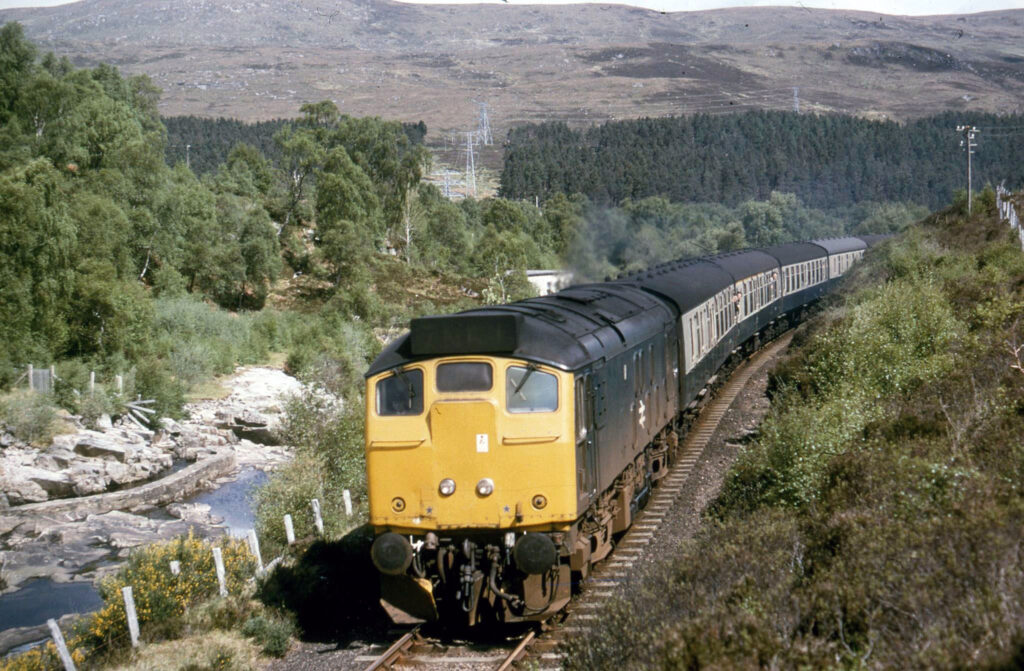
The design was considered largely successful, though some issues emerged early on. Crews criticised the cab layout for being poorly arranged and draughty, while maintenance staff found servicing difficult due to the positioning of some mechanical components.
Between the cabs, the body structure used aluminium framing with a glass-fibre roof. Gangway connections were fitted to allow staff to access train-heating equipment in coupled locomotives while on the move, but this was later judged to be unnecessary complexity and the gangways were plated over. Even before the first batch entered service, British Railways had identified a need for more locomotives of this type. A further ten were ordered in 1957 for the Eastern Region (D5020–D5029), although they were ultimately allocated to the London Midland Region.
The Class 24s were equipped with the “Blue Star” electro-pneumatic multiple-working system from new, permitting up to three locomotives to be driven from a single cab, a requirement originally specified by the British Transport Commission and already common practice in the United States. The operational requirement covered remote control of engine start/stop, power and speed regulation, reversing, braking, protective interlocks and fault indication.
The initial loan of locomotives to the Southern Region revealed early route-availability concerns. With an operational weight of 77–79 tonnes for the early Class 24/0s, giving a Route Availability of 6, their five-ton excess weight over Southern limits required the removal of boilers and associated fittings to permit use on Kent Coast traffic. Even then, route restrictions remained, and most work was freight, particularly in winter when the lack of steam-heating made passenger use impractical. Once the Southern Region’s own Type 3 fleet entered service, the boilers were reinstated, and the Class 24s worked in multiple with the BRCW locomotives under common Blue Star multiple-working controls.
The bogies were fabricated as welded box-frame structures with outside frames and coil springs for both axlebox and bolster suspension, complemented by anti-slip braking equipment that proved valuable on steep and sharply curved lines such as the Highland and Cambrian routes. Early production included evaluation of axlebox suppliers: ten of the first locomotives used Athermos plain-bearing boxes, while the other ten used SKF roller bearings.
Production expanded significantly in 1958, with an order for 84 locomotives spread across the Eastern, North Eastern, London Midland, and Scottish Regions, followed by a final batch of 37 in 1959. These later locomotives were constructed not only at Derby but also at Crewe and Darlington, accelerating delivery to support steam withdrawal on lightly-laid routes.
The Class 24 body structure employed a trussed girder framework for strength with low weight, a key factor in their suitability for the Highlands and the Cambrian system. With Route Availability 6 and a maximum speed of 75mph, they were well-suited to secondary passenger and mixed-traffic work on restricted routes. However, the original low-mounted bodyside air-intake grilles proved prone to ingesting dust and brake debris, a flaw that later caused accelerated cylinder wear, particularly in Scottish service.
Internally, the locomotives were divided into three compartments: the number one end carried the radiator and cooler group, the centre held the engine, generator, compressor and traction-motor blowers, and the number two end housed the steam-heating boiler unless replaced by additional air-compressor equipment (as on locomotives D5102–D5111). Self-draining radiators aided frost protection in cold climates.
With a relatively low axle loading and a reputation for versatility, the Class 24s were allocated across the Midland, North Eastern, and Scottish Regions, where they worked a mix of passenger and freight duties. Though not the most powerful of diesel designs, their light axle loading made them well-suited to restricted routes, helping to replace steam in areas where weight limitations were a concern. However, their career was relatively short-lived, as newer and more powerful locomotives, such as the Class 25s and Class 26s, gradually replaced them from the early 1970s onwards.
Electrical equipment varied within the class: the first fifty locomotives (D5000–D5049) were equipped with British Thomson-Houston (BTH) generators, specifically BTH RTB15656 main generators with BTH RTB7440 auxiliary generators, while others employed slightly revised systems to improve reliability. Four axle-hung, nose-suspended traction motors were permanently connected in parallel, using BTH 137BY motors, with early Class 24s rated at 843hp (629kW) at rail. Gear ratios of 16:81 gave a top speed of 75mph, sufficient for secondary passenger and freight duties typical of their operating territory.
Most Class 24s were equipped with Stone OK 4616 or OK 4610 steam-heating boilers, enabling them to work passenger trains in addition to their freight duties. However, as electric train heating (ETH) became more common, many of the boilers were later removed or decommissioned. Where no boiler was fitted, concrete ballast was installed to maintain even axle loading. Notably, locomotives D5102–D5111 were built without train heating equipment, as the space was needed for air compressors operating the Consett iron ore trains. These locomotives were visually identifiable by an additional air delivery pipe on the buffer beam for the wagon discharge system, and normally worked in pairs in Blue Star multiple.
While generally reliable, Class 24s did suffer liner leakage, turbocharger jacket cracking and fuel starvation caused by clogged filters. Early locomotives showed vibration-related issues where aluminium body panels transmitted resonance from the engine, and underframe damage after heavy buffer impacts indicated structural weakness in accident conditions. Over time, corrosion developed particularly around cab floors and the bodyside sections between the cabs, with water ingress and vibration accelerating deterioration on locomotives allocated to Scotland.
Under the TOPS classification system, the Class 24 fleet was divided into two subclasses, Class 24/0 and Class 24/1, reflecting incremental development during production rather than any fundamental redesign. The split broadly separated the early Derby-built locomotives from later examples constructed after experience had been gained in service.
The Class 24/0 subclass comprised locomotives D5000–D5049, later numbered 24001–24049 under TOPS. Built at Derby between 1958 and 1959, these were the first production examples and embodied British Railways’ initial standard Sulzer Type 2 design. They had an operational weight of 77–79 tonnes, giving Route Availability 6, and were fitted with Stone OK 4616 or OK 4610 steam-heating boilers from new. Externally, they were characterised by disc-and-lamp headcode arrangements, droplight cab-side windows, and gangway doors at both ends, features reflecting contemporary thinking during the early years of dieselisation. In service, they proved capable but revealed several shortcomings, including a draughty cab environment, awkward access for maintenance in certain areas, and vulnerability to dust ingestion through the low-mounted bodyside air-intake grilles.
The Class 24/1 subclass covered locomotives D5050–D5150, later numbered 24050–24150, and represented a progressive refinement of the original design. Built between 1959 and 1961 at Derby, Crewe and Darlington, these locomotives incorporated a series of detail changes informed by early operational experience. Their most significant difference was a reduced operational weight of 71–73 tonnes, improving their suitability for lightly laid routes while retaining Route Availability 6. External features evolved during production rather than changing uniformly across the subclass, and headcode boxes were introduced only on the later-built locomotives, beginning with the Scottish Inverness batch from D5114. Locomotives intended for Scottish service were also built with a recess on the driver’s cab side to allow for the later fitting of tablet-catching equipment, reflecting their anticipated use on single-line routes worked by the electric train token system.
Most Class 24/1 locomotives retained steam-heating boilers, but a small sub-group, D5102–D5111, was constructed without train-heating equipment. In these locomotives, the boiler space was occupied by additional air-compressor equipment for working the Consett iron ore trains, and they were visually identifiable by an extra air delivery pipe on the buffer beam. Despite this specialised role, they remained part of the Class 24/1 subclass under TOPS.
Although the distinction between Class 24/0 and 24/1 is sometimes overstated, the differences were sufficient to influence route availability, regional deployment and later modification programmes, particularly in Scotland and on other weight-restricted lines.
Class 24s in Scotland
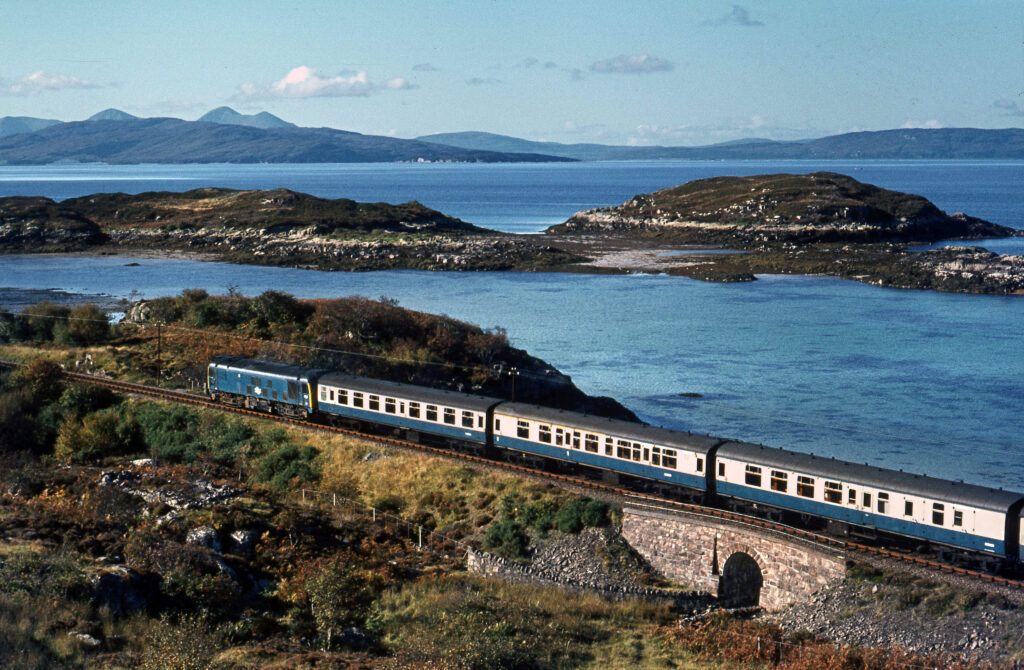
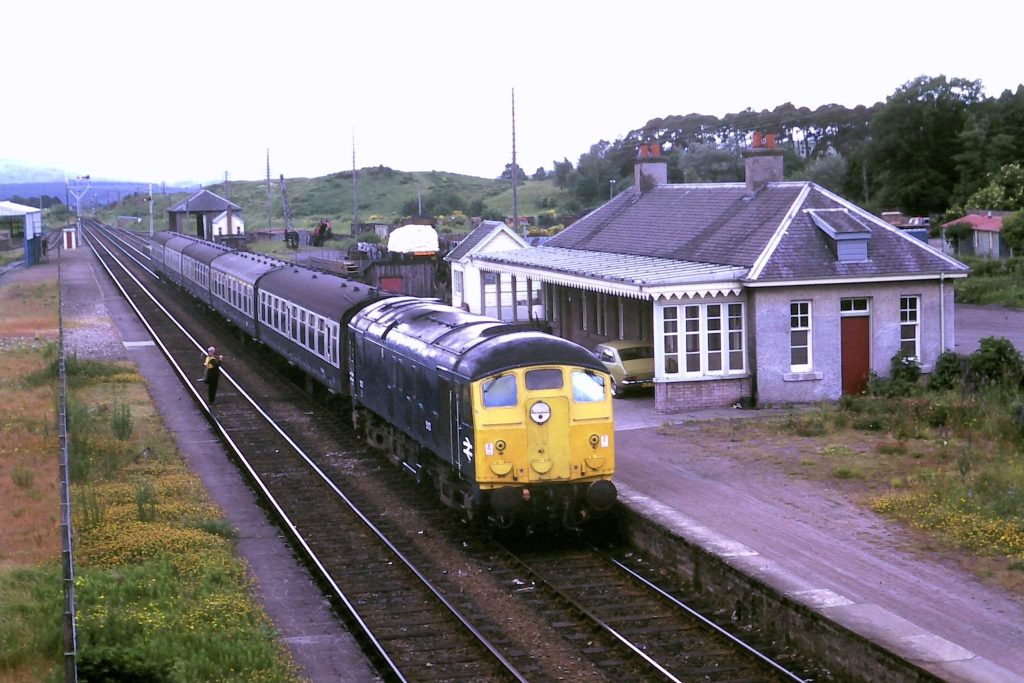
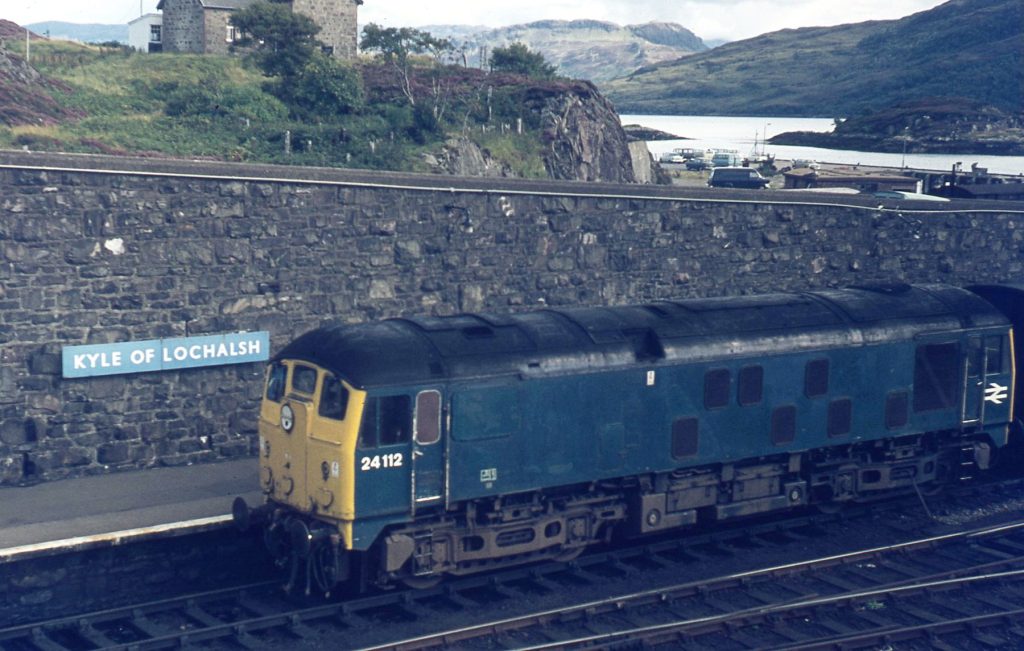
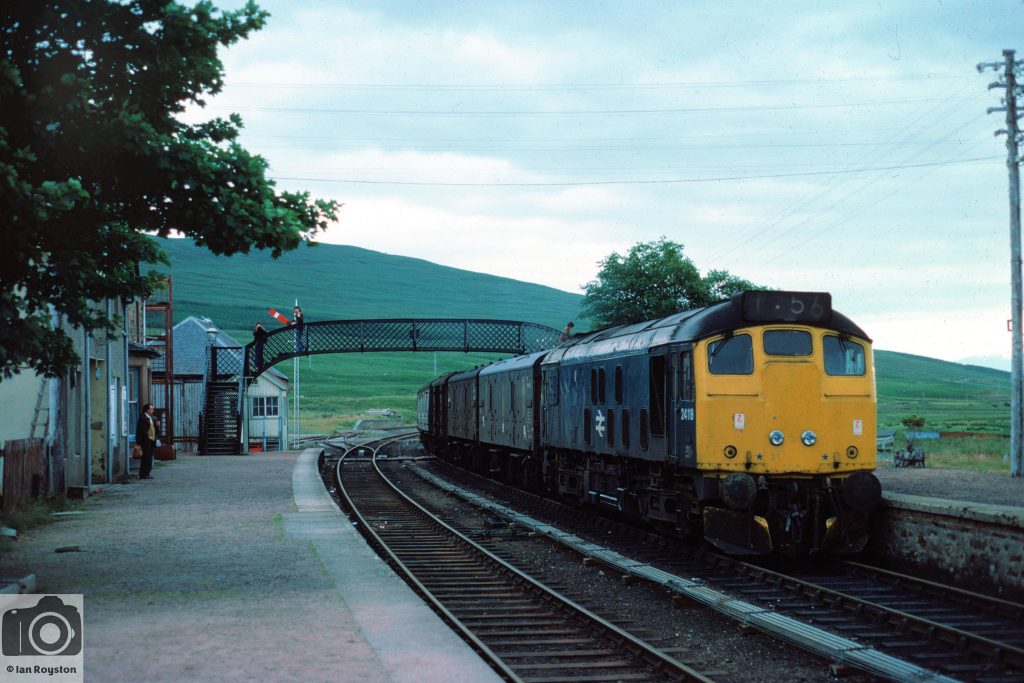
Inverness was the first Scottish depot to receive Class 24s, with nineteen locomotives (D5114–D5132) delivered directly from Derby Works between April and September 1960. These locomotives played a crucial role in displacing steam in the Highlands, working alongside Birmingham Railway Carriage & Wagon (BRCW) Type 2s (later Class 26) and English Electric Type 1s (Class 20). Their relatively light weight and high route availability made them well-suited to the challenging single-line routes of the Far North, Kyle of Lochalsh, and West Highland lines.

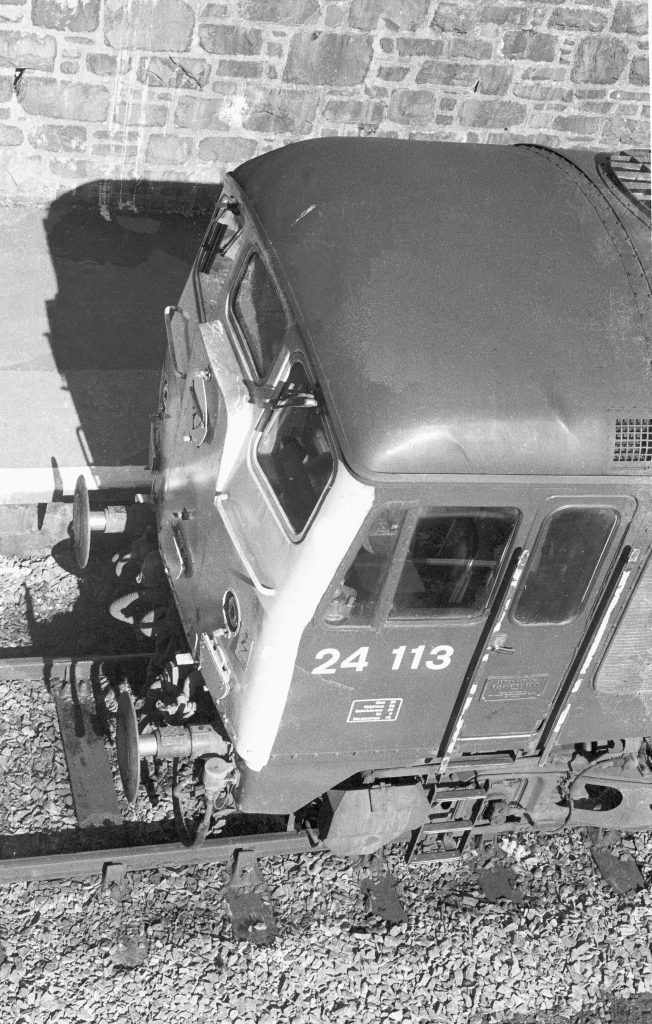
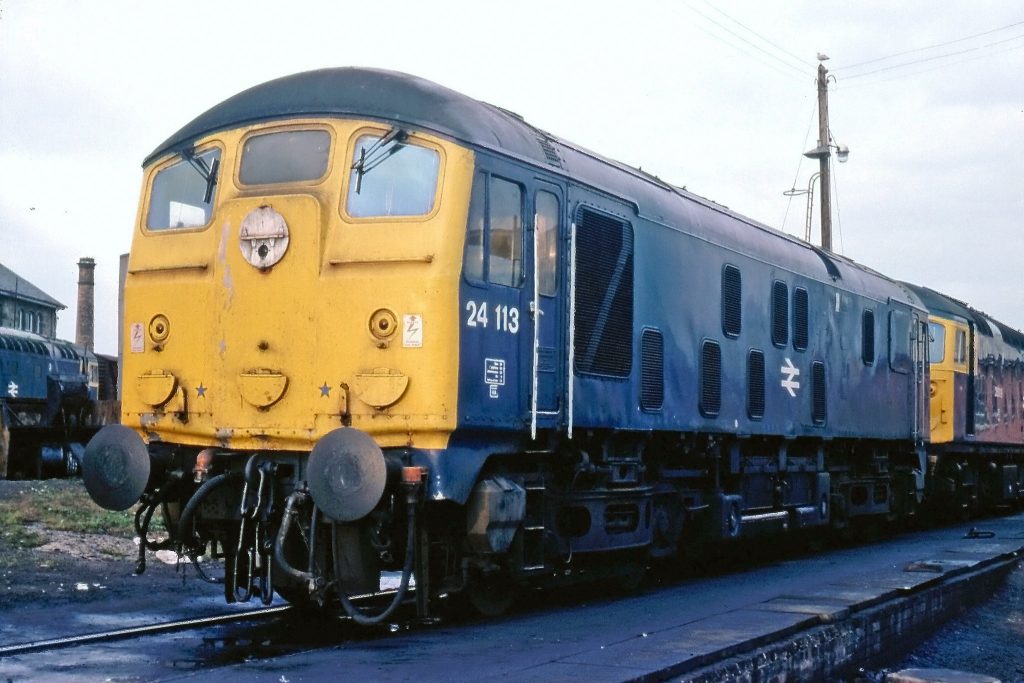
This batch introduced the first major design variation within the class. By 1960, British Rail had abandoned the older disc-and-lamp train identification system, prompting a redesigned cab front. The Inverness locomotives were the first to feature this new arrangement, with a neater, more streamlined front-end appearance. A housing above the cab enclosed the four-digit alphanumeric headcode displays, and the locomotives retained gangway doors, a feature that would later be removed or plated over. Another notable design change was the provision of an external recess on the driver’s cab side, allowing for later installation of tablet-catching equipment. This was a key adaptation for Highland operations, where single-track routes relied on the electric train token system. Though the recesses were incorporated at the factory, the equipment itself was not fitted until later at St Rollox Works in Glasgow in October 1960. The droplight cab-side window was also replaced with a sliding version on the driver’s side. However, the tablet catchers were rarely used and were mostly removed by the late 1960s, with only D5116 and D5117, still in BR blue livery, still so fitted.
Despite their usefulness, the Class 24s were not as well regarded in Scotland as their BRCW-built counterparts, the Class 26s and 27s. Maintenance teams identified a critical issue: engine-room contamination caused by the low-mounted air-intake grilles led to excessive cylinder wear. This contrasted with the more robust BRCW designs, which had their grilles positioned at cant-rail height. The harsh Highland climate also prompted further modifications, particularly around the steam-heating boiler compartment, which was prone to freezing. To improve airflow and reduce the risk of ice build-up, the Inverness batch received distinctive blanking plates with five vertical ventilation slats. This feature was unique to the Scottish-allocated locomotives.
In January 1965, it was announced that many of the Inverness locomotives would be fitted with twin sealed-beam headlights to improve visibility, especially on the numerous unprotected level crossings across the region. These lights were mounted centrally on the cab-front connecting doors and were fitted to all except D5114 and D5131. The headlights were later removed as the class approached withdrawal, with square plates installed over the resulting recesses.
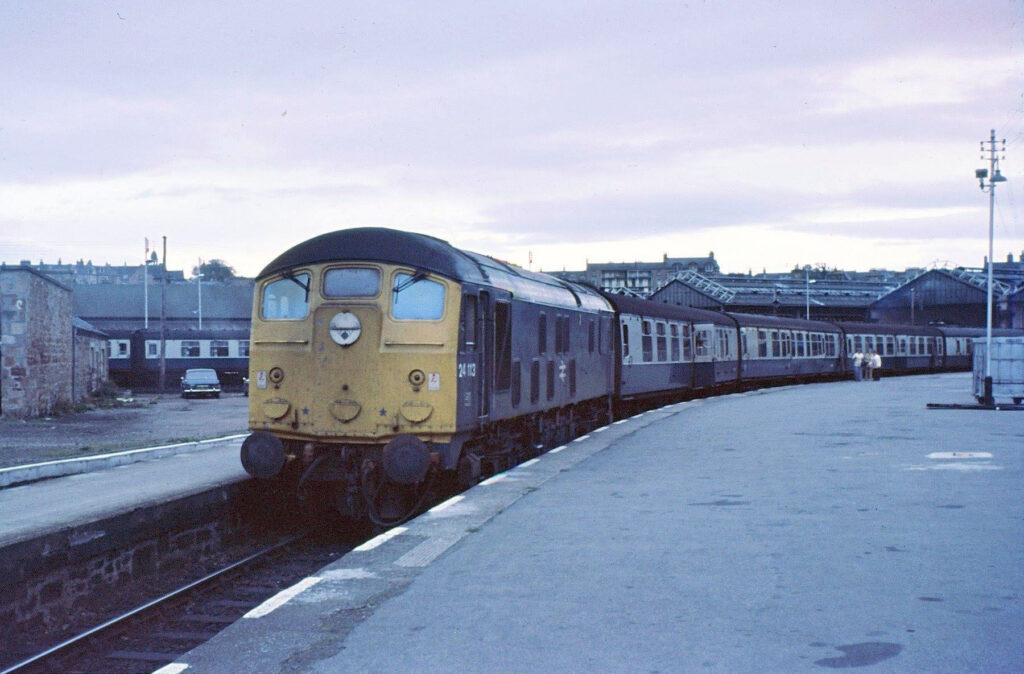
As these locomotives aged, additional modifications were made. The rarely used cab front connecting doors were partially sealed with strips of metal from around 1966, and by the early 1970s, the front ends were completely re-skinned, removing any trace of the door outline. This modification was seen on several locomotives while they were still in green livery, though no examples of green-painted Class 24s with fully flush ends have been recorded.
Despite their early importance, the Class 24s had a relatively short career in Scotland. By the mid-1970s, they were being displaced by more powerful and reliable locomotives, such as the Class 26s and Class 37s.
By 1980, the last Scottish Class 24s had been withdrawn, marking the end of their contribution to Highland rail operations. Despite their brief tenure, they played a vital role in modernising railway services in northern Scotland, helping to replace steam and reshape the region’s transport infrastructure.
On the Cambrian
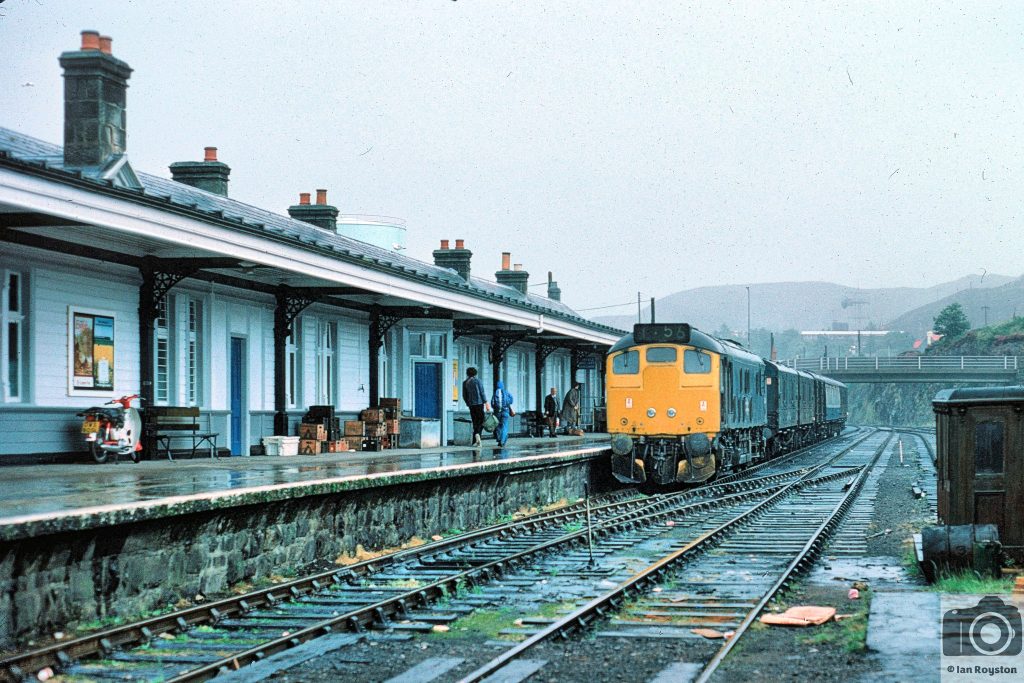
The Cambrian network became one of the final strongholds of the Class 24s. Their light axle-loading made them ideal for the sharply curved and weight-restricted former Cambrian Railways routes radiating from Shrewsbury toward Aberystwyth and Pwllheli. Throughout the 1960s and 1970s, they dominated traction west of Sutton Bridge Junction, becoming closely identified with the scenic Mid-Wales lines.
Passenger duties included long-distance trains from the Midlands and local stopping services, often handling heavy summer Saturday traffic to the coast.
Even as Class 25s became the dominant Western Region Type 2, Class 24s could still be found on Cambrian metals into 1980, significantly outlasting their Scottish counterparts and securing their reputation as the ‘Cambrian Type 2’.
Conclusion
By the late 1960s and early 1970s, the role of the Class 24s had begun to decline. The Beeching closures had significantly reduced the need for locomotives on secondary passenger and freight duties, while wagonload freight, once a staple of the class, was also in decline. Accidents took their toll, with 14 locomotives withdrawn before they could even receive their TOPS numbers in the early 1970s.
In Scotland, the closure of the Waverley Route in 1969 and the completion of Glasgow’s electrification schemes left many of the remaining Class 24s surplus to requirements. The remaining examples were gradually transferred to the London Midland Region, marking the end of their Scottish allocation.
The number in service continued to dwindle throughout the 1970s. By 1976, just ten remained, all based at Crewe. A handful saw alternative uses, 24061 was transferred to British Rail’s Research Department at Derby, while 24042 and 24142 were converted into static train pre-heating units on the Western Region.
The final operational example, 24081, became something of a celebrity in its final years. It soldiered on until 1980, when it was finally withdrawn, marking the end of Class 24s on the main line.
Although the Class 24s had their shortcomings, they were ultimately a successful design, fulfilling their intended purpose well. Their withdrawal was due more to the changing railway landscape than any fundamental flaw.
Preservation
Despite their relatively short service life, four Class 24s survived into preservation. Fittingly, 24081, the last to remain in service, was exhibited by BR at Steampower in Southport. After failing there with flat batteries, it was preserved rather than scrapped. It spent time at the Llangollen Railway and is now based at the Gloucestershire Warwickshire Railway.
D5054 (24054) has been fully restored to operational condition at the East Lancashire Railway, where it is a regular performer on weekend passenger services. It remains one of the best-preserved examples of the class, frequently hauling heritage services.
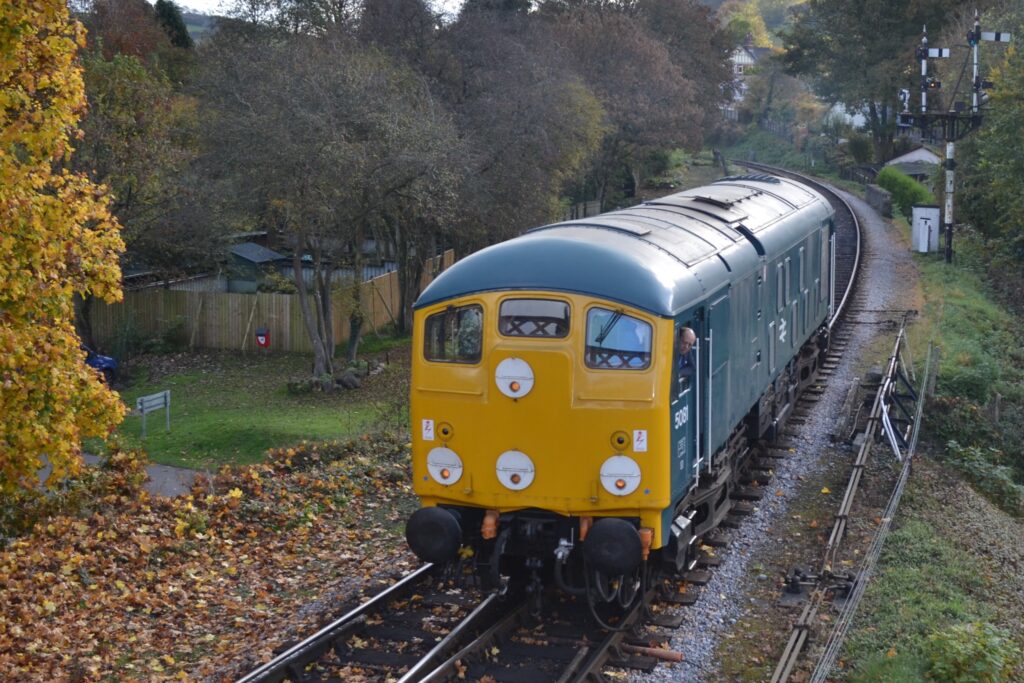
Two others reside at the North Yorkshire Moors Railway but are currently non-operational: D5061 (formerly 24061, which had spent its later years with BR’s Research Department) and D5032, now named ‘Helen Turner.’ D5032 was initially sold for scrap to TJ Thomson in 1976 but was instead loaned to the NYMR, where it has remained ever since, amassing over 100,000 miles in preservation.
Although the Class 24s had their shortcomings, they were a well-engineered and functional design that served British Rail effectively. Their withdrawal came not due to mechanical failings but because of changing operational needs. The four surviving locomotives have now been in private hands for longer than they were in mainline service. Thanks to the dedication of heritage railways and preservation groups, these early diesels continue to be appreciated, ensuring they will be enjoyed by future generations for years to come.
Modelling
- Unknown BR Green Achnaseen – https://colourrail.co.uk/api/image/medium/ed955f37-849a-4689-b196-8a27a9ca984b
- D5059 – (Strathcarron – green on a cattle train).??
D5112, 5122- D5113, 5113, 24113
D5114, 5114- D5115, 5115, 24115 (Kyle, Garve)
https://colourrail.co.uk/api/image/medium/6ea5772b-47f0-45d3-89d9-08946dc64117
https://colourrail.co.uk/api/image/medium/2ec0a521-46f1-4dfd-bb10-4273e9b23263
https://colourrail.co.uk/api/image/medium/7f8c77e3-c08e-41bb-8946-5dcfd5f3caba - D5116, 5116, 24116
- D5117, 5117, 24117 (K)
https://www.derbysulzers.com/24117.html
https://colourrail.co.uk/api/image/medium/dd6deea9-8dd1-4695-9bc5-15fec0b4fee1 - D5118, 5118, 24118 (K)
https://www.derbysulzers.com/24118.html
https://colourrail.co.uk/api/image/medium/2ec0a521-46f1-4dfd-bb10-4273e9b23263
https://colourrail.co.uk/api/image/medium/d22f5ac1-7307-42bb-a525-09397460aa93 - D5119, 5119, 24119
- D5120, 5120, 24120
- D5121, 5121, 24121
D5122, 5122- D5123, 5123,24123 (Kyle, Achnasheen)
https://colourrail.co.uk/api/image/medium/4d2059e3-21ed-4135-be2e-0da1943b1a16
https://colourrail.co.uk/api/image/medium/3b3019b2-f18c-4471-b886-2c20e1550a5c
https://colourrail.co.uk/api/image/medium/e4f962fa-8d60-461f-b9a3-693b34b84d65 - D5124, 5124, 24124 (K)
https://colourrail.co.uk/api/image/medium/1d6ac420-c697-45d5-8fa5-dd486db83693
https://colourrail.co.uk/api/image/medium/a8ec290b-0e75-4957-a7ec-3d25abce935f - D5125, 5125, 24125 Kyle
https://colourrail.co.uk/api/image/medium/77a1af4b-15ce-4106-ad1c-29ce727b1d67 - D5126, 5126, 24126 (Garve, Kyle)
https://colourrail.co.uk/api/image/medium/e1e4acaa-ef48-4562-980f-760dea09fdc0 - D5127, 5127, 24127
- D5128, 5128, 24128
- D5129, 5129, 24129
- D5130, 5130, 24130 (K)
https://colourrail.co.uk/api/image/medium/17e5069b-5f14-40bf-91bc-8dfd9d788da7
https://colourrail.co.uk/api/image/medium/a8ec290b-0e75-4957-a7ec-3d25abce935f - D5131, 5131, 24131
- D5132, 5132, 24132
Farish released in December 2009.
- Graham Farish 372-976 – Class 24/0 D5013, BR Green with Late Crest
- Graham Farish 372-976A – Class 24/0 D5031, BR Green
- Graham Farish 370-062 (Suburban Sulzer Train Set) – Class 24/0 D5033, BR Green
- Graham Farish 372-977 – Class 24/0 D5038, BR Two-Tone Green with Late Crest
- Graham Farish 372-979A – Class 24/1 D5053, BR Two-Tone Green – Weathered

- Graham Farish 370-065 – Class 24/1 D5072, BR Two-Tone Green, DCC Fitted (Split from Set)
- Graham Farish 372-979 – Class 24/1 D5085, BR Two-Tone Green
- Graham Farish 372-981 – Class 24/1 D5100, BR Green – Weathered
- Graham Farish 372-975 – Class 24/0 24035, BR Blue with Yellow Ends
- Graham Farish 372-975A – Class 24/1 24064, BR Blue with Yellow Ends

- Graham Farish 372-978 – Class 24/1 24081, BR Blue with Yellow Ends
- c – Class 24/1 24077 from set
Graham Farish 372-975Z – Class 24 97201, BR RTC Blue & Red Livery – Limited Edition for ModelzoneGraham Farish 372-980 – Class 24 97201 “Experiment”, BR RTC Red & Blue – Weathered
24113
https://www.derbysulzers.com/24113.html
24118
DCC Sound Installation
esu v5 nx18 with legomanbiffo’s sound file with a 9 x 25 sugar cube
Reduce default brightness from 255 to 15 for a more realistic effect.
Tail Light Modification
If tail lights cannot be switched off separately, place a small piece of electrical tape over the contact inside the bodyshell to disable them.
Coupling & Weathering
Dapol non-automatic knuckle couplers can be fitted for improved operation.
Weathering and detailing can enhance the locomotive’s realism.
Conclusion
This process enables a quick and effective conversion of a Farish Class 24 (or similar) to 2mm finescale using Association drop-in wheelsets. The original wheels remain intact for future reinstallation, and the model can be operational almost immediately.
Legomanbiffo Function List
- F0 – Directional Light
- F1 – Engine On/Off – CV259 = 228 CV419 = 150
- F2 – Playable High-Note Horn – CV435 = 228
- F3 – Playable Low-Note Horn – CV443 = 228
- F4 – Buffering Up (if moving) / Coupling Hook (if stationary) – CV282 = 190
- F5 – Brake Application (if moving) / Brake Dump (if stationary) – CV291 = 150
- F6 – Driver’s Door Slam – CV299 = 228
- F7 – Compressor – CV303 = 150
- F8 – Drive Hold (Locks motor drive to simulate a heavy load while using the throttle)
- F9 – Variable-Speed Flange/Wheel Squeal CV323 = 228
- F10 – Despatch Whistle – CV331 = 200
- F11 – Not in use
- F12 – Roof Fan / Cooler Group – CV347 = 210
- F13 – Sanders – CV355 = 130
- F14 – Vacuum Exhauster – CV363 = 228
- F15 – Spirax Valves – CV315 = 228
- F16 – Disposal Air Dump – CV379 = 128
- F17 – Not in use –
- F18 – Track Detonators (Speed-dependent, three-bang stop) – CV395 = 128
- F19 – Directional Cab Lights – CV427 = 228
- F20 – Directional Tail Lights On/Off –
- F21 – Battery Isolation Switch -CV451 = 128
Selectable Horn Sets
High Horn Set A – CV155 = 0
High Horn Set B – CV155 = 1
Low Horn Set A – CV156 = 0
Low Horn Set B – CV156 = 1
Selectable Compressor Sets
Single Compressor – CV157 = 0
Double Compressor – CV157 = 1
Conversion to 2mm Finescale
Modern N gauge locomotives can be converted to 2mm Finescale standards quickly using 2mm Scale Association drop-in wheelsets. This avoids the delay of sending wheels away for turning and allows the loco to be run almost immediately. Original Farish wheelsets can be stored and reused later or returned to N gauge specification for resale.
Tools and Materials Required
- Small screwdriver
- Microbrushes
- Isopropyl alcohol
- Tweezers (optional)
- 4 x 2mm Scale Association 3-308 Farish Drop In Wheelsets (7.5mm Wheel: 16t Geared Axle)
Step-by-Step Conversion
- Running in the Locomotive
Run the locomotive as per the manufacturer’s instructions before making modifications. - Removing the Bogie Sideframes
Use a small screwdriver to gently lever up the mounting lug at the rear of each sideframe. The sideframes will unclip easily. - Clean the Wheels
Clean the wheel treads and rear faces using isopropyl alcohol and a microbrush to remove contaminants. - Replacing the Wheelsets
Remove the existing wheelsets by carefully prising them out. Insert the new drop-in wheelsets, ensuring they are seated correctly. - Adjust the Pickups
Ensure the electrical pickups make firm contact with the rear of each wheel. If necessary, carefully adjust the pickup arms to improve contact. - Reattaching the Sideframes
Clip the bogie sideframes back into place securely. Confirm that the wheelsets rotate freely and are not fouling the frames. - Final running-in
Run the locomotive at low to moderate power for at least 20 minutes in each direction. This allows the new wheels and gear mesh to settle in and improves smoothness.
Detailing
Etched Pixels DET34: Class 24 Detailing Etch (was £2.50)
Detailing/updating parts for the Graham Farish by Bachmann class 24/0. The etch contains the following. Replacement roof grille and fan, fold-up headcode boxes for 24/1 and 25/0 conversions, early round exhaust grille, alternate battery box doors, Inverness slatted steam boiler grilles, nose door lights (early high intensity lighting), plates for bodyside steps.
Cab Ends and Headcode Area
- Plate over central end doors.
- Convert to plated-door version with seam retained where applicable.
- Fit full headcode box.
- Fit sealed beam headlights (in plated door or box).
- Slim down moulded headcode discs.
- Add disc catches.
- Plate over redundant top marker lights.
- Add extra nose pipework (steam heat, vacuum, air as required).
- Add token/tab tablet catcher recess.
- Fit tablet catcher arm on Scottish variants.
- Fit finer replacement nose handrails.
Roof and Fan
- Remove moulded roof grille.
- Replace with etched 3D fan grille.
- Fit visible multi-layer fan beneath grille.
Bodysides
- Plate over bodyside footsteps.
- Modify or replace bodyside grilles to match prototype.
- Replace or reposition bodyside access doors.
- Fit etched worksplates.
Bogies and Running Gear
- Add speedometer cable to appropriate bogie.
- Remove bogie ladder where not applicable.
Underframe and Tanks
- Shorten water tanks as per subclass.
- Add extra fuel fillers/caps where visible.
- Relocate existing fuel cap when wrong for chosen locomotive.
- Add gauges and pipe detail around tank area.
- Replace boiler grille blanking plate with correct pattern.
Buffer Beam and Coupling Area
- Add full pipe / screw coupling detail at one or both ends.
- Maintain semi-detailed beam at the coupling end if operationally required.
- Fit snowploughs on Scottish or winter-equipped examples.
Cab Interior
- Fit driver figure.
- Fit secondman figure where desired.
More Information
- Clarke, David. Diesels In Depth – Classes 24/25. Ian Allan Publishing, 2006.
- Derrick, Kevin. Looking Back at Class 24 & 25 Locomotives. Amberley Publishing, 2016.
- Donnelly, Andrew. “A Rat’s Tale.” Modern Railway Modelling, no. 6, Spring 2006, pp. 14-19.
- Green-Hughes, Evan. “BR’s First Sulzer Type 2s.” Hornby Magazine, no. 172, Oct. 2021, pp.94-97.
- Ian’s N Gauge. “129 – Maintenance – DCC Fitting – Graham Farish Class 24.” YouTube, 10 Oct. 2024, https://www.youtube.com/watch?v=fjcCU-ZwHNo.
- Mallott, David. “Kylestrome’s 2mm Workbench.” RMweb, 2019, https://www.rmweb.co.uk/topic/149013-kylestrome%E2%80%99s-2mm-workbench/
- Matcham, Pete. “24124… And Down to Business…” RMweb, 9 Oct. 2019, https://www.rmweb.co.uk/blogs/entry/19088-24124and-down-to-business/
- Modern Locomotives Illustrated: Class 24 & 25. No. 177, June–July 2009, TheRailwayCentre.com
- Tayler, A.T.H. BR Locomotives: 2 – Sulzer Types 2 and 3. Ian Allan Ltd., 1984.
- Whitehouse, Alan. “Fine Scale in Time for the Queen’s Speech.” The 2mm Magazine, Apr./May 2010, pp. 29-30.