The GP38 was EMD’s answer to railroads that wanted a reliable, straightforward machine without the complexity of a turbocharged engine. Powered by a 2,000-horsepower normally aspirated 16-645 prime mover, it shared the looks of the GP40 but was designed for economy and ease of maintenance. It proved an instant hit, particularly with smaller and medium-sized roads, and the improved GP38-2 of 1972 extended the design’s legacy for decades.
Bangor and Aroostook
The Bangor & Aroostook’s GP38 fleet began with two new EMD units in 1966, followed by further new locomotives in 1967. In the 1980s, the roster was expanded with second-hand GP38s from Conrail/PRSL and Missouri Pacific, many of which were renumbered into the 350-series.
In the summer of 1984, BAR 90 and 92 were hired by the Maine Central, with a restriction that they couldn’t run west of Rigby, Portland.
| No. | Model | Built | Order | Serial | Origin / Later Number | Notes |
|---|---|---|---|---|---|---|
| 81 | GP38 | Feb 1966 | 7858 | 31213 | Renumbered 361 | One of BAR’s first two GP38s. |
| 82 | GP38 | Feb 1966 | 7858 | 31214 | Renumbered 358 | Tested on Maine Central in June 1966. |
| 83 | GP38 | Mar 1967 | 7980 | 33050 | Renumbered 357 | Part of BAR’s second GP38 group. |
| 84 | GP38 | Mar 1967 | 7980 | 33051 | Renumbered 365 | Later sold to WAMX. |
| 85 | GP38 | Mar 1967 | 5726 | 33052 | Renumbered 350 | Later sold to WAMX. |
| 86 | GP38 | Sep 1967 | 5734 | 33199 | Renumbered 352 | Later GP38M 352; subsequently WAMX 3829. |
| 87 | GP38 | Sep 1967 | 7059 | 33200 | Renumbered 359 | Original BAR GP38. |
| 88 | GP38 | Sep 1967 | 7059 | 33201 | Renumbered 360 | Original BAR GP38. |
| 90 | GP38 | Dec 1967 | 7076 | 33799 | Ex-PRSL / Conrail; renumbered 354 | Purchased by BAR in 1983. |
| 91 | GP38 | Dec 1967 | 7076 | 33800 | Ex-PRSL / Penn Central / Conrail; renumbered 362 | Later to MWLX and SLRS. |
| 92 | GP38 | Dec 1967 | 7076 | 33801 | Ex-PRSL / Conrail; renumbered 355 | Purchased by BAR in 1983; later sold to WAMX. |
| 93 | GP38 | 1969 | 7154 | 34752 | Ex-PRSL / Conrail; renumbered 353 | Purchased by BAR in 1983. |
| 94 | GP38 | 1969 | 7154 | 34753 | Ex-PRSL / Conrail; renumbered 366 | Purchased by BAR in 1983; later sold to WAMX. |
| 95 | GP38 | 1967 | 7938 | 32672 | Ex-Missouri Pacific; renumbered 363 | Used locomotive acquired by BAR. |
| 96 | GP38 | 1967 | 7938 | 32496 | Ex-Missouri Pacific; renumbered 356 | Used locomotive acquired by BAR. |
| 97 | GP38 | 1969 | 7999 | 33174 | Ex-Missouri Pacific; renumbered 364 | Used locomotive acquired by BAR. |
| 98 | GP38 | 1969 | — | — | Ex-Missouri Pacific; renumbered 351 | Used locomotive acquired by BAR. |
Maine Central

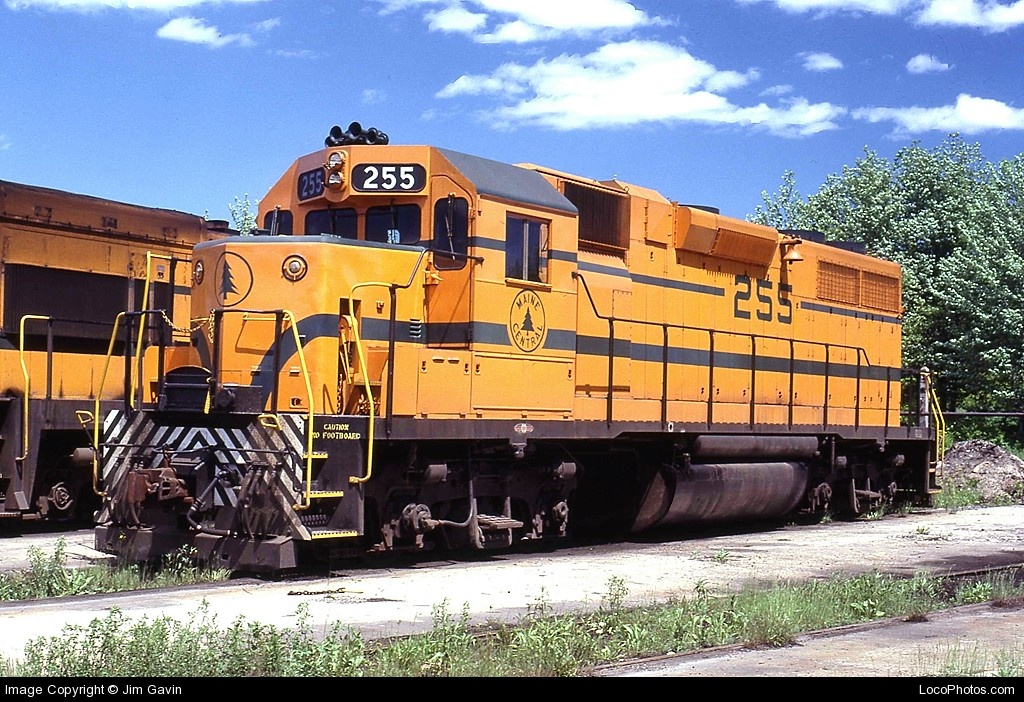
The Bangor & Aroostook was among the GP38’s earliest customers, taking delivery of a pair in March 1966. The Maine Central paid close attention. Its fleet of F3s was nearing the end of usefulness, and that summer the BAR’s new units — nos. 81 and 82 — were tested on MEC rails. From 11–22 June they logged more than 2,000 miles between Vanceboro and St Johnsbury, including work on the Calais and Rumford branches.
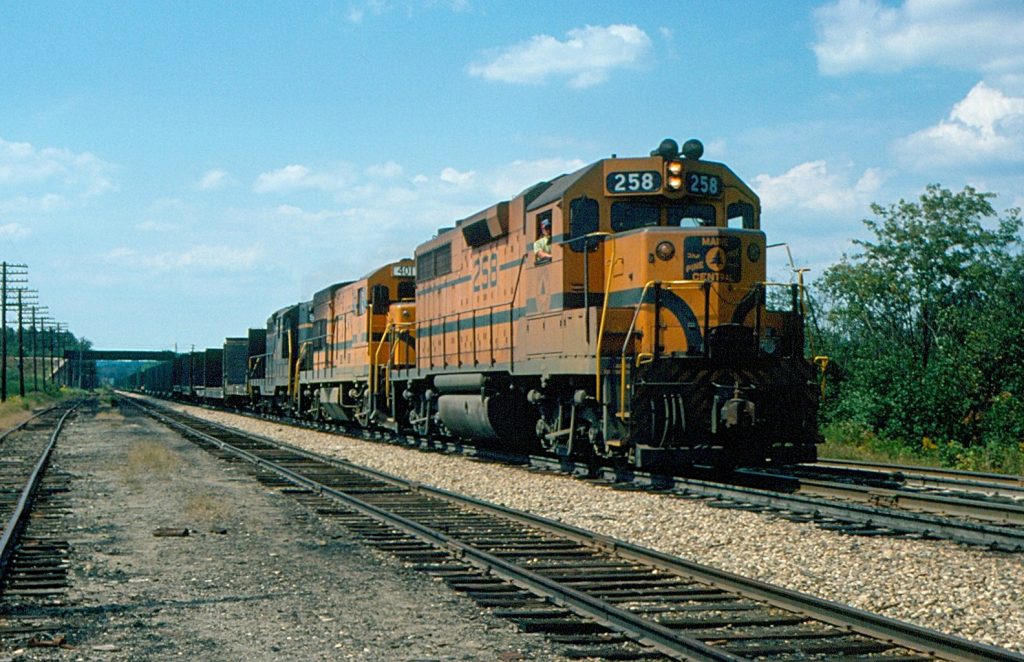
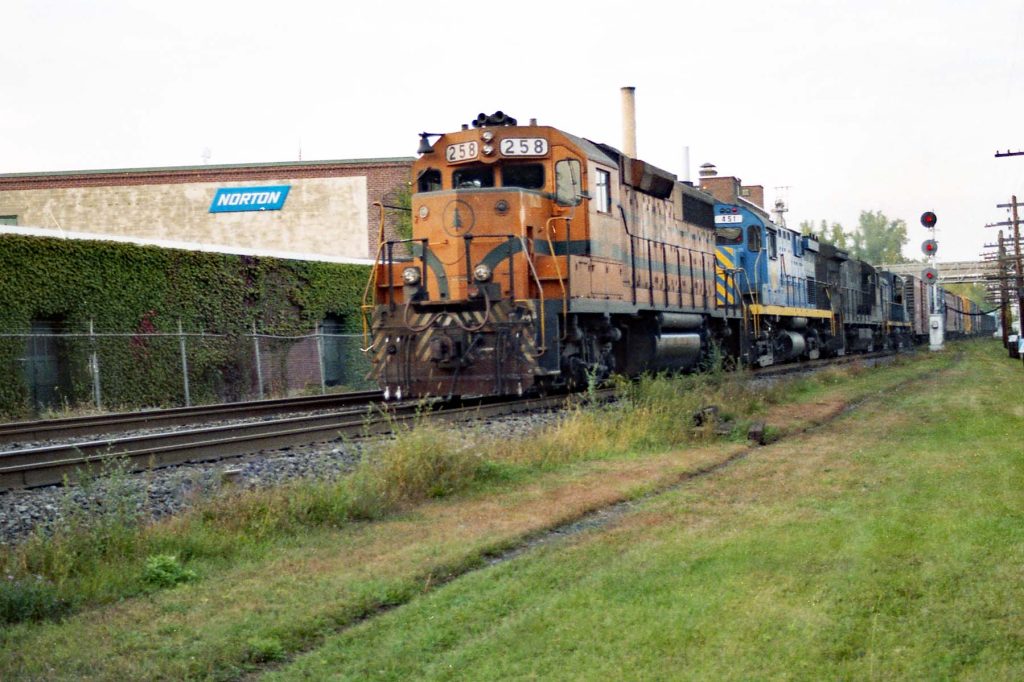
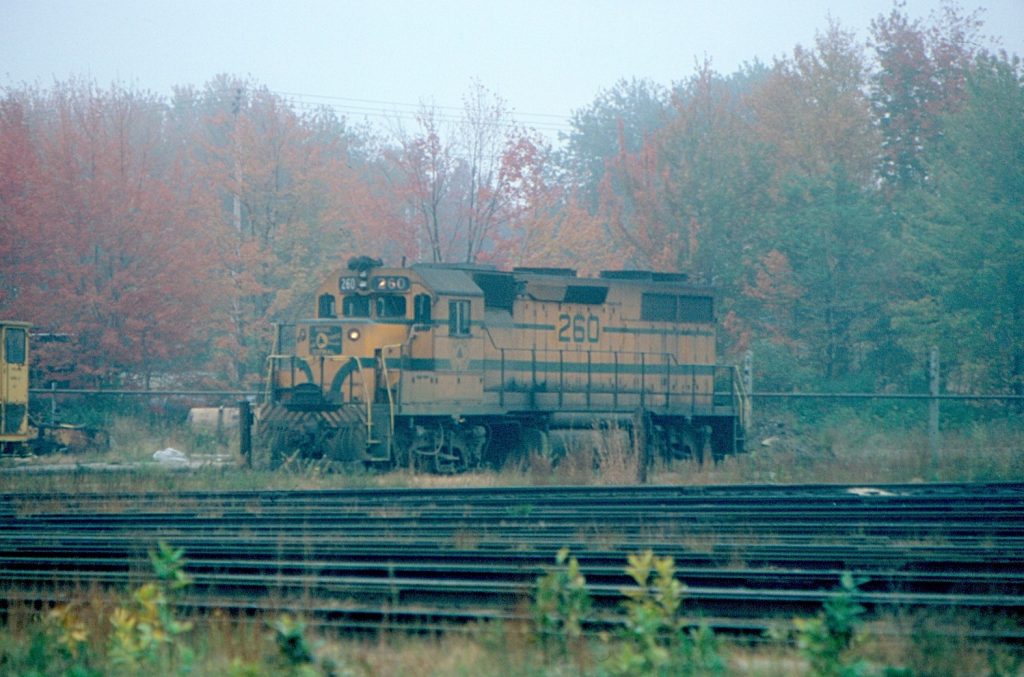
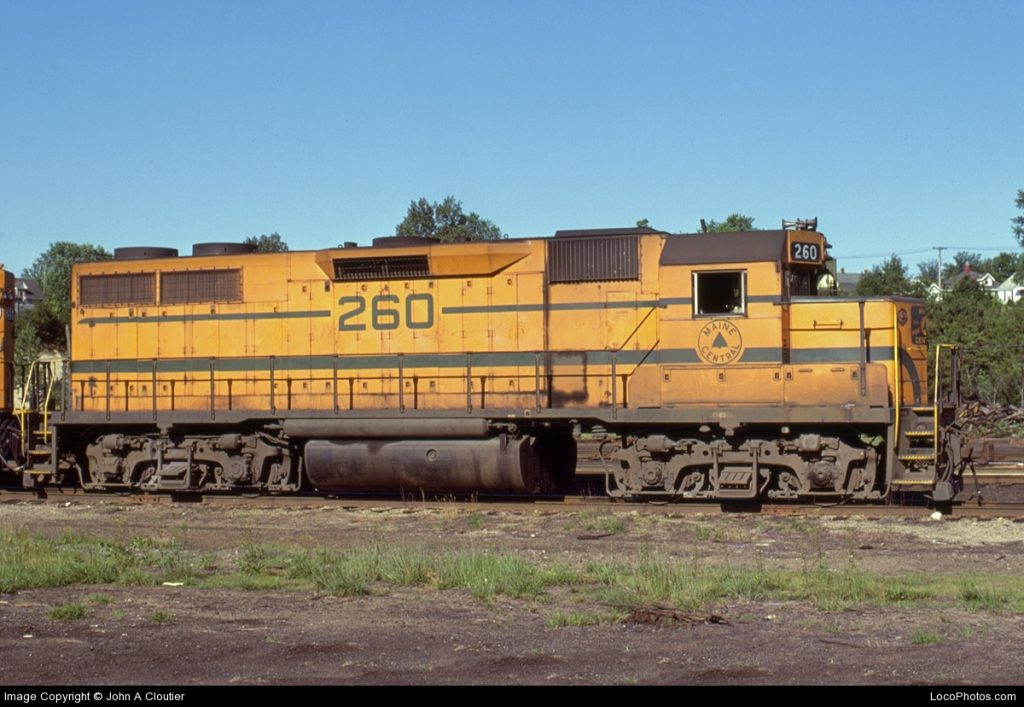
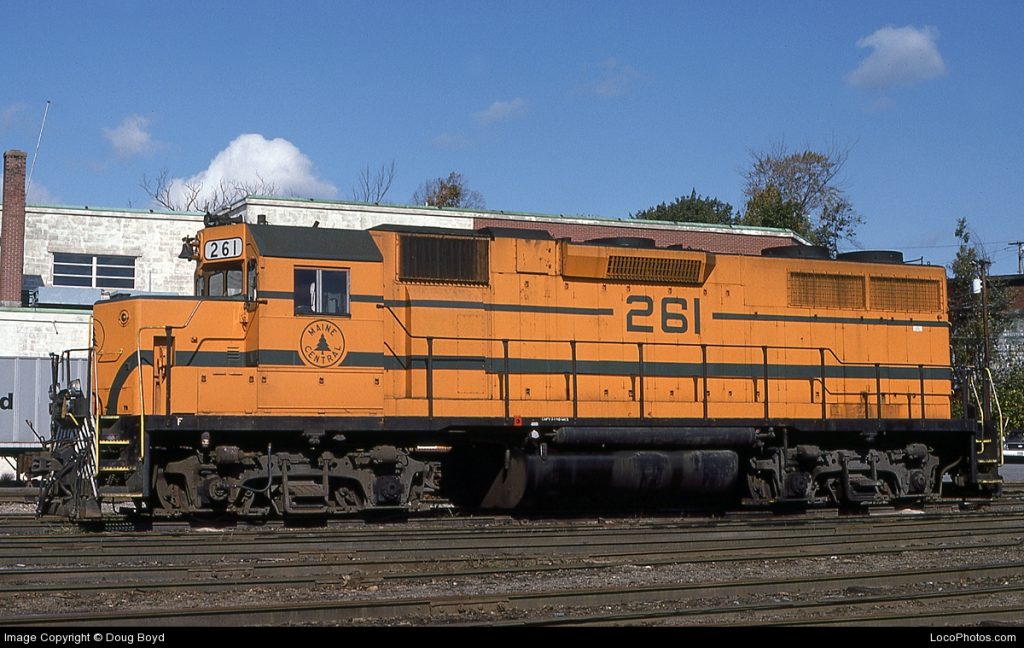
The results were convincing. In August 1966 the MEC placed its largest diesel order to date: twelve GP38s with dynamic brakes. Delivered in November and December via Canadian Pacific at St Johnsbury, they ushered in the “Harvest Gold” era and marked a break from the maroon and gold years. These locomotives became the everyday power of the late 1960s and 1970s, pushing the F-units into trade-in status.
Although many of the class soldiered on into the Guilford years, a fair number never wore anything but Harvest Gold. A handful lasted in service until the late 1980s, while others were sold or rebuilt. One, no. 257, even became a GP38-2 in Union Pacific service before moving on again to leasing companies and finally to Canada.








| No. | Type | Built | Serial | Liveries | Notes | Photographs | Modelling |
|---|---|---|---|---|---|---|---|
| 251 | GP38 | Nov 1966 | 32660 | Harvest Gold until at least Mar 1983. Guilford Grey by Apr 1984. | RRPA | ||
| 252 | GP38 | Nov 1966 | 32661 | Harvest Gold at least Sep 1984. Guilford Grey by Oct 1984. | RRPA | ||
| 253 | GP38 | Nov 1966 | 32662 | Harvest Gold until at least December 1988. Never carried Guilford Grey? | RRPA | ||
| 254 | GP38 | Nov 1966 | 32663 | Harvest Gold. Never carried Guilford Grey? | RRPA | ||
| 255 | GP38 | Nov 1966 | 32664 | Harvest Gold. Never carried Guilford Grey? | To HELM Financial; to CLP 203 | RRPA | |
| 256 | GP38 | Nov 1966 | 32665 | Harvest Gold. Never carried Guilford Grey? | RRPA | ||
| 257 | GP38 | Nov 1966 | 32666 | Harvest Gold. Never carried Guilford Grey. | To CDOT 257; to Locomotive Leasing Partners in 1998; rebuilt 13th May 1998 by VMV to GP38-2 as UP 2382; to UP 882 on 20 Jul 2001; to GMTX 2101 on 22 Jun 2006; to CCGX 4205 in Oct 2016. | RRPA | |
| 258 | GP38 | Nov 1966 | 32667 | Harvest Gold until at least May 1989. Guilford Grey by Mar 1991. | RRPA | ||
| 259 | GP38 | Nov 1966 | 32668 | Harvest Gold. Never carried Guilford Grey? | RRPA | ||
| 260 | GP38 | Nov 1966 | 32669 | Harvest Gold. Never carried Guilford Grey? | Fire damage Jul 1985; retired Jul 1990, scrapped. | RRPA | |
| 261 | GP38 | Nov 1966 | 32670 | Harvest Gold. Never carried Guilford Grey? | To BM 261; scrapped. | RRPA | |
| 262 | GP38 | Nov 1966 | 32671 | Harvest Gold. Never carried Guilford Grey? | RRPA | ||
| 263 | GP38 | Sep 1967 | 33280 | Harvest Gold until at least Sep 1984. Guilford Grey by May 1989 | To HLCX 263; to HLCX 3617; to YVRR 3617; to CALA 3617; to SSRX 3617. | RRPA |
Temp… (I have at least one GP38).
| Livery | Manufacturer | Standard | DCC | Released |
|---|---|---|---|---|
| Harvest Gold / Green “Circle Herald” | Atlas | 48926 | 48988 | May 2007 |
| Harvest Gold / Green | Atlas | 48920 | 48984 | April 2005 |
| Harvest Gold / Green “Circle Herald” | Atlas | 48927 | 48989 | May 2007 |
| Harvest Gold / Green | Atlas | 48921 | 48985 | April 2005 |
| Harvest Gold / Green | Atlas | 48908 | 48976 | March 2002 |
| Harvest Gold / Green | Atlas | 48909 | 48977 | March 2002 |
| Harvest Gold / Green | Atlas | 48910 | – | March 2002 |
| Harvest Gold / Green | Atlas | 48910 | – | April 2005 |
| Harvest Gold / Green “Circle Herald” | Atlas | 48928 | – | May 2007 |
Conway Scenic
| No. | Built | Serial | Liveries | Notes | Photographs | Modelling |
|---|---|---|---|---|---|---|
| 252 | RRPA | |||||
| 255 | RRPA |
Allagash Railway
The Allagash placed its first order for GP38s in 1967, part of the company’s move to standardise on four-axle EMD power. Delivered in Spruce Green with Deluxe Gold lettering, they replaced early road-switchers on heavy freights and spread quickly across the system. Reliable and straightforward to maintain, the GP38s became the road’s default power through the 1970s, supplementing the dwindling cab units and covering everything from manifest freights to branch turns.
Most of the class stayed in green throughout their careers, though a handful received simplified repaints in the late 1970s. When newer GP40s arrived in the early 1980s the GP38s were bumped from premier assignments, but many remained in secondary service until the mid-1990s. Several were sold into lease fleets or shortline service, ensuring that Allagash GP38s continued to wander North America long after their home-road careers had ended.
| No. | Built | Serial | Name | Livery | Notes | Photographs |
|---|---|---|---|---|---|---|
| 401 | Nov 1967 | 32672 | — | Spruce Green with Deluxe Gold | Delivered new; worked system-wide. Later sold to LLPX, rebuilt as GP38-2. | RRPA |
| 402 | Nov 1967 | 32673 | — | Spruce Green with Deluxe Gold | One of the most photographed Allagash Geeps; repainted simplified green in 1979. | RRPA |
| 403 | Nov 1967 | 32674 | — | Spruce Green with Deluxe Gold | Standard unit; sold mid-1980s to Helm Leasing. | RRPA |
| 404 | Nov 1967 | 32675 | — | Spruce Green with Deluxe Gold | Wore fresh green repaint in 1978; later scrapped after fire damage in 1991. | RRPA |
| 405 | Nov 1967 | 32676 | — | Spruce Green with Deluxe Gold | Kept original paint until retirement in 1987; preserved on a tourist line. | RRPA |
| 406 | Nov 1967 | 32677 | — | Spruce Green with Deluxe Gold | Repainted simplified scheme in 1978; sold to short line in the South, still active in the 2000s. | RRPA |
| 407 | Nov 1967 | 32678 | — | Spruce Green with Deluxe Gold | Often paired with 401 on heavy freights; retired 1990. | RRPA |
| 408 | Nov 1967 | 32679 | — | Spruce Green with Deluxe Gold | Repainted in 1980; last Allagash GP38 in service, retired 1995. | RRPA |
Allagash Railway
The Allagash placed its first order for GP38s in 1967, part of a deliberate move to standardise on four-axle EMD power. Numbered in the 200 series, the first to arrive were 202 and 203, followed in 1968 by dynamic-brake-equipped 204. Finished in Spruce Green with Deluxe Gold lettering, they immediately displaced older road-switchers and cab units on heavy freights across the system. More F-units were traded away in 1969 when 208–212 joined the roster, completing what was then the railroad’s largest single diesel investment.
The gap in numbering was the result of a cancelled Alco order: slots 205–207 had been reserved for additional C420s before Alco’s collapse. They were eventually filled by MLW M420s in 1973, making the Allagash, alongside Providence & Worcester, one of only two American railroads to buy new power from Montreal Locomotive Works. Through the 1970s the 200-class GP38s became the railroad’s default power, handling everything from bridge manifests to branch turns and providing the reliable, easy-to-maintain backbone the system needed.
| No. | Built | Livery | Notes | Photographs |
|---|---|---|---|---|
| 202 | Nov 1967 | Spruce Green with Deluxe Gold | First GP38 delivered. Traded from F-units. | |
| 203 | Nov 1967 | Spruce Green with Deluxe Gold | Part of initial 1967 order. | |
| 204 | Jan 1968 | Spruce Green with Deluxe Gold | Only GP38 delivered with dynamic brakes. | |
| 208 | Sep 1969 | Spruce Green with Deluxe Gold | Delivered after Alco order was cancelled. F-units traded in. | |
| 209 | Sep 1969 | Spruce Green with Deluxe Gold | Part of second GP38 batch. | |
| 210 | Sep 1969 | Spruce Green with Deluxe Gold | Part of second GP38 batch. | |
| 211 | Sep 1969 | Spruce Green with Deluxe Gold | Part of second GP38 batch. | |
| 212 | Sep 1969 | Spruce Green with Deluxe Gold | Part of second GP38 batch. Later repainted in simplified green. |
Modelling
- Atlas EMD GP38
- Highball Graphics LN-232 Conway Scenic Yellowbird GP38 & GP35
- Spookshow Atlas EMD GP38
More Information
- Melvin, George F. Maine Central in Color Volume 3. Morning Sun Books, 2008, pp.12,32.
- Robertson, E. B. Maine Central Diesel Locomotives. Edwin B. Robertson, 1978, pp. 12-17.
Epilogue
The GP38s were the turning point for the Maine Central. They marked the road’s commitment to second-generation diesels and defined its look for nearly two decades. While some fell victim to fire, wrecks, or corporate reshuffling, many never lost their original Harvest Gold identity. Others, like 257, wandered far from New England and survived into the 21st century in rebuilt form. In their prime they were the road’s workhorses, equally at home on hot freights or local turns, and they remain among the most recognisable locomotives to wear the Pine Tree herald.