St. Johnsbury | Eastbound to Alongside the Moose River ▶
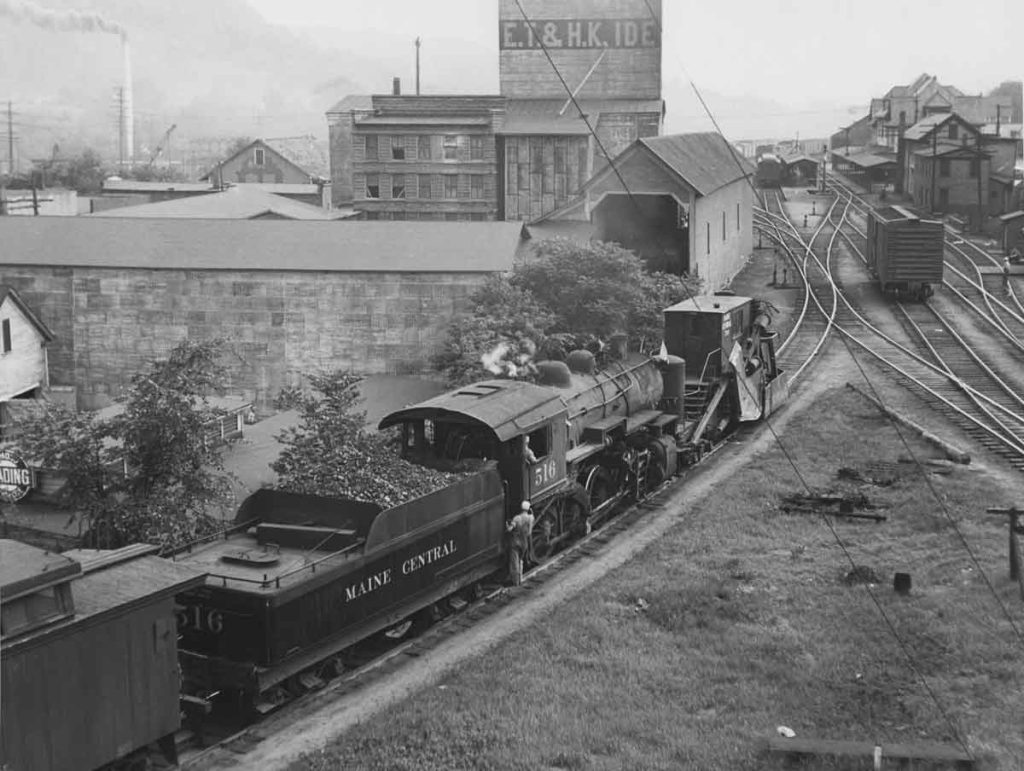 Maine Central 2-8-0 No. 516 approaches St. Johnsbury, Vermont, in September 1947, working in an unusual formation between a Jordan spreader and a caboose. The scene captures the character of a busy New England junction, with industry crowding the right of way and complex trackwork threading through the town. © Philip R. Hastings
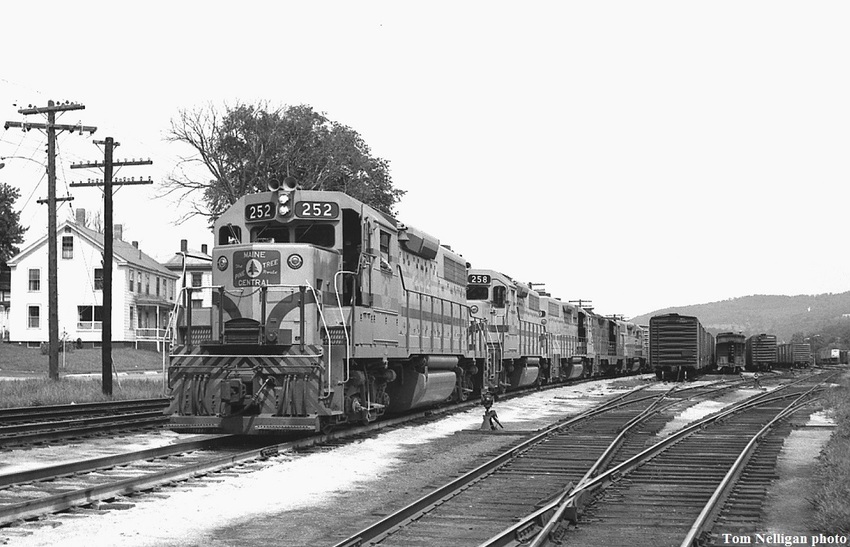 Maine Central RY-2, led by GP38 no. 252 with a mixed lash-up behind, stands at the south end of St. Johnsbury yard on 6 August 1967 after arriving from Rigby Yard, Portland. The road power is about to cut off as the train is handed over for onward classification and interchange, a routine but vital part of Mountain Division operations in this period. © Tom Nelligan
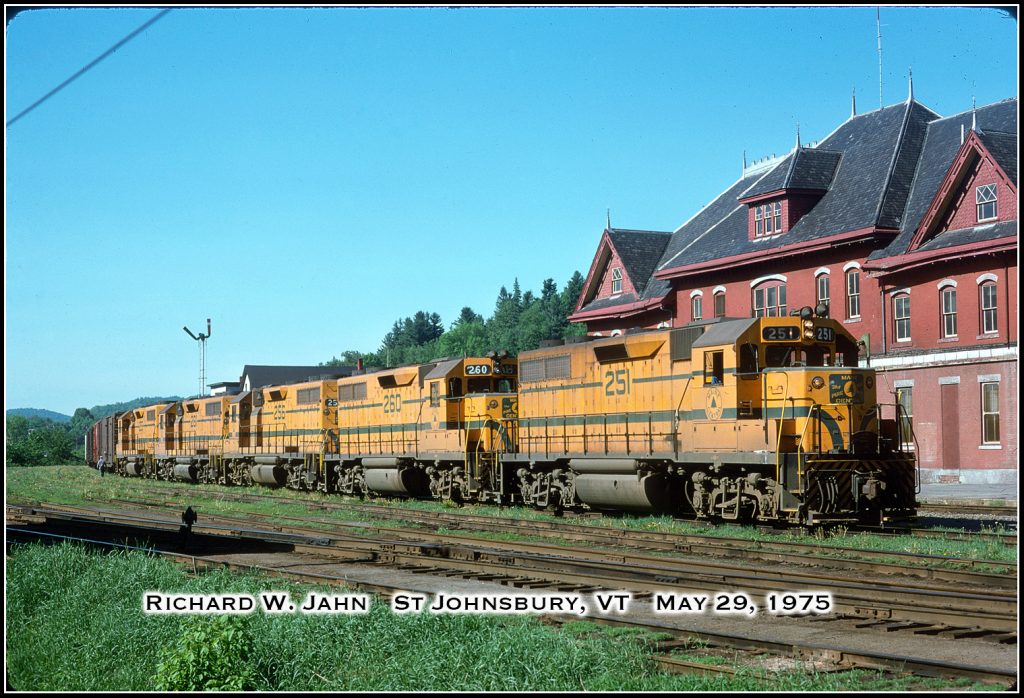 A classic Mountain Division lash-up stands at St. Johnsbury, Vermont, on 29 May 1975, as Maine Central YR-1 prepares for its westbound departure. GP38 no. 257 leads a solid set of road power, including sister units such as no. 260, all in Harvest Gold, before the arrival of the later GE U18B fleet that would soon dominate the line. The train pauses beside the distinctive station building, a familiar scene in the mid-1970s when YR-1 still ran as a regular, heavy road freight over the mountains toward Whitefield, Crawford Notch and onward to Rigby, Portland. © Richard W. Jahn
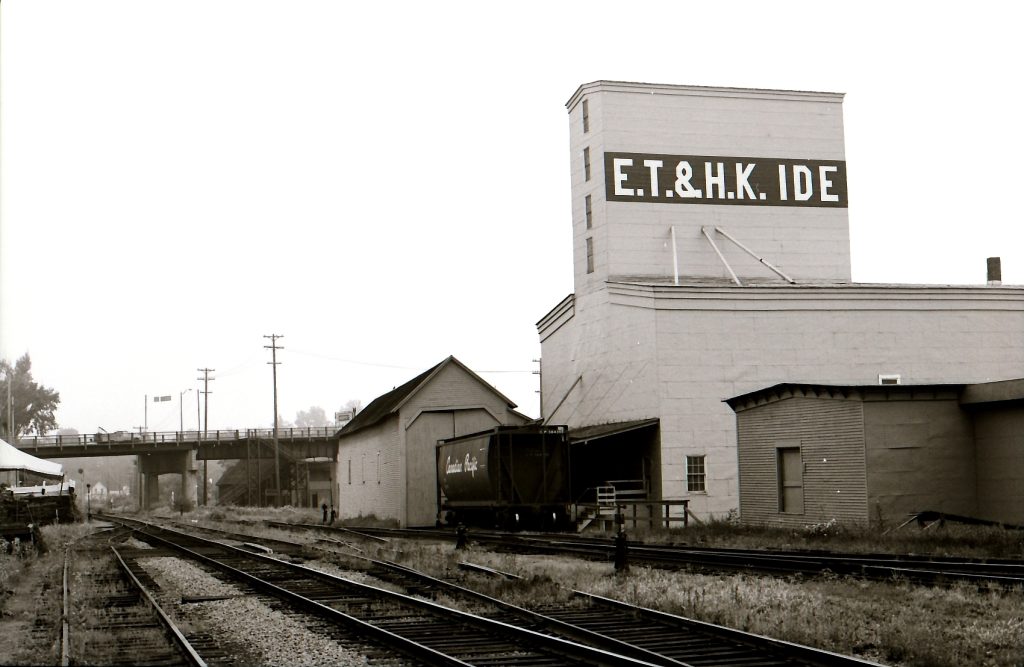 Looking north from the station at St. Johnsbury in July 1975, Canadian Pacific yard tracks spread out beneath the E.T. & H.K. Ide grain elevator. At right, the Maine Central’s Mountain Division diverges under the highway overpass, marking the start of the westward route toward Crawford Notch and Portland. The scene captures the close physical and operational relationship between the CP and MEC at this important interchange point. © Bruce Nelson
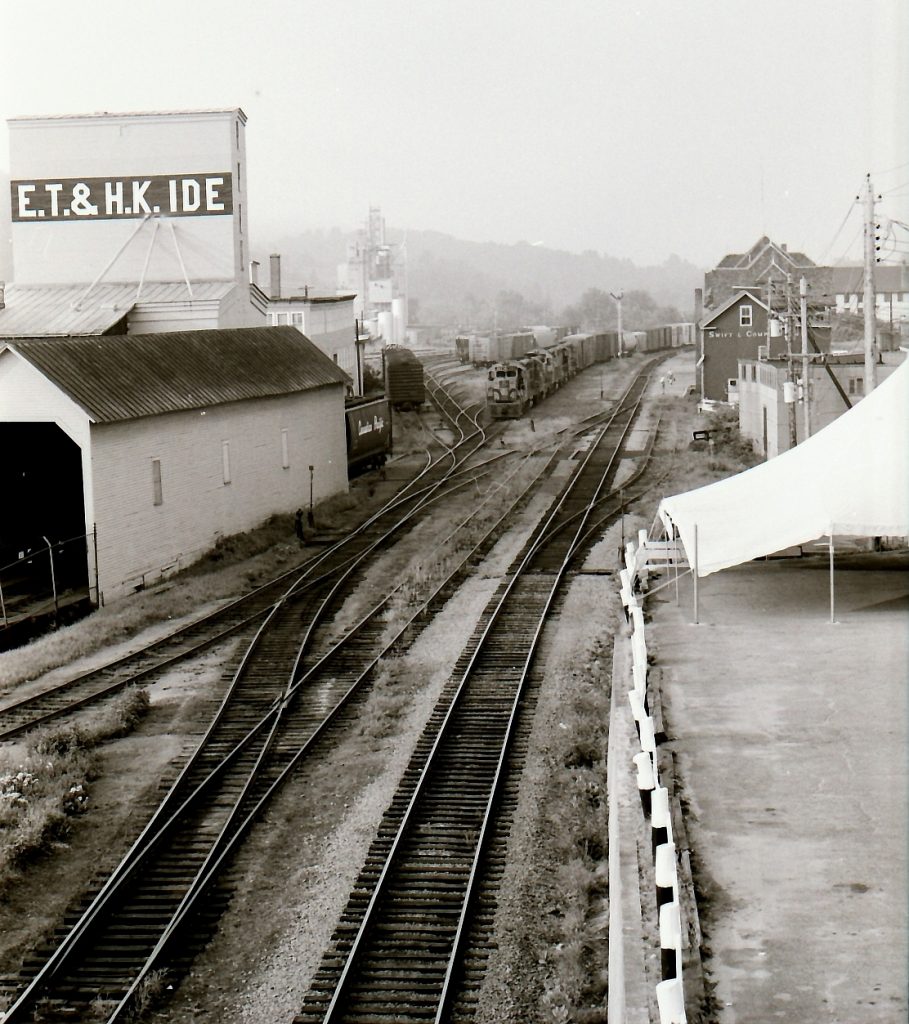 Seen from above the yard at St. Johnsbury in July 1975, Maine Central YR-1 is assembled with a five-unit lash-up of GP38s and a GP7, ready for departure east toward Rigby Yard, Portland. The train occupies the Canadian Pacific yard throat beneath the E.T. & H.K. Ide grain elevator, illustrating the close interchange between the two roads at this busy junction. © Bruce Nelson
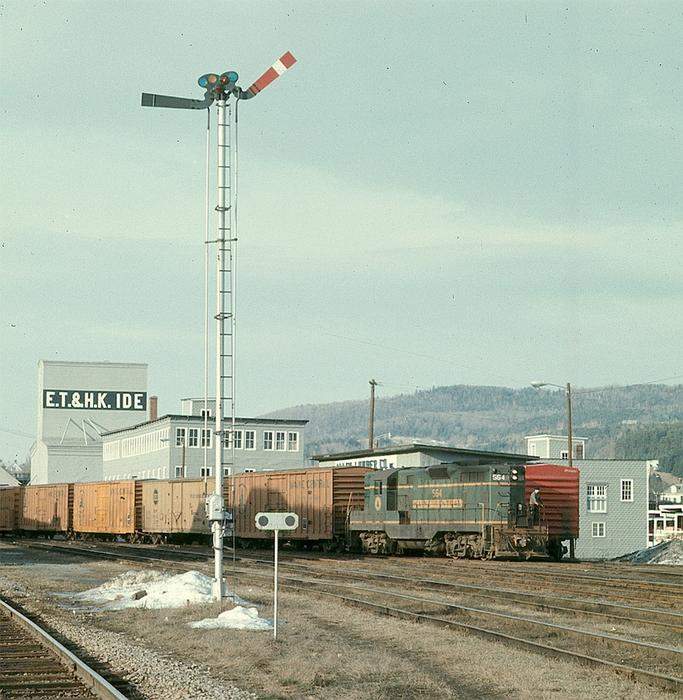 Maine Central GP7 no. 564 works a cut of boxcars at St. Johnsbury in July 1976, passing beneath the distinctive semaphore train order signal. The E.T. & H.K. Ide grain facility rises in the background, a key on-line industry, while the compact yard layout and classic New England setting make the scene feel almost purpose-built for a model railroad. © Brian Nicholson
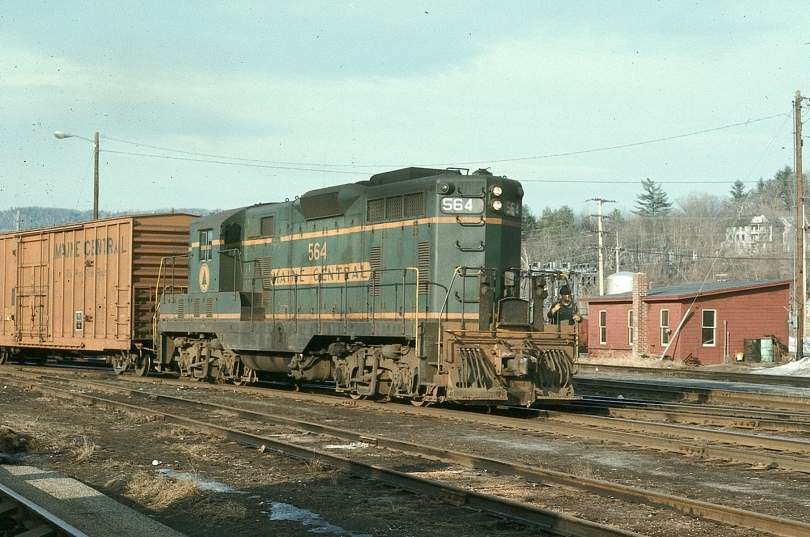 Maine Central GP7 no. 564 shuffles a boxcar through the yard at St. Johnsbury in July 1976. Wearing one of several variations of the green and gold scheme carried by the class in this period, the veteran road-switcher handles local work in a yard that remained busy with interchange traffic. © Brian Nicholson
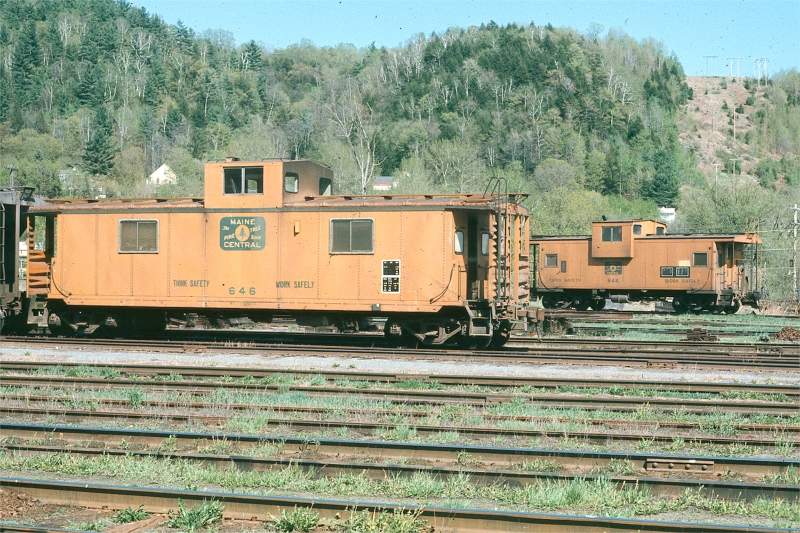 Maine Central caboose no. 646, a converted boxcar, stands alongside an International-built wide-vision caboose in Harvest Gold at St. Johnsbury in May 1975. The pairing neatly captures the transition from older rebuilt equipment to more modern caboose designs in MEC service, set against the busy three-road junction of the CP, MEC and St. Johnsbury & Lamoille County. © Brian Nicholson
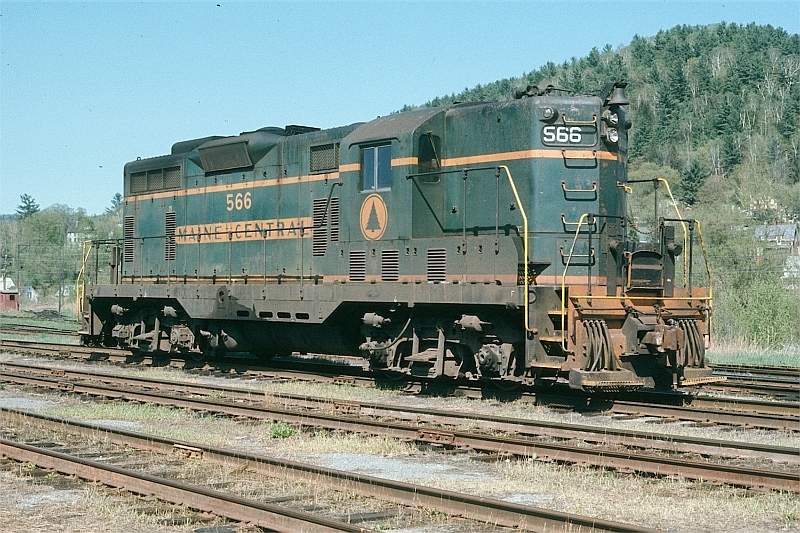 Maine Central GP7 no. 566 stands in the yard at St. Johnsbury in May 1975, wearing the road’s green and gold scheme typical of the era. One of the veteran first-generation road-switchers, it handled local and yard duties at this important junction with Canadian Pacific and the St. Johnsbury & Lamoille County, just a few years before Mountain Division through service came to an end. © Brian Nicholson
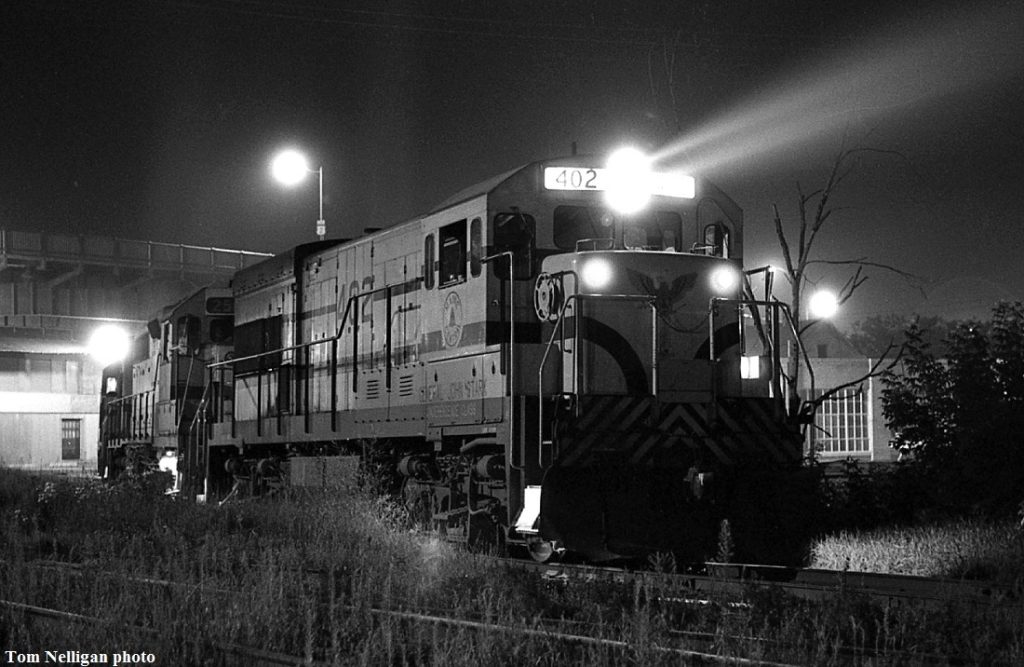 Maine Central RY-2, led by U18B no. 402 General John Stark, pauses on arrival at St. Johnsbury, Vermont, in July 1977 as a brakeman lines the switch for entry into the yard. Headlights flare in the night air, picking out the consist behind and the station area beyond, a quiet end to the westbound run from Rigby over the Mountain Division. © Tom Nelligan
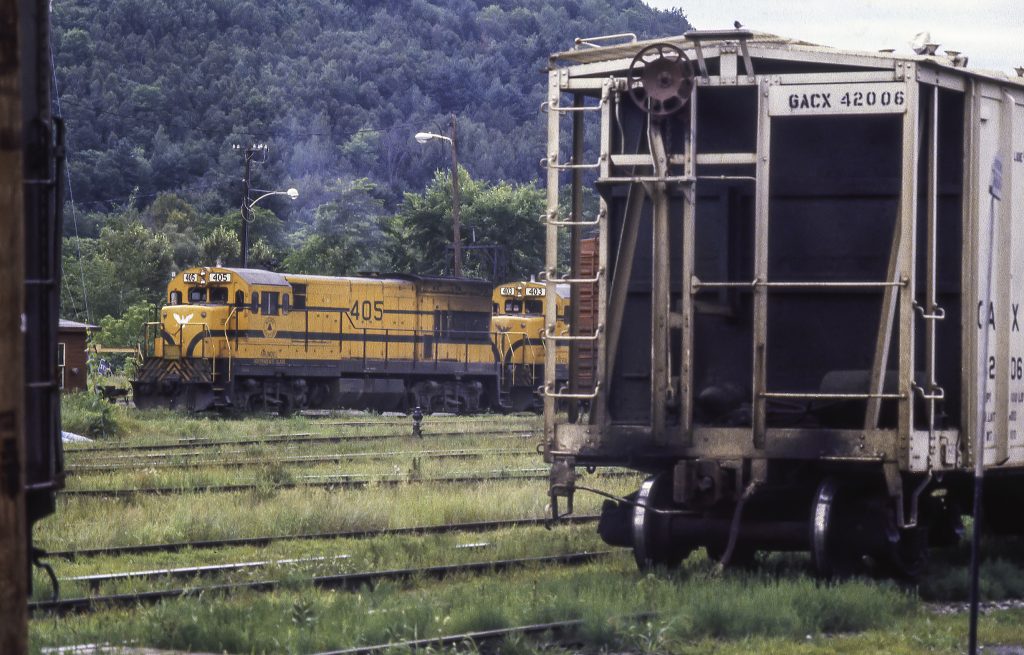 Maine Central U18Bs no. 405 Arundel and no. 403 General Peleg Wadsworth lay over at St. Johnsbury in August 1981, idling before their evening return west as YR-1 toward Rigby Yard, Portland. The faded eagle emblem on 405 is reduced to a ghostly outline. In the foreground, GACX no. 42006, a General American 2,600 cu ft Airslide covered hopper from the 1950s lease fleet, stands among the yard tracks, reflecting the type of grain traffic once handled in the area. © Warren Beckwith
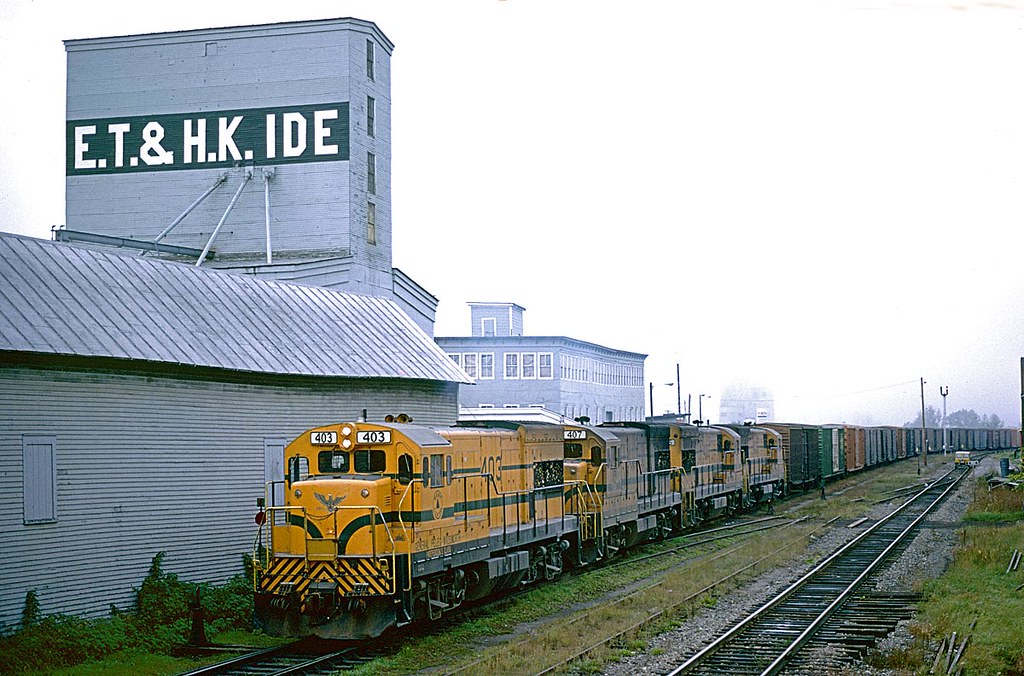 Maine Central GE U18B no. 403 General Peleg Wadsworth leads freight YR-1 at St Johnsbury, Vermont, on 26 September 1981, with no. 407 Unity and additional “Independence Class” units trailing. The train stands in the yard beside the E.T. & H.K. Ide mill as early morning fog lingers, about to depart west over the Mountain Division. A classic St Johnsbury scene from Maine Central’s final years of through freight on the route. © crr200
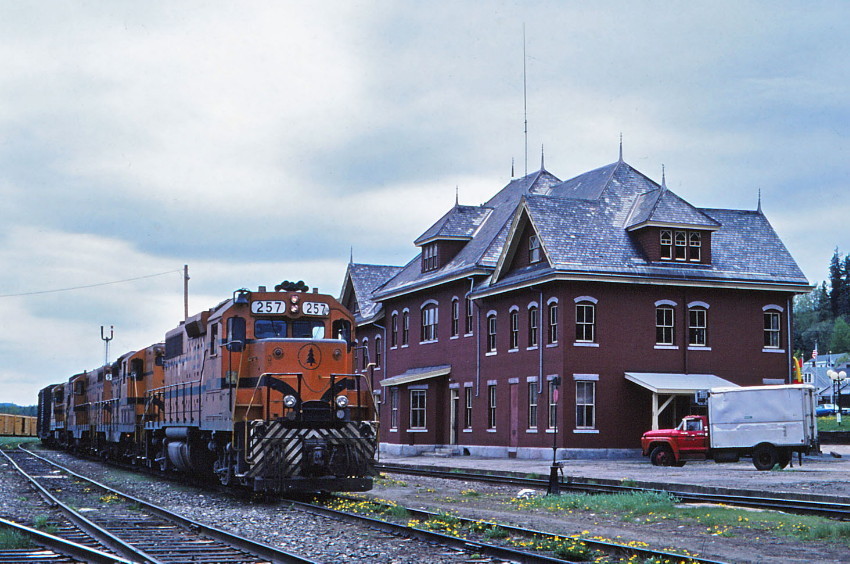 Maine Central RY-2 departs St. Johnsbury for Rigby Yard, Portland, on 16 May 1982, led by EMD GP38 no. 257 in Harvest Gold. The train passes the substantial former station building, by this time serving freight operations, as the Mountain Division freight begins its climb east toward Crawford Notch. © Bruce Macdonald
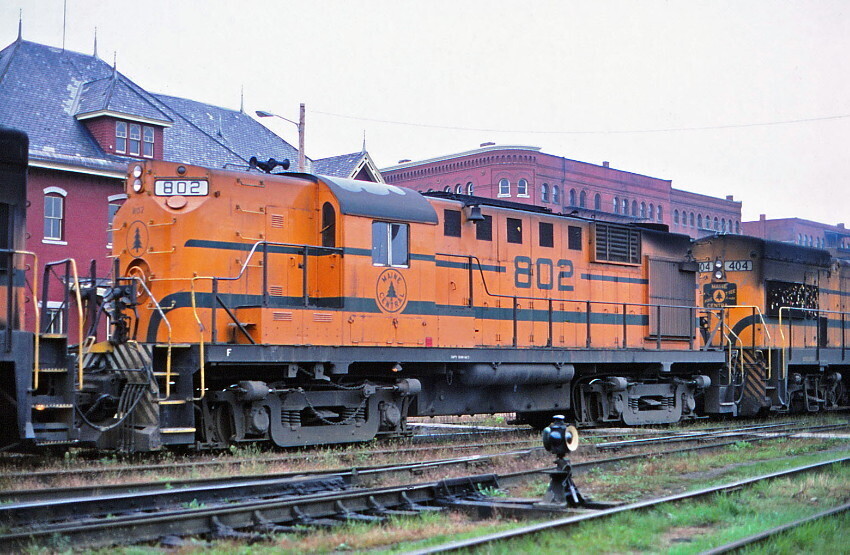 Maine Central ALCO RS-11 no. 802, built in June 1956 as Portland Terminal no. 1082, stands at St. Johnsbury, Vermont, on 3 October 1982, coupled ahead of GE U18B no. 404 Kenneth Roberts. One of just two RS-11s on the roster, no. 802 worked alongside sister no. 801 in the final years of Mountain Division service, both locomotives representing the last of Maine Central’s ALCO road power before their withdrawal and scrapping in the mid-1980s. © Bruce Macdonald
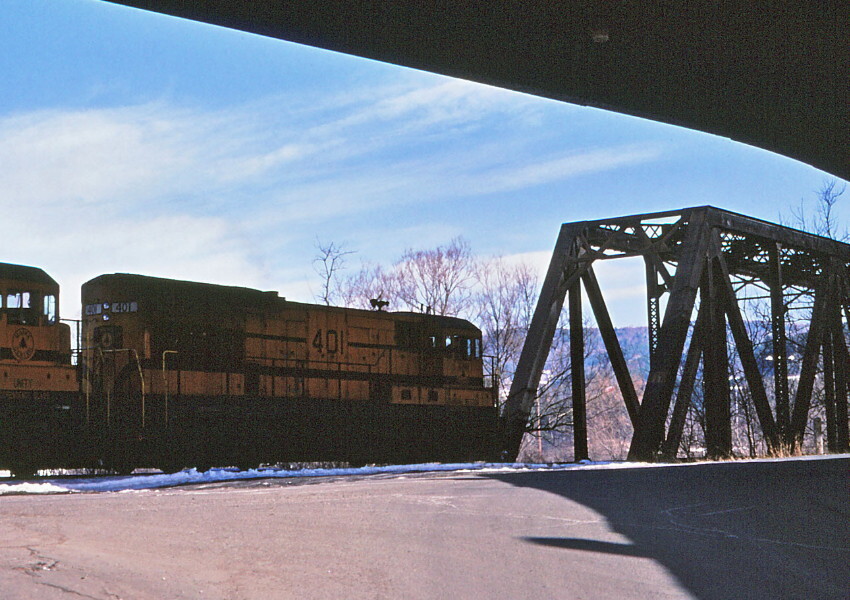 Maine Central GE U18B no. 401 Hannah Weston leads an eastbound freight across the Passumpsic River at St. Johnsbury, Vermont, on 27 February 1983, seen from Weeks Court beneath the Theodore Roosevelt Highway. The train emerges into winter light as it crosses the steel truss bridge, continuing its climb toward the Mountain Division. This scene captures the line in its final months of through service before operations ceased later that year. © Bruce Macdonald
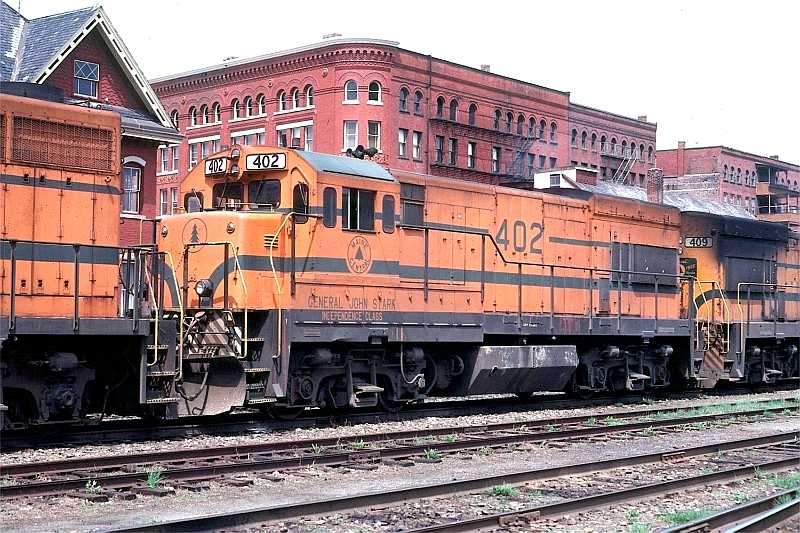 Maine Central U18B no. 402 General John Stark, one of the “Independence Class” Baby Boats, stands at St. Johnsbury in May 1983 near the end of regular Mountain Division operations. Another U18B trails behind in matching Harvest Gold, the pair representing the distinctive GE power that defined Maine Central’s final years over Crawford Notch. © Brian Nicholson
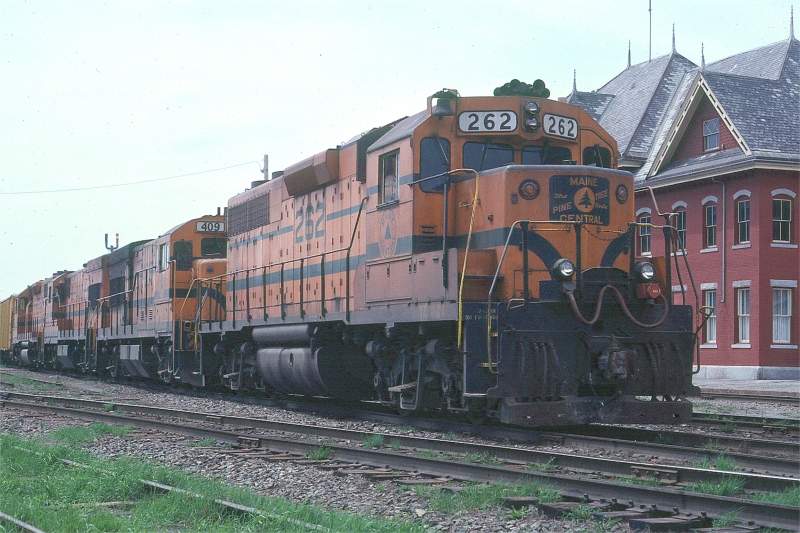 Maine Central GP38 no. 262 leads a westbound departure from St. Johnsbury in May 1983, one of the last regular freights to leave Vermont for Portland over the Mountain Division. U18B no. 409 Berwick trails in the consist, part of a solid lash-up of Harvest Gold power assembled for the run east through Crawford Notch. Within months, scenes like this would disappear as Maine Central operations in Vermont came to an end. © Brian Nicholson
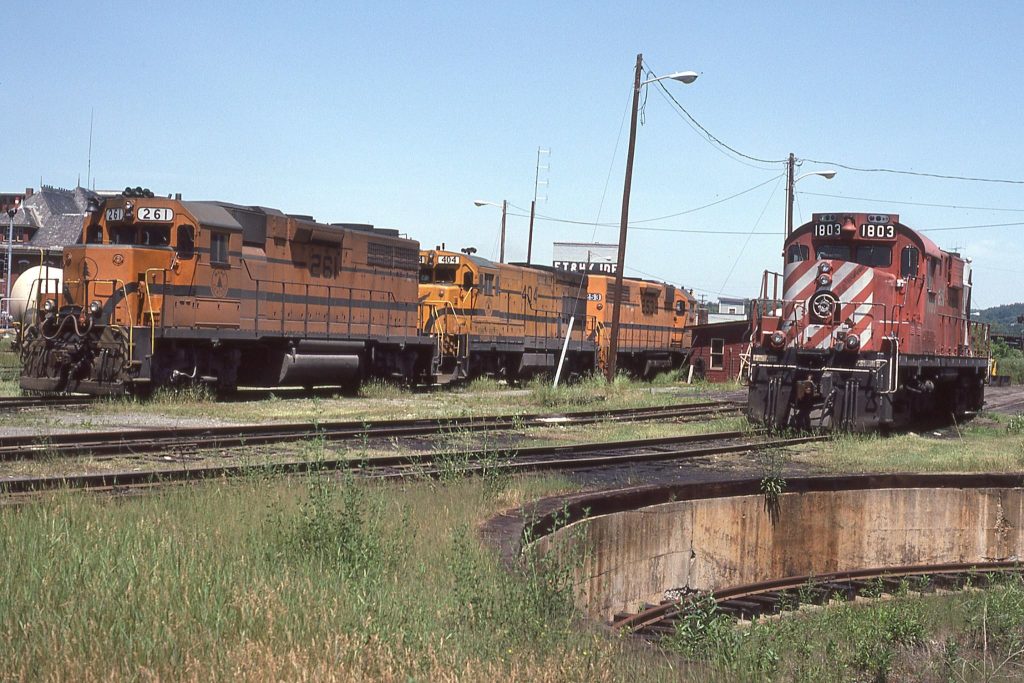 Maine Central EMD GP38 261, GE U18B 404, and GP38 253 alongside Canadian Pacific ALCO RS-18 no. 1803 at St. Johnsbury, Vermont, on 30 June 1983. The MEC units were working the “Mountain Job” (YR-2), while the CP unit handled yard switching. This was the day Guilford completed its purchase of the Boston & Maine, and among the final summer months of regular operations over the Mountain Division. © Gil Ford
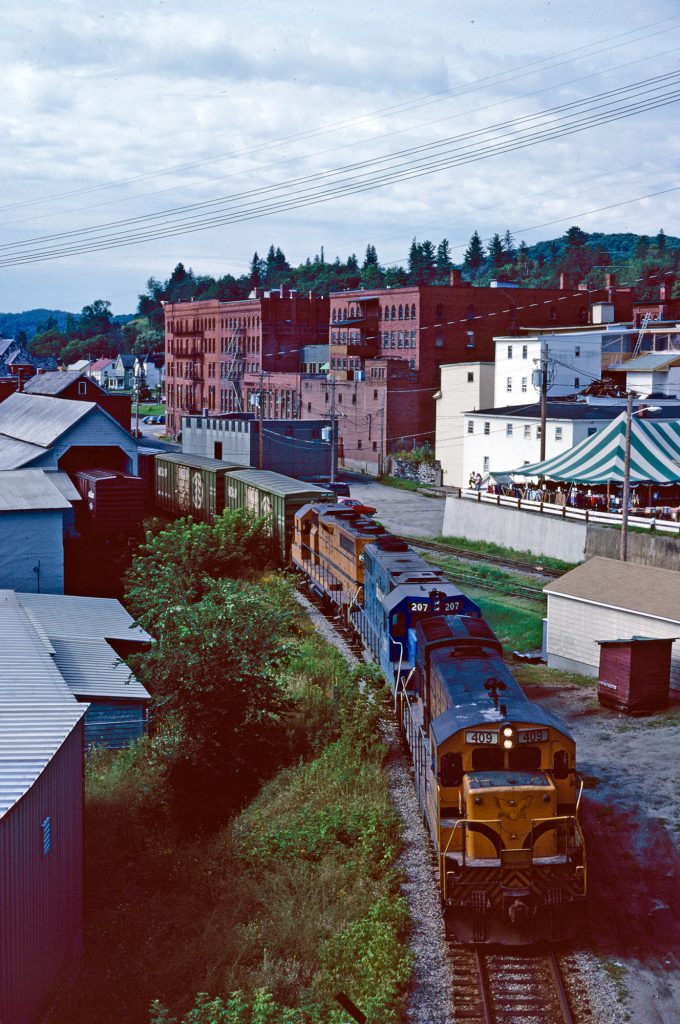 Maine Central GE U18B no. 409 leads Boston & Maine EMD GP38-2 no. 207 and Maine Central EMD GP38 no. 258 departing St. Johnsbury, Vermont, with eastbound freight RY-1 on 11 August 1983. Seen from the Portland Street overpass, the train is leaving the western end of the Mountain Subdivision. The line it occupies is now abandoned but remains in place. © Terry Chicwak
St. Johnsbury | Eastbound to Alongside the Moose River ▶